Semrush Content Toolkit (ContentShake AI) is one guided writer at a single fixed price of $60 a month billed annually, and it does not track AI answers. BrandWell (formerly Content at Scale) starts at $249 a month and bundles AI answer tracking, bulk generation, internal linking and refresh suggestions. The first suits one marketer who wants a cheap writer, and the second suits a team that wants the bundle. DeepSmith is a strong alternative to both for teams that want a Content Map to find the gaps and Autowrite to publish on schedule, with AI answer tracking on the same plan.
Semrush Content Toolkit vs BrandWell mostly comes down to how much of the content job you want one product to cover. Semrush sells a guided writing workflow with one public plan. BrandWell sells RankWell in three tiers and bundles tracking, linking and refresh tools into each one. The facts below come from each vendor's own pages and public reviews, checked in late September 2026. DeepSmith sits next to both, as a platform that finds the topic gaps, writes the articles and tracks the AI answers from one set of data.
Semrush Content Toolkit vs BrandWell: the short answer
- Choose DeepSmith if you want to see where AI answers leave your brand out, find the topics competitors cover that you do not, and have articles written and published on a schedule, from $99 a month ($80 billed annually) with a 7-day free trial.
- Choose Semrush Content Toolkit if you are one marketer or a small team that wants a guided topic-to-WordPress workflow at $60 a month billed annually and you do not need AI answer tracking in the same product.
- Choose BrandWell if you publish enough to use 25 to 100 articles a month and want AI answer tracking, bulk generation, internal linking and refresh suggestions bundled in, from $249 a month.
| Criterion | DeepSmith | Semrush Content Toolkit | BrandWell |
|---|---|---|---|
| Entry price, billed monthly | $99/mo | Not listed | $249/mo |
| Entry price, billed annually | $80/mo | $60/mo | Not listed |
| Articles at entry tier | 20/mo | 10,000/mo, 5 with SEO boost | 25/mo |
| Free trial | Yes, 7 days | Yes, 7 days | Partial, terms vary by page |
| Grounding in stored brand knowledge | Yes | Partial | Yes |
| SERP-based content scoring | - | Yes | Yes |
| Internal linking | Yes | Not listed | Yes |
| Bulk generation | Yes | Not listed | Yes |
| Finds topics competitors cover that you do not | Yes | Partial | Partial |
| Scheduled writing and publishing | Yes | Not listed | Partial |
| AI answer tracking | Yes | No, sold separately | Yes |
| Public API | Yes, read-only | Not listed | Yes |
| SOC 2 report | Yes | Not listed | Not listed |
| Review rating | 4.8/5 on G2 | 7.2/10 on Info-Tech SoftwareReviews | 9.1/10 on TrustRadius |
Pricing and features as of September 2026, from each vendor's site and public reviews.
Semrush Content Toolkit (ContentShake AI)

Semrush Content Toolkit is the product that used to be called ContentShake AI. Semrush split its platform into separate toolkits in May 2025, and the old ContentShake page now redirects to the Content Toolkit. Anyone searching for ContentShake AI vs BrandWell is looking at this same product.
It is a guided workflow. Topic Finder suggests topics with Semrush search volume and keyword difficulty, the SEO Brief Generator builds an outline from top-ranking pages, the AI Article Generator drafts, and the Content Optimizer scores the result for SEO and AI search criteria. Finished articles can be turned into social posts and emails, and publishing goes to WordPress, Mailchimp and Semrush Social Poster. Semrush describes it as built for individuals and small teams.
The standout is the price and the Semrush data behind it. One public plan, Base, costs $60 a month billed annually, and it includes up to 50 brand voices. The real limitation is that only five SEO-boosted articles a month come with the plan, ten more cost $30 a month, and the product does not track brand mentions in AI answers, which Semrush sells separately as its AI Visibility Toolkit. Semrush's own pages also disagree on whether Base allows 10,000 or unlimited standard articles, so it is worth confirming that before you buy.
Reviewers praised topic discovery and briefs, and said the generated text still needs human review. The only product-specific rating is 7.2/10 from 7 reviews on Info-Tech SoftwareReviews, checked in September 2026. The G2 and Capterra scores for Semrush cover the whole suite, so they say little about this one tool. If you are weighing Semrush against another writer, we also compared Semrush Content Toolkit with Frase in a separate piece, which covers a different pair of trade-offs.
BrandWell (formerly Content at Scale)

BrandWell is the 2024 rebrand of Content at Scale, so a search for Semrush Content Toolkit vs Content at Scale ends up at the same comparison. Its content product is RankWell, which sits inside a wider growth platform that also sells buyer-intent data, visitor identification and outreach as separate products. RankWell researches, writes, scores and publishes articles to WordPress, Contentful or Google Docs, and it can start from a keyword, a URL, a video or a podcast. It is built for content and SEO teams and agencies that publish on a regular cadence.
The standout is how much comes in every plan. Visibility, which tracks answers on ChatGPT, Claude, Gemini and Perplexity, is included with RankWell, along with automatic internal linking and suggestions on what to optimize, merge or delete. The plans cost $249, $499 and $999 a month for 25, 50 and 100 articles.
The limitations are mostly about clarity. BrandWell does not state check quotas for its AI answer tracking, its pricing page and its registration page show different plans and trial terms, and it publishes no SSO or security certification. Reviewers say drafts need editing and fact checking. The review base is small and mostly from 2023, with 5 reviews on Capterra (4.0/5), 2 on TrustRadius (9.1/10) and 1 on Trustpilot, so it tells you little about the current product. If you want DeepSmith set against the same product under its earlier name, our DeepSmith vs Content at Scale comparison does that.
DeepSmith: the alternative that finds the gaps and publishes on schedule

Neither tool fully covers the step before writing, which is knowing what to write. Semrush Content Toolkit and BrandWell are both partial on finding topics competitors cover that you do not. Topic Finder works from a starting topic you give it, and BrandWell shows competitor ranking keywords and the AI answer questions where rivals are named, but neither documents a dedicated gap report. Semrush does not document scheduled publishing of articles, and BrandWell's is partial, because the vendor says generation creates editable work and publishing needs a separate approved delivery path.
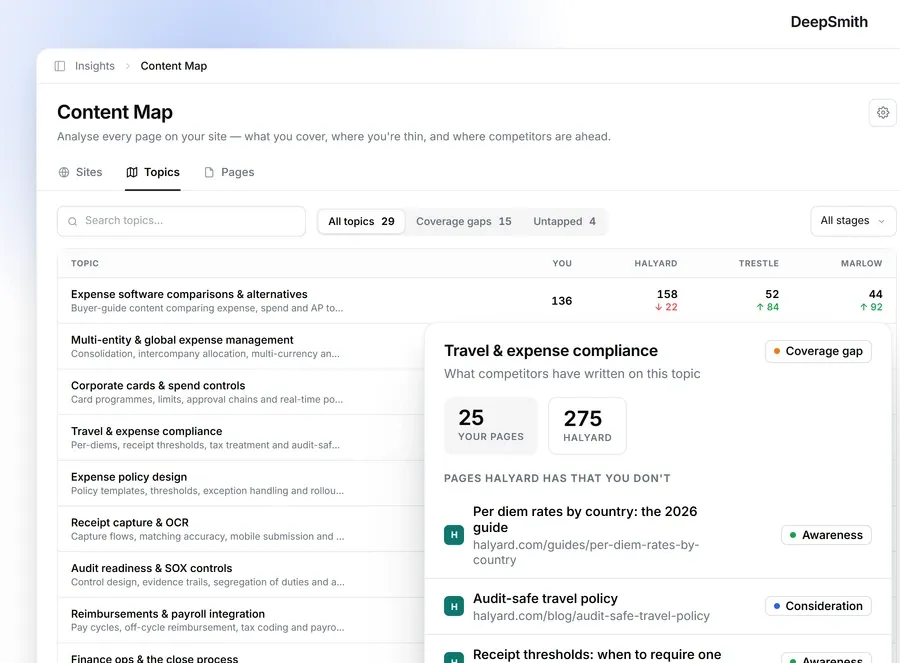
DeepSmith closes both gaps in one platform. The Content Map puts your site and your competitors' sites onto one topic taxonomy and lists coverage gaps, where a competitor publishes more than you, and untapped topics, where they publish and you have nothing. Opportunity Agents read your AI visibility data and that map and return content ideas, and each idea carries the data point that justifies it.
The Writer turns a planned idea into a researched, internally and externally linked article with a cover image and publish-ready metadata, grounded in Deep IQ, the brand context you set up once from your website. Autowrite writes an article on its scheduled date with no one in the app and can take it all the way to published, and Produced Content publishes to WordPress, Webflow, Strapi, Sanity or Contentful.

AI answer tracking runs on the same plan, so what the tracker finds feeds what the Writer produces next. DeepSmith reports Mention Rate, Citation Rate and Share of Voice, and engine coverage rises by tier, from ChatGPT on Pro to all ten engines on Enterprise. The plans are $99, $199 and $399 a month ($80, $160 and $299 billed annually) for 20, 40 and 90 articles, with a 7-day free trial and no long-term contracts. DeepSmith is rated 4.8/5 on G2.
Pricing and value
Semrush Content Toolkit is the cheaper tool at entry, with BrandWell's first plan at $249 a month against Semrush's $60 on annual billing. Base is $60 a month billed annually, and the Semrush pricing page did not show a month-to-month price when we checked, so a monthly buyer should confirm at checkout. Add-ons change the total, since ten more SEO-boosted articles are $30 a month and each extra user is $20 a month. Connecting Google Analytics and Search Console goes through $10 and $20 reporting add-ons.
BrandWell's three RankWell plans are public at $249, $499 and $999 a month, which works out to about $10 an article at the entry tier. Programmatic SEO and Link Builder start at the $499 Growth plan. The terms are stricter than most. Payments are non-refundable apart from a 3-day guarantee that applies only if no more than two articles were generated and none were published, and unused credits are forfeited after cancellation. An older registration page still shows 12-month plans from $899 to $2,999 a month, and the vendor has not said whether those are still sold.
What DeepSmith does: DeepSmith publishes four plans with their limits on the page, and each is priced by articles, tracked prompts, seats and engines. Tracking and production come in the same monthly price instead of as separate purchases. You can start with the 7-day free trial and stay on a monthly plan without a long-term contract, and see the tiers on DeepSmith pricing.
Writing and brand grounding
BrandWell has the stronger long-form workflow. Its article generation runs a research step before writing and keeps the sources in a tab beside the draft. A Company Project holds brand context, voice rules and uploaded documents, and a queue can write articles in priority order. Semrush pulls real-time search results into generation only on the SEO-boosted articles, grounds its output in a brand voice built from a writing sample, and documents no knowledge base or bulk run. Articles come one at a time.
Semrush is ahead on the short-form side. It repurposes an article into posts for LinkedIn, Facebook, Instagram, X and Pinterest, plus email newsletters and Google Business Profile updates, and it ships a free Chrome extension with 50 rewrites a month. BrandWell's repurposing is partial, since it turns videos, podcasts and blog URLs into articles but does not document turning an article into social or email formats.
What DeepSmith does: DeepSmith stores your product, persona, voice, visual guidelines and content types in Deep IQ, and every article runs against that context, so you do not re-brief for each piece. Each article arrives with social posts already written, and the Apps Library adapts it for LinkedIn, X, Medium, newsletter and other channels. If you care about grounding content in brand voice and product facts, that is the layer doing the work.
Optimization, linking and refresh
BrandWell wins here. Its editor scores a draft live against search results with NLP, entity and salience analysis, adds internal links automatically in every plan, and its content plan flags pages that are losing clicks from Search Console data and suggests what to optimize, merge or delete. BrandWell says the score is guidance and not a ranking guarantee.
Semrush's Content Optimizer is a good scorer. It computes a Content Score on demand against targets you set, checks AI search criteria such as authorship credentials and question-and-answer formatting, and offers a one-click rewrite with a side-by-side diff. Semrush describes the effect on AI citations as a goal, not a measured result. It also documents no tool that suggests or inserts internal links, and it can optimize an existing page by URL but does not document decay detection. These are the same jobs that eat a marketer's week, which is why automatic internal linking is worth checking for in any tool you shortlist.
AI answer tracking
In BrandWell vs Semrush Content Toolkit on tracking, BrandWell wins, because Semrush Content Toolkit does not track AI answers at all. The Content Toolkit's optimizer checks your drafts against AI search criteria, but it monitors nothing. Semrush sells tracking as a separate toolkit, and we cover that product in a DeepSmith vs Semrush AI Visibility Toolkit comparison.
BrandWell includes Visibility in every RankWell plan. It runs tracked buyer questions on ChatGPT, Claude, Gemini and Perplexity, and it saves the answer, brand presence, citations and check time so you can compare over time. The gaps are in the detail, because BrandWell does not state quotas per plan, how often checks run, how long answers are kept, or whether collection uses official APIs or consumer interfaces.
What DeepSmith does: DeepSmith tracks the questions you define on a schedule and reports Mention Rate, Citation Rate, Share of Voice, Sentiment and trend. It shows which of your pages AI actually cites and which competitor pages win citations for your prompts, with full answer history per prompt. Coverage is ChatGPT on Pro, Perplexity added on Grow, Gemini added on Scale, and all ten engines on Enterprise.
From insight to action
BrandWell is closer to closing the loop between tracking and writing, and Semrush Content Toolkit covers only the writing half. BrandWell's AIMEE agent runs workflow templates such as Close a visibility gap, with named approval points, and its editorial calendar holds scheduled dates. Even so, the vendor says publishing needs an approved delivery path, and a gap analysis is something AIMEE prepares when asked, not a standing report.
Semrush follows a fixed path from topic to brief to article to optimization to repurposing, and its topics refresh weekly for saved lists. It documents scheduled posting for the social and email content it repurposes, after review, and no unattended scheduled generation of articles.
What DeepSmith does: DeepSmith runs the loop in one place. Tracking shows where you are missing, the Content Map shows which topics competitors cover that you do not, Opportunity Agents return ideas with the evidence attached, and Planned Content gives each idea a date. Autowrite then writes it on that date, and Produced Content publishes it. Webhooks notify your own systems about content status changes, and the REST API and MCP server give read-only access to the workspace data. Teams that want publishing handled without extra tooling can also look at AI content tools with CMS auto-publish.
Which should you choose
- DeepSmith fits a marketing lead who wants one platform that shows where AI answers skip the brand, finds the topics competitors own, writes publish-ready articles in the brand's voice and publishes them on a schedule, without stitching a tracker, a writer and a scheduler together.
- Semrush Content Toolkit fits one marketer or a small team that already uses Semrush data, publishes mostly to WordPress, wants a low fixed price and a guided path from topic to post, and will handle AI answer tracking and internal linking another way.
- BrandWell fits a content team or agency that publishes 25 to 100 articles a month, wants tracking, internal linking and refresh suggestions inside the plan, and can live with unclear quotas and mixed pricing messages. If it is the Content at Scale name that brought you here, our list of alternatives to Content at Scale covers the wider field.
Between the two, I would pick Semrush Content Toolkit on budget and BrandWell on scope, and I would look at DeepSmith before paying for either if tracking and publishing both matter to you.
You can start a DeepSmith free trial and run tracking, the Content Map and Autowrite against your own site for 7 days.