If you have been putting off content until the strategy feels finished, the honest answer is that the cost of delaying content strategy is not a fee you get billed. It is an opportunity cost. You lose the time during which content could have been discovered, ranked, read, and turned into leads, and you push back the date when you find out what actually works for your product. The evidence on when to start content marketing is strongly supported on this point, with real qualifications: nobody can hand you a dollar figure for a delayed quarter, but the case for starting sooner rather than later holds up.
Here is the grade, stated plainly. The claim that delay has a real cost is strongly supported. The claim that every article compounds into growing traffic, or that you can calculate an exact opportunity cost content marketing loses per quarter, is not supported by anything in the research. This piece walks through what the evidence actually says, what it does not say, and what that means for a founder deciding whether to start now or wait for a better plan.
What "compounding content" actually means
You will hear people say content compounds, and it is worth being precise about what that means before you build a decision around it. Compounding content is content whose traffic keeps growing, or at least holds steady, well after it publishes, instead of spiking once and fading. It is not a claim that every post you write will behave this way.
HubSpot's 2015 research on this looked at more than 15,000 companies and analyzed 19,519 blog posts in detail. It split posts into two groups: compounding posts, where traffic grew steadily over time, and decaying posts, where traffic spiked early and then dropped off. One in ten posts in that sample was still compounding twelve months after publication. That one in ten was a minority of the posts, but it produced 38% of all the traffic in the sample. Over its life, a single compounding post generated as much traffic as six decaying posts combined.
That is the clearest piece of evidence behind the idea that content value is not spread evenly across everything you publish. A small number of durable pages can carry a disproportionate share of the results. But HubSpot is also clear that this is not a formula you can apply to any one article in advance. You cannot look at a draft and know it will be one of the ten. The compounding rate varies by industry and audience, and seasonality moves the numbers around too. So when you hear "content compounds," read it as a property of a portfolio built over time, not a guarantee attached to the next post you hit publish on.
The evidence for a real cost of waiting
Three separate pieces of evidence point the same direction, and they come from different places, which is part of why the overall grade is strong.
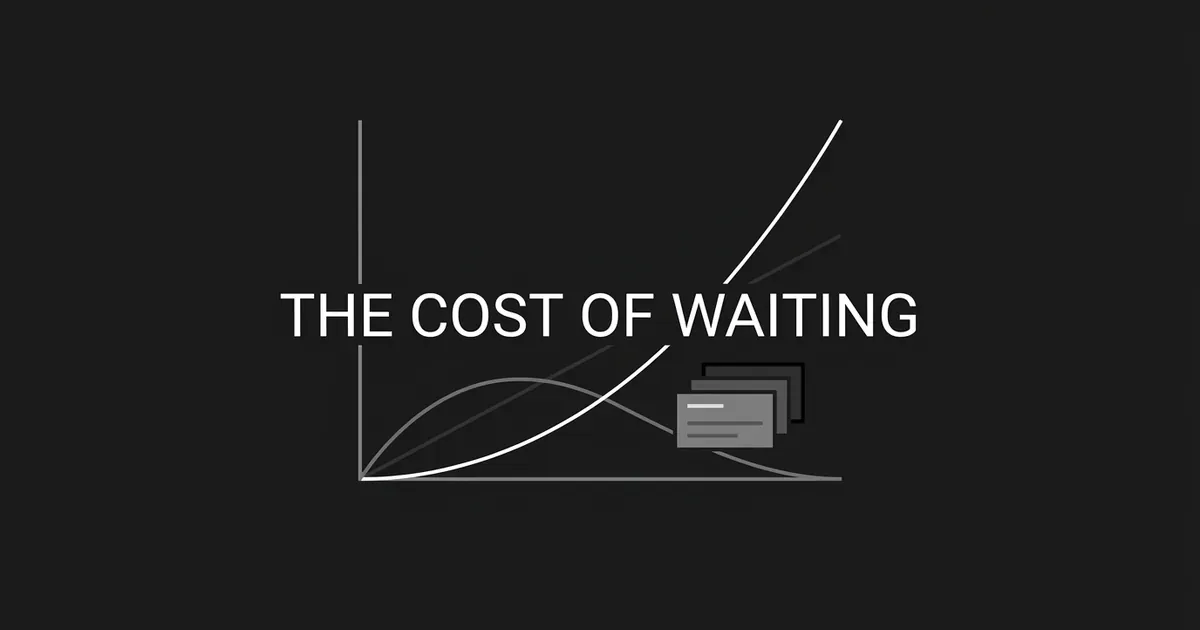
Start with HubSpot's compounding data again, because it is the most direct piece of evidence for the compounding claim specifically. If a minority of your future content is going to become a durable traffic asset, every quarter you delay is a quarter you have not yet started identifying which pieces those will be, and a quarter later those pieces begin earning traffic. In HubSpot's data, a compounding post published in January could be getting 2.5 times as many visits per month by July. A decaying post published the same month could fall to less than a fifth of its initial audience over the same stretch. Waiting does not avoid that split. It just moves the whole curve later.
Then there is Ahrefs' study on how long ranking actually takes, an older Ahrefs dataset built from two million keywords and two million tracked pages. The exact publication date is not stated in the material available, so treat it as an older benchmark rather than a current one, but the pattern is instructive. The average page ranking in the top 10 for its keyword was more than two years old. The average page ranking first was almost three years old. Only 22% of top-10 pages had been created within the previous year. Of the two million pages Ahrefs tracked over a year, only 5.7% reached the top 10 for any keyword at all, and only 0.3% reached the top 10 for a high-volume keyword. Among the 5.7% that did succeed within the year, most took somewhere between about two and six months to get there.
Read that carefully, because it is easy to misuse. The two-to-six-month window is not how long it takes a typical page to rank. It is how long it took the small slice of pages that succeeded. Almost 95% of the tracked pages did not reach the top 10 within a year at all. What this does support is a more modest but still important point: starting later does not just cost you the months you waited. It also pushes back the start of a ranking process that, when it works, can itself take months and is never guaranteed.
Semrush's 2023 study, run by Olga Andrienko and published March 2, 2023, adds a third angle. Semrush tracked 28,000 domains that were new to its US database before July 2021, following them for 13 months through July 2022. Only 7.65% of those domains kept any ranking presence in the top 100 for the entire period. Semrush then narrowed to the 2,155 domains that stayed visible and found that within that group, about 41% reached the top 10 by the end of the study, though only 4.2% held a top-10 ranking for all 13 months. The top 10% of sites in the study were pulling in more than 4,000 average monthly organic visits after their first year. Sites that never ranked got close to nothing.
That gap, thousands of monthly visits against almost none, is the clearest illustration of what a year of head start can look like. It does not mean your site will land in that top 10%. It does mean that the first year is when the separation between sites that build durable visibility and sites that do not tends to happen, and the sooner you start that year, the sooner you find out which side of it you are on.
Where the evidence stops short
None of this adds up to a precise number you can put in a slide. It is worth being just as clear about what the research does not prove, because overstating this case is its own kind of mistake.
It does not prove that most content compounds. HubSpot's own number, one in ten posts twelve months out, tells you compounding is the exception in that sample, not the rule. Most of what you publish will behave like a normal post: some initial traffic, then a decline.
It does not prove that publishing more automatically produces more traffic. The Ahrefs and Semrush datasets are observational. They describe what happened to pages and domains that were tracked over time, not a controlled test of what happens when a company decides to publish weekly instead of monthly. Orbit Media's 2016 survey of more than 1,000 business bloggers adds some texture here: bloggers who spent six or more hours per post were more likely to report strong results than those who spent less time, and those who checked analytics regularly reported stronger results too. But it is a self-reported survey, not a study that isolates cause from effect, so treat it as context for the time and attention content takes, not as proof that more hours guarantee more traffic.
It does not prove that page age itself causes rankings. Older pages in the Ahrefs sample likely also picked up more backlinks, more internal links, more updates, and stronger alignment with what searchers actually want, over that same time. Age is something those pages have in common, not a demonstrated cause on its own.
And it does not justify a specific dollar figure for a delayed quarter. Getting to a real number would need company-specific inputs: how much you plan to publish, how much demand exists for your topics, your conversion rate, the value of a customer, what you would otherwise spend on paid channels, the odds any given page ranks, and how long a page stays useful once it does. None of the studies here supply those inputs for your business, and no honest article can invent them for you.
What the primary sources actually say
It helps to separate what Google itself says from what vendor research reports, because they are doing different jobs. Google's own SEO Starter Guide, last updated December 10, 2025, says plainly that every change takes time to show up in Google's systems, that some changes might show effects within hours while others take several months, and that site owners should generally wait a few weeks before judging whether a change worked. Google's documentation on how Search works also breaks the process into three separate stages: crawling, where Google finds and downloads pages, indexing, where it analyzes and stores what it found, and serving, where it decides which pages to show for a given search. Google states directly that not every page makes it through all three stages, and that being crawled or indexed is never guaranteed.
That matters for how you should read the word "delay." Publishing a page is not the same thing as that page becoming visible. A quarter of delay before you publish also becomes a quarter of delay before you even enter the evaluation window Google describes, the one that can itself run weeks or months before you know whether something worked.
HubSpot, Ahrefs, Semrush, and Orbit Media are a different category of source. They are vendor and industry research, built from real data, but data selected and analyzed by companies with their own interests in the outcome. That does not make the findings wrong. It means they should be named as vendor research rather than treated as neutral, independent studies, and their sampling choices matter. Semrush, for instance, dropped domains that fell out of the top 100 before running its deeper analysis, which means its most striking numbers describe a survivor group, not every new domain that started the clock.
The verdict, and what to do with it
Put together, the evidence supports this: the cost of delaying content strategy is real even without a dollar figure attached to it, and waiting for a perfect content strategy is not a neutral choice. It postpones the start of a process that Google itself says can take weeks or months to show results, and independent research shows that durable visibility, when it happens, often takes longer than that and is achieved by a minority of pages. Instead of a fixed invoice, it shows up as delayed traffic, delayed leads, delayed learning about what actually resonates with your buyers, and a later start on building the small set of durable pages that HubSpot's data suggests can carry a disproportionate share of your long-term results.
The strongest version of this argument is not "publish anything today." Rushing out thin or irrelevant content does not shortcut any of the timelines above, and none of the sources here suggest that volume alone helps. The more defensible move is to start once your strategy is good enough to produce something genuinely useful, because waiting longer does not remove the uncertainty in any of these numbers. It only pushes back the point where you start learning what works for your product and your buyers.
This is also where a founder's actual constraint shows up. Early-stage teams do not usually lack the argument for starting sooner. They lack the hours. Every one of the studies above assumes someone is doing the work: researching topics, writing, checking what is ranking, updating older pages. If your current process is a spreadsheet, a general AI writer, and your own weekends, the ranking and compounding timelines above are competing with your calendar, not just with your strategy. That is the practical case for a system that keeps your positioning, product details, and voice in one place and produces publish-ready drafts from it, so the constraint on starting sooner is not how many hours you personally have left this month. If that is the piece missing for you, DeepSmith's free trial is a low-cost way to see what a week of content actually looks like once it is off your plate.
What would change this verdict
If a future study showed a controlled experiment tying publication timing directly to traffic outcomes while holding content quality, links, and competition constant, that would strengthen the causal case beyond where it sits today. If someone published current, dated research on time-to-rank rather than relying on an older Ahrefs dataset, that would sharpen the timeline. And if AI-driven search experiences change how citations relate to page age in ways that differ from traditional organic ranking, some of this evidence base may need revisiting. None of that is available yet, so the honest verdict stands as it is, a real cost that cannot honestly be reduced to a single fixed number.