You ran the scan. You got the score. And you still don't know what to publish on Monday.
That gap is why most people start looking at Troovue alternatives. Troovue does one job well. It crawls your pages, checks the structure, and hands you a deterministic 0 to 100 Visibility Eligibility Index. Seven weights build it, led by Topical Coverage at 25% and Citation Readiness at 20%, with crawl readiness, authority, freshness, internal linking, and structured data making up the rest. The workflow is Scan, Diagnose, Prioritise, Track. Troovue pricing runs from Validate at £24 a month up to Scale at £166.
Here's the honest part, and Troovue says it plainly itself. That score does not predict whether an AI engine will actually cite you for a specific query. It's a readiness condition, not an outcome. So if your boss asks "are we showing up in ChatGPT yet," a structural grade can't answer that.
Take a breath. This is solvable, and you're closer than you think. You need one of two things, sometimes both: evidence of what AI engines are actually saying about you, and a way to turn that evidence into published pages. This guide walks the eight tools that do it.
How we picked and ranked these tools
A roundup is only useful if you know the yardstick. Here's ours, and it is why troovue pricing alone was never the deciding factor.
- Direct evidence. Does the tool show you real AI mentions, citations, source URLs, or page eligibility? Not a proxy. Actual answers.
- Diagnostic depth. When you're missing, does it tell you why, clearly enough that someone on your team can act on it?
- A path to the fix. Does the tool help you do something about it, or does it stop at the chart?
- Fit for a marketing team. Repeatable workflows beat a one-off score, every time.
Price, engine coverage, prompt capacity, page-level evidence, and integrations break the ties.
One thing to hold onto before you scroll through troovue.com competitors anywhere else. There are two product categories in this list. A citability diagnostic grades the structural conditions on your page. A visibility tracker watches what AI engines actually answer. Neither guarantees a citation. Knowing which problem you're solving will save you a month of shopping.
This is an editorial fit ranking, not a vendor-neutral benchmark, and no tool here can promise you citations.
Quick comparison of the best Troovue alternatives
| Rank | Tool | Best fit | Public starting price | AI-search evidence | Main trade-off |
|---|---|---|---|---|---|
| 1 | DeepSmith | Teams that need diagnosis connected to publish-ready remediation | Pro $99/mo, Grow $199/mo, Scale $399/mo | Prompt-level mentions, citation rate, cited pages, competitors, source analysis | Engine coverage is tiered, all ten engines are Enterprise or Custom |
| 2 | Profound | Enterprise visibility, citation sources, and agent analytics | Starter $99/mo billed yearly, Growth $399/mo billed yearly | Answer Engine Insights, source citations, sentiment, prompt volume, bot analytics | Trial, cancellation, and integration details are not publicly confirmed |
| 3 | Peec AI | Marketing teams needing source, competitor, and opportunity analysis | Starter $95/mo, Pro $245/mo, Advanced $495/mo | Visibility, position, sentiment, prompt tracking, sources, recommendations | Prompt allowances and billing detail are not published |
| 4 | Scrunch | Visibility monitoring plus site audits and AI-ready delivery | Core $250/mo, Enterprise custom | Prompt results, authoritative citations, trends, audits, gaps | Core has tight audit, sitemap, country, and persona limits |
| 5 | AthenaHQ | Enterprise governance, citation intelligence, and claim review | Essential free, Starter $295/mo, Enterprise custom | Citation rate, source rankings, attribution, prompt responses, gaps | The strongest governance features are Enterprise only |
| 6 | Otterly | Small teams wanting low-entry monitoring plus GEO audits | Lite $29/mo, Standard $189/mo, Premium $489/mo | Mentions, website citations, Share of AI Voice, sources, GEO audits | Several engines are paid add-ons |
| 7 | Rankscale | Agencies tracking many brands, engines, and regions | Essentials from $20/mo, Pro $99, Growth $385, Enterprise $780 | AI visibility, rankings, citation analysis, sentiment, page audits | Credit-based usage makes headline price hard to compare |
| 8 | LLMrefs | Budget-conscious teams that prefer keyword-based tracking | Free account, All in One $79/mo | Keyword rankings, citations, source URLs, share of voice, competitors | Keywords are not the same as prompt-by-prompt auditing |
1. DeepSmith
Best for: Marketing leads who need to see where AI visibility is being lost, then move straight from that evidence to on-brand content that closes the gap.
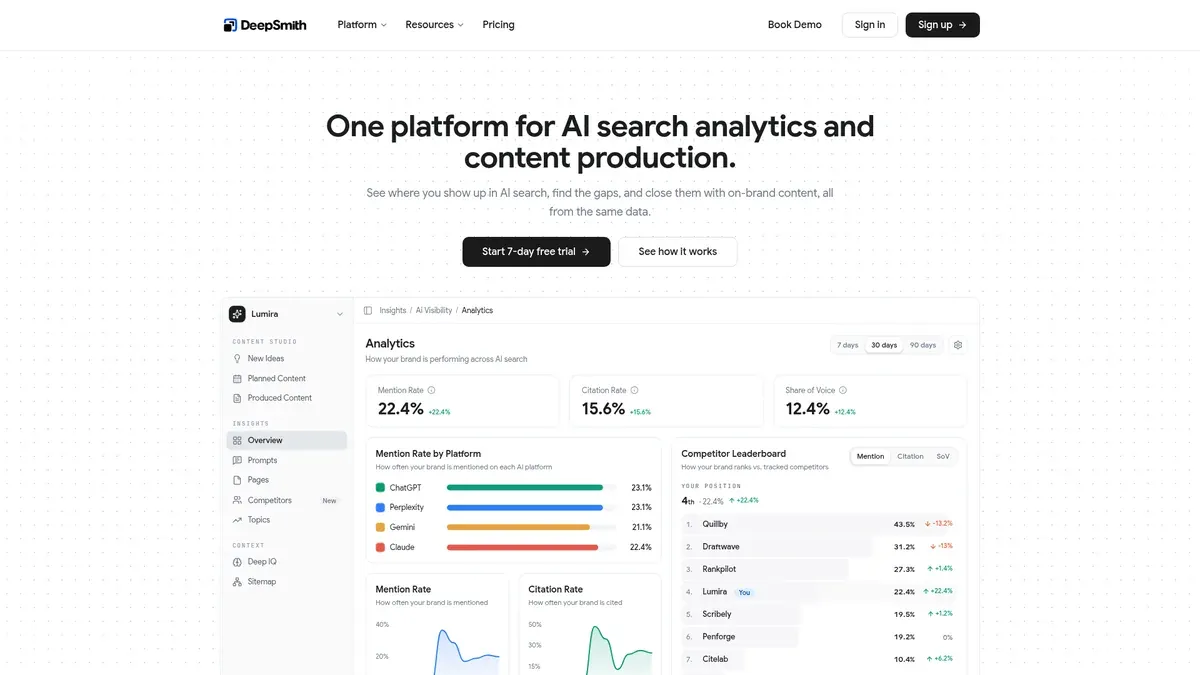
DeepSmith is one platform for AI search analytics and content production. That's the whole reason it sits at number one on a list about replacing a diagnostic tool. A score tells you the page isn't ready. DeepSmith tells you what AI actually said, which page earned the citation, who took the ones you wanted, and then writes the article that goes after them.
Start with the evidence. The AEO area reports mention rate, citation rate, share of voice, sentiment, and visibility trend, per platform. Prompts holds the questions you track, with per-prompt mention and citation rates and the full answer history. Pages shows which of your URLs AI actually cites and each page's share of your total citations. Competitor citations shows who wins your prompts, on which exact pages. That's four answers to "why am I not there," and none of them are inferred.

Then the map. Content Map crawls your site and your competitors' sites and classifies every page onto one shared topic taxonomy and a funnel stage: Awareness, Consideration, Decision. Coverage gaps are topics where a rival publishes more than you. Untapped topics are the ones where you have nothing at all. Sitemaps re-check every 24 hours, so new pages fold in without a re-import.
Then the ideas. Opportunity Agents read your own data and hand back content ideas with the reason attached. Get cited for a tracked prompt. Turn mentions into citations. Take a competitor's citations. Every idea travels with the data point that justifies it, which is what lets you defend a backlog in a planning meeting instead of guessing at it.
Then the work gets done. Content Studio moves an idea through New Ideas, Planned Content, and Produced Content. The Writer turns one planned idea into a finished, brand-grounded article with internal and external links, a cover image, and publish-ready metadata. Autowrite generates it on its scheduled date with nobody in the app. Deep IQ stores your company facts, products, personas, brand voice, and content types, so output sounds like you. Publishing goes to WordPress, Webflow, Strapi, Sanity, Contentful, or your own webhooks, and Repurpose turns the finished piece into LinkedIn, X, newsletter, and more.

Key features: mention rate, citation rate, share of voice, sentiment, and visibility trend across ten named engines (ChatGPT, Gemini, Perplexity, Claude, Google AI Overviews, Google AI Mode, Grok, Meta AI, Microsoft Copilot, DeepSeek), prompt-level answer history, cited-page attribution, competitor citation tracking, Content Map, Opportunity Agents, Content Studio with Autowrite, Deep IQ, multi-CMS publishing, and Multi-Workspace for agencies.
Pricing: Pro is $99 a month, or $80 billed annually, with 20 articles, 50 tracked prompts, 5 seats, and ChatGPT. Grow is $199, or $160 annually, with 40 articles, 100 prompts, and Perplexity added. Scale is $399, or $299 annually, with 90 articles, 200 prompts, and Gemini added. Enterprise and Custom cover all ten engines with custom limits, 1:1 onboarding, and a dedicated account manager. There's a 7-day free trial, no long-term contracts, and no cancellation fees.
Honest limitation: DeepSmith is not a deterministic structural grader the way Troovue is. It measures observed AI answers, mentions, citations, cited pages, and competitors rather than assigning a universal markup-readiness score. If your next step is a pure schema and crawlability audit for an engineering ticket, that's a real difference. If your next step is publishing the pages that close a citation gap, the connected Content Map, Opportunity Agents, Content Studio, Autowrite, and publishing workflow are exactly why it ranks first here.
2. Profound
Best for: Enterprise teams that want answer-engine visibility, citation-source authority, prompt-demand data, and AI-bot analytics.
Profound goes deep on the intelligence side. Answer Engine Insights covers visibility, how your brand is represented in AI conversations, source citations, sentiment, and Content AEO. Prompt Volumes shows what people are actually asking AI, so your tracking list matches real demand instead of your best guess. Agent Analytics shows how AI bots read and crawl your site.
The citation analysis matters most for anyone leaving a diagnostic tool. It shows the sources AI pulls from, how you and your rivals rank for citations, and where to act. Its product pages name Perplexity, ChatGPT, Claude, Gemini, Grok, Microsoft Copilot, DeepSeek, and Google AI Overviews.
Key features: Answer Engine Insights, citation analysis and source rankings, brand sentiment, Prompt Volumes, Agent Analytics for AI bot traffic, competitor visibility, and enterprise controls including SSO, SAML, and SOC2 compliance.
Pricing: Starter is $99 a month billed yearly with 50 unique prompts, 1,500 responses, and ChatGPT. Growth is $399 billed yearly with 100 prompts, 9,000 responses, and Perplexity plus Google AI Overviews added. Enterprise is custom, with up to nine named answer engines. Both paid tiers advertise two months free on yearly billing.
Limitation: Profound is a strong analytics fit, and the public evidence does not document a connected content-production workflow. You'll still need a separate way to write and publish the pages the data points you toward. Trial length, cancellation terms, integrations, and retention are also not publicly confirmed.
3. Peec AI

Best for: Marketing and SEO teams that want a readable visibility dashboard with source discovery, competitor benchmarking, and recommendations they can hand to a writer.
Peec is built for marketers rather than analysts, and it shows. It tracks visibility, position, sentiment, mentions, impressions, and trends. You can tag prompts, add your own, use AI-suggested ones, and see volume estimates before you commit a slot.
The source analysis is the standout. Peec identifies the places AI keeps citing, things like G2, LinkedIn, Reddit threads, and editorial domains, then recommends what to do about each one: keep the G2 profile current, join the conversations that keep surfacing, chase digital PR. Peec MCP is live, and there's CSV export, a Looker Studio connector, and API reporting.
Key features: visibility, position and sentiment tracking, prompt tagging and AI-suggested prompts, source discovery with recommended actions, competitor benchmarking, MCP, CSV export, Looker Studio connector, and API reporting.
Pricing: Starter is $95 a month with 1 project, Pro is $245 with 2 projects, and Advanced is $495 with 5 projects. All three self-serve tiers include 3 models and daily tracking, with access to ChatGPT, AI Mode, AI Overviews, Microsoft Copilot, Perplexity, and Gemini. Enterprise is custom and annual.
Limitation: Peec's public evidence emphasises visibility, sources, benchmarking, and recommendations. It does not document a structural citation-readiness score, a gap-analysis module, fanout analysis, or a crawlability module. Prompt allowances, seat limits, and trial length aren't published, so ask before you sign.
4. Scrunch

Best for: Teams that want visibility monitoring and citations sitting in the same program as site audits and AI-ready content delivery.
Scrunch is the closest thing here to a diagnostic-plus-monitoring hybrid, which makes it worth a look if the audit half of Troovue is what you'd miss. It monitors prompt results, authoritative citations, brand performance, trends, topic share, competitive blind spots, and content gaps. There's a free AI visibility audit advertised at 30 seconds with no credit card.
The delivery side is unusual. Alongside site auditing, Scrunch runs an Agent Experience Platform that detects AI agents at the edge and serves them AI-optimized content without changing what a human visitor sees.
Key features: prompt monitoring, authoritative citations and sources, site audits, content gaps and competitive blind spots, sentiment, content optimization, AI bot traffic tracking, funnel stages, and an Agent Experience Platform. Enterprise adds a Data API.
Pricing: Core is $250 a month with 125 unique prompts, 5 site audits a month, and four LLMs: ChatGPT, Perplexity, Google AI Overviews, and Copilot. Core caps you at 1 workspace, 5 licenses, 1 country, 3 personas, 5 competitors, 25 sitemap pages, and 1 page optimization a month. Enterprise is custom, covers nine named LLMs, and adds full fanout, API, MCP, Looker Studio, SSO, and dedicated support.
Limitation: Core is materially narrower than Enterprise, and those caps bite fast on a real site. Twenty-five sitemap pages and one page optimization a month is a pilot, not a program. Retention, alerts, and citation-level detail are not documented publicly.
5. AthenaHQ

Best for: Enterprises and agencies that need citation intelligence, source attribution, claim review, governance, and executive reporting.
Athena is the governance pick. Its dashboard tracks visibility, mentions, citations, sentiment, competitive movement, share of voice, and AI-search value estimates. Prompt and response analysis surfaces demand, prompt-level responses, and mention gaps.
Citation intelligence is why it's on this list. It measures citation presence and rate, ranks sources, maps attribution flows, and points at citation opportunities and outreach targets. Competitor heatmaps show visibility by topic. It also flags inaccurate claims about you, inaccessible pages, content gaps, and technical factors, then prioritises what to fix. If you've ever watched an AI engine state something wrong about your product, that last part will land.
Key features: visibility and share of voice tracking, citation intelligence with source rankings and attribution, prompt and response analysis, competitor heatmaps, inaccurate-claim detection, and technical and content gap flags. Enterprise adds Knowledge Base and claim review, Oracle discrepancy detection, the Athena Citation Engine, persona targeting, the Recommendation Engine, multi-region support, SSO, audit logs, and BI connections.
Pricing: Essential is free with $25 in credit, 300 credits, and five engines. Starter is $295 a month with 3,600 credits (one credit equals one AI response), ten named models, unlimited seats, RBAC, citation intelligence, and CSV export. Enterprise is custom. Annual billing is shown at 17% off, though annual dollar figures aren't published.
Limitation: The features that justify the price are mostly Enterprise-side. Starter doesn't list the Citation Engine, multiple countries, persona targeting, the Recommendation Engine, SAML SSO, audit logs, or white-glove setup. API access and extra credits are paid add-ons there, and the exact prompt cap isn't stated.
6. Otterly

Best for: Solo marketers, small teams, and agencies that want accessible AI-search tracking plus GEO auditing without a big commitment.
If budget is what's keeping you stuck, start here. Otterly lets you define prompts that mirror real queries, run them across AI engines, see which brands get cited, and read the surrounding context. It reports brand mentions, website citations, Share of AI Voice, sentiment, trends, the links being referenced, winning and losing queries, and sources worth chasing.
Recommendations point at pages to optimise, third-party sites to pursue, and presence gaps. The wider set includes prompt research, crawlability checks, Content Audit and Prediction, Content Briefs, and GEO optimization, which is the part that overlaps most with what a diagnostic tool gave you.
Key features: prompt tracking, brand mentions and website citations, Share of AI Voice, sentiment and trends, weekly recommendations, crawlability checks, GEO URL audits, Content Audit and Prediction, Content Briefs, Looker Studio, and API and MCP access.
Pricing: Lite is $29 a month, or $25 annually, with 15 prompts, 4 engines, 1 workspace, and 1,000 GEO audits a month. Standard is $189, or $160, with 100 prompts, unlimited workspaces, 5,000 GEO URL audits, and Looker Studio. Premium is $489, or $422, with 400 prompts and 10,000 audits. Enterprise starts from $1,000 a month. Annual billing is 15% off, there's a free trial, and you can cancel any time.
Limitation: The entry price isn't the real price for most teams. Base tracking covers ChatGPT, Google AI Overviews, Perplexity, and Microsoft Copilot. AI Mode and Gemini are add-ons at $9 a month on Lite and $59 on Standard. Claude is $29 and $109. Extra 100-prompt packs run $99 a month. Otterly also notes that manual spot-checks can differ from its results, because AI platforms personalise answers using memory, retrieval, history, and location.
7. Rankscale
Best for: Agencies and enterprise programs managing many brands, regions, engines, and dashboards under one roof.
Rankscale is built for breadth. It tracks AI visibility and rankings, produces an AI visibility score, and includes a Brand Visibility Dashboard, AI Rank Tracker, Competitor Analysis, Citation Analysis, Sentiment Analysis, Page Audits, and Prompt Research. Page Audits and Citation Analysis together come closest on this list to the scan-and-diagnose loop you're leaving behind.
The enterprise tier supports 17+ engines, 240+ countries, all languages, eight monitoring schedules, multi-brand workspaces, role-based access, white-label reporting, and executive views sliced by engine, market, and business unit. New models get added to all accounts, and Rankscale states that coverage isn't fragmented behind higher tiers or per-engine surcharges.
Key features: AI visibility score, rank tracking, citation analysis, sentiment analysis, page audits, prompt research, unlimited search terms on every plan, all regions, hourly-to-monthly schedules, credit rollover, white-label reporting on Growth, and REST API on Growth and Enterprise.
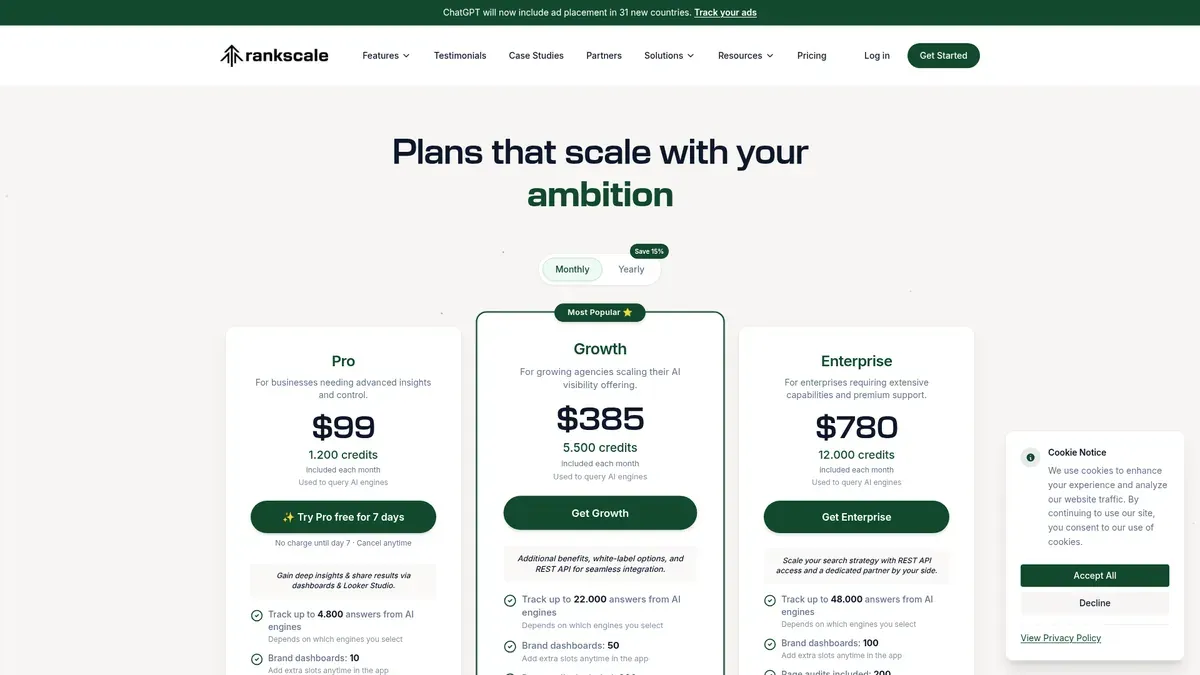
Pricing: Essentials starts from $20 a month with zero credits included and top-ups any time. Pro is $99 with 1,200 credits, up to 4,800 answers, 10 brand dashboards, and 50 URL audits. Growth is $385 with 5,500 credits and up to 22,000 answers. Enterprise is $780 with 12,000 credits and up to 48,000 answers. A typical engine query uses 0.25 credits. Pro has a 7-day free trial, and yearly billing shows a 15% saving.
Limitation: The credit model means the headline price tells you very little. Your real capacity depends on which engines you select and how fast queries burn credits, so model your volume before you buy. Named integrations beyond the REST API and export quotas aren't documented.
8. LLMrefs

Best for: Budget-conscious teams and agencies who want broad model and geographic coverage without rebuilding their tracking model.
LLMrefs makes one interesting bet: it tracks keywords rather than prompts. You import your existing SEO keyword list and carry it into AI search, and the platform generates fan-out prompts from real AI conversations. For a team with years of keyword data and no prompt portfolio, that's a much shorter on-ramp.
It tracks keyword rankings, citations, source URLs, brand mentions, share of voice, position, competitors, and content or outreach opportunities. Results filter by answer engine and country. Named engines include ChatGPT, Google AI Overviews, Google AI Mode, Gemini, Perplexity, Claude, Grok, Copilot, Meta AI, and DeepSeek.
Key features: keyword-based AI visibility tracking, automatic fan-out prompt generation, citations and source URLs, share of voice and competitor benchmarking, weekly refreshed reports, geo-targeting across 50+ countries and 20+ languages, CSV export, and API access.
Pricing: There's a free account with no credit card required. All in One is $79 a month with 500 prompts for mentions, sources, and fan-out queries, every listed engine at no extra fee, unlimited members, projects and domains, CSV and API, and a 7-day free trial.
Limitation: Keyword tracking is not the same as prompt-by-prompt answer auditing, and it isn't a structural eligibility audit either. The public evidence doesn't document a deterministic citability score, a page-level remediation workflow, or free-tier limits. If what you valued most about a diagnostic was the explainable score, this is the furthest tool from it.
How to choose your Troovue alternative
Feeling like every option sounds reasonable? That's normal. Here are the best Troovue alternatives by situation.
Pick DeepSmith when you need observed prompt-level visibility, cited-page attribution, and competitor evidence, plus a production system that turns those gaps into scheduled, on-brand articles. If the reason you're weighing alternatives to Troovue is that a score never moved your publishing calendar, this is the one.
Pick Profound when enterprise answer-engine intelligence, source authority, and AI-bot analytics matter more than a built-in publishing workflow, and you already have writers.
Pick Peec AI when you want a marketing-friendly dashboard with source discovery, competitors, recommendations, and reporting connections your team will actually open.
Pick Scrunch when page audits and AI-ready delivery belong in the same program as visibility tracking, and the Core limits genuinely fit your site size.
Pick AthenaHQ when governance, claim review, discrepancy detection, citation intelligence, and multi-region controls justify custom pricing.
Pick Otterly when you're small, you want a low starting price, and you can live with paying for extra engines as you grow.
Pick Rankscale when you're an agency running many brands across many engines and regions on white-label reporting.
Pick LLMrefs when you want the lowest-cost broad model coverage, you'd rather import keywords than build a prompt portfolio, and you don't need a structural eligibility score.
Still stuck? Answer one question: after the tool tells you what's wrong, who writes the fix? If the answer is "me, on top of everything else," weight the production side heavily. If you have writers with spare capacity, weight the analytics side. That one question sorts these alternatives to Troovue faster than any feature grid.
Start with one week, not one giant migration
You don't need to rip out a tool and rebuild your whole program this quarter. You need to see what AI engines say about you right now, then pick one gap to close.
DeepSmith sets up from your website in minutes: your brand brief, competitors, starter tracking prompts, and a first batch of ideas are populated before you pay anything. Then you watch one prompt, see who's winning it, and let the Writer produce the page that goes after it.
Start your 7-day free trial and see real data and real drafts before you decide.
One prompt. One page. That's the whole first week. You've got this.