You've been doing the off-domain work. A podcast here, a review-site push there, a few Reddit answers, a listicle placement you chased for a month. And you still can't say which one earned you anything in an AI answer.
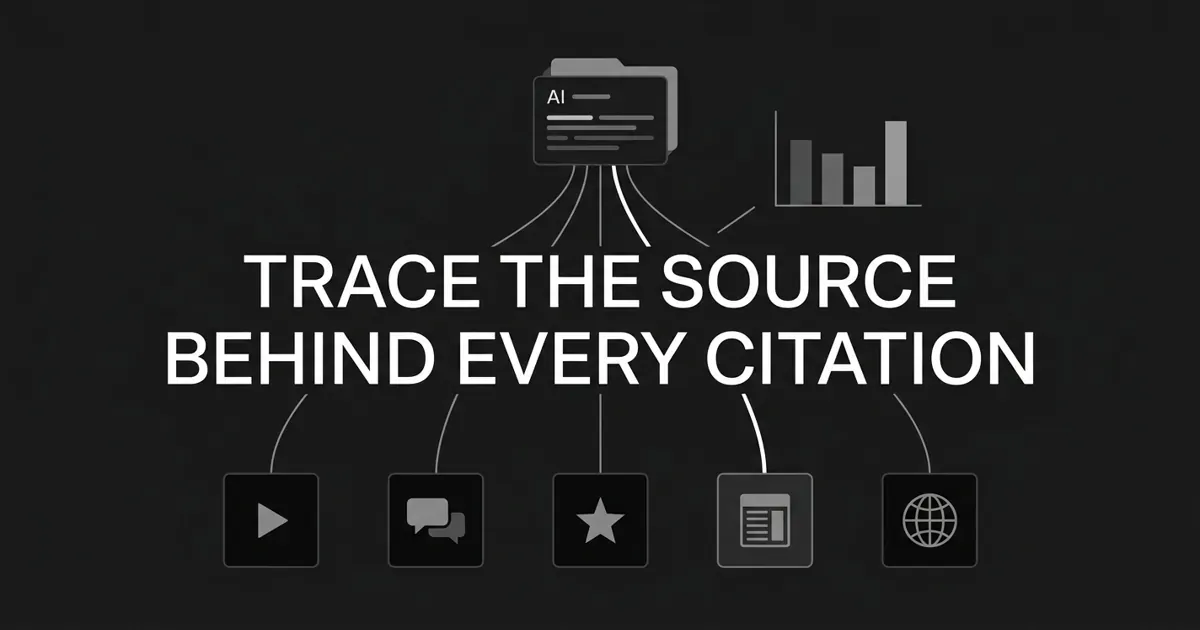
That gap is normal, and it's fixable. The missing piece isn't more effort, it's one column of data: the source URL sitting behind every citation you earn.
This guide walks you through the eight steps that let you measure third-party AI citations properly, so you can point at a channel and say "that one is working, that one isn't." AI citation source attribution sounds like a big build. It's really one habit and one field. We're staying on attribution here, so full visibility dashboards and the wider metric set are their own topic.
Ready? Let's build it.
Step 1: Build a prompt set that can actually show off-domain citations
Your prompt list decides what you're able to see. Get this wrong and every number downstream is quietly useless.
Write 30 to 100 prompts that real buyers ask AI engines about your category. Spread them across awareness, consideration, and decision. Mix branded prompts with non-branded ones, and be generous with the category-comparison shapes: "best X for Y," "X vs Y," "alternatives to Y." Those are the prompts where third-party pages do the heaviest lifting.
Group them by intent, and tag each one with a buyer stage and a persona.
How you know it's done: every prompt has a stage and a persona next to it, each one is answerable in a sentence or two, and the list survives a review with your team mostly intact.
Where people go wrong: they track only branded prompts. It feels safe, and it hides the entire problem. When someone asks AI about your brand by name, your own pages have a natural advantage. The off-domain share only becomes visible on the prompts where nobody has typed your name.
Two other traps. Too few prompts and you're reading noise as signal. Prompts so broad ("what is marketing software") that no action follows from the answer.
If staring at a blank doc is the thing stopping you, DeepSmith's Discover Prompts generates a starter set from your product, persona, and buyer-stage context, so you're editing a list instead of inventing one. You'll still want to shape it yourself. That's the point.
Step 2: Collect answers on a schedule, engine by engine
One manual check in ChatGPT tells you almost nothing. AI answers move. What you need is the same prompts, asked on a repeatable cadence, with every answer stored.
Run collection daily where you can, weekly at minimum, across the engines your plan covers. For each run, record three things: the full answer text, every cited URL, and whether your brand was named. That third field is cheap to capture now and expensive to reconstruct later.
This is the layer that lets you track off-site AI visibility at all. Without a stored answer history, every off-domain question you'll want to ask in a month has no data behind it.
Keep the engines separate. This is the discipline most teams skip, and it costs them. ChatGPT, Perplexity, Gemini, Claude, and Google AI Mode disagree considerably about which sources deserve a citation. Studies comparing them keep finding low overlap in the source lists. Pool them into one number and you've averaged away the exact thing you're trying to learn.
DeepSmith runs this collection for you on a schedule and keeps the full answer history per prompt, with engine coverage rising by plan: ChatGPT on Pro, Perplexity added on Grow, Gemini on Scale, and all covered engines on Enterprise. Whether you build it or buy it, the requirement is the same. Same prompts, same cadence, answers kept.
How you know it's done: you have a fresh row for every prompt, every day, on every engine you cover, with the cited URLs intact and not stripped out.
Where people go wrong: collecting once and calling it a baseline. Reporting on an engine your plan doesn't actually cover, which produces a silent zero that looks like invisibility. And rewording a prompt without versioning it, which snaps your trend line without telling you.
Pro tip: when you do change a prompt's wording, keep the old version running for two more weeks. You'll be able to tell whether a drop is real or just the new phrasing.
Step 3: Split every answer into mention, citation, both, or neither
Here's the distinction that makes the rest of this work, and it's worth slowing down for.
A mention is when the answer names your brand in its text. A citation is when the engine attaches a clickable source URL to the answer. They travel independently more often than you'd expect.
You can be mentioned and not cited: the engine says your name and links to a review site instead. You can be cited and not mentioned: your page is one of the sources, but your brand never appears in the answer text. The industry has started calling that second one a ghost citation, and research suggests it's the majority case, not an edge case. Roughly six in ten citations point at pages that never visually name the brand.
So for every answer, capture four fields:
- Mentioned: yes or no.
- Cited: yes or no.
- Source domain: on-domain or off-domain.
- Position: where in the citation list that source sits.
That fourth one matters more than it looks. A first-position citation and a seventh-position citation are not the same asset, and treating them as equal will flatter your numbers.
How you know it's done: you can filter your data to "mentioned but not cited" and get a real list back. That list is one of the most useful things you'll own.
Where people go wrong: using mention rate and citation rate interchangeably in the same report. Ignoring position entirely. And celebrating ghost citations as earned-media wins when the cited page has nothing to do with you.
Step 4: Bucket every cited URL by source type
Raw URLs are unreadable at volume. After two weeks of collection you'll have thousands, and no pattern will jump out.
Buckets fix that. Classify every off-domain citation into a small, stable set of source types:
- Earned media and news (trade press, analyst write-ups, mainstream outlets)
- Reddit, at the thread level
- YouTube
- Wikipedia
- Review sites (G2, Capterra, TrustRadius, GetApp)
- Roundups and listicles
- Forums and niche communities
- Substack and independent newsletters
- Documentation and technical references
- Your top five named outlets, kept as their own bucket by hand
Ten or so buckets is plenty. Resist adding more.
Some of these will surprise you. YouTube is one of the most-cited domains in Google's AI Overviews, and it's not because of video titles. Engines are reading transcripts. Review sites dominate B2B comparison prompts. Earned media shows up as the most frequently cited source class across the major engines in the research that's been published so far.
How you know it's done: every row has a source-type value, and you review the bucket list once a quarter rather than tinkering with it weekly. Ask "which sources drive AI citations for us" and the answer comes back as a short ranked list of types, not a wall of links.
Where people go wrong: two things, both common. Mixing paid placements into the earned-media bucket, which makes the earned number look better than it is. And treating a subreddit as the unit of analysis when almost every Reddit citation points to one specific thread. Track the thread. The subreddit view will tell you a story that isn't true.
Step 5: Persist the source URL behind every citation
This is the step. Everything before it was setup.
For every citation event, store the actual source URL as a structured field, not as text buried in a screenshot or a note. One column. That's what turns "we got cited 40 times" into "this one comparison post on this one outlet drove 40% of our citations."
Once that column exists, sort by it. Look at your top 20 source URLs by frequency inside a single week. You will almost certainly find that a small number of pages, most of which you don't own, are doing most of the work. That's the whole insight, and you can't reach it any other way.
Notice what just happened. To measure third-party AI citations, you didn't need a new metric. You needed the existing metric to carry an address.
This is where a tool earns its keep. DeepSmith surfaces the source URL behind every citation event and separates on-domain from off-domain in its Link Citation Analysis, so your off-domain share becomes a number you can watch instead of a hunch you defend. The Pages view then shows which of your own URLs earn citations and which prompts drove them, so you can see both halves of the picture in one place.
The point isn't the tool, though. It's the column. Build it in a spreadsheet if that's what you have.
How you know it's done: you can answer "which sources drive AI citations for us this week" with a ranked list, not an opinion.
Where people go wrong: tracking citation counts without the URL. Rolling all citations into one metric. And forgetting to track disappearance. When a source URL stops earning you citations, that's information too, and it's invisible if you only ever count what's currently there.
Step 6: Run the same prompts for your competitors and diff the sources
You now know which off-domain sources cite you. The bigger prize is knowing which ones cite them and not you.
Take the identical prompt set from step 2. Run it for your top three to five competitors. Classify their citations into the same buckets. Then diff.
The output you want is a simple list: source domain, prompt, your position, their position. Sort it by prompts you care about most. Done side by side like this, AI citation source attribution stops being an internal scorecard and becomes a competitive map.
What comes back is usually uncomfortable and extremely actionable. A trade outlet that cites two competitors and never you. A Reddit thread where three alternatives get named. A "best tools for X" roundup that's quietly deciding a whole prompt cluster.
DeepSmith's competitor citations view does this comparison natively: who wins citations on your prompts, on which exact pages, and how each competitor performs per platform. It also tracks what they publish, which tells you where the next citation is likely to come from.
How you know it's done: you have a ranked gap list, and the top five rows have a name next to them.
Where people go wrong: running the gap analysis only on prompts where you already do well. It's a very human instinct and it produces a useless report. Comparing total citation counts instead of going prompt by prompt. And assuming a competitor's engine mix matches yours when it often doesn't.
Step 7: Turn the ranked sources into one action per channel
You have the list. Now pick a small number of moves and actually make them.
One action per bucket. Not five.
Earned media: pitch the specific reporters at the specific outlets your data flagged. Lead with a data point or an exclusive, not a story angle.
Reddit: find the exact threads earning citations and add a genuinely useful answer. Thread level, real account, no astroturfing. The engines are reading the thread, and so are people.
YouTube: identify the creators cited on your tracked prompts. Offer a walkthrough or a co-produced segment. Make sure the transcript actually contains the answer, because that's what gets retrieved.
Review sites: drive verified reviews, respond to the ones you have, and encourage reviewers to name specific use cases rather than generic praise.
Wikipedia: don't edit your own entry. Work on the sources cited in the surrounding topic articles instead.
Roundups and listicles: pitch for inclusion with original data or product screenshots. One placement on a high-authority roundup can carry an entire prompt cluster.
How you know it's done: every bucket in your top five has one owner and one next step dated inside 30 days.
Where people go wrong: trying every channel at once and finishing none. Underestimating what earned media costs in relationship time. And skipping the follow-up measurement, which is the next step and the one that keeps you honest.
Step 8: Re-measure, and be honest about cause
You made a move. Six weeks later your citations on that prompt cluster went up. Did your move cause it?
Maybe. Probably partly. But an engine choosing to cite a page doesn't prove that page caused anything, and correlation is going to be the honest ceiling here most of the time.
So do the version of this that's actually available to you. Note the publication date of each off-domain placement. Watch the citation curve for the prompts that placement is relevant to, week over week. Track new citations and lost citations separately, because churn on Reddit threads and video content can drain your footprint while you're busy adding to it.
Teams that track off-site AI visibility for a full quarter tend to find the same thing: their footprint isn't stable, and the losses were always there. They just weren't counted.
If you want something closer to a real test, stagger your placements. Publish in one channel, hold the others steady for a few weeks, then measure. It's not a controlled experiment, and it's a lot better than guessing.
Common mistake: treating a cited URL as proof that the page's content is accurate about you. Engines occasionally surface a real URL that doesn't contain the claim it appears to support. Open the page before you act on it.
One more thing worth building into your rhythm: keep a hand-written list of the ten off-domain targets that would genuinely change your position if they covered you. The outlets, the subreddits, the creators, the reviewers. Run every source report through that filter. It stops you from optimizing toward whatever happens to be noisy this month.
What to do next
Don't build all eight steps this week. You'll stall.
Start with step 3 and step 5. Split mention from citation, and store the source URL. Those two changes alone will tell you more about your off-domain footprint than any dashboard you've looked at so far. The buckets, the competitor diff, and the action map get much easier once the data underneath them is shaped correctly.
Then give it four weeks of collection before you draw a single conclusion. AI citations move around, and a one-week read will send you chasing something that was never a trend. Four weeks in, you'll be able to attribute AI citations to off-domain pages by name, and that's the moment the off-domain work stops feeling like a leap of faith.
If you'd rather not assemble the collection layer yourself, DeepSmith tracks your prompts across the covered engines, surfaces the source URL behind every citation, separates on-domain from off-domain, and shows you which competitor pages are winning the prompts you care about. It also writes the content you decide to publish in response, which is usually the next bottleneck. You can start a free 7-day trial and see real data on your own prompts before you commit to anything.
You're closer than you think. You just needed the column.