You typed your category into ChatGPT, and a Reddit thread came back as the answer. Your page, the one you spent three weeks on, wasn't anywhere.
That stings. It's also completely normal, and it isn't a verdict on your writing.
Here's the short version. Engines don't rank sources by effort. They weight them by independence, corroboration, freshness, and authority, and your own site loses points on the first two by definition.
So does AI trust Reddit over my site? On the questions your buyers actually ask, usually yes.
This piece walks you through how AI weights sources, tier by tier and signal by signal, so AI citation source trust stops feeling random. By the end you'll know why the gap exists, which parts of it you can close, and where your next piece of content should live.
Take a breath. You're closer to fixing this than you think.
Does AI trust Reddit over my site? Usually, and the reason is structural
On most buying-stage questions, the thread wins. The reason has almost nothing to do with quality.
An engine reads your product page as a self-report. You have a stake in the claim, so the claim starts life as a hypothesis, not as evidence.
A Reddit comment has no stake. Neither does a G2 review or a Wikipedia entry. That independence is the single biggest lever in the whole system.
The numbers back it up. A January 2026 analysis of more than 150,000 citations across ChatGPT, Perplexity, and Google AI Overviews put Reddit at 40.1% of all citations, Wikipedia at 26.3%, YouTube at 23.5%, news articles at 15.2%, and company websites at 12.1%.
The same study scored user trust out of ten: Wikipedia 9.2, Reddit 8.5, YouTube 7.9, news 7.8, and company websites 6.1.
Read that last number again. Company websites sit below three categories you don't control.
That's the UGC vs owned content AI trust gap in one line. It applies to every brand equally, including the ones beating you today, so don't take it personally.
It's worth separating two things people tend to blur. A mention is your brand named inside an answer. A citation is your page linked as the source behind it. You can be mentioned constantly and cited almost never, and source weighting is the reason why.
Your next step: open ChatGPT and Perplexity, ask the five questions your buyers actually ask, and write down every source that appears. Don't fix anything yet. Just look.
The four-tier hierarchy behind how AI weights sources
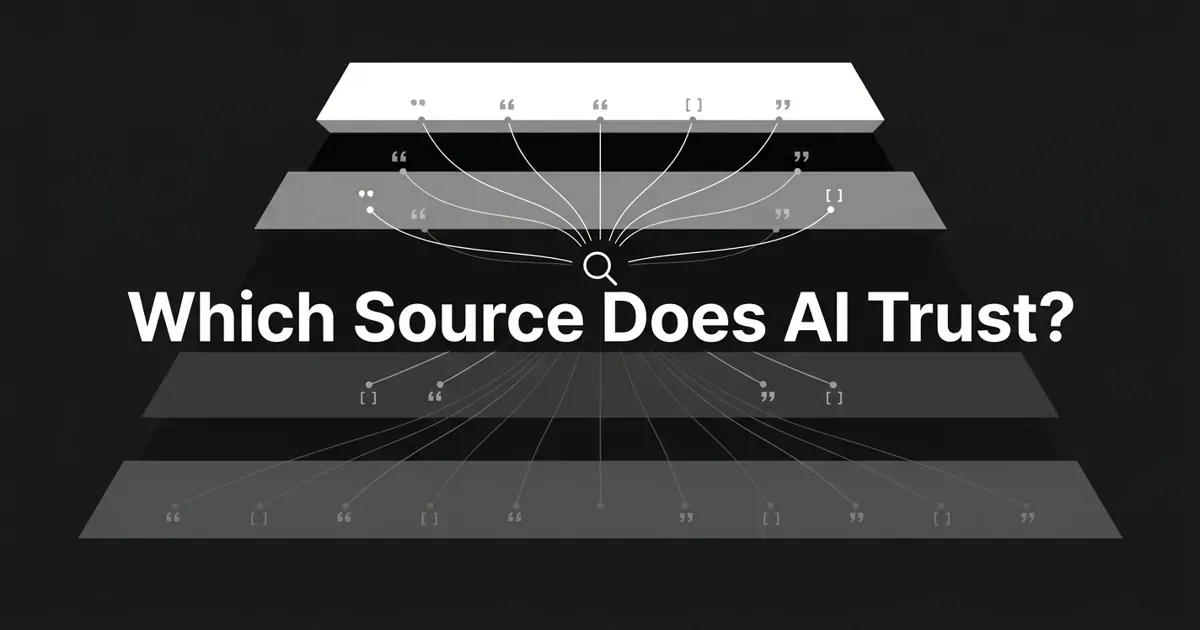
Picture source weighting as a pyramid with four tiers. It's the cleanest way to see how AI weights sources before you touch a single page.
Tier 1, the apex: reference and major editorial. Wikipedia, Wikidata, Britannica, and publications like Forbes, TechCrunch, Harvard Business Review, and the Financial Times. Engines go here first for any entity or claim.
Tier 2, critical influence: review and list ecosystems. G2, Capterra, Trustpilot, Clutch, TrustRadius, Gartner Peer Insights. Every listing is a separately indexed page, and each one bundles independence, structured data (star ratings, pros and cons, vendor metadata), and recency into a single URL.
Tier 3, community: the peer-validation layer. Reddit, Quora, YouTube, Stack Overflow, niche forums. Lower editorial standards than Tier 1, and far more lived experience.
Tier 4, the base: everything you own. Your website, your blog, your product pages, your social accounts. Promotional by default, discounted by default.
Here's the mechanic that makes the pyramid click.
A claim on your page is a hypothesis. The same claim in a Tier 1 source is a fact. The same claim in a Tier 3 thread is evidence.
And the same claim showing up across Reddit, G2, and Wikipedia at once? That's consensus. Consensus is what an engine cites.
Your next step: list your brand's presence in each tier, honestly. Most teams find Tier 4 crowded and Tiers 2 and 3 nearly empty. That imbalance is your map.
The six signals that decide AI citation source trust
AI citation source trust isn't one score. It's a stack of signals, and your own site can only ever cover part of the stack.
Six of them do most of the work.
Independence. Does the source have a stake in the claim? Wikipedia's neutral-point-of-view policy is the purest version of this signal. Product pages have no equivalent.
Corroboration. Do multiple independent sources say the same thing? When the same fact shows up on G2, on Reddit, and in an analyst report, the engine treats it as settled. That's the third-party source authority AI keeps reaching for.
Freshness. How recent is the page compared to the moment someone asks? It matters most on time-sensitive questions and least on evergreen ones.
Authority. Does the domain carry an established floor? In health queries the effect is dramatic, with AI answers leaning on institutional sources: NIH around 39%, Healthline around 15%, Mayo Clinic around 14.8%, and Cleveland Clinic around 13.8%.
Entity recognition. Can the engine resolve your brand into a distinct thing? This is where Organization schema, Person schema on author bylines, and sameAs links out to Wikidata, Crunchbase, LinkedIn, and G2 earn their keep.
Information gain. Does the page add something that isn't already everywhere? Consensus material gets absorbed without attribution. Original data gets cited.
Now the uncomfortable part.
Your own site can genuinely earn entity recognition and information gain. It structurally cannot earn independence, corroboration, or a third-party review footprint.
That asymmetry, not your writing, is what makes the engine reach for the thread.
One clarification on structured data, because it gets oversold. Schema doesn't make your page win. It makes your page eligible to win. Without it, an engine can't reliably tell Acme Inc. from Acme Holdings LLC, so it guesses, and it usually guesses the brand it already knows.
Your next step: pick the single weakest signal on that list and fix only that one this month. Momentum matters more than a perfect audit.
Why a thread beats your product page on the same question
Because the thread answers a different kind of question better, and buyers ask that kind of question constantly.
Five things are happening at once.
Lived experience reads as independent. "I tried it and here's what broke" is structurally different from "our platform is reliable." The engine isn't rewarding anonymity. It's discounting the official voice.
Failure detail beats capability claims. Threads say what broke, in what order, with which error message. Product pages describe the best case. For someone mid-decision, the failure mode is the more useful fact.
Threads sit outside the model's training window. Plenty of recent threads describe products and features the base model never saw. The engine has no internal answer, so it has to go and retrieve one, and community content is what's there.
Disagreement is a signal. A thread holds several voices reporting different outcomes. Your page holds one voice. On subjective questions, multi-perspective content carries more weight than single-perspective content.
The form matches. A thread is a question with answers underneath it. That's the same shape as a prompt. A product page is a description of capability, which matches nothing.
One caveat worth holding onto: the preference is stable, but the share isn't.
Weekly snapshots in a 2025 Semrush study watched ChatGPT cite Reddit in roughly 60% of prompt responses in early August, then fall to roughly 10% by mid-September. Wikipedia moved from about 55% to under 20% across the same weeks.
So don't build a plan around one platform's current share. Build it on the UGC vs owned content AI trust logic underneath, which doesn't move.
There's a harder version of this worth knowing about. When a third-party page is critical of you, it often matches the question better than your own page does, and the engine picks it.
A February 2026 BrightEdge study found outright negative brand mentions are rare, at 2.3% of Google AI Overviews answers and 1.6% of ChatGPT answers. They cluster, though. Brand controversies and legal issues made up 32% of categorized negatives, product limitations 21%, safety and recalls 17%, and service failures 11%.
The engines don't even agree with each other here. Asked the same question, they disagree about which brand gets the negative flag 73% of the time.
That isn't a reason to panic. It's a reason to know what's out there before your prospect finds it.
Your next step: find the three threads already surfacing for your category and read them properly. They're telling you exactly what your buyers need answered.
How the engine actually picks its sources
It runs a pipeline, and ranking on Google is only one step inside it.
Roughly, here's the sequence:
- Sub-query decomposition. The engine splits your question into smaller ones. Google's fan-out is the most explicit version of this.
- Retrieval. Each sub-query hits an index. ChatGPT browsing leans on Bing, Gemini and AI Overviews on Google, Perplexity on its own crawl of more than 50 billion pages.
- Initial ranking. Relevance, page authority, and freshness produce a candidate set, usually 50 to 200 documents.
- Reranking. Cross-encoders and LLM rerankers score each query and document pair far more precisely than the first pass did.
- Authority and entity resolution. Documents get upweighted or penalized on domain authority and on whether the engine can resolve the entities inside them.
- Corroboration scoring. Documents are compared against each other. Agreement raises confidence, contradiction lowers it.
- Synthesis. Three to five sources typically make it into the answer you see.
Two consequences matter for you.
First, ranking isn't enough anymore. An Ahrefs analysis published in March 2026, covering 863,000 SERPs and four million AI Overview URLs, found 37.9% of cited URLs came from the top ten organic positions, down from roughly 76% a year earlier. Around 31% came from pages that don't rank in the top 100 at all.
Second, you can't win the whole answer. Engines prefer a spread of domains over several URLs on one site, so ten citations across ten domains outweigh ten citations on yours.
It helps to name what changed. The old assumption was that the highest-ranked page is the page to cite. The new one is that the highest-ranked page is one candidate among many, rescored on agreement, authority, entity resolution, and freshness before anything makes the answer.
Two smaller shifts ride along with that. Answers now pull from several sources at once, so you're competing for one slot in a synthesis rather than for a click. And matching happens on information need rather than keywords, because the question was decomposed before the search ever ran.
Your next step: stop grading AI visibility by rank. Start grading it by which sources appear in the answer, including the ones that never rank.
The third-party source authority AI rewards, by category
"Third-party" isn't one bucket. Engines treat seven categories differently, and each one is reachable by a different move.
- Reference apex: Wikipedia and Wikidata. Wikidata is the graph layer, Wikipedia the prose layer. These are the highest-leverage entity assets you can earn.
- Major editorial: Forbes, TechCrunch, Bloomberg, the Financial Times, Harvard Business Review. They set the authority floor in industry, financial, and B2B contexts.
- Domain specialists: Search Engine Journal and Search Engine Land in search, NIH and Mayo Clinic in health. Narrow, deep, and heavily cited inside their vertical.
- Review aggregators: G2, Capterra, TrustRadius, Trustpilot, Clutch, Gartner Peer Insights, Product Hunt. The fastest-impact surface for product discovery, and the most reachable tier for most teams.
- Community Q&A: Reddit, Quora, Stack Overflow, and niche vertical forums. Lived experience and peer validation.
- Open-access research and standards: NIH, arXiv, university presses, .gov domains, standards bodies. Engines treat these as primary sources and lean on them in health, science, policy, and legal questions.
- Video: YouTube. In the March 2026 Ahrefs data it accounted for 5.6% of all AI Overview URLs and 18.2% of citations that don't rank in Google's top 100, after 34% growth in six months.
Accessibility counts for more than most teams expect. Content sitting behind a paywall is harder to retrieve, so publishing openly carries a quiet advantage over gating everything.
Engines also disagree about which categories they favor, which is why your Perplexity results look nothing like your ChatGPT results.
ChatGPT skews toward encyclopedic sources and established media. Google AI Overviews lean hard on Reddit, YouTube, and Quora. Perplexity mixes community and institutional sources, with Reddit, LinkedIn, and NIH near the top. Claude prefers documentation and practitioner explainers and cites fewer sources per answer. Google AI Mode leans on LinkedIn, which appeared in nearly 15% of its responses during the Semrush study window.
The overlap between engines is thinner than most teams assume. A 2026 Semrush audit of 680 million citations found ChatGPT and Perplexity share only 11% of their cited sources.
Your next step: pick the one category where you're already closest to present and go deeper there. For most B2B teams that's review aggregators, not Wikipedia.
Where your content should live now
Not away from your own site. That's the wrong lesson to take from all of this.
Your owned pages are the canonical record an engine checks third-party mentions against. Without them, a Reddit mention of your brand has nothing to resolve to, and the engine will resolve it to whoever it can recognize instead.
So keep publishing. Just change what you expect each surface to do.
Owned pages carry your canonical facts, your original data, and your entity signals. They win the questions that need a reference answer: what you are, what you cost, how you compare.
Third-party and community surfaces carry independence and corroboration. They win the buying-stage questions, and the third-party source authority AI leans on is earned in public, not on your own domain.
Then make the two agree. Inconsistent facts across surfaces trigger skepticism, and when your G2 profile lists different pricing than your website, engines can skip citing you altogether.
If you want a concrete starting point on the entity side, it's a short list. Organization schema on your homepage and About page with sameAs links out. Person schema on author bylines. Article schema on posts, pointing back to both. Product or Service schema wherever it applies.
Keep the sameAs list clean: canonical https URLs, and only profiles that carry weight, like Wikidata, Crunchbase, LinkedIn, G2, and Capterra. Stuffing it with low-quality directories dilutes the signal you were trying to send.
One more thing, and it's the part most teams underestimate.
The source mix moves monthly. Reddit's share inside ChatGPT swung from roughly 60% to roughly 10% in about six weeks. YouTube grew 34% in half a year.
You can't intuit that. You have to watch it.
That's the gap DeepSmith's AI Visibility module was built for. It tracks mention rate, citation rate, and share of voice across ChatGPT, Gemini, Perplexity, Claude, and Google AI Mode, and it surfaces the prompts where you're named but never cited. The competitor view shows which third-party pages are winning citations for the prompts you track, so corroboration becomes a target you can aim at instead of a thing you hope for.
You don't need to fix all four tiers this quarter. You need one honest baseline and one tier to work on.
Ready to see where you actually stand? Start a 7-day free trial and get real data on which sources AI cites in your category before you commit to anything.