A shopper types "best running shoes for flat feet" and Google writes the answer for them, complete with three product cards, a price column, and links that are not yours. That is the moment you are competing for now. This guide is for the marketing lead at an ecommerce brand who needs a working playbook for AI Overviews shopping queries, not another think piece about the future of search. By the end you will have a baseline, an eligible product feed, schema that matches your pages, content built to be quoted, and a number you can put in front of your leadership.
What you need: Merchant Center access, edit rights on your product page template, and a spreadsheet.
If this feels like a lot, that is normal. You do not have to do all seven steps this month.
Step 1: Understand how a shopping AI Overview gets built
Here is the single most useful thing to know: a shopping AI Overview is assembled, not ranked.
Google runs roughly five moves on every query that earns one.
- Query interpretation. Google decides the query has shopping or comparison intent, then decides which attributes matter: price band, use case, brand, specs, size, color.
- Retrieval. Candidates get pulled from two places at once. The Shopping Graph, which is Google's product-entity database fed by Merchant Center feeds and structured data from the open web. And the regular web index, scored on topical relevance, entity alignment, structured-data confidence, and freshness.
- Grounding and synthesis. The model writes an answer grounded in what it retrieved, attributing assertions to URLs.
- Citation selection. The most relevant URLs become clickable citations.
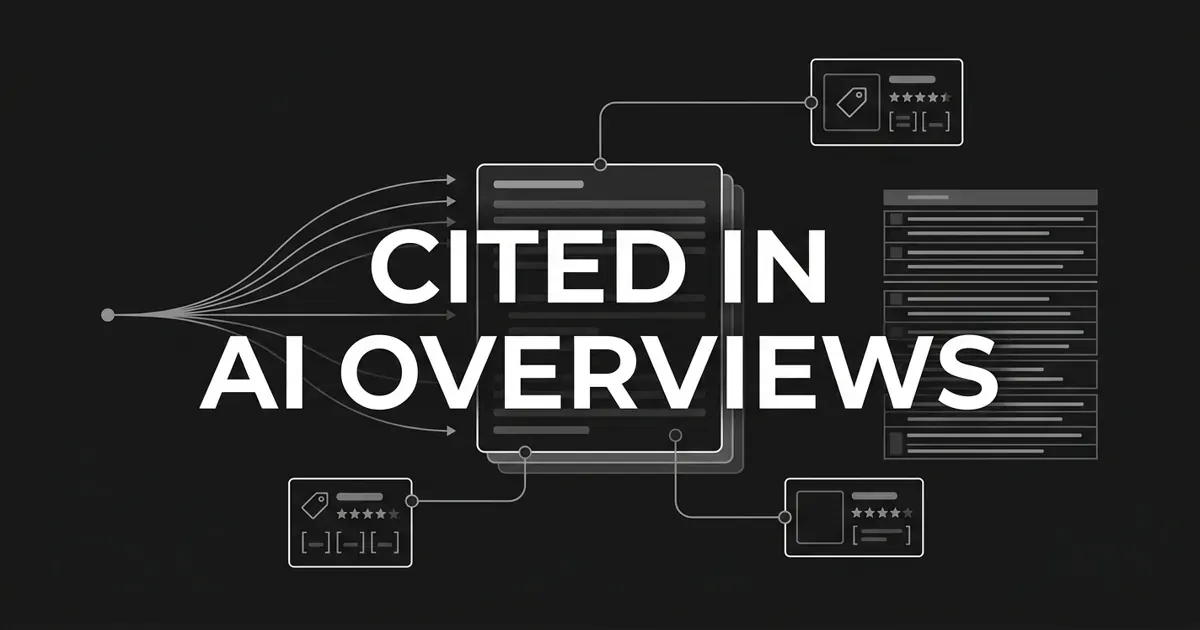
- Rendering. You see up to three blocks: a generative text answer with inline links, a product carousel with image, title, price, merchant, and star rating, and sometimes a comparison table with two to four product rows.
Eligibility gets you into the candidate pool. Structure, clarity, and entity alignment decide who actually gets picked.
Now the part that should change your priorities. Roughly 80% of products cited in AI Overviews do not hold a top-10 organic ranking for the query that triggered them. In a separate 2026 study, only about 38% of AI Overview citations came from pages ranking in Google's top 10, down from about 76% in mid-2025. Retail citations are also more dispersed than other verticals: the top cited source takes around 27%, versus about 35% across categories.
Read that again, because it is good news. Page one is no longer the toll gate. That is the kind of shopping AEO Google can actually act on: accurate product data, clean markup, and evidence, rather than raw domain muscle.
Common mistake: treating Shopping ads as the same thing as a citation. Performance Max and standard Shopping ads run on a separate surface. Paying for ads is allowed, and it does not buy you an organic AI Overview citation.
Done when: you can name, for your five biggest queries, which blocks appear and who currently fills them.
Step 2: Baseline where you show up today
You cannot improve a number you have never written down.
Pull your top 50 commercial queries, the ones with buying intent: "best X for Y," "X vs Y," "X under $200." For each one, log five things:
- Did an AI Overview fire at all?
- Was there a product carousel or comparison table?
- Which domains got cited?
- Were you cited?
- If yes, was it your product page or somebody else's article?
Run these in incognito, on both desktop and mobile, in the locale you actually sell to. Google personalizes heavily, and a logged-in Chrome window will lie to you.
That gives you four numbers to carry forward: AI Overview Presence Rate (how often one fires), Citation Share (how often you are cited), Citation Position (where you land in the block), and Citation Type (your page versus a third party).
A Google AI Overviews ecommerce baseline takes an afternoon for 50 queries. It is tedious. It is also the only honest starting point you will get.
Doing this by hand every month gets old fast, which is where systematic prompt tracking helps. DeepSmith checks a defined prompt set on a schedule across ChatGPT, Gemini, Perplexity, Claude, and Google AI Mode, reporting mention rate, citation rate, share of voice, and which competitors win which prompts. AI Mode is the closest tracked neighbor to AI Overviews and both draw on the Shopping Graph, so pair that trend data with your manual Overview checks rather than expecting one to replace the other.
Common mistake: testing once, on one device, while logged in, and treating the result as the truth. Sample weekly or biweekly and look at the trend.
Done when: you have a spreadsheet with a citation share percentage in it and a date next to it.
Step 3: Make your products eligible in Google's Shopping Graph
This is the foundation, and skipping it makes everything after it pointless. Google will not cite a product it is not confident exists at the price you say it does.
Start with the account:
- Create a Merchant Center account and claim your website. Domain verification through a DNS TXT record covers you site-wide. The HTML meta tag route is faster but limited to that path prefix.
- Fill in legal entity details: business name, address, country, contact email.
- Add your returns policy URL.
- Configure shipping and tax, including handling time and transit time.
Then the feed. These attributes are required: id, title, description, link, image_link, availability, price, condition. Miss one and the product does not get approved.
These are strongly recommended and worth the effort: gtin, mpn, brand, google_product_category, product_type, item_group_id, color, size, gender, age_group, shipping, and additional_image_link.
Two attributes matter more than most people realize, because they are written for machine reading:
product_highlight: a short list, typically up to four, of bullet-style facts. "Lightweight." "Dishwasher safe." "18-hour battery."structured_description: key and value pairs like "Material: Stainless steel" or "Battery life: 18 hours."
Those two are exactly the shape a generative answer wants to lift. Fill them in per SKU.
Next, turn on Free Listings. That is the non-paid route for your products to appear in Google Shopping surfaces, including AI Overviews, AI Mode, the Shopping tab, and Google Images. The bar is a verified and claimed website, an active feed with required attributes populated, a landing page whose price and availability match the feed at checkout, a working checkout on the verified domain, and no policy violations. You do not need a Google Ads account.
Pick the submission method that matches your catalog. File upload works for small catalogs. Scheduled fetch pulls from a URL on your domain daily or hourly. Content API suits large catalogs with fast-moving inventory. If your prices or stock move in under 30 minutes, use the Content API or sub-hourly fetch, because stale prices suppress eligibility outright.
Everything you do to get products in AI Overviews depends on this feed being clean and staying clean.
Common mistake: a price mismatch between feed and landing page. Even a small gap suppresses eligibility. The same goes for stale availability, missing return policy URLs, and images with watermarks, borders, or graphics-only placeholders.
Done when: feed approval sits at 95% or better, required-attribute coverage is at 100%, and Free Listings is live with no policy flags.
Step 4: Put Product structured data on every product page
Your feed covers the Shopping Graph side. Your markup covers the open web side. You need both, because your product page is what actually gets linked when a citation lands.
Use JSON-LD. It is the only format Google documents for Product markup here, so Microdata and RDFa are not the move.
Only name and image are strictly required. The list worth actually implementing is longer:
description,sku,gtin,mpnbrandas a Brand entity with a nameofferswithpriceCurrency,price,availability, andurlaggregateRatingwithratingValueandreviewCount, plus individualreviewentries with author, date, body, and ratingcategory,material,color,size,pattern,weightshippingDetailswith destination and delivery timehasMerchantReturnPolicywith return days and methodmanufacturerandreleaseDate
For variants, use ProductGroup with hasVariant pointing at the child products. Skip that and you spawn duplicate product entities, which splits Google's confidence across SKUs that should be one family.
The rule underneath all of it: markup must reflect what a human sees on the page. Price, availability, ratings, and review text in your schema have to match the visible page.
Validate in two places. Run the Rich Results Test on your top pages, then watch Search Console under Enhancements for Products.
Common mistakes, and these are the ones that actually show up:
- Aggregate ratings backed by one fake or duplicated review.
- Reviews that exist only in schema and never appear on the page.
- Image URLs that 404 or sit behind a robots.txt block.
- Offers with no
availabilityvalue, which some parsers read as out of stock. - Schema prices that disagree with on-page prices.
- Missing
ProductGroupon variant families.
Pro tip: schema is necessary, not sufficient. It raises Google's confidence in your product entity. It does not buy a citation on its own, and no amount of markup rescues a thin page.
Done when: the Rich Results Test throws zero errors across your top 100 product pages and variant families carry valid ProductGroup markup.
Step 5: Build the comparison and buying-guide content that gets quoted
Now the fun part. Feeds and schema make you eligible. Content is what gets you quoted.
Formats earn citations in roughly this order for shopping intent:
- "Best of" and buying-guide listicles.
- Side-by-side comparison articles.
- Product detail pages.
- Editorial review roundups with an explicit scoring methodology.
- Category pages with structured comparison blocks.
- Single-product editorial reviews on authoritative publishers.
- Forum threads, for long-tail experience questions.
A 2026 study of 75,000 AI answers found listicles, articles, and product pages together account for roughly 52% of AI Overview citations across verticals.
Structure matters as much as topic. The patterns that get lifted into answers:
- A direct, declarative answer in the first 100 to 150 words. Overviews often quote the lead sentence almost verbatim, so put the answer there and nowhere else.
- H2 and H3 headings phrased the way a buyer would ask. "Best running shoes for flat feet." "Which is better for backpacking?"
- A comparison table, three to five columns by three to five rows, with one distinct fact per cell: price, weight, battery life, material, warranty.
- Pros and cons, or a "best for" line, on every option.
- A visible "last updated" date.
- A visible methodology section. "How we picked." "How we tested." Name the criteria.
- Original media: your own product photos, your own test data, hands-on video.
- An author byline with credentials and a linked bio.
- Outbound citations to primary sources like manufacturer specs or regulatory filings.
And the things that quietly suppress you: affiliate-only content with no original testing, answers buried under hero images and banners, headlines that do not match the body, pages under 300 words, schema that contradicts visible content, and generic listicle patterns the model has already seen ten thousand times.
If producing one cornerstone buying guide and one cornerstone comparison page per priority category sounds like a quarter of work, that is where a production system earns its keep. DeepSmith's Content Studio writes from your stored brand context, so drafts arrive with heading structure, keyword coverage, internal links, schema, and metadata already built in, then publish straight to WordPress, Strapi, Webflow, or a webhook. The judgment about which categories to target stays yours.
You are not trying to get products in AI Overviews by writing more. You are trying to write the two or three pages per category that are genuinely the best answer.
Done when: every cornerstone page has an answer block up top, a comparison table, per-option pros and cons, a named methodology, and a last-updated date.
Step 6: Earn citations on pages you do not own
Half or more of product citations in AI Overviews go to third-party publishers rather than the brand's own product page. That stings a little. It also means there is a whole second field to play on.
What works:
- Pitch listicle writers and reviewers with something they cannot get elsewhere: original benchmark data, a loaner unit, exclusive test results, an interview with the person who designed the thing.
- Get product into the hands of authoritative reviewers in your category. Established review outlets, niche enthusiast sites, newsletter reviewers, creators with real audiences.
- Answer questions in forums and communities where your buyers already are, usefully and without a pitch. Disclose who you are. Disclosure builds trust rather than costing you any.
- Pitch news outlets with original trend data: buyer surveys, price-index studies, category reporting nobody else has.
What helps once you land a mention: descriptive anchor text rather than a naked URL, links inside the editorial body rather than a footer block, and co-citation, meaning being named on the same page as your top competitors in comparable context. That last one signals to the retrieval model that you belong in the same set.
What does not work, and can hurt: undisclosed paid placements, private blog network links, review gating where you only solicit happy customers, coordinated forum posting, and conflict-of-interest Wikipedia edits.
Underneath all of it sits E-E-A-T: experience, expertise, authoritativeness, trustworthiness. AI Overviews inherit those signals. Hands-on photos and first-person testing cover experience. Author bios with real credentials cover expertise. External citations from industry and regulatory sources cover authoritativeness. A clear About page, an editorial policy, visible affiliate disclosures, HTTPS, and real contact information cover trust.
Knowing which competitor pages keep winning your queries makes the pitching much less guessy. DeepSmith's competitor tracking shows what your rivals publish as it ships and which of their pages earn citations, and Remix turns a competitor page that is working into original angles for your own queue. Google AI Overviews ecommerce results reward the brand with the widest credible footprint, so treat this as an ongoing program, not a campaign.
Done when: three or more priority outlets link to your product pages with descriptive anchors, at least one creator has published a hands-on review, and you have a genuine presence in one relevant community.
Step 7: Measure citation share and iterate
Six steps in, you need to know whether any of it worked.
Track six things:
- AI Overview Presence Rate: the share of your priority queries where an Overview fires.
- Citation Share: the share of Overview-bearing queries citing one of your URLs.
- Citation Position: where you land inside the block.
- Citation Type: your product page versus a third-party article.
- AI surface traffic: sessions attributable to those citations.
- Feed health: approval rate, attribute coverage, open policy flags.
Four ways to get the data, each with limits worth knowing. Manual SERP testing is slow, honest about presence and position, and blind on clicks. Third-party trackers sample at scale and have real coverage gaps, so treat them as directional. Search Console has no dedicated AI Overview filter, so that traffic sits blended into standard search results. Merchant Center Insights reports impressions, clicks, and conversions for products on AI surfaces separately from standard Shopping, with limited history so far.
Count the product citations AI Overviews actually hand out, not the impressions you hope exist. Then set targets you can defend: feed approval at 95% or better, required-attribute coverage at 100%, citation share up 10 percentage points quarter over quarter, citation position in the top three, and time-to-cite falling.
Build the cadence into your calendar. Weekly feed diagnostics, resolving flagged items within a week. Monthly, re-run the same AI Overviews shopping queries and log the movement. Quarterly, compare against baseline and diagnose the queries where a competitor is cited and you are not. Open their cited page. Look at the table format, the methodology section, the comparison blocks. The pattern is usually sitting right there.
Give it time. Feed and content changes typically surface in Overviews within two to six weeks, depending on crawl frequency and how much the category is churning. Some land in days.
DeepSmith's Pages view is useful here for the tracked engines: it shows which of your URLs AI engines actually cite, each page's share of your total citations, and the prompts driving them. It tracks and reports what is happening. It does not control or guarantee citations, rankings, or traffic, and no tool that tells you otherwise is being straight with you.
Common mistake: over-optimizing one high-volume query. Citation share across a portfolio of commercial queries beats winning a single trophy term, every time.
Done when: you have a quarterly report showing citation share against baseline and at least three diagnosed changes behind the movement.
What to do next
Pick one thing this week. If your Merchant Center feed has open diagnostics, fix those first, because nothing downstream works without them. If your feed is already clean, baseline your top 50 queries instead. If both are done, write the one buying guide your best category is missing.
Momentum matters more than completeness here. Most shopping AEO Google work is maintenance, not launch work: a feed you keep clean, markup you keep honest, a few pages you keep current. A brand doing that steadily will out-cite a much larger competitor coasting on domain authority, because the citation layer is not the ranking layer.
Want to see which prompts already mention you and which competitor pages are taking the citations you want? Start a 7-day free trial of DeepSmith and get real data before you pay.