You searched your own category in Perplexity, and the answer cited a Reddit thread and a G2 listing. Not your site. That stings, and it's also the clearest signal you'll ever get about where the work actually is. Perplexity citation sources are mostly other people's websites, which means the fix lives off your domain, not on it. This guide walks you through eight steps: which sources Perplexity cites most, which of them match your category, and what one realistic quarter of effort looks like on each.
You don't need a bigger team for this. You need to pick the right two or three surfaces and show up there on a schedule.
Step 1: Start with the sources Perplexity actually cites most
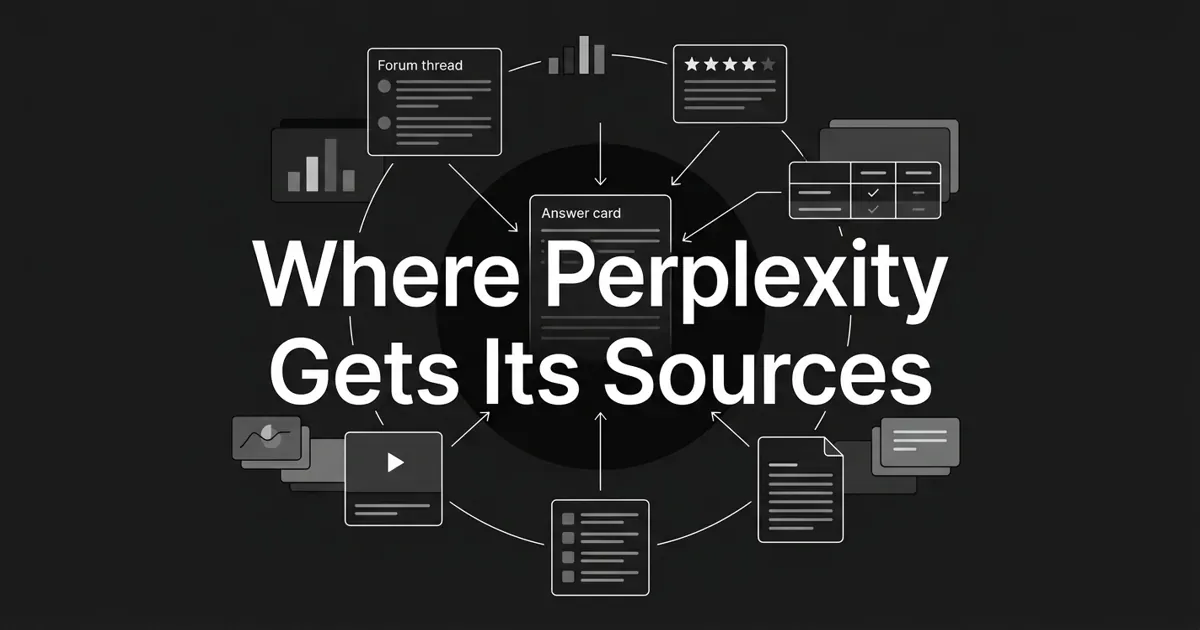
Perplexity citation sources cluster around user-generated content and review platforms. Across a 13-week study of 230,000 prompts and more than 100 million AI citations, Perplexity's top sources came out as Reddit, LinkedIn, NIH, Microsoft, and Google. Reddit sits at the top of nearly every independent analysis of the engine.
Here's the shape of the landscape, so you know what you're aiming at.
| Source category | What lives here | Where it shows up |
|---|---|---|
| Forums and Q&A | Reddit, Quora, niche practitioner forums | General advice, consumer research, technical questions |
| B2B review platforms | G2, Capterra, GetApp, Software Advice, TrustRadius | Software shortlists and "alternatives to X" prompts |
| Local review platforms | Yelp, TripAdvisor, Angi, BBB, Thumbtack, HomeAdvisor | "Near me" and local services prompts |
| Video | YouTube | Product questions and how-to prompts |
| Long-form UGC | Medium, Substack, expert blogs | Thought leadership and explainer prompts |
| Reference and encyclopedic | NIH, .gov, .edu, Wikipedia | Medical, scientific, regulatory, academic prompts |
| Earned media | Trade press, news, analyst coverage | News-shaped and market prompts |
A few numbers worth holding on to, because they redraw where you spend the quarter:
- In a benchmark of 1,260 B2B SaaS prompts, G2.com was the single most-cited domain at 5.8% of all citations, and the wider G2 family (G2, Capterra, GetApp, Software Advice, TrustRadius) took 8%. Perplexity alone drove more than 71% of those G2 citations.
- In that same B2B set, Reddit took only 1.4% of citations. Reddit's dominance is real, but it swings hard by category.
- For local discovery, an analysis of more than 28 million AI responses in Q4 2025 put Yelp at 62.1% of Perplexity's local citations, roughly 4.9 times the next competitor.
- Wikipedia sits at about 0.8% of Perplexity citations. If you have been chasing a Wikipedia mention for Perplexity specifically, that is a very small door.
- One community test of 926 Perplexity citations on product questions found 14.1% pointed at YouTube or creator videos, including a video with 560 views.
How to tell this step is done: you can name the three source categories that dominate the prompts your buyers actually type.
Where people go wrong: quoting one Reddit percentage everywhere. Reddit ranged from 1.4% in that B2B set to as high as 46.5% in general-knowledge testing. The rank order across studies is consistent. The exact percentages are not, because methodologies and categories differ. Match the study to your category, and treat everything here as directional.
Step 2: Audit where Perplexity cites your brand and your category today
Before you pick channels, get a baseline. Pull your top 10 buyer prompts, the real questions people ask before they choose someone in your space, and run each one in Perplexity. For every answer, write down two things: whether you were mentioned, and every domain in the sources list.
After ten prompts you will have a source-by-domain picture of your category. That picture is your map. It tells you which third-party surfaces are already answering your buyers' questions, and who is being cited instead of you.
How to tell this step is done: you have a per-prompt record of mentions plus a ranked list of the domains Perplexity leans on in your category.
Where people go wrong: auditing only brand-name prompts. In that local-discovery analysis, 91% to 97% of Yelp citations came from category queries, not brand queries. Your name is not the game. The category question is.
Doing this by hand once is a great baseline, and it gets old fast by week three. This is where DeepSmith's AI Visibility module does the repetitive part: you define the prompts you care about, it checks them on a schedule across ChatGPT, Perplexity, Gemini, Claude, and Google AI Mode, and it reports mention rate, citation rate, share of voice, and the sources AI cites most, with a competitor leaderboard beside them. Not sure which prompts to track? Discover Prompts generates a starter set from your product, persona, and buyer-stage context. Perplexity coverage starts on the Grow plan at $199 per month, or $160 per month billed annually.
Step 3: Match the citation mix to two or three channels you can win
If that list in Step 1 felt like a lot, that's normal. You can't work every surface, and nobody can. The Perplexity off-domain sources that deserve your quarter are the ones your category's citation mix already favors. Let the rest wait.
Use your Step 2 map plus these anchors:
- B2B SaaS: the G2 family first, because Perplexity drives the overwhelming majority of G2's AI citations.
- Local and home services: Yelp first, with Angi, Thumbtack, HomeAdvisor, and BBB as the second tier.
- Restaurants and travel: Yelp and TripAdvisor, with OpenTable and delivery platforms behind them.
- Consumer products: Reddit first, YouTube second.
- Thought leadership and services: LinkedIn plus long-form on Medium, cross-published rather than stranded.
Pick two. Three at most. A quarter of real presence on two surfaces beats a month of thin presence on eight.
How to tell this step is done: you have named your channels in writing, with an owner and a weekly time budget for each.
Where people go wrong: picking channels by internal comfort instead of citation data. Plenty of teams choose LinkedIn because they already post there, while every answer in their category cites review platforms they have never touched.
Competitor data sharpens this fast. DeepSmith's competitor citations view shows which competitor pages win citations for your exact prompts, on which platform. Remix then turns a competitor page that is clearly working into ready-to-use idea titles in your Idea Bank, so the gap becomes a queue instead of a nagging feeling.
Step 4: Earn forum citations with a real posting history
Forums are the highest-ceiling and slowest-burning channel here. Perplexity reads older threads, not just what's hot today, and it weighs the credibility of the account behind an answer. That cuts both ways. A two-week campaign gets you nothing. A year of genuine participation compounds.
What good looks like on Reddit:
- Long-form, opinion-anchored answers from accounts with real posting history and karma.
- Plain English packed with entities. Real product names, real feature names, real numbers. Perplexity extracts entities, not adjectives.
- Answers to a specific question, not a pitch wearing an answer's clothes.
- Sustained presence in two or three relevant subreddits, over about 12 weeks, before you judge results.
Quora works on similar logic, with about 14% of citations in general-purpose testing. The winning pattern is a credentialed-looking profile, a long answer with specifics, and enough tenure that the answer becomes the canonical one. Niche practitioner forums sit in the long tail, roughly 4% in aggregate across community platforms, but they punch above that inside their vertical. Most have minimum account-age rules, so warm up an account for about 90 days before you post anything that matters.
How to tell this step is done: you have accounts with history in your chosen communities and at least a handful of substantive answers that stand on their own without a link.
Where people go wrong: three predictable ways. Treating a subreddit like a billboard. Astroturfing from disposable accounts, which the credibility filters catch. Posting once and calling the channel dead.
Pro tip: one deep thread on the right subreddit can outperform six months of publishing on your own blog. Give a forum channel a full quarter of honest effort before you write it off.
Step 5: Win the review platforms your category actually uses
Review platforms are the fastest lever in the whole playbook, because you are optimizing a profile that already ranks rather than building an audience from zero.
For B2B software
If you sell software and you want to get cited by Perplexity on shortlist prompts, this is your first stop. Perplexity treats G2, Capterra, GetApp, Software Advice, and TrustRadius as one family and leans on the strongest member. So:
- Keep review velocity steady. Around 20 verified reviews a quarter beats a burst of 60 and then silence.
- Push for reviews that name and compare two or three competitors. Comparative language extracts far more cleanly than pure praise.
- Enrich the listing itself: features, integrations, pricing tiers, segment callouts, and a genuine alternatives section.
- Make sure reviewer profiles carry role, company size, and use case. Thin anonymous reviews do less work.
Where people go wrong: assuming your own comparison page will carry "alternatives to X" prompts. For those queries, Perplexity usually reaches for the review-platform page even when your page is the stronger SEO asset. Own both, and stop expecting your domain to win alone.
For local and consumer businesses
Local is where the numbers get loud. In one quarter, 24 unique "plumber near me" queries produced 1,168 Yelp-cited answers on Perplexity. Between September and November 2025, Yelp's AI citations grew roughly 19 times while AI citations overall grew about three times.
What earns that:
- A claimed, complete profile with structured hours, services, and photos from the last 12 months.
- Category keywords in your description, because category queries drive the vast majority of citations.
- A steady cadence of recent reviews. Businesses with reviews inside the last 90 days dominate the cited set.
- Owner responses to reviews, which correlate with higher citation share.
How to tell this step is done: every profile in your family of review platforms is claimed, current, category-worded, and gathering reviews on a rhythm you can sustain.
Step 6: Make LinkedIn, YouTube, and long-form UGC extractable
These three surfaces fail for the same reason: teams publish there without leaving anything a machine can lift.
LinkedIn sits in Perplexity's top five sources. Publish from a real person's profile rather than a company page. Keep posts long enough to survive extraction, roughly 200 words and up, and load them with named products, named customers, and real numbers. Announcement prose extracts terribly. A specific explanation extracts beautifully.
YouTube gets cited because Perplexity reads transcripts, not because a video is popular. That 560-view video proves the point. Write descriptions of 200 words or more that front-load a question and answer it. Make sure the transcript is clean and real. Name the host with credentials, and add VideoObject schema on the page where the video lives. Two videos a quarter done this way beats twelve done carelessly.
Medium and Substack are your long-form UGC play. Aim for 1,500 words and up, with clear H2s Perplexity can lift as standalone answers, an author bio that traces back to a verifiable professional identity, and specifics in the first 100 words. One practical note: crawlers handle Medium's canonical URLs better than Substack's fragmented subdomains, so cross-publish rather than stranding a post on a lone subdomain.
Where people go wrong: treating these as vanity channels. A video with no extractable content, a post under 200 words, or a byline with no traceable identity will not get cited by Perplexity no matter how well it performs socially.
Step 7: Apply the five rules that decide whether anything gets cited
Every channel playbook above reduces to the same five mechanics. Perplexity pulls roughly 5 to 10 candidate pages per query and cites 3 or 4 of them. These rules decide which ones survive.
- Recency wins. Around 70% of Perplexity's top citations carry a visible publication or update date inside the last 12 to 18 months, and decay can start within 2 to 3 days on fast-moving queries. Treat every asset as perishable and put a refresh date on it.
- Answer in the first 100 words. Roughly 90% of top citations follow that pattern. Lead with the answer, then support it. Everything after the opening block is evidence.
- Entity richness beats keyword density. Real names, real features, real figures. That is what gets extracted.
- Schema markup earns its keep. Pages with JSON-LD hit a 47% top-three citation rate versus 28% without, and adding Person schema with author credentials correlates with a 2.3 times higher citation rate. FAQ, Organization, Person, and VideoObject are the ones that matter here.
- Author identity is a ranking signal in disguise. A comment from an account with history outperforms an anonymous one on the same thread. A post from a named person outperforms the same words from a company page.
Notice what's missing from that list. Backlinks. About 92.78% of pages Perplexity cites have fewer than 10 referring domains. Domain authority isn't the gatekeeper you were trained to think it is, and that's genuinely good news if you're the smaller brand in your category.
Common mistake: publishing one page on your own site and waiting for Perplexity to find it. The pipeline re-ranks by corroboration. Third-party mentions are what let your own page survive the same filter, so Perplexity off-domain sources and your owned content are one strategy, not two.
This is also where most content operations quietly break. Knowing that schema, answer-first structure, and entity-rich phrasing matter is easy. Doing it on every asset, every week, is the hard part. DeepSmith's Deep IQ stores your product facts, personas, brand voice, and a trusted-sources list, and Content Studio writes from that context, with heading structure, schema markup, internal linking, and metadata built into the draft rather than bolted on afterwards. The output is a publish-ready article, so your review time goes to editorial judgment instead of formatting.
Step 8: Track your sources by domain weekly and rotate
Citations move. A thread that anchors an answer today can be replaced next week, so a one-time audit tells you almost nothing about whether the work is landing.
Re-run the same prompt set every week and watch three things: your mention rate, your citation rate, and the mix of Perplexity citation sources behind each answer. When a channel you invested in starts appearing in that mix, you have proof. When 12 weeks pass and nothing shifts, rotate the effort somewhere else instead of doubling down out of stubbornness.
How to tell this step is done: you can point to at least one new third-party domain citing you that was not there last quarter.
Where people go wrong: buying placements on low-quality sites to force the number up. Perplexity's spam-site citation share was measured at 11.3% in that B2B benchmark, second highest of any source group, so the engine is not a perfect filter. That is a warning, not an invitation. Junk placements pollute how the engine understands your brand and do nothing for the buyers who actually read the answer.
If keeping a weekly rhythm is the part that keeps slipping, that is a systems problem, not a discipline problem. Tracking runs on a schedule inside AI Visibility, and Autowrite handles the production side by writing scheduled articles on their planned date and dropping them into Produced Content for review or hands-off publishing. The cadence stops depending on whoever has a free afternoon.
What to do next
Your Perplexity AEO third-party plan doesn't need to be long. Pick your two channels this week. Run the ten-prompt audit. Write down the minimum quarterly effort for each channel, the one from Step 4 or Step 5 that fits, and put it on someone's calendar.
Then leave it alone for 12 weeks. Forum history, review velocity, and transcript-rich video all compound slowly and then all at once. Checking daily will only make you anxious, and it won't change the outcome.
Once your cited-source mix starts moving, the next move is expanding into the adjacent categories you have been ignoring, using the same map.
If you would rather see this measured than guessed at, start a 7-day DeepSmith free trial and get real data and real drafts before you pay. Track your prompts, see which third-party domains own your category, and produce the content that closes the gap, all in one place.