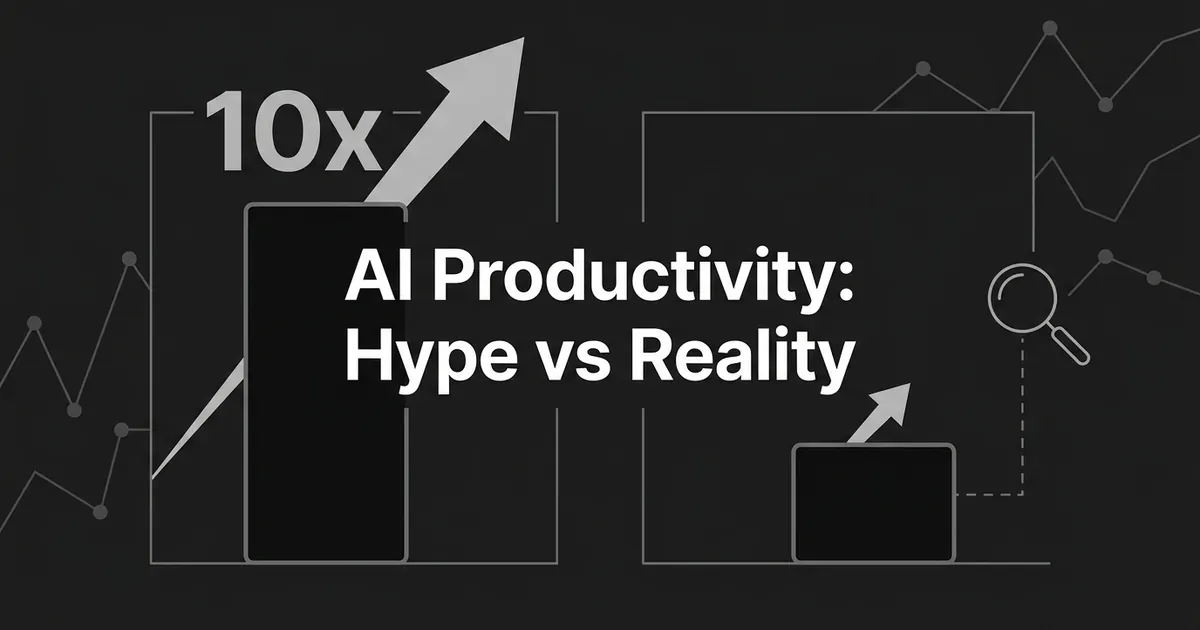
Does AI make marketers more productive? Yes, on some tasks, and the honest answer stops there. The evidence grade is mixed: task-level gains are well supported by controlled research, but the blanket claim that AI delivers 10x productivity across an entire marketing team is not. Studies show real, sometimes large improvements in speed and quality on bounded writing and knowledge work. None of them show that a whole marketing department produces ten times more accepted, on-brand, revenue-driving content once you turn on a tool. AI marketing productivity is real and it is also smaller, patchier, and harder to bank on than the pitch decks suggest.
This matters because "10x" has become the default unit marketing software uses to describe itself, and once a number like that is in your head it is hard to plan around anything smaller. If you are trying to figure out whether AI productivity gains marketing teams actually see will show up in your own numbers, you need to know what has been measured, what has only been reported, and where the two get confused.
What the 10x claim leaves out
A person can finish a draft faster without producing more work that gets accepted. A team can generate more drafts without publishing more useful content. A workflow can save time on writing and then spend it back on fact-checking, editing, or approvals nobody accounted for.
It helps to hold a few terms apart instead of letting them blur into one word, "productive."
Task speed is how long a defined task takes. Throughput is how many outputs actually get accepted in a given period, not how many get generated. Quality is a human or objective judgment of whether the work is correct, useful, original, and on brand. Quality-adjusted productivity combines the two: accepted output, at an agreed quality bar, per unit of time or cost. Capacity is time freed up, which is not automatically the same as more output, because freed time can go to strategy, meetings, or nothing at all. Business performance is what happens downstream: pipeline, conversions, search visibility, retention. Adoption is how much of the team's actual work runs through the tool, since a system can be excellent on paper and barely touched in practice.
A credible 10x claim has to say what the ten refers to. Ten times as many drafts is not the same claim as ten times faster completion, and neither is the same as ten times the accepted, published, on-brand output, and none of those is the same as ten times the business result. A real claim also has to say whether review, corrections, approvals, and publishing are included in the count, because those steps do not disappear when a draft gets faster.
The evidence for real gains
The strongest evidence that AI can help marketing-adjacent work comes from a controlled experiment published in Science in 2023 by Noy and Zhang. It is the closest major study to marketing work because the 453 participants included marketers, grant writers, consultants, and HR professionals doing real writing tasks: cover letters, restructuring emails, customer-targeting analysis plans, each designed to take 20 to 30 minutes. Half the group got access to ChatGPT-3.5 for their second assignment. The AI group finished about 40 percent faster on average and their work was rated 18 percent higher in quality, with the biggest gains going to the lower performers in the group, which narrowed the gap between them.
That is a real, task-level result, and it is worth being precise about what it does and does not show. The tasks were short and fully specified for anonymous participants who had no company, product, or customer context to get wrong. Real marketing work is rarely that self-contained: it comes with stakeholder alignment, legal review, fact-checking, and a publishing step none of this experiment had to account for. The researchers themselves noted that adding rigorous fact-checking could change the result, and the study used a 2023 model, not whatever your team runs today.
A related line of evidence, a 2023 Harvard Business School and Boston Consulting Group field study, tested AI assistance across 18 realistic business tasks for skilled knowledge workers. Inside the tasks AI was good at, speed rose more than 25 percent and human-rated quality rose more than 40 percent, with the largest gains again going to lower performers. But the same study found the opposite outside that zone: on a task explicitly outside the tool's reliable capability, a group working without AI scored roughly 85 percent correct while AI-assisted groups scored 60 to 70 percent, a meaningful drop. The researchers call this the jagged technological frontier: AI can be strong on one task and quietly worse on another that looks similarly hard, inside the same workflow. AI-assisted work in that study was also more similar across people, higher quality on average but less varied, which matters for a brand that competes on a distinct voice.
A third study, from the customer-support world, adds a real operational result rather than a lab one. Researchers examined about 3 million chats handled by more than 5,000 agents at a Fortune 500 software company after it rolled out an AI assistant that suggested responses and surfaced documentation. Productivity, measured as resolutions per hour, rose 14 percent on average, again concentrated among newer and less experienced agents, with little gain for the most experienced ones. This is a genuine, measured field effect, but it is a support-team result on a task with one clear unit of output (a resolved chat), not a marketing-team result on tasks with a much fuzzier definition of "done."
A 2025 OECD review pulling together experimental evidence across customer support, software development, and consulting reported average gains ranging from about 5 to more than 25 percent, and it is consistent on what drives the variation: how well the task fits the AI's actual capability, how skilled the user is, how well they can judge the output, and whether the tool augments a defined workflow or gets pushed past what it is reliable at.
A randomized study of software developers across Microsoft, Accenture, and an anonymous Fortune 100 company found a pooled 26 percent increase in completed tasks across nearly 5,000 developers, with larger gains again concentrated among less experienced participants. It is a different profession entirely, but the same pattern shows up: real gains, uneven across people, and not a substitute for measuring your own team.
Where the gains break down
Put those three results together and a pattern holds across all of them: gains concentrate inside a system's reliable capability, and they shrink or reverse outside it. That single idea, the jagged frontier, is the reason a marketing workflow can contain both a high-gain step and a quietly negative one, often in the same afternoon. Drafting a first pass, summarizing a report, or generating variations sits well inside most tools' capability. Judgment calls that depend on proprietary context, brand nuance, or catching a plausible-sounding but wrong claim sit outside it, and that is exactly where marketing work tends to live.
The homogenization finding is worth sitting with too. Better individual outputs that also look more like each other is a real trade-off for any brand trying to sound distinct rather than generic, and it does not show up in a productivity percentage at all.
None of the strongest independent studies measured an entire marketing department's monthly output, campaign pipeline, or revenue. They measured bounded tasks, real but narrow ones. Treating a 40 percent time reduction on a 20-minute writing task as proof of a 40 percent lift in a marketing team's total output, or treating a support-desk result as a marketing benchmark, is exactly the kind of leap the evidence does not support.
What marketing surveys actually show
Survey data tells a different, and in some ways more revealing, story than the controlled experiments, because it measures what marketers believe changed rather than a defined outcome under a defined comparison.
The Content Marketing Institute's most recent B2B survey, fielded through mid-2025 with more than a thousand marketers, found that 95 percent of organizations already use AI tools, and among marketers using AI for content creation, 87 percent said productivity had improved. That sounds decisive until you look at the next number in the same survey: only 39 percent said content performance had improved, and 22 percent were either unsure or said it was too soon to tell. Feeling faster and getting better market results are not the same finding, and this survey is the clearest evidence that a lot of teams currently have one without the other.
The prior year's CMI survey adds useful context on why that gap exists. Even with 81 percent of teams reportedly using generative AI, only 19 percent said it was integrated into daily workflows rather than used ad hoc, and only 17 percent rated the AI-generated output as excellent or very good. Widespread trial use, thin daily integration, and modest confidence in the output together explain how a tool can make a single task faster without moving a team's finished work very far.
Two more figures deserve caution rather than repetition. A 2025 St. Louis Fed analysis found workers reported saving about 5.4 percent of their weekly hours using generative AI, which the researchers translated into a modest 1.1 percent productivity estimate, a useful reminder that reported time saved and realized output are different things even in careful research. A separate vendor-published sales and marketing survey claimed a 47 percent productivity gain, but it does not disclose enough about its sample or methodology to treat as an independent benchmark, and claims like it are worth reading as self-reported marketing rather than evidence.
Why "10x" keeps showing up anyway
Vendor pages use 10x as a persuasive shorthand for possibility, not as a disclosed measurement. It becomes a real number only when someone defines the baseline period, the exact task, the unit of output, whether that output was accepted or merely generated, whether review and correction time were counted, and what business outcome, if any, moved as a result. Reviewing how the phrase actually gets used in marketing content, the pattern holds: framing and ambition dressed as a statistic, without a sample, a comparison group, or a disclosed method behind it.
A useful habit, whenever you see the phrase, is to ask what the ten is measuring, for whom, over what period, against what baseline, and whether the number includes the review and correction work that real output requires. When those answers are missing, the claim may still describe something worth trying, but it is not a measured productivity statistic and should not be treated as one.
What a marketing lead should actually expect and measure
The research supports a specific, more modest set of expectations. Expect meaningful gains on bounded, repetitive, well-structured tasks, and expect the size of the gain to depend heavily on fit between the task and the tool. Expect newer or less experienced team members to often see the largest relative improvement, while experienced people gain when the tool complements judgment they already have rather than replaces it. Expect results to vary within a single workflow rather than applying evenly across it, and expect human review to keep mattering wherever correctness, brand voice, or proprietary context is on the line. Expect perceived speed to show up well before any downstream business result does, if one shows up at all.
The more useful posture is to separate what you are actually measuring. Track full workflow time, not just time to a first draft, since review and approval time can absorb everything a draft saved. Track how many outputs get accepted and published, not how many get generated. Track revision cycles, factual and brand-accuracy error rates, and quality ratings using the same rubric before and after adoption, so the comparison is real. Track what share of eligible work is actually running through the tool, since a system barely used cannot move a team-level number no matter how good it is on paper. And track whether saved time turns into more accepted output, better quality, freed-up strategic work, or simply goes unused, because those are four different outcomes that "productivity" quietly lumps together.
Where a production platform earns its place in this picture is in making the full workflow visible rather than just the drafting step. A platform that carries research, brand context, generation, linking, and publishing in one system lets a team see accepted output and quality across the whole chain, not just how fast the first draft appeared, which is closer to what the evidence says actually matters. That is a workflow observation, not a productivity claim: no independent study reviewed here measured a specific platform's effect on a marketing team's output, and none should be read to.
What would change this verdict
The claims to be skeptical of are specific: that AI marketing productivity means a team is automatically 10x more productive, that an 87 percent self-reported productivity improvement means 87 percent more content, that a 40 percent writing-task time reduction scales into a 40 percent output increase for a whole team, or that saved time automatically becomes revenue. None of those follow from the evidence reviewed here.
What would actually change the verdict is more team-level evidence: a replicated experiment measuring a real marketing team's full workflow, a transparent baseline and comparison group, a quality-adjusted throughput number rather than a speed number, adoption sustained over months rather than a pilot week, and a downstream business result tied to it. Until that evidence exists, the safer language for your own team is "AI released some capacity" rather than "AI multiplied our output," because the first claim is one you can actually check.
If you want to try the trial before you plan next quarter's headcount around it, start a free trial.