A content inventory tells you what exists. A content audit tells you how well it works and what should happen next. That's the whole distinction, and it matters more than it sounds like it should, because a lot of teams do the first one, call it the second one, and stop there.
If you've ever pulled together a spreadsheet of every page on your site (URL, title, owner, last updated) and felt like you'd just finished a content audit, you probably hadn't. You'd finished a content inventory. What is a content audit, then, if it's not that list? It's the step after the list, the one where someone looks at each row and decides what it means.
What is a content inventory?
A content inventory is a catalog of the content your organization has. It can cover webpages, PDFs, videos, images, spreadsheets, whatever counts as a content asset for your team. The point of an inventory is to answer questions like these: what do we have, where does it live, what format is it, who owns it, when was it published or last touched, and what is it about.
Typical fields in an inventory look like this:
- Title or name
- URL or storage location
- File type or page type
- Topic or theme
- Owner, author, or publisher
- Primary audience
- Publication date and last-updated date
- Status (published, unpublished, archived)
- Relationships to other pages, like parent and child pages or linked campaigns
An inventory is usually built as a table, one row per page or asset. It's a living record, not a document you finish once. Content gets created, edited, and retired, so the inventory needs upkeep to stay accurate.
What an inventory is good at is showing you scope and structure. It can surface that you have three pages about the same topic, or that nobody owns a page that's been live for four years, or that a whole section of the site is thin. Those are useful things to notice. But noticing them isn't the same as deciding what to do about them, and the inventory itself doesn't make that call. It records that the pages exist. It doesn't judge whether any of them are any good.
What is a content audit?
A content audit is the evaluation that comes after the catalog. It takes the rows in the inventory and asks a harder set of questions: is this accurate, is it still relevant to the audience it was written for, does it duplicate or contradict something else on the site, does it meet the standards your team holds content to, is it actually performing, and does it need to be revised, merged, replaced, archived, or removed.
Where an inventory describes, an audit judges. The criteria aren't fixed. Depending on why you're running the audit, you might weigh user needs and business goals, editorial standards, accuracy, duplication, accessibility, search or AI visibility performance, or brand fit. A migration audit leans on different criteria than a governance audit, and both look different from an audit built to find pages worth refreshing. Which lens you use decides what counts as a finding.
The output of an audit is a decision or a recommendation attached to each piece of content, not just a description of it. Common outcomes include:
- Keep it as is
- Update or revise it
- Fix an accessibility or quality problem
- Merge it with another page
- Replace it
- Archive it
- Remove it
- Redirect the URL as part of a broader decision
- Create something new to fill a gap the audit uncovered
- Prioritize the work, since not everything gets fixed at once
That last point matters. An audit that stops at "this page has problems" without saying what to do or who owns the fix hasn't really finished the job. The judgment has to land somewhere.
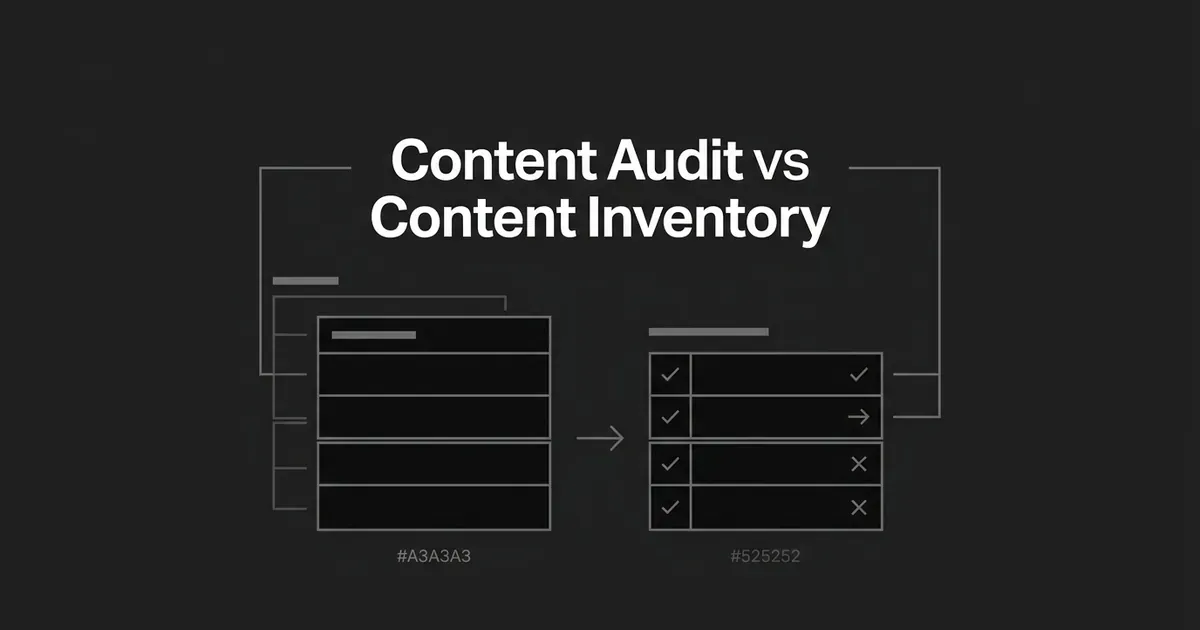
Content audit vs content inventory
The difference isn't that an audit is a bigger, more detailed inventory. Plenty of teams publish inventory templates as if the template alone were the finish line. It's that the two activities do different work.
| Content inventory | Content audit | |
|---|---|---|
| Core question | What do we have? | How good is it, and what should happen next? |
| Nature of the work | Descriptive, cataloging | Evaluative, judgment-based |
| What it produces | A record of pages and assets | Findings, priorities, recommended actions |
| Relationship | Supplies the dataset | Uses the dataset to decide |
| Requires judgment? | Not necessarily | Yes |
An inventory maps the collection. An audit assesses the collection and decides what to do about it. Some teams build the inventory first and audit afterward. Others design the two together from the start. Either order works, but the evaluative step is a distinct piece of work, not a formality you tack onto the end of the spreadsheet.
There's a real wrinkle in the language here too. Some guidance uses "content audit" loosely enough to include the cataloging step inside it, as if the audit is one activity that starts with listing and ends with judging. That's a fair way to describe how the work actually gets done in practice. But even that broader use of the term still separates the listing from the deciding once you look closely, because the decisions are the part that makes the work valuable. Use whichever label your team prefers, just make sure someone is doing the evaluation and not stopping at the list.
Why the distinction matters
Calling a catalog an audit creates a false sense of being done. You've got titles, owners, dates, URLs, all present and accounted for. It looks thorough. But none of it answers the questions that actually matter: which pages can you trust, which ones contradict each other, which ones are failing the people who land on them, which ones deserve more investment, and which gaps are real versus just theoretical.
The risk is that a team stops at the easier, more mechanical stage. Building the record takes real effort, so it feels like progress, and it is progress, just not the kind that changes anything on its own. The record doesn't produce a decision. A person still has to look at the row and say "this one needs to go" or "this one is fine."
This confusion shows up in a few predictable ways. A team treats a long list of content as proof the content is good, when length says nothing about quality. Or they assume a page updated last month must be accurate, when a timestamp only tells you when someone touched it, not whether they fixed anything real. Or two pages on the same topic sit in the inventory unresolved because nobody assigned the decision of which one should win. Each of these is a case where the descriptive step got treated as if it were the evaluative one.
Why is a content audit useful?
The audit is where the descriptive record turns into something you can act on.
It protects accuracy. Reviewing content for outdated claims and duplication catches most of the version conflicts before a reader hits them. It also matters for the AI systems that summarize your pages, since they don't know which version you consider current. That's one more reason stale content doesn't just sit there quietly.
It tells you what needs action, specifically. An audit sorts content into what can stay as is and what needs revision, consolidation, replacement, archiving, or removal, rather than leaving everything in an undifferentiated pile marked "exists."
It finds gaps that actually matter. An inventory can show a topic isn't covered. The audit is what decides whether that absence is worth fixing, because not every gap is worth the effort to fill.
It helps you prioritize with a limited team. Nobody has the capacity to fix every page at once. Audit findings rank content by how bad the problem is, how much it matters to users or the business, and how urgent the fix is, so the next piece of work is obvious instead of a guess.
It surfaces misalignment. A page can be well written and still be the wrong page: wrong audience, overlapping with something else you've already published, or no longer serving the purpose it was built for. An audit is what catches that, because an inventory has no mechanism to flag it.
It supports a redesign or migration. The inventory tells the team what exists before a rebuild, which is where planning usually starts. Deciding which pages get published first or reworked first is the same judgment call whether you're fixing an old site or building a new cluster. The audit is what tells the team what should move, change, merge, or get left behind, the harder and more consequential part of planning a migration.
It reduces the risk of an outdated page being treated as current, which matters for a reader who lands on the wrong version and for any system, search or AI, that might surface it without knowing better.
A quick example
Say you have a page called "How to Choose a Marketing Platform." An inventory entry for it would record its title, URL, owner, format, topic, audience, and the dates it was published and last updated.
An audit judgment on the same page might conclude something different: the page is still relevant, but a few of its claims are out of date, it overlaps heavily with another buying guide you've published since, and it never really settled on one intended audience. The recommended action might be to revise it and merge it with the overlapping guide. A different page in the same batch might come back "keep as is." A missing topic the audit turns up along the way might get logged as a new content opportunity instead.
The inventory entry tells you what the page is. The audit tells you what to do about it. That's the whole gap between the two, in one example.
Common misunderstandings
A few claims about audits are worth naming so you don't carry them into your own process.
An audit is not just a spreadsheet with more columns. The spreadsheet, if you use one, holds the records. The audit is the evaluation applied to them, and you can run that evaluation with sticky notes if you want, the tool isn't the point.
Traffic numbers alone don't decide a page's fate. Low traffic can be completely appropriate for a specialized page written for a narrow audience. High traffic doesn't prove a page is accurate or well built either. Analytics are one input among several, not the whole judgment.
An audit isn't only an SEO exercise. Search performance can be one of the things you check, but a real audit also looks at accuracy, accessibility, duplication, whether the content matches user needs, and whether it fits your brand. Narrowing the whole idea down to rankings misses most of what makes the audit worth running, and it's part of why an internal link audit or a governance-driven audit can turn up problems a pure SEO lens would miss entirely. That's worth checking alongside the content criteria, not instead of them.
And an audit is never finished for good. High-impact pages generally need a shorter review cycle than low-impact ones. Content changes, gets added, gets retired between cycles. The criteria you used last year might not be the right ones this year either.
A catalog is the starting point, not the judgment
An inventory is an account of what exists. An audit is a reasoned judgment about what that content is worth and what should happen to it next. The inventory is genuinely valuable on its own: it gives a team visibility they didn't have before, and that visibility is worth having even if nothing else happens. But the audit is the stage that turns a list into decisions, and it's usually the more valuable half of the work precisely because it's the harder half.
If you're about to run one, the practical version to remember is this: finishing the catalog is not finishing the evaluation. If your team has already built out a content inventory before planning a cluster, the audit is the next layer on top of it, not a rename of the same work. Either way, the harder step starts once the list is closed.