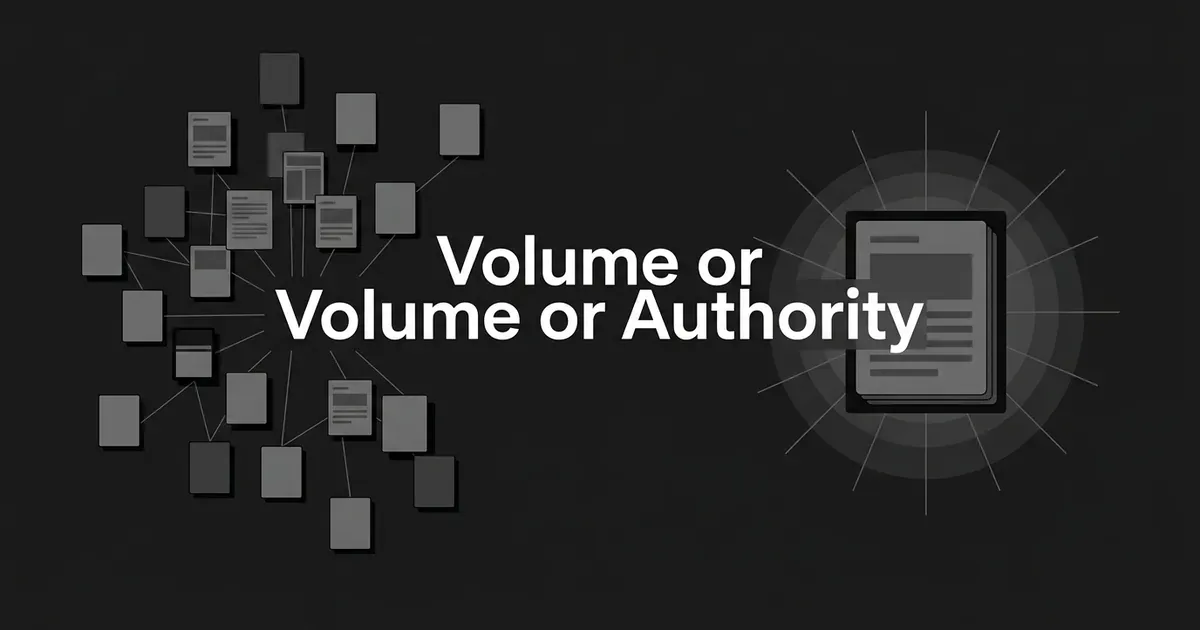
If you are weighing content volume vs quality right now, you are probably staring at two plans that both sound reasonable. One says publish a lot, cover every angle, and let the pages compound. The other says slow down, go deep on fewer topics, and build a handful of pages nothing else can match. Both plans have real evidence behind them, and neither one wins on its own. The honest answer is that the right philosophy depends on your site's age, your team's capacity, how crowded your topic is, and how AI search actually retrieves pages, not on a rule that works for every content program.
Here is the short version, then the rest of this piece walks through why. Publish more when the next page adds real, distinct coverage and you can do that without lowering your quality floor. Invest in fewer, deeper pages when the topic is competitive, the reader needs to trust you before they act, or your team's limiting factor is expertise rather than ideas.
What high volume and high authority actually mean
Before you can pick one, it helps to be precise about what each philosophy is actually claiming, because both get misdescribed a lot. Framed as content authority vs volume, the choice sounds like a values question. In practice it's a resourcing question: which bet does your team's next hour of work actually support.
A high-volume strategy puts weight on the number of useful pages you ship. Done well, it covers a wide set of related questions, captures long-tail demand your competitors haven't bothered with, tests formats and angles quickly, and keeps your site current in areas where things change often. It is not the same as publishing indiscriminately or accepting weak work because the calendar says a post is due. High volume only works if every page clears a real floor: accurate, useful, matched to what the reader actually searched for. When that floor slips, you get the failure mode people are usually worried about, a site full of thin, repetitive pages competing with each other instead of covering anything new.
A high-authority strategy puts weight on the depth, originality, and trustworthiness of a smaller number of pages. It aims to answer a substantial question in one place, bring firsthand expertise or original thinking rather than summarizing what everyone else already wrote, and become the page people reference when the topic comes up. "Authority" here is not a single score you can chase. It is topical relevance, demonstrated expertise, original value, and a genuinely satisfying experience for the reader, combined. The failure mode on this side is over-concentration: spending so long polishing a handful of pages that you miss adjacent questions your audience is asking, or your flagship pages go stale while you're busy defending them.
Neither one is a shortcut. A high-volume program still needs a real editorial process behind it, and a high-authority program still needs someone with the expertise to make the depth genuine rather than just long.
The real difference is breadth against marginal depth
Once you strip away the framing, publishing frequency strategy debates usually collapse into one question: where does the next hour of work produce more durable value, another page that expands your coverage, or a deeper pass on a page that earns trust, links, and repeat use over time?
Moz ran a publishing-volume experiment on its own blog that is worth knowing because it is one of the few direct tests of cadence rather than a theory about it. They compared a normal period against two weeks at half their usual cadence and two weeks at double cadence. Cutting volume in half for two weeks reduced blog-included sessions by 2.9%, a drop Moz itself called close enough to negligible. Doubling volume had no average effect on unique pageviews. Interestingly, the posts published during the half-cadence period scored noticeably higher on Moz's own internal quality metric than the ones published during the double-cadence period, and the author was careful to note that the specific articles published could explain that gap as easily as the schedule could.
Treat that experiment for what it is: a short, single-site, non-scientific test where the pieces published were different in each period, not a clean answer about frequency. What it does support is a narrower and more useful conclusion. Doubling your output does not automatically double your results, and performance tracks the quality bar you hold more than the number of posts on the calendar. That is a very different claim from "publish less," and it is worth keeping the two apart.
The correct comparison, then, is not content volume vs quality as opposites. It is what the next unit of work actually produces. A new page that answers a question nobody on your site has answered yet is adding coverage. A new page that restates something your best existing page already covers is adding weight without adding value, and that's true whether you publish one page a month or twenty.
How site age, team size, and competition change the answer
The same philosophy can be the right call for one team and the wrong call for another, because three conditions change the economics underneath it.
Site age matters less than what a site has accumulated. Google representatives have said directly that domain age is not itself a ranking factor, so the common shortcut, "older sites can publish less and still win," does not hold up as stated. What actually changes with time is accumulated context: internal links that make sense, external references, a clearer topical footprint, and editorial knowledge about what your specific audience responds to. A new or lightly established site usually does better starting with a focused authority play, because it gives the site a coherent subject area before it has earned the right to sprawl. A site that already owns a topic but has let its best pages go incomplete or stale often gets more value from an authority-style refresh of those pages than from adding new ones next to them.
Team size is a weaker predictor than people assume. A peer-reviewed study of content marketing effectiveness, drawing on senior marketers across 263 organizations, found that organizational context explained a meaningful share of the variance in effectiveness, while the reported employee-size categories were not statistically significant predictors on their own. In plain terms, headcount is not a reliable shortcut for strategy. What actually matters is more specific: whether you have access to real subject-matter expertise, enough review capacity to catch mistakes, and the ability to update existing pages instead of only publishing new ones. A small team should lean toward authority when a topic needs specialist review it can't repeat often, and toward volume when the questions are narrow, repeatable, and answerable without a research project each time. A larger team should resist defaulting to volume just because it has more writers; more people create more capacity, not automatically more insight.
Competitive density is about the strength of what's already ranking, not just the count of pages. Volume tends to outperform where demand is spread across many related questions and the existing results are incomplete or poorly organized, because your team can create genuinely useful pages faster than competitors close the gaps. Authority tends to outperform where a query is already dominated by established, trusted sources and a shallow page would be interchangeable with a dozen others. A useful gut check: ask whether your next page would create a new, useful answer, or just another version of an answer that already exists somewhere credible. If it's new, volume is probably the right call there. If it repeats what a stronger page already says, that hour is better spent making the stronger page more useful.
What AI retrieval changes about the calculation
Search doesn't work the same way it did even a couple of years ago, and that shifts this decision without flipping it entirely.
Google's own documentation describes AI Overviews and AI Mode using a technique it calls query fan-out, issuing multiple related searches across subtopics as it builds a response, and it says AI Mode in particular is useful for complex comparisons that pull from a wider set of supporting links. That has two implications worth separating. Breadth can matter at the retrieval layer, because a site with several clearly differentiated pages gives an AI system more chances to match the individual subquestions inside a complex request. Depth can matter at the answer layer, because a page with clear definitions, real evidence, and directly usable passages is easier for a system to select and quote from when it composes a response.
Neither of those is a reason to believe an AI engine simply rewards the site with the most pages, or the single longest page. Retrieval and citation behavior is genuinely platform-specific. A 2026 study comparing five search systems across 11,000 real queries found meaningfully different citation rates and source patterns between them. Google itself is clear that there are no special schema requirements or AI-specific markup needed to appear in AI Overviews, only that a page be indexed and eligible to appear in ordinary Google Search in the first place. The safest reading of all this evidence is that AI search creates a case for both breadth and authority, through different mechanisms, and that neither page count nor word count is a substitute for actually being useful.
When each philosophy wins
Bringing the conditions together, here is where each bet tends to pay off.
High volume is the stronger dominant strategy when most of these are true: the audience is asking many adjacent questions rather than circling one central question, each page can answer a defined need without a research project behind it, competition on those questions is fragmented rather than dominated by a few strong incumbents, the topic changes often enough that fresh coverage has real value, and your team has the production and review capacity to keep the quality floor in place as output grows. The volume argument is strongest when "more" means more genuine coverage, and weakest when "more" quietly becomes more variations on the same answer.
High authority is the stronger dominant strategy when most of these are true: the topic is already well covered by strong publishers, the reader is making a decision where being wrong is costly, your team has scarce specialist expertise that a small number of people must personally review, you have something genuinely distinctive to add such as original data or firsthand experience, and the question is complex enough that a shallow page would leave the reader needing to search again. The authority argument is strongest when a page can become something people actually reference, and weakest when "authority" becomes an excuse to delay publishing or to write long instead of writing well.
Most real content programs end up somewhere in between, and that's a legitimate answer rather than a way of avoiding the decision. A deliberate hybrid works when a few flagship pages genuinely need authority-level investment while the surrounding topic also contains many supporting questions your site can answer well at a lighter weight. The discipline that makes a hybrid actually work is keeping those two standards separate on purpose, rather than letting every page drift toward "good enough" because nobody decided which job it was supposed to do.
The decision rule
A publishing frequency strategy only works if it's tied to conditions like these rather than a fixed number on a calendar. Use this as a working diagnostic rather than a formula. Lean toward high volume when there are many distinct, commercially relevant questions your site hasn't answered yet, when the next page would add coverage rather than duplicate something you already have, when the competition on those questions has obvious gaps, and when your team can sustain the pace without the quality floor slipping. Lean toward high authority when a small set of difficult queries controls a large share of your opportunity, when the existing competition is already credible and well established, when your limiting factor is expertise or review time rather than ideas, and when you have proprietary evidence or experience that could make one resource meaningfully better than anything else available on that question.

Once you've made the bet, watch for the signals that tell you whether it's working. On the volume side, that's new pages attracting qualified traffic without cannibalizing your existing ones, and your team learning which topics and formats deserve more investment. On the authority side, that's flagship pages earning references and repeat use, and readers finishing the page without immediately needing to search again for a better explanation. If neither is happening, that's the signal to reconsider the bet itself rather than just publishing more of the same thing faster.
Knowing which philosophy fits your situation is only half the work. The other half is having a clear read on where your brand is already showing up, in regular search and in AI answers, so the bet you make is grounded in your actual gaps rather than a guess. DeepSmith's AI Visibility tracking shows which of your pages AI engines are already citing and where competitors are winning instead, which is the kind of evidence that makes a volume-or-authority decision a lot less theoretical.