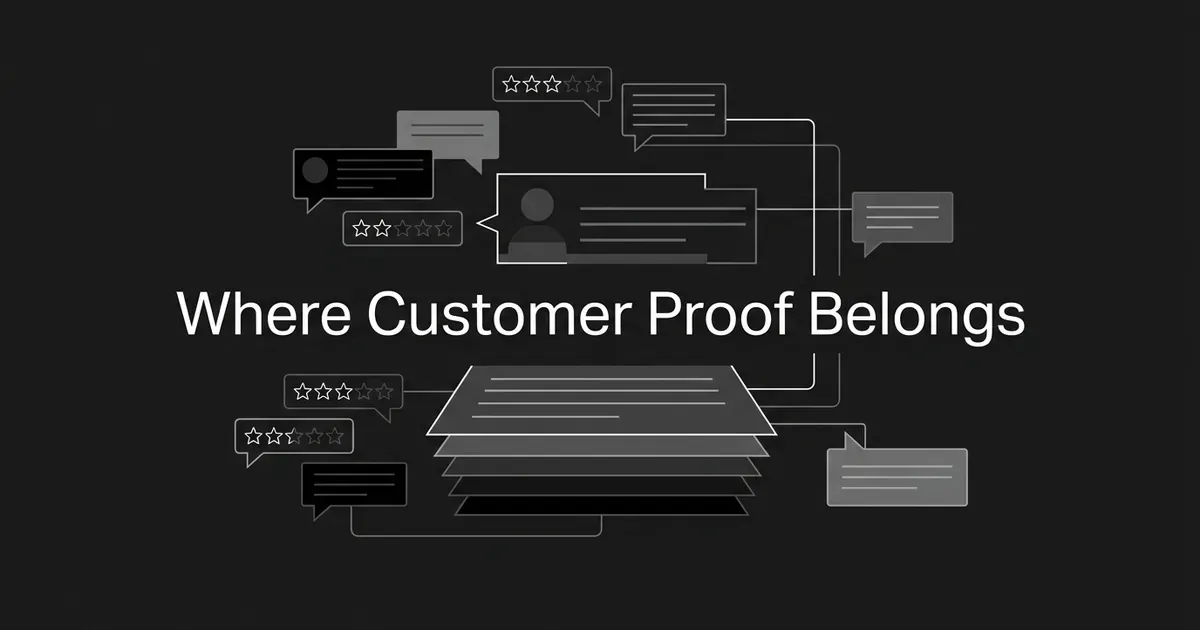
User generated content b2b has a real place, but it is a narrower and different place than the one it holds in consumer marketing. It works best as peer evidence: reviews, community answers, and customer examples that help a buying group judge fit, risk, and likely outcome, sitting alongside your expert and product content rather than replacing it. If you have been wondering whether UGC belongs in your plan at all, the short answer is yes, and the rest of this piece walks through where a user generated content strategy actually earns its place and where it does not.
What counts as UGC in B2B
User-generated content is anything customer-related that the customer actually created, not something your team wrote and the customer approved. That distinction matters more for user generated content b2b than most people assume, because a lot of what gets labeled UGC here is really brand-produced content that leans on a customer.
A review a buyer writes on an independent site is UGC. A forum answer from someone who has used the product is UGC. A workflow a customer posts describing how they set something up is UGC. A quote your team drafted and sent to a customer for a thumbs up is not UGC, even if the customer's name is on it. A case study your writers built from an interview is customer marketing content, useful in its own right, but it is brand-produced, not user-generated.
The forms that matter most in B2B tend to be less visual and less campaign-shaped than what you see from consumer brands:
| Format | What it gives the reader | Buyer question it answers |
|---|---|---|
| Independent reviews and ratings | External validation, strengths and weaknesses | Can I trust this vendor? |
| Customer-submitted use cases | Applications you may not have anticipated | How would this work in my environment? |
| Community questions and answers | Practical knowledge from actual use | What happens in real use, including edge cases? |
| Support-forum discussions | Troubleshooting detail and limitations | What will adoption actually be like? |
| Public practitioner comments | Buyer language, objections, comparisons | How are people like me framing this problem? |
| Customer-submitted templates and workflows | A demonstration of good usage | What can I actually do with this? |
None of this has to live on your own site to be useful. It can sit on a review platform, a professional network, a support forum, or a public thread. The strategic question is not "can we publish this," it is what buyer uncertainty this particular piece of customer voice reduces, and where in the journey that uncertainty shows up.
A quick note on a few things that get confused with UGC. A customer testimonial can be UGC if the customer wrote it themselves. If your team wrote it and the customer approved it, call it what it is: a brand-produced testimonial. A case study can carry real customer evidence without being UGC at all, because a heavily edited, brand-written narrative is customer marketing, not user creation. And employee content, even employees using your own product, is a separate category from customer UGC. Keep these lines clear, because the credibility UGC borrows comes partly from the reader believing it is genuinely independent of you.
Why B2B UGC does a different job than B2C UGC
Consumer UGC usually earns its place through scale, a good visual, and social participation. Enough photos of people using a product start to feel like proof on their own. That mechanism barely applies in B2B.
B2B purchases involve multiple stakeholders, real financial and operational consequences, longer evaluation windows, and integration questions that a photo can't answer. So the useful question about a piece of UGC stops being "is this popular" and becomes something closer to: has a comparable organization used this, what problem did it solve, what did they have to change or learn to adopt it, and what tradeoffs showed up once it was actually running.
That reframes what makes B2B UGC valuable. It is specificity and credibility, not reach. A single comment that explains an integration constraint clearly can do more work than a polished customer video. A detailed community answer can be more useful to someone evaluating a purchase than a generic product page, because it comes from someone with no reason to flatter you. A review that names a real limitation often builds more trust than one that praises everything, because it makes the positive parts read as earned rather than selected.
UGC also carries language you would not naturally produce yourself. Reviews, forum threads, and public comments show you how practitioners actually describe their problem, which alternatives they weigh against you, and which objections keep coming up. That vocabulary is worth feeding back into how you plan and write your own content strategy, even when you never quote the source directly.
Where UGC earns a place across the buying journey
UGC does not sit in one spot in your content mix. It shows up differently depending on where the reader is.
Early on, when someone is still working out what kind of solution they need, independent reviews and public practitioner discussions do the job of showing that the category is real and worth attention. They surface the language and questions buyers use before they ever talk to a salesperson. Your own educational content still has to do the heavy lifting here: clear explanations, original point of view, category framing. UGC's job at this stage is to keep that content from reading like it was written entirely from your own point of view.
In the middle, once someone is trying to map a solution onto their own situation, customer-submitted examples and community answers carry more weight than broad awareness content. A vague comment like "this saved us time" does very little. A concrete account of what work actually changed, which team used it, and what constraint shaped the rollout gives a reader something they can compare against their own situation.
Near the decision, UGC is doing something brand content is structurally bad at: validating a choice in a way that survives internal scrutiny. Reviews, customer evidence, and peer conversations answer questions your own site can't credibly answer, because you obviously have a stake in the outcome. The strongest evidence at this stage names the customer's role and context, the reason they picked the solution, what adoption actually looked like, and any tradeoffs, not just the win. One good review is not proof of a universal result. It is evidence of one experience, and it should read that way.
After the purchase, community answers and support discussions keep creating value. They become a living knowledge layer that sits around your formal documentation, covering the workarounds, edge cases, and real workflows that documentation never quite gets to. This is a different job from promotional proof: it is product content that happens to be written by customers.
Over time, satisfied customers become an ongoing evidence layer rather than a one-off quote. That layer can range from a short line on a product page to a full customer story to a peer reference for someone deep in evaluation. Treat customer advocacy as a relationship you maintain, not a campaign you run once.
What reviews, communities, and examples each do that brand content can't
A few things are worth separating out, because they are often lumped together as "customer content" when they earn their place for different reasons.
An independent review gives a buyer a perspective with no obvious reason to flatter you. That is its whole value. The moment you script it, edit it heavily, or pay for it without disclosure, you lose the thing that made it worth having.
A community answer or forum thread gives a buyer lived experience your product pages can't fake: the setup step nobody documents, the integration quirk, the workaround someone found after running into a wall. Support forums can sometimes help a reader more than an FAQ, precisely because the person answering has actually hit the problem.
A customer-submitted example or workflow shows what your product looks like in someone else's hands, in a context you may not have designed for. That is a different kind of proof than a feature list, because it demonstrates fit rather than describing capability.
None of these three replace a brand-written case study or product page. They fill a gap those formats structurally can't fill: an outside point of view, real operating context, and honest tradeoffs, including the negative ones. A content library that hides every limitation reads as less credible over time, not more.
Where UGC breaks down
UGC is not a shortcut, and treating it as one causes most of the problems people run into.
The most common mistake is proof inflation: treating one good review as evidence of a universal result. A review documents one organization's experience. It is not a performance guarantee, and writing about it that way undercuts trust the moment a reader checks it against their own situation. The same goes for review volume. A high review count on a platform shows activity, not representativeness or quality.
The second problem is authenticity and disclosure. UGC borrows credibility from the perception that it comes from an independent user rather than the vendor. When a customer received payment, a discount, free access, or another material benefit for creating content, that needs to be disclosed, and it should not be presented as spontaneous independent opinion. The FTC's endorsement guidance is explicit that an endorsement has to reflect the honest opinion of the person giving it, and that any material connection between the endorser and the company needs to be clear to the audience. Editing a customer's words until the meaning shifts, or quietly dropping the limitations they mentioned, erodes the same trust you were trying to borrow.
The third problem is the SEO and AI-search overclaim. UGC can genuinely help discoverability, because reviews and community discussions often use the exact language buyers search for. But it does not come with a guaranteed ranking or citation benefit, and open, unmoderated UGC channels can create real risk instead. Google's guidance on preventing user-generated spam is direct about this. Open comment sections and other user-content inputs get abused by spammers, which is exactly why Google's spam policies define a category specifically for spammy content injected through channels meant for user contributions. If your UGC channel includes outbound links from users, Google's guidance on qualifying outbound links recommends marking them appropriately rather than letting them pass unchecked authority. None of that means avoid UGC. It means don't build a community page purely to generate indexed text, and don't promise a stakeholder that publishing more reviews will move mention rate or citation rate without evidence that it actually will.
The fourth problem is scope creep: letting community answers stand in for documentation. Community knowledge is genuinely useful, but it is not authoritative the way official product, security, or contractual information needs to be. Keep those separated clearly enough that a reader always knows which one they are looking at.
How to decide UGC's place in your own strategy
Building a user generated content strategy for B2B is less about picking a format and more about matching the evidence to the uncertainty. A simple test helps more than a rule of thumb. Lean toward including UGC when most of these are true: the reader's uncertainty is about fit, implementation, or risk rather than a basic definition, your customers have experience you genuinely can't simulate from the inside, the topic involves real edge cases or recurring questions, and the content will still be useful once the current buying cycle ends.
Lean toward brand-authored content instead when the topic touches legal, security, or contractual claims, when the reader needs a definitive technical answer, or when the only reason on the table for an ugc content strategy is an assumed SEO or AI-search benefit with nothing behind it. If the available customer submissions are thin, repetitive, or purely promotional, that is also a sign to lean on your own writing instead of forcing a customer quote to carry weight it can't hold.
Getting this right at scale usually starts with knowing which questions your buyers are actually asking and where your current content leaves a gap, which is exactly the kind of thing a tool like DeepSmith's Content Map and Opportunity Agents are built to surface, so the decision about where UGC belongs is based on an actual gap rather than a guess.
Treat UGC as one evidence layer in a content mix that still needs your educational content, your product pages, your original analysis, and your documentation doing the jobs only brand content can do. A working ugc content strategy earns its place by supplying something those formats structurally can't: an outside perspective, real operating context, and honest tradeoffs. It is not a replacement for the rest of your content strategy. It is the layer that makes the rest of it more believable.