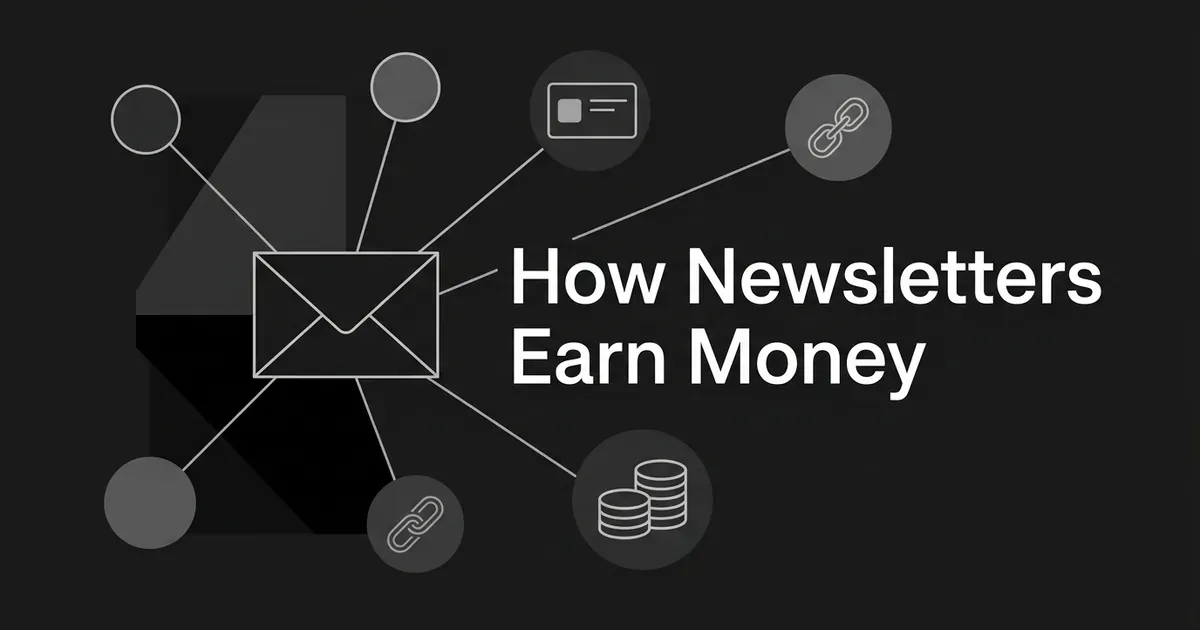
Newsletters make money by selling access to their readers' attention through sponsorships, charging readers for paid access, earning commissions on recommendations that can be tracked, or selling a related product or service. How much of that money you keep depends on how engaged your readers are, how many of them act, and what fees and work sit between the payment and your bank account. If you run a newsletter for your SaaS company, you're probably wondering whether it should earn anything directly, or whether it's already doing its job by helping you sell software. This piece walks through how newsletters make money so you can judge that for your own list.
It helps to remember that a newsletter is an owned audience, which means you can choose how, and whether, to earn from it. A newsletter can use more than one model at once, and revenue is not the same thing as profit.
What newsletter monetization actually means
Newsletter monetization is any way a newsletter turns its readership into money, and the useful question to ask about each model is who pays. That single question sorts the whole topic, because the payer changes the business you're running.
With a sponsorship, an advertiser pays you. With a paid subscription, your reader pays you. With an affiliate link, a company that sells something pays you when a reader buys through your link. With your own products, the reader pays you for something separate from the newsletter, and the newsletter is the way they found it. These are four different businesses, not four names for the same ad slot.
Your newsletter business model can also be a mix of these. A free newsletter can carry ads or affiliate links. A paid newsletter can still carry a sponsor if your readers are fine with that and it's clearly labeled.
If you sell software, there's one more thing to keep straight. A newsletter that leads to software sales can be very valuable without collecting any newsletter-specific revenue. You shouldn't count your whole software revenue as newsletter revenue, and you don't have to earn money from the newsletter itself for it to be worth sending.
Newsletter sponsorships: advertisers pay for the placement
Newsletter sponsorships are the most common starting point. A sponsor pays to put a labeled promotional message in an issue. The brand pays, not the reader, so your readers keep getting the newsletter for free. Some sponsors deal with you directly, and an ad network can also match your newsletter with advertisers and handle the offers.
There are a few ways a sponsor can pay, and it's worth knowing the words because the deal depends on which one you agree to.
- Flat fee. An agreed amount for a particular placement or issue, no matter how many clicks it gets, unless your contract says otherwise. Four placements at $250 each would be $1,000 before costs. That's an example to show the math, not a typical result.
- CPM. The price per thousand units. The important part is what the "unit" is, and it has to be written into the deal. One publisher's pricing example counts subscribers, so 10,000 subscribers at $25 per thousand gives a $250 placement. Beehiiv's ad network, by comparison, pays its publishers on unique opens, so at $5 per thousand unique opens, 2,000 qualifying opens would earn $10. A CPM that counts subscribers and a CPM that counts opens can't be compared directly.
- CPC. Payment for each qualifying click. In beehiiv's example, $2 per verified unique click times 100 clicks is $200. Sending an issue to 100 readers doesn't create 100 payable clicks, and neither do 100 unverified events.
- CPA. Payment only after an agreed outcome, like a qualifying purchase or a sign-up. You'd want the deal to say what counts, how long the attribution window lasts, and what happens with refunds. This one puts more of the risk on you than a flat fee does.
Sponsorship inventory is limited. There are only so many placements in an issue, and you have to be able to show the sponsor that the placement ran and what it did. Beehiiv says its ad-network reports show opens, clicks and earnings about 96 hours after a send, which gives you an idea of how long results can take to come in on that platform. That's one network's setup and not a rule for every direct sponsorship.
On rates, be careful with what you read. Beehiiv's published pricing guide gives an indicative range of $10 to $75 CPM, and estimated placement prices of $50 to $250 for lists under 5,000 and $500 to $3,000 for lists between 5,000 and 50,000. That's guidance from a vendor, not a sampled market average, and it doesn't promise that a list of your size can sell at those prices. There isn't one universal sponsorship rate, and any number you hear should come with what it's pricing: sends, subscribers, opens, or something else.
Opens deserve a warning too. An open isn't always a person reading your issue. Apple Mail Privacy Protection can preload the tracking pixel without the reader opening the email, and Mailchimp says this inflates open-based numbers and makes them unreliable for the people it affects, which is why Apple Mail Privacy Protection is worth understanding before you sell on open rate. Clicks and tracked purchases tend to say more, although a platform may still filter or verify them.
For a founder, the real question is whether the work is worth it. Someone has to find advertisers, sell the spots, and deliver the results. A small list of the right business readers can interest an advertiser, but being relevant doesn't guarantee a deal. Some audience research on who is actually on your list will tell you what to tell a sponsor. And you'll want to weigh the income against any loss of trust or attention to your own offer.
Paid subscriptions: readers pay for access
With a paid subscription, some or all of your newsletter sits behind a monthly or yearly price. Many publishers keep a free edition alongside a paid tier. Gross revenue is roughly the number of active paying subscribers times the price, over the same billing period. Monthly and annual prices need to be converted to the same period before you add them up.
What you actually receive is lower than that. Renewals, cancellations, discounts, refunds, taxes and fees all take a piece. Fees are a good place to see how platforms differ, and this is only to show how the math changes, not to tell you what to buy. Substack says publishing for free is free, and that it takes 10% of each paid-subscription transaction. Its support pages also list Stripe card processing of 2.9% plus $0.30 per transaction and a 0.7% recurring billing fee, and say the payment fees depend on your country and payment method. Ghost shows a different structure, a flat platform plan that starts at $9 a month in its pricing explainer, with a 0% platform transaction fee and payment processing fees still applying. One takes a percentage and the other charges a fixed amount. Check current terms before you work out what you'd take home.
The number that keeps people honest is conversion. In its June 22, 2026 analysis of thousands of paid publications on its own platform, beehiiv reports a median paid conversion rate of 0.62%. That works out to about six paying subscribers for every 1,000 subscribers, at that median. It isn't a forecast for a new SaaS newsletter, and it's six people per thousand, not sixty-two. The sample comes from one platform, and it doesn't tell you the typical price or profit for any one publisher.
A paid tier makes sense when readers have a reason to pay for the newsletter itself. The test is whether people will pay and keep paying, and the size of your free audience doesn't answer that. As a SaaS founder you'll also want to ask whether charging for the newsletter fits with your main customer relationship, or gets in its way. A free newsletter that helps sell software may do more for you than a paid one. What goes into the newsletter to make it worth paying for is a topic for a separate piece.
Affiliate links and other ways to earn
An affiliate link is a trackable link that pays you when a reader completes an action that qualifies under the program's terms, usually a purchase. The company that sells the product pays the commission. Your reader buys from that company, not from you.
Here's the kind of arithmetic to keep in mind. If 20 purchases are approved and the program pays $10 per approved purchase, that's $200 in commissions. It doesn't tell you how many clicks it took to get those 20 purchases, or whether refunds later cancel some of them. Rates, eligible products, attribution windows, exclusions and payout minimums all depend on the program, so there's no standard newsletter affiliate rate to plan around, and a click is not income.
Affiliate links work best when your newsletter already recommends things from other companies. The catch is the incentive. Once you're paid for a recommendation, you have a reason to favor the one that pays. It also helps to write each recommendation so the issue can support sales without sounding salesy, which is easier when you say plainly why you like the thing. Readers need to be able to tell your honest opinion apart from a paid promotion, and for a SaaS company there's also the question of whether recommending someone else's product costs you credibility or confuses your customers.
There are a few other ways a newsletter can earn, and they're worth knowing even if you never use them.
- Selling your own products or services. An issue can lead readers to a paid course, a report, an event, a consulting call, or your software. The newsletter is the sales channel, and the revenue shows up when the separate offer sells. Many teams already know how to turn one article into a month of content, and an issue of the newsletter is an easy place for some of it to land. Track it apart from any subscription income, and don't assume every sale was caused by the email. If you're thinking about where an issue fits in the buyer journey, this is the model that connects to it most directly.
- Paid referrals to other newsletters. A publication can earn an agreed amount when it sends a verified new subscriber to another publication. Beehiiv describes its Boosts this way, with an example offer of $2.50 for a qualifying subscriber who meets a U.S.-location condition, and another where 45 verified subscribers at $2 each comes to $90. Those are examples of specific offers, not an industry standard. A reader forwarding your newsletter to a friend isn't monetization on its own.
- Direct listings or promotions. You could sell a listing or an announcement to a business for an agreed price. That's really advertising inventory under another name, so it's not a separate revenue engine, and it should be labeled as paid.
These can exist side by side. Just avoid counting one transaction twice. A referral payment, an affiliate commission and a product sale are separate revenue only when separate payments actually happened.
Where the numbers and the rules trip people up
Some figures get repeated a lot, so it helps to know what they do and don't show.
Beehiiv reports $19 million in paid-subscription revenue on its platform in 2025, up 138% from 2024, based on its own analysis of thousands of publications across 2021 to 2026. That's the total across one platform, not what a typical newsletter earns. It also projects $35 million by the end of 2026, and that's a projection, not a result. The 0.62% median conversion is a useful reality check if you're imagining a big share of your free readers turning into paying ones, but the right benchmark for your own list stays unknown until you test your own price with your own readers.
Stories about individual newsletters that earn a lot are also worth reading with care. They're a selected group, and they usually leave out expenses. No reliable figure came up here for the average newsletter's income, how often sponsorship spots sell, net margin, or affiliate conversion, so those are best left as unknowns instead of guessed at. If you want to keep score properly, look at content metrics that matter beyond raw opens and list size.
The rules matter too, and they're worth knowing before your first paid message goes out. The FTC says native ads should be recognizable as advertising, and that any disclosure should be clear, prominent and close to the ad. Labels like "Ad," "Advertisement" and "Paid Advertisement" are easy to understand. For affiliate links, the FTC's endorsement guidance says to disclose the relationship clearly and near the recommendation. Its example wording is "I get commissions for purchases made through links in this post," and it says "Paid link" right next to a link should be enough to identify it. A note buried in a general footer may not do the job. Adjust the wording to your actual arrangement and where you operate.
Each affiliate program has its own terms as well. Amazon Associates, for instance, currently allows its qualifying Special Links in solicited emails under its terms, so the old idea that Amazon links can never go in an email isn't safe to rely on. But permission in one program isn't permission in all of them.
In the U.S., the CAN-SPAM Act applies to messages whose primary purpose is commercial advertising or promotion. An email that mixes editorial and promotion needs a primary-purpose look, and one sponsor slot doesn't automatically make the whole message commercial. For covered messages, the FTC's guidance includes truthful headers and subject lines, a valid physical postal address, a clear way to opt out, and honoring opt-outs. That's a U.S. baseline and not a full international checklist or legal advice.
How to decide which model fits your newsletter
Whichever newsletter business model you lean toward, the comparison to run is what you take in, minus payment and platform charges, the cost of delivering it, and the time you spend selling. Use the same time period each time. Gross revenue, reader engagement and business profit are three different things, and it's easy to blur them.
This table lines up the main questions with the model and the biggest thing you won't know until you try.
| Question | Model to consider | Biggest unknown |
|---|---|---|
| Will a relevant advertiser pay for a defined placement? | Sponsorship | What you can charge, and whether you can sell it again, since subscriber count alone doesn't decide it |
| Will readers pay to access the newsletter itself? | Paid tier | How many actually pay and renew, after fees |
| Do your readers buy things from third parties you can honestly recommend? | Affiliate links | Approved actions, commission terms, and reader trust |
| Does the newsletter lead to purchases of your own offer? | Own-product sales | Sales you can attribute, and margin, since newsletter receipts won't show it |
| Can you send verified readers to another publication for a fee? | Paid referrals | Whether offers are available and who qualifies |
You don't have to monetize the newsletter separately if it already serves a purpose you can measure. Plenty of founders send one to keep in touch with prospects, or to support the rest of their content marketing, which is hard to keep up when you have no time to write. If most of your readers are already customers, the issue may do more good as retention and onboarding content than as a revenue line. If it helps you sell software and keeps customers reading, that may be the return you want, and a sponsor or a paid tier could get in the way of it.
If you do want to test one, pick the model that matches how your readers already behave. A small trial with a single sponsor, one paid offer, or a handful of affiliate links will teach you more about your list than a spreadsheet of guesses. Then check what actually came in against what it cost you to earn it.