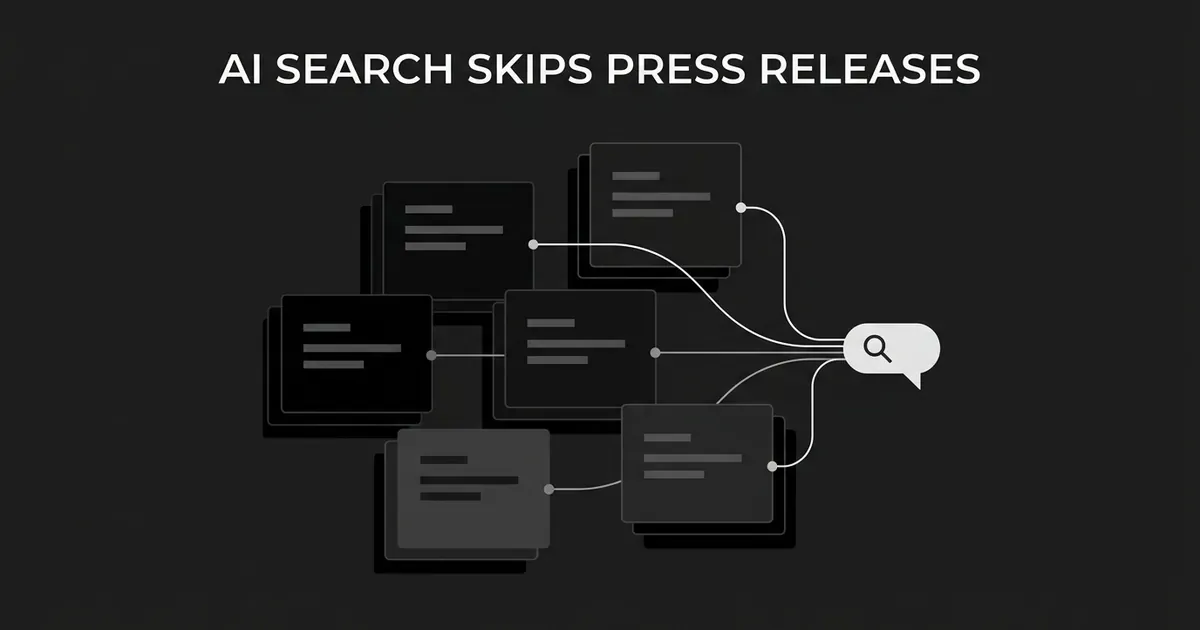
You published a press release. You paid to send it out on a wire. And when you ask ChatGPT about your company, it still does not show up. That is the press releases AI search problem in one sentence, and it is not a sign that AI search hates press releases. The real issue is usually one of five things: the page nobody can crawl, the wire copy competing with your own version, an announcement that never explains itself, a page with no evidence behind it, or a page that only answers one narrow question. This piece walks through each one so you can tell which is happening to you, and what to publish so the next announcement actually earns a citation in AI search.
The short version: a wire release is a distribution event, not a citation asset. Most releases live on many pages at once, in a format built to announce something rather than explain it. AI systems do not cite every page that mentions your company. They pick pages that are reachable, relevant to the exact question being asked, and useful enough to support an answer. A release can clear the first bar and still miss the second two. That does not mean AI engines never cite press releases. A release can still be the right source for a narrow "what did this company just announce" question. It just is not built to answer the broader questions your buyers actually type into an AI search.
The page is not reachable by the crawler that matters
What it looks like. You can open the release URL in your own browser, but a plain search for a distinctive line from it turns up nothing. Or the wire's copy shows up everywhere except yours. This happens when the company's own version sits behind a login wall, gets a stray noindex tag, or is blocked at the CDN or firewall level before a crawler ever reaches it. Google says a page has to be indexed and eligible to appear in a regular search result before it can support an AI answer. It also happens when a publisher has opted out of a specific AI crawler, so the page can still rank in ordinary search while staying invisible to that one engine.
How to confirm it. Open the release URL in a private browser window, with no login. Check the page's robots.txt and its meta robots tag for anything blocking indexing. If you use Google Search Console, run the URL through the URL Inspection tool and see whether it is marked as indexed. For ChatGPT specifically, confirm your robots.txt does not disallow OAI-SearchBot: OpenAI's crawler documentation says a site that opts out will not appear in ChatGPT search answers, and remember that a robots.txt change can take about a day to take effect. If you have never done this before, work through how to configure robots.txt for AI crawlers before touching anything else on the page. Then search a distinctive sentence from the release in a regular search engine. If nothing at all comes back, you are dealing with a discoverability problem, not an AI citation problem yet.
The fix. Get the page public, crawlable, and indexed before you worry about anything else. Remove any accidental noindex directive, allow the crawlers you actually want, and link to the page from somewhere else on your site so it is not an orphan. Making a page crawlable does not force a citation. It just removes the one problem that makes every other fix pointless.
The wire copy and your own page look too much alike
Duplicate content on AI citation comes down to a simple mechanic. When the same announcement sits on your site and on a wire's site, with the same headline, the same quotes, and the same boilerplate, search systems treat those pages as a cluster and pick one representative version to show and crawl more often. Google calls this canonicalization, and it says plainly that a canonical preference is a hint, not a rule. You can tell it which page you want to be the winner. It can still choose the other one, especially when the wire's domain has more established search authority than yours.
This is the duplicate content AI citation problem at the center of most press-release visibility complaints. What it looks like. A search for your own headline returns the wire's page, or a syndicated partner's page, instead of yours. Your company page is technically indexed, but it never seems to be the version anyone sees.
How to confirm it. Put the two pages side by side. If the headline, body, and quotes match almost word for word, that is your answer. Search the exact headline and see which URL comes back. Check whether your page carries a canonical tag pointing to itself and whether it has internal links pulling weight toward it, since an orphaned page loses that fight by default.
The fix. Stop treating the release as your finished content asset. Use it as raw material for a separate, genuinely different page on your own site: more context, more detail, a different structure, information the wire copy never had. A title change and a few extra keywords will not get you there. The page needs to earn its place as the more useful version, not just the more recent one. Syndicated content AI citations are rare precisely because syndication multiplies the same words instead of adding new ones.
The release announces something without explaining it
A press release is built to say what happened. Most of the questions your buyers ask an AI engine are not "what happened," they are "what does this mean" or "how does this work" or "should I care." A release that is mostly an executive quote and a boilerplate paragraph answers the first question and nothing else. AI search needs a page that can support an answer, and an announcement alone rarely carries enough explanation to do that.
What it looks like. The page reads fine as news and falls apart as a reference. There is a headline, a quote, and a call to action, but nothing that explains what the product actually does, who it is for, or what changed in practice.
How to confirm it. Write down the exact question you want your company to win in AI search. Then find the paragraph in the release that answers it. If you cannot point to one, the release was never going to be the right page for that question, no matter how well it is distributed. Test a handful of different questions separately: the announcement itself, what your company does, how the thing works, and how it compares to what came before. A release can pass the first test and fail every other one, and that is not automatically a problem, as long as something else on your site is built to pass the rest.
The fix. Publish a companion page that answers the durable question behind the announcement: what changed, who it affects, how it works, what it does not do, and what evidence backs it up. Lead with a direct, liftable answer, the same way you'd write definition blocks AI search cites as the answer, then explain the rest below it. The release can link to that page, but the page itself should stand on its own, so a reader (or an AI engine) never has to reconstruct meaning from a quote.
The page has no evidence an AI engine can use
An announcement that only contains your own assertion is thin by design. There is no methodology, no product detail, no named expert, nothing that could not be produced by swapping in a different company's name. Google's own guidance on helpful, reliable, people-first content asks whether a page shows real expertise, not just an official statement. That is not a trust problem, it is a usefulness problem. A release can be the correct source for the fact that you made an announcement. It is rarely the right source for a broader claim about how well something works or what it changed for customers.
What it looks like. Every claim traces back to "we said so." The quotes are interchangeable with a quote from any other company in the space. There is no data, no walkthrough, no documented limitation, nothing specific to your product or your customers.
How to confirm it. Ask a blunt question of the page: could a competitor publish this exact copy by swapping the company name? If yes, there is little for an AI system to treat as distinctive evidence. Running a rough E-E-A-T content audit on the page will surface the same gap: check whether any claim is tied to a date, a named person, a specific product, or a document a reader could go check for themselves.
The fix. Add evidence that belongs specifically to you: a benchmark with a stated method, a technical walkthrough, documentation of how the announced capability actually works, or a case study with verified details and clear context. Never invent a customer result, a percentage, or a credential to fill this gap. If the evidence does not exist yet, narrow the claim instead of dressing up the release to look like proof.
The page answers one question and misses every other version of it
ChatGPT can rewrite a question into several targeted searches, and other AI systems fan a broad question out across related subtopics before pulling an answer together. That means a single announcement page, built around one specific piece of news, often only covers one narrow slice of what a buyer is actually asking. Adding more keywords to that same page will not fix it, because this is less about keyword tricks and more about the tactical writing and source signals that get a page quoted in the first place. The problem is not what words are on the page. It is that the explanation those other questions need simply is not there.
What it looks like. Your release shows up when someone searches the exact company name and announcement headline, and nowhere for a broader category question that a buyer would actually type.
How to confirm it. Build a short list of the ways a buyer might ask about this: the exact announcement, your company name, the product category, "how does it work," and "what does it replace or compare to." Check each one separately. If the release only clears the first, its scope is simply narrow, and that calls for a different page rather than a rewrite of this one.
The fix. Build one page per real information job instead of asking one announcement to rank for every version of the question. Use the words your buyers actually use, not your internal product language, and put the direct answer near the top rather than at the end of a longer story.
What to publish instead of another release
The fix across every cause above is the same shape: keep the wire release for reach and record-keeping, and build a separate owned page that does the explaining. Which kind depends on what the announcement was actually about. A product change usually needs a plain-language explainer that covers what changed, how it works, and what it does not do. A claim about impact or performance needs a transparent write-up of what was measured, over what period, and with what limitations, never a "benchmark" built from a handful of examples. A technical release needs documentation: prerequisites, configuration, examples, and known limitations. A customer-facing change might call for a case study, but only with a verified outcome and the customer's own context, never a quantified result you cannot back up. And if the announcement raises questions the release never answers, a short, honest FAQ can carry real weight, as long as it holds actual answers instead of the same headline repeated four different ways. None of this is a substitute for digital PR aimed at earned media, which is its own playbook and worth reading on its own rather than folding into this one.
None of this requires special AI markup or a new kind of schema. The foundation is the same as it has always been: a page that is reachable, that answers the question it claims to answer, and that says something the wire copy did not already say. PR wire AI visibility improves once the wire and the owned page stop trying to do the same job. Teams that are trying to fix this systematically often start by tracking which of their own pages actually get cited for the questions their buyers ask, and where a competitor's page is winning instead, so the next piece they publish is built to close a gap they can already see rather than guessed at from scratch. DeepSmith's AI Visibility module works this way: it tracks mention and citation rates across the AI engines you actually care about, then feeds the pages losing that fight into the content pipeline that produces the replacement.
When none of these match your situation
If you have checked crawlability, ruled out a near-duplicate fight with the wire, confirmed the page explains itself, found real evidence on it, and matched it against the actual questions buyers ask, and it still is not showing up, the honest answer is that no source guarantees a citation. A broader checklist for a page that never makes it into AI Overviews at all can help you double check the basics. AI engines are explicit about this: placement is not promised, and results can shift day to day even when nothing on your page changed. At that point, stop debugging the release itself and check the same five questions against the page you actually want cited going forward. Test the same handful of prompts over a few weeks rather than once, since a single check is not a measurement.
Keep the wire release doing what it is good at: fast, wide distribution and an official public record. Do not ask it to also be your best explanation of what happened, because those are two different jobs, and only one of them earns an AI citation. Treat press releases AI search performance and PR wire AI visibility as two separate scorecards: one measures how far the announcement traveled, the other measures whether anything it left behind was worth citing.
If you would rather see this in your own numbers before you write a single explainer, you can start a free trial and pull up which of your own pages already get cited and which ones never do.