You checked Search Console. The page is indexed. It even ranks on page one. And yet, search by search, it is still not appearing in AI Overviews while other sites get quoted right at the top. If that AI Overview visibility problem is frustrating you, take a breath. This is a diagnosable problem, and you are closer to fixing it than you think.
Here is the reframe that changes everything. Being indexed is necessary, but it is not enough. AI Overviews are not a separate index or a separate ranking system you have to court. They pull passages from pages that already qualify for Google Search, then choose which passages to quote. So when your indexed but not in AI Overviews page never surfaces, the block is almost always at one specific stage, and you can find it.
Marketers keep asking the same thing: why excluded from Google AI Overviews when the page is clearly indexed and ranking? This guide answers that by walking you through eight diagnostic steps, in the order a careful auditor would run them. Each step tells you what to check, how to know it passed, and where people go wrong. Work them top to bottom on one priority page first. Momentum matters more than perfection.
First, understand what you are actually diagnosing
Google's own documentation is clear: eligibility for AI Overviews depends on the same technical requirements as regular Google Search, including the requirements for featured snippets. There is no special AI crawler, no separate AI index, and no AI-specific schema you are missing. AI features read the standard robots controls, the same ones that govern snippets.
So picture the path a citation actually travels. Google crawls the page, renders it, indexes it, then decides whether it qualifies for snippets. For a given search, the system fans that query out into many sub-questions, retrieves passages that answer each one, scores those passages for relevance and trust, writes a synthesis, and attaches citation links to the exact passages it used. Fail at any early stage and the later stages become impossible.
Your job is to work backward from the symptom to the earliest stage that is failing. That backward walk is how you answer why excluded from Google AI Overviews for any given page. There are four families where pages break: eligibility and snippet blocking, passage-level structure, cluster coverage, and authority signals. The steps below check each one.
Step 1: Confirm the page is indexed and snippet-eligible
Start where the most common self-inflicted block lives. A page can be fully indexed, ranking well, and still be completely ineligible for AI Overviews because a robots directive is quietly stripping its snippet rights. No snippet means no AI Overview, by definition.
Open URL Inspection in Search Console for the page. You want to see "Indexing allowed? Yes", your own URL as the user-declared canonical, a recent crawl date, and no "Excluded" or "Blocked" reason. That confirms indexing. It does not yet confirm snippet eligibility.
Now view the raw HTML, not the rendered DOM, and search it for four strings: "nosnippet", "noindex", "max-snippet", and "data-nosnippet". Then check the response headers for an X-Robots-Tag. Any of these can block you:
- A meta robots
nosnippetapplied at the template level. - A
data-nosnippetattribute wrapped around your article body, often injected by a security or anti-scraping plugin without anyone noticing. - An
X-Robots-Tag: nosnippetheader set at the CDN or reverse proxy by a misconfigured security rule. - A
max-snippetdirective set to 0 across the site.
How you know this step passed: the raw HTML and headers are clean of every directive above, and URL Inspection shows no snippet restriction. The fix is simple once you find it. Remove the directive from the template, plugin, or header, then re-validate in URL Inspection. There is no way to compensate for a snippet block with better writing, so clear this gate first.
Common mistake: a site-wide directive that was meant to block one section, like internal search result pages, gets applied to article templates too. The pages index fine, so no one catches it. Always check a real article URL, not the homepage.
Step 2: Verify the rendered HTML actually contains the answer text
A page can be eligible and still have nothing to quote. If the sentence that answers the question only appears after JavaScript runs, and Googlebot does not execute that JavaScript, then for retrieval purposes the passage does not exist. You cannot cite text that is not in the rendered HTML.
Use the rendered HTML view inside URL Inspection. Find the actual answer text on the page, the specific sentences a reader would quote, and confirm they appear in what Google rendered. If your key content is client-side rendered and missing from that view, you have found your block.
The fix is to make the answer text available in the static HTML through server-side rendering, or a noscript fallback that carries the real content. If you run a script-heavy stack, this is worth a careful look at how JavaScript-heavy sites stay visible to AI crawlers, because the fix lives in your rendering setup, not your copy.
How you know it passed: every answer passage you care about is present, as text, in the rendered HTML Google shows you.
Step 3: Restructure each priority page for passage-level extraction
Here is a mindset shift that unlocks a lot. AI Overviews do not retrieve pages. They retrieve passages. The scoring layer works on individual passages, judging each one for whether it directly answers a sub-question. So a page can rank for the head term and still contain no passage worth quoting. When that happens, nothing inside the page is citable.
This is often the real reason a page stays indexed but not in AI Overviews. The answer is there, but it is buried. It shows up in the third paragraph of a section, after a preamble, after credentials, after "in this article we will discuss." Retrieval strongly prefers passages that lead a section and state the answer in the first sentence or two.
Walk your priority page and fix these patterns:
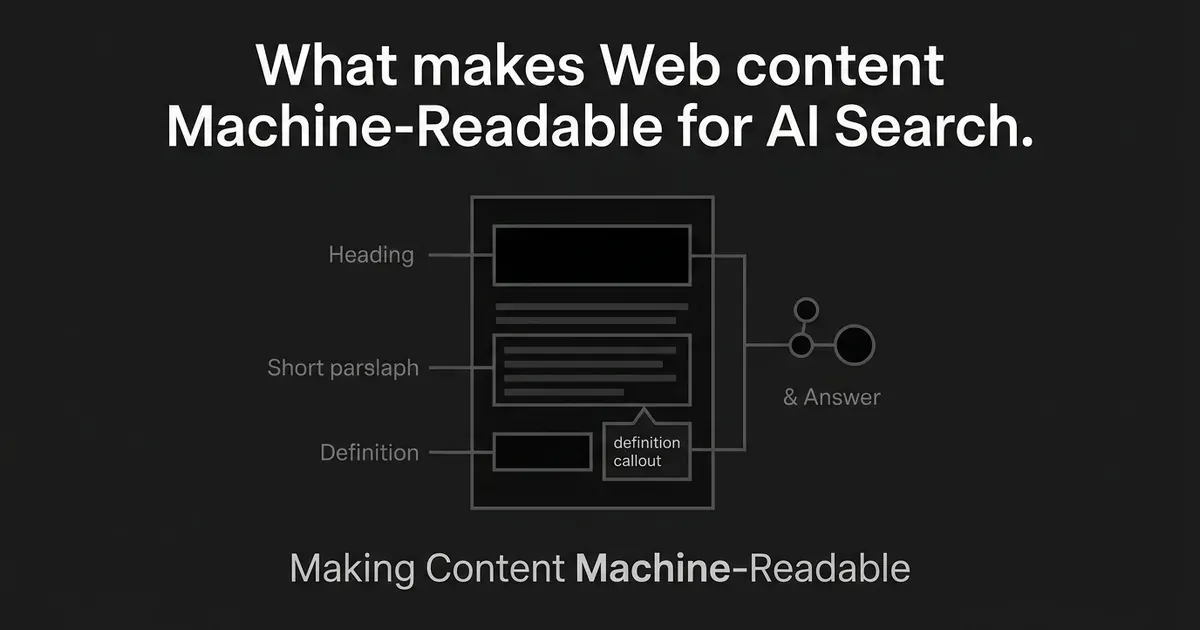
- Buried answers. Under any heading that targets a question, put a direct 40 to 60 word answer first, then the supporting detail. This answer-first passage shape is what gets extracted; writing self-contained passages an engine can lift is the single highest-leverage change on most pages.
- Vague headings. "Why this matters" does not match how anyone phrases a search. Rewrite headings as the actual question: "Why is my indexed page not cited?" Question-based headings that mirror real queries are how passages get matched to sub-questions.
- Prose where structure belongs. Steps, criteria, and comparisons hidden in flowing paragraphs are hard to extract. Use ordered lists for steps, bullet lists for criteria, and tables for comparisons. Tables are especially high-signal.
- Missing definitions. AI Overviews love a clean "X is Y, and it works by Z" sentence. If your page assumes the reader already knows the term, add a dedicated definition block for the term you want to own.
One more rule from the retrieval evidence: the first 100 words of a priority page should state the answer to the page's main question. If your opener is an anecdote or a "welcome to our guide" line, you lose the passage you needed. Studies of AI Overview citations find they tend to pull from the upper portion of a page, so put your best answer where the engine looks first.
Step 4: Map your topic cluster against the fan-out surface
If your page passes structure and still is not cited, widen the lens. The system rarely answers with one page. It fans a single query into eight to twelve sub-questions and retrieves passages for each. A page that only targets the head term is competing for one slot in a race with many slots. The winners are usually part of a cluster that covers the whole fan-out surface together.
Build a coverage matrix. Down the rows, list the sub-questions an AI Overview would fan your topic out into: definition, mechanism, cost, alternatives, comparison, common mistakes, examples, requirements. Across the columns, put your pages, your competitors' pages, and the empty cells. Those empty cells are your missing pages, and understanding how fan-out breaks a query into sub-queries tells you which cells matter most.
The trap to escape is the single pillar. One big pillar page per topic, with no supporting pages, wins the head term and stays invisible to the rest of the fan-out. The fix is the cluster model: one comprehensive pillar plus a set of supporting pages, each answering a specific sub-question, connected with descriptive internal links. This is exactly where a real topic cluster strategy pays off, and where descriptive anchor text matters, because "click here" and "this article" break the signal that helps the engine discover and trust your supporting pages.
Do not skip comparison and alternatives pages. "X vs Y" and "best X for Z" pages are among the most cited types, because fan-out surfaces comparison sub-questions constantly. Leave those pages unwritten and you hand those citations to a competitor.
This is also where measurement gets hard to do by hand, and where a platform earns its keep. Seeing which of your pages AI actually cites, which competitor pages win the prompts you care about, and where your cluster has holes is exactly what DeepSmith's AI visibility tracking is built to surface, so you are mapping coverage against real citation data instead of guessing.
Step 5: Audit every passage for groundedness and sources
Retrieval does not just check whether a passage is relevant. It checks whether the claim can be trusted, a check often described as groundedness. A passage that leads with a bold number but never names where the number came from tends to get filtered out.
Go through your priority page and find every numeric claim, named entity, and quoted statement. For each one, confirm the passage itself contains the source by name, the date, and, where possible, a link to the underlying study. A statistic with no provenance reads as unverifiable, and the system treats it that way.
The upside is real. Passages built on first-party data, original research, named expert quotes, and primary sources are preferred, because they offer something the engine cannot find on ten other pages. That is information gain, and it is worth investing in. Learning how to present statistics and quotes so AI engines trust them turns your raw data into citable passages.
Pro tip: you do not need to source everything. You need to source the specific claims a reader would question. Fix the load-bearing numbers first, then work outward.
Step 6: Strengthen E-E-A-T signals across author, brand, and entity
E-E-A-T stands for Experience, Expertise, Authoritativeness, and Trustworthiness. It is a quality lens, not a single dial you can turn. For AI Overviews it matters even more, because the groundedness check is essentially asking whether the system should trust this source at all. That weight climbs higher for YMYL topics like health, finance, and legal.
Check these signals honestly:
- Author. Anonymous or team-bylined content underperforms wherever expertise matters. Add a named author, a credentialed bio, and a link to an external profile like LinkedIn. Building verifiable author entity pages AI engines can read is often the missing piece.
- Organization. A site with no clear identity, no About page, no contact information, no editorial policy, gets downweighted on trust-sensitive queries. Publish a real About page, a Contact page with verifiable details, and an editorial policy that explains how your content is produced and reviewed.
- Off-domain footprint. Mentions on reputable third-party sites and profiles on authoritative platforms build entity-level trust. This is sustained presence, not link spam, and it takes time.
How you know this step is landing: an outside reader could tell, in seconds, who wrote the page, what makes them qualified, and who stands behind the site. If any of those is unclear, so is your trust signal. A deeper E-E-A-T pass for AI search will show you which signals to prioritize by topic.
Step 7: Refresh content and signal freshness
Stale pages lose to fresher ones, even when the underlying quality is comparable. A page with an old "last updated" date, references to past years as if they were current, or statistics from a few years back will slip in freshness scoring on any topic where recency matters.
Fix the signals honestly. Give priority pages an accurate "last updated" date that reflects a real update, not a cosmetic timestamp bump. Use current-year statistics where the topic is time-sensitive. And when you refresh, add new information, do not just rephrase the old sentences. Freshness weighs differently across topics, so knowing how recency and freshness affect citation selection helps you decide which pages to refresh and how often.
How you know it passed: your priority pages carry honest, current dates, and the last substantive update actually changed something a reader would notice.
Step 8: Measure, track, and iterate
You cannot manage what you cannot see, and this is the step people skip. AI Overviews are volatile. The same page can be cited one week and dropped the next, and citation sets rotate even when the answer wording stays stable. A single manual check tells you almost nothing.
Build a baseline you can return to. Run manual searches in incognito for your priority prompts. Watch Search Console performance for the queries where AI Overviews appear. Then re-run this eight-step diagnostic after each fix and track which queries shift. The work is a loop, not a one-time checklist.
This is the other place a platform saves you real hours. Tracking how often your brand and pages get cited across prompts, watching the trend after each change, and monitoring which competitor pages are winning is exactly what DeepSmith's AI visibility module does on a schedule, so you are iterating against data instead of memory. It will not control or guarantee citations, and no honest tool can. What it can do is show you where you stand and where the gaps are, which is the whole point of a diagnostic.
What to do next
You do not need to fix everything this week. Pick one priority page and run the eight steps in order. Nine times out of ten, the fastest way to get into AI Overviews is to clear the earliest block: a stray snippet directive, a buried answer, a missing cluster page. Clear that one, confirm the fix in URL Inspection, and move to the next page.
Then make it a habit. Re-run the diagnostic on a small batch each month, track what moves, and let the pattern teach you where your site tends to break. That is how a scattered AI Overview visibility problem turns into a routine you actually control.
If you want the measurement and the production to live in one place, so you can see where you are not appearing in AI Overviews and produce the pages that close the gap, you can start a free DeepSmith trial and work from real data and real drafts before you pay.