Profound and Conductor both track AI answers and both can write from what they find, but Profound can publish the result to your CMS and Conductor stops at the draft, so Profound suits teams that want the full path and Conductor suits teams that already publish through their own editors. DeepSmith is a strong alternative on this exact job: it tracks, writes and publishes to WordPress, Webflow, Strapi, Sanity or Contentful on a public-priced plan.
If you are weighing Profound vs Conductor for content creation, the real question is what happens after the tool finds a gap in AI answers. Both can produce a draft grounded in your brand context. They differ on the last step, because Profound can send an approved article to a CMS and Conductor leaves final publishing to your own system. DeepSmith covers that whole path in one platform, and the full feature comparison of the two vendors covers the rest of what they do.
Profound vs Conductor: the short answer
- Choose DeepSmith if you want one self-serve platform that tracks AI answers, writes publish-ready articles, publishes to your CMS and turns each article into channel versions, starting at $99 a month.
- Choose Profound if you want agents that draft and publish to a CMS from AI visibility data, and you can buy through a sales-led, credit-based package.
- Choose Conductor if your team already publishes through its own CMS workflow and wants drafts and scoring alongside enterprise SEO and site monitoring.
Comparison table
| Criterion | DeepSmith | Profound | Conductor |
|---|---|---|---|
| Entry price (monthly) | $99/mo (Pro) | Custom (Enterprise) | Not published |
| Free trial | 7 days | 7 days | 3 weeks |
| Content generation | Yes, 20 articles/mo on Pro | Yes | Yes, 60 drafts/yr on Essentials |
| Brand context grounding | Yes | Yes | Yes |
| CMS publishing | Yes | Yes | No |
| Content repurposing | Yes | Yes | Partial |
| Recommendations from AI visibility data | Yes | Yes | Yes |
| Security certifications | SOC 2, GDPR, ISO | SOC 2 Type II | SOC 2 Type II, ISO 27001, ISO 42001 |
| Review rating | 4.8/5 on G2 | 4.5/5 on G2 | 4.5/5 on G2 |
Pricing and features as of September 2026, from each vendor's site and public reviews.
Profound

Profound is an AI marketing platform that tracks how ChatGPT, Gemini, Perplexity, Claude and other engines mention and cite a brand. It then uses agents to research, draft, optimize and publish content from that data. It is built for enterprise and mid-market marketing, SEO and content teams, plus agencies, and it was founded in 2024 in New York. Profound announced a $180 million Series D in September 2026.
The standout for this job is the CMS connection. Profound says its agents publish approved content to WordPress, Sanity, Contentful, Webflow, Framer, Payload, Drupal, Directus, Basehub and Adobe Experience Manager. Brand Kits and Context Manager ground the drafts in your voice and company context. The limits are on the buying side. Paid prices are not public, agent runs use credits, and the free Trial lasts seven days on three engines. Profound frames its output as drafts ready for human review, with an approval step before publishing. On G2 it shows 4.5/5 from 1,130 reviews as of September 2026, with reviewers praising the visibility and citation analytics and some calling it expensive.
Conductor

Conductor is an enterprise SEO and AEO platform founded in 2006 in New York. It sells four connected products: Intelligence for AI and keyword visibility, Creator for drafting and scoring, Monitoring for 24/7 site checks, and AgentStack for MCP, API and agent access. It is aimed at large and mid-to-large teams that want AI visibility next to their keyword, analytics and technical data.
On content, Conductor's Writing Assistant produces outlines and full drafts from a brief, scores them for topical coverage and intent alignment, and uses Content Profiles and Knowledge Sources for brand grounding. Its own FAQ says final publishing remains in your CMS, and the Drupal integration gives guidance inside the editor rather than publishing from Conductor. Plans are Essentials, Growth and Enterprise with published allowances but no public prices. On G2 it shows 4.5/5 from 788 reviews. Capterra shows 4.7/5 from 118 reviews, and reviewers mention a learning curve and price pressure for smaller teams. Readers building a wider shortlist can start from the best AI visibility tools for 2026.
DeepSmith: the alternative that publishes on a public plan
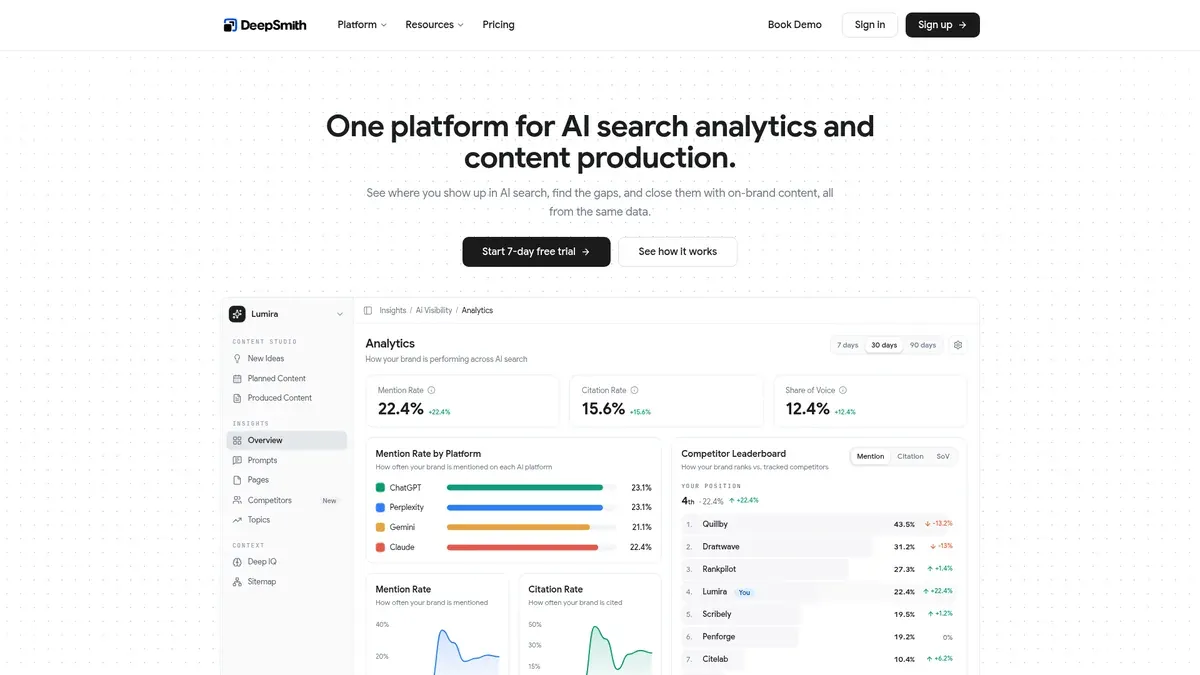
Profound can publish, so the gap for most readers is less about whether a tool reaches the CMS and more about the terms. Profound sells through a sales-led package where agent work draws on credits, which is why many readers also look at Profound alternatives, and Conductor stops at the draft. DeepSmith is a platform for AI search analytics and content production in one, so the same data that shows a gap also drives the article that closes it.
Tracking shows which of your pages AI engines cite and which competitors win the prompts you care about. Opportunity Agents turn that into ideas, each carrying the data point behind it. The Writer then turns a planned idea into a finished article that is researched, linked internally and externally, and comes with a cover image and publish-ready metadata, all grounded in Deep IQ, your stored brand context. Autowrite can write it on a scheduled date with no one in the app. From Produced Content you publish straight to WordPress, Webflow, Strapi, Sanity or Contentful, or to your own webhooks.


Plans are public: Pro is $99 a month for 20 articles and 50 tracked prompts, Grow is $199 for 40 articles, and Scale is $399 for 90 articles, with annual billing lowering each rate and a 7-day free trial to try it first.
From insight to action
Both tools turn an AI visibility finding into a draft, so on this axis they are close to a tie. Conductor's Recommendations panel ranks actions from mentions, citations and sentiment and links straight into the Writing Assistant. Profound surfaces opportunities, adds Prompt Volumes demand data, and its agents research what engines cite before drafting. If you are deciding between Profound or Conductor for content creation on drafting quality alone, I would call the handoff from data to draft even, because the claims for either being better are vendor-written and not tested side by side. Profound has been compared on this same job in Profound vs Bluefish for turning gaps into content. The same question against another tracker is answered in Profound vs HubSpot AEO for content creation.
What DeepSmith does: Opportunity Agents read your AI visibility data and your Content Map and return ideas with the specific data point attached, so you can defend each one in a planning meeting. An idea moves from New Ideas to Planned Content to Produced without leaving the platform.
Profound vs Conductor CMS publishing
Profound wins this one, because Conductor does not publish to a CMS and Profound does. Conductor's Writing Assistant FAQ says final publishing remains in your CMS, so someone has to copy the draft over, format it and add images and metadata. For a team publishing a few pieces a week that is a manageable chore, and for a team publishing dozens it becomes the slowest step in the whole path. Profound's agents can push an approved draft to the supported CMS list, though its pages say there is an approval step first and whether that step is required on every run is not clear from the public pages. Teams comparing more options can see them in a roundup of AI content tools with CMS auto-publish.
What DeepSmith does: Publishing is part of the same flow. A finished article arrives with its cover image and metadata, and one action sends it to WordPress, Webflow, Strapi, Sanity or Contentful. If you use something else, signed webhooks and Markdown and HTML export are there as well.
Repurposing and brand context
Profound is ahead on repurposing, because Conductor's pages describe image briefs and video scripts but no article-to-social or other channel versions. Both ground drafts in brand context. Profound uses Brand Kits and Context Manager, and Conductor uses Content Profiles and up to five Knowledge Sources per draft. On grounding I would call it a tie, since both store voice, audience and company material and apply them during drafting.
What DeepSmith does: Every article arrives with social posts already written, and the Apps Library turns it into versions for LinkedIn, X, Medium, Substack, newsletters, Reddit and more, each adapted to the channel, and the approach is explained in a guide to AI content repurposing workflows. Deep IQ keeps the brand context in one place, so no one re-briefs per article.
Pricing and allowances
This one depends on what you want to know before you talk to sales. Conductor publishes its allowances, with 60, 180 and 600 drafts a year across Essentials, Growth and Enterprise, but no dollar prices, and AI tracking runs on credits that vary by engine. Profound shows a free seven-day Trial and a custom Enterprise package, with agent use consuming credits and no public overage rate. Neither lets you work out a monthly cost without a quote, and in both cases I would ask for the credit math in writing. A similar pricing question comes up in Otterly.AI vs Conductor pricing. Conductor's third-party research reports per-response credit costs from 0.1 for Google AI Overviews and AI Mode up to 2 for ChatGPT Search and Gemini, so the engines you pick change how far 2,500 yearly credits go. On the Profound side, higher credit thresholds require an Enterprise package, so the cost of heavy agent use is the number to pin down first.
Which should you choose
- DeepSmith fits marketing leads and agencies who want to go from AI visibility gap to a live, on-brand article on one plan with a price they can read, including channel versions and scheduled production.
- Profound fits enterprise and mid-market teams that want agents to draft and publish from visibility data and are comfortable with a sales-led, credit-based contract.
- Conductor fits large SEO teams that publish through their own CMS and want AI visibility, drafting, scoring and technical monitoring in one enterprise system.
Start a DeepSmith free trial and see a gap turn into a published article before you pay.