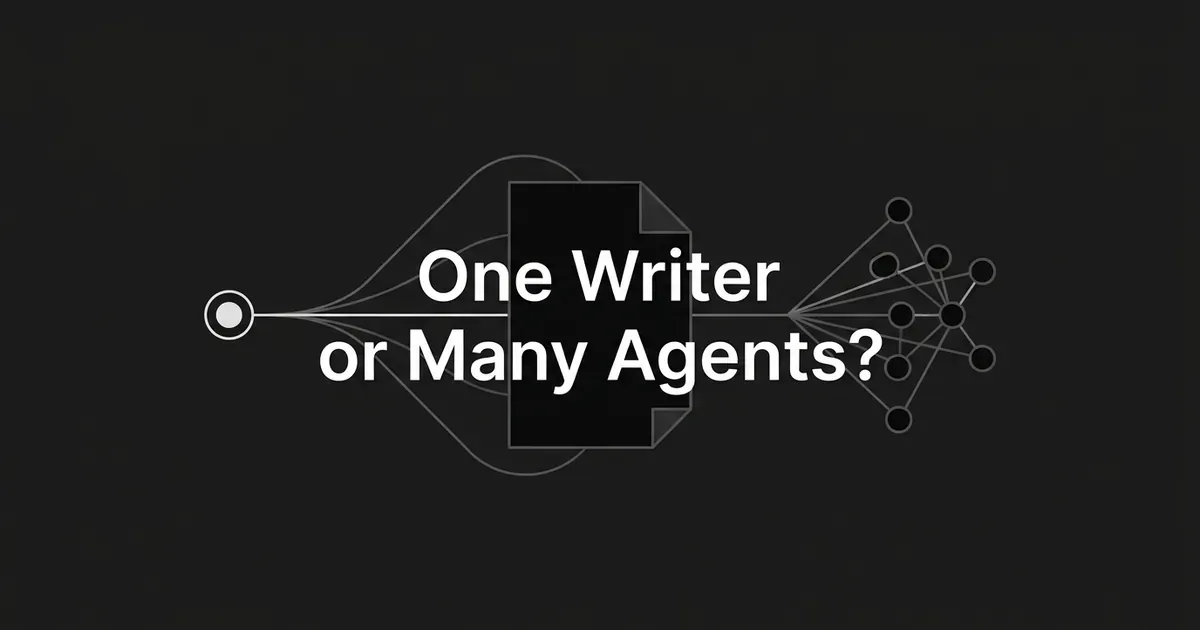
If you are deciding between one AI writer and a team of specialized agents, the real question is whether splitting the job into roles will make the finished article better enough to justify the extra coordination. A single AI writer keeps the research, drafting and revising inside one main writing context. Multiple writing agents divide those jobs across separately instructed roles that pass their work along. For ai writing agents vs single ai writer, the short answer is that a strong single writer is usually enough for a well-specified article, and extra agents start to pay off when independent research or a distinct check solves a quality problem you can actually point to.
Most of the confusion in multi agent content writing comes from setting a polished pipeline next to a single rushed prompt and crediting the agents for the gap. This article keeps the comparison fair and looks at what changes in the text a reader sees: coverage, depth, consistency, error catching and the cleanup an editor still has to do.
One note before we start. The research here mixes academic studies and vendor reports, and none of it is a neutral test on marketing blog posts, so our recommendations are our own reading of it, not results we measured.
| Output dimension | Strong single-writer workflow | Coordinated multi-agent workflow |
|---|---|---|
| Narrative coherence | One main context can hold a continuous argument | Needs a synthesis step when separate contributions carry different assumptions or repeat each other |
| Research coverage | Can be thorough when the brief and evidence are complete | Can look into separate questions or perspectives independently |
| Depth | Depends on the evidence, the follow-up questions and the synthesis | Can add specialist investigations, and can also add loosely connected material |
| Brand voice | One writing owner makes consistent voice easier to manage | Needs shared brand rules and a final pass over the whole document |
| Error catching | Can revise its own work, especially with outside evidence | Separate checks can expose gaps, but agreement is not verification |
| Production overhead | Fewer handoffs | More instructions, handoffs, retries and integration work |
What is a single AI writer?
A single AI writer is one main writing role that owns the article's argument and its prose. That does not mean one prompt and one try. A good single-writer workflow can start with an approved audience, angle and outline, use a research dossier or retrieve its own sources, bring in brand and product context, draft, critique the draft and revise it, and then go to a human before publishing.
That baseline matters because a single model can improve its own output through separate passes. In the Self-Refine work presented at NeurIPS 2023, the same model produced a first answer, gave itself feedback and then refined the answer. The authors reported roughly a 20 percent absolute improvement on average across seven tasks compared with one-step generation from the same model. The tasks ranged from dialogue responses to math reasoning, so it is not a 20 percent accuracy gain for blog posts. It does tell us that extra passes help without extra agents, and that is the bar a multi-agent setup has to clear.
What are multiple writing agents?
In the ai writing agents vs single ai writer debate, multiple writing agents are separately instructed roles or workers that each handle part of the production job and hand their findings or revisions to a coordinated workflow. Typical roles are a researcher, an outline planner, a drafter, a factual reviewer and a brand editor. Those are examples, not a minimum team size.
Two details are easy to miss. The agents do not all have to write the article, since several researchers feeding one drafter is a multi-agent content writing design even though one voice writes the final text. The agents can also all run on the same underlying model. A role is a defined responsibility and an agent is a configured worker with its own instructions and possibly its own context and tools, so one model can fill several roles, and agents can run one after another instead of side by side.
A role title also does not make an expert. Calling an agent a senior editor does not mean it was trained or validated for that job. When you evaluate any setup that uses ai writing agents, ask what each role receives and what it can verify, and pay less attention to the labels.
How does research depth and coverage change?
This is where a divided workflow has its clearest advantage, and it shows up before any drafting starts. A single writer tends to follow one promising line of inquiry and build the article around it. A coordinated system can send separate workers after the main claim, the counterevidence, the practical constraints and the questions your audience would ask.
Anthropic's description of its multi-agent research system is a good picture of this. Its subagents have their own context windows, tools and instructions, and they explore different directions. A lead agent pulls the findings together and decides whether more digging is needed. Anthropic reports that a setup with a lead agent and subagents beat a single agent by 90.2 percent on its own internal research evaluation. That is a vendor-run test of research tasks, not of article quality, and Anthropic also reports that how much compute the system used explained much of the performance difference in a related analysis. So it supports the idea that parallel investigation helps with broad questions. It does not show that more agents make better prose.
The closest direct evidence for articles comes from Stanford's STORM project, published at NAACL in 2024. STORM finds different perspectives on a topic, simulates conversations grounded in web sources, builds an outline from them and then writes cited sections. With ten experienced Wikipedia editors judging articles on 20 topics, it raised the share judged organized by 25 percentage points and the share judged to have good coverage by 10 percentage points, compared with an outline-driven retrieval baseline. The STORM paper is also honest about the downsides, since it reports unsupported inferences, inaccurate paraphrasing and source bias showing up in the generated articles.
So the safe reading is that structured research and planning improved the organization and coverage of informational articles in that study. The unsafe reading is that multiple agents make all writing 25 percent better. The study changed how perspectives were gathered and how outlines were built, so it was never a clean test of agent count.
For a marketing article, better research means the draft answers questions a single line of inquiry would have missed, includes the real exceptions and says where the evidence is thin, not that it has a longer source list. Workers with overlapping assignments can repeat the same searches, and several agents leaning on one weak source are not several confirmations.
What happens to depth?
More material does not mean more depth. Depth is the explanation of why something works, when it fails, what supports it and how the answer shifts in different conditions. Breadth is how many relevant issues you touched, and length measures neither one reliably.
Narrow investigations from several agents can add real depth, or they can leave you with sections that each sound reasonable and never answer the reader's main question. Whoever does the final synthesis has to decide which findings change the answer, which disagreements come from different methods rather than real conflict, which examples help, and which details are interesting but not needed. They also have to cut any conclusion that goes beyond what the sources establish.
That is why the synthesis role carries more weight than any one researcher in a good multi-agent setup. When you compare outputs, read for whether the article explains relationships and limits.
How does consistency and brand voice change?
Consistency means several things. Voice is tone, vocabulary and rhythm. Terminology means one concept keeps one name. Factual consistency means dates, figures and product details agree throughout, and argument consistency means the conclusion follows the opening position. Structure means the sections fit together without repeated definitions or abandoned promises.
A single writing owner has fewer handoffs, so these usually come more easily, though one writer can still contradict itself or drift away from the brief. A multi agent content writing setup can enforce shared terms and voice, but only if the relevant context really reaches every contributor and the final editor. The more people or agents involved, the more a shared brief and a last pass over the whole article matter.
LangChain's Harrison Chase made a useful point in a June 2025 analysis, which is that reading tasks split across agents more easily than writing tasks. When several agents write at the same time, they can make decisions that conflict and are hard to reconcile afterward. The middle path is to let several agents research while one main agent writes the final piece, so multiple researchers do not require multiple competing authors.
If you do run more than one role, these controls help keep one voice:
- One approved audience, angle and outline for everyone.
- A shared record of terms and claims.
- The same brand constraints given to every writing and editing role.
- One named owner who settles conflicting recommendations.
- A final review of the complete article, not only of each section on its own.
How does error catching change?
A second reviewer can point out a problem, but only outside evidence lets anyone justify a factual correction. It helps to think of three kinds of review. A style and structure check can find repetition, unclear headings, inconsistent terms and banned phrasing, though it cannot tell you whether an outside fact is true. An internal consistency check can find conflicting numbers and mismatches with the brief, though it cannot tell you whether the shared source material is right. A factual check compares a claim with a reliable source and confirms the scope, date and unit match, though even that does not prove a claim is absolutely true.
A real citation can also sit next to a sentence that overstates it. A good factual reviewer checks the link between the sentence and its evidence, not only that a link exists.
The research on self-correction is mixed. A critical survey by Ryo Kamoi and colleagues, published in Transactions of the Association for Computational Linguistics, finds stronger support when reliable outside feedback is available, and it warns that gains can be overstated when the starting answer is weak. So a reviewer agent needs the evidence in front of it, not only the finished draft, and a correction should name the source conflict or the unmet requirement behind it.
Multiple agents can also share the same misconception, and if every role leans on the same source, their agreement tells you very little. The "Debate or Vote" paper from NeurIPS 2025 gives a small, cautionary example. On a small summarization test of 30 CNN/DailyMail examples, adding rounds of debate did not improve the scores consistently, and the best ROUGE-1 and ROUGE-L results came from different conditions. That is a test of summaries and overlap scores, not of original articles or factual accuracy, so it does not show that specialist review is useless. It does show that more discussion between agents is not automatically better.
The failure side is documented too. The paper "Why Do Multi-Agent LLM Systems Fail?" annotated more than 1,600 traces across seven multi-agent frameworks and sorted the problems into 14 failure modes under three headings: system design issues, inter-agent misalignment and task verification. Those were coding, math and general-agent tasks, so applying them to writing is our inference. Missing instructions, conflicting decisions and weak final verification are all useful things to look for in a multi-agent failure analysis of your own pipeline.
What gets lost in handoffs?
Handoffs are where a good finding can turn into a bad sentence. A conclusion by itself is not enough to pass along. The next role also needs to know what was measured, when, against what baseline, with what limits, and where the support can be checked.
When that context drops out, an internal benchmark turns into a universal claim, a relative improvement turns into a percentage-point change, a historical figure reads as current, or an editor trims a needed qualification just to shorten a sentence.
A practical fix is a claim record that travels with the draft, holding each claim, its supporting passage, the source date, what it applies to and its limits. The same record helps a single writer too.
What about speed and cost?
The comparison that matters to a business is the time and money needed to reach the same publication standard, and a faster first draft is only part of that. Parallel research can shorten the clock time of the research stage. Research, drafting, verification and rewriting still depend on each other, and more simultaneous work usually means more total work.
It is worth tracking time to a first draft, time to an approved article, model and service spend, failed runs, and human repair time separately. Anthropic's own guidance in building effective agents is to start with the simplest solution that meets the task and add complexity only when testing shows it is worth it, and it openly treats performance, latency and cost as a tradeoff.
We could not find a defensible price or token multiplier for single-writer versus multi-agent marketing production, so we are not going to give you one. A multi-agent workflow can cost more to run and still pay for itself if it cuts expensive review or produces more articles that get approved. It can also cost more and add nothing. Both are possibilities to test, not savings anyone has established.
When does the extra structure pay off?
Add a role when it addresses a specific, recurring failure that you can check, and keep it only if the improvement in accepted articles is worth the coordination, run time and review it adds. No article length or agent count has been shown to be the right switch point.
| Situation | Starting recommendation | Why |
|---|---|---|
| Narrow topic with a complete, approved evidence pack | Single writer with revision and validation | More research delegation may solve nothing that is still missing |
| Broad topic with independent lines of inquiry | Several research roles and one synthesis owner | Separate investigations can widen coverage without splitting the prose |
| Voice-led thought leadership | One final writing owner, with research and checks as needed | The position and flow of the argument need a clear owner |
| Recurring factual or product-claim errors | Add targeted, evidence-based validation | The missing piece is verification, and more drafting will not supply it |
| Repeated structure or style violations at scale | Add explicit criteria and a focused review pass | Some requirements are easier to check mechanically or in one pass |
| Tightly linked argument with little independent research | Be careful with parallel drafting | Putting it back together can cost more than the work saved |
| High-stakes factual claims | Reliable outside verification and qualified human review | More agents do not replace someone accountable who knows the subject |
| Small budget and output you already accept | Improve the brief and the baseline first | Extra coordination needs a benefit you have seen |
This lines up with how the market is sorting itself out. Some tools are built around fast one-click drafting, which is closer to the single-writer end. Others lean toward configurable workflows where you decide which role does what, and some offer a guided SEO content workflow that walks a piece through stages. Which one fits depends on the failures you actually have.
How should you compare the two on your own content?
If you want to test this yourself, keep the comparison fair. Give both workflows the same audience, angle, source access, approved product facts, brand context, target length and acceptance criteria. If one gets current sources, several revision attempts and a bigger budget while the other gets one unsupported generation, you are measuring the whole process and not the number of agents. Use more than one topic and more than one run, and where you can, have reviewers judge without knowing which workflow made which.
Then judge the delivered article and ignore the activity log. Look at:
- Coverage of the brief's real questions and the important exceptions.
- Factual correctness of dates, figures, descriptions and conclusions.
- Whether the claims that can be checked are actually supported, and whether each cited passage backs the wording and scope of the sentence.
- Coherence, including contradictions and repeated explanations.
- Human effort, meaning what an editor still has to research, rewrite or remove.
A simple business number comes out of this. Take your total production and review spend, including retries and human repair, and divide it by the number of articles that met your standard, which tells you more than drafts per hour. Much of the work that decides quality happens in the work that happens after the first draft, so make sure your test counts it.
Where do SEO and AI search fit in?
How many agents worked on an article is a production choice, and it is not a search ranking credential. Google's guidance says established SEO practices still apply to AI Overviews and AI Mode, and that no special optimization method, AI file or schema markup is required. A page still has to be indexed and eligible to show with a snippet.
So do not promise AI citations because several agents touched a draft. Google's guidance on generative AI content puts the weight on accuracy, quality and relevance, and it calls for manual review and fact-checking before publication, including metadata. Clear headings, answers near the top and supported claims are worth having whichever way you produce the draft.
Which approach fits your content?
For most teams the practical path has three steps. Start with a strong single-writer workflow that has a real brief, real sources and a revision pass, and look at what still goes wrong. Then add a role only for a failure that keeps coming back, such as missed coverage on broad topics or unsupported claims that slip through. Keep one person or one final agent responsible for the whole article.
If your pieces are broad and need independent research, a design with several researchers and one writer is a sensible place to begin. If your pieces are short, well-defined and already close to publishable, extra agents will probably add cost faster than quality. If you keep hitting the same checkable errors, a focused verification step is likely worth more than a larger cast of writers. Teams often reach this decision while looking at AI content tools that publish straight to a CMS, and it is a good moment to ask how each one divides the work and what it checks, as well as how fast it drafts.
The useful question is less how many agents touched the draft and more which research, writing and verification jobs were done well enough that the reader gets a clearer, better-supported article. Before you add another agent, write down the failure it is meant to catch and the improvement that would make it worth keeping. If you are also weighing the surrounding setup, it can help to look at automations around the draft, at consolidating a content stack that today runs on a chat window, a Google Doc and an SEO tool, and at tools that track and write for AI search. Teams that publish in bulk can also read about bulk article generation.
Related guides
- AI Writing Tool or AI Content Platform: What Is the Difference?: Tell an AI writing tool from a content platform by what each handles.
- Can Programmatic SEO With AI Work Without Thin Content Problems?: Judge whether programmatic SEO with AI can avoid thin content by checking data uniqueness, page usefulness, template variation and review sampling, and see which setups tend to fail.
- Averi AI Alternatives: 7 Best AI Marketing Content Tools for 2026: Seven Averi AI alternatives (DeepSmith, Jasper, Copy.ai, Writesonic, Scalenut, Surfer, Anyword) sorted into camps, weighing Averi's AI-plus-human-expert-network model and $99 to $199 pricing against pure software platforms that.
- Copy.ai Review: Features, Pricing, and Whether It Is Worth It: Reviews Copy.ai's shift from AI copywriter to a go-to-market automation platform of workflows, agents, and data tables, its short-form strengths, weaker long-form output, and four-figure pricing tiers, concluding.
- HyperWrite Alternatives: 8 Best AI Writing Assistants for 2026: Compares eight HyperWrite substitutes split into two groups: marketing content systems (DeepSmith, Jasper, Writesonic, Copy.ai) and assistant, research or browser tools (Grammarly, ChatGPT, Claude, Perplexity), with pricing, trade-offs.