If you're trying to decide between a content optimization tool and an AI writer, the first thing to work out is where your articles actually get stuck. If you can already get drafts but spend your time fixing what's missing in them, an optimization tool is the closer fit. If getting the words on the page is what takes too long, you need an AI writer. If both are true, you need both abilities, and they don't have to come as two separate subscriptions.
That's the short version of a question people usually type in as "surfer vs ai writer" or "clearscope vs ai content tools." Those searches sound like a product face-off, but the real decision comes before any product. It's about which job you need done. This article stays on that decision. It won't rank specific vendors, because the right product depends on features and pricing that are better handled in a dedicated comparison.
One caution up front. A high optimization score doesn't prove an article is accurate or useful, and a fast draft doesn't either. Neither one tells you the page will rank or get cited by an AI engine. Keep that in mind as you read, because the content optimization vs AI writing question is really about which job is missing, and it comes up a few times.
Content optimization vs AI writing at a glance
The table below compares the two capabilities by the job each one does. These are functional differences, not promises about every product. Plenty of tools do a bit of both, so treat each row as a question to ask in a demo.
| What you're comparing | Content optimization | AI writing | What it means for your buying |
|---|---|---|---|
| Main job | Assess content and point out what to improve | Generate, rewrite or transform text | Work out whether diagnosing or producing eats more of your week |
| Where you start | A target query, a brief, a draft or an existing page | Instructions, source material, an outline or a brief | Neither label tells you how much prep you'll still have to do |
| What you get back | Coverage suggestions, terms or sections to add, structure advice, sometimes a score | Outlines, passages, full drafts, summaries or rewrites | A list of recommendations and a finished revision are different things |
| Existing pages | Finds weak coverage, old information or a mismatch with the query | Rewrites sections or adapts the copy | Refresh work usually needs both a diagnosis and someone to make the changes |
| New articles | Shapes the brief and checks a draft before it goes live | Produces the first text and later revisions | Optimization doesn't have to wait until a page is published |
| Depends on | A good target and someone to interpret the suggestions | Clear instructions, reliable evidence and brand context | Weak inputs hurt either one |
| Brand voice | Term coverage doesn't tell you if it sounds like you | Can follow examples, but still needs checking | Test the voice yourself, don't assume it from a feature list |
| Facts | A coverage score isn't proof the claims are true | Fluent text can still be wrong | Keep a separate source check either way |
| Finishing work | May point to work someone still has to do | May write text and leave links, images, metadata and publishing undone | Look at the whole route to an approved article |
| Search and AI visibility | Can support improvements, no guarantee of placement | Can produce useful material, no guarantee of discovery or citation | Measure real results separately from production numbers |
Where a content optimization tool fits
A content optimization tool earns its place when you have writers who give you readable drafts, and the drafts keep coming back needing the same kind of repair work. In the common version of this workflow, the tool compares your draft with the pages that rank for a target query, picks out the topics and terms those pages share, and tells you where your draft is thin. Some turn that into a brief or a score. That's one way of doing optimization, not a universal standard.
You can usually tell this is your gap when you notice a few things:
- Your writers send in good drafts, but you keep finding the same missing questions or sections.
- Published pages have old information, or they no longer match the searches that bring people to them.
- Editors keep rebuilding headings, adding explanations and fixing internal links by hand.
- You have a solid library of content and no real process for refreshing it.
- You publish enough, but the review and improvement work keeps piling up.
What it can't tell you
A suggestion list can't tell you whether a claim matches its source, whether the article has any first-hand knowledge in it, or whether a suggested topic is relevant to your audience. It also can't tell you whether copying what competing pages cover adds anything new, whether your team has time to act on the advice, or whether a page will rank, convert or be cited.
It's worth being careful here. It would be wrong to say optimization software can't write, because some of it does. The more accurate point is that analyzing a page and producing text are two different jobs, even when one product offers both.
A simple way to work on existing pages
If your gap is mostly old pages, you don't need a paid tool to start. Here's a workable order:
- Pick a page for a reason, such as business importance, outdated facts, or a change in its traffic. Don't refresh everything just to change a date.
- Write down who the page is for and what they should understand or be able to do after reading it.
- Look at the searches that already show the page. In Search Console, open the Queries tab, select a query, then look at the Pages tab.
- Compare what people are asking with what the article actually answers, before you add any terms or length.
- Name the specific gaps. Missing information, poor organization, weak evidence and wrong facts each need a different fix.
- Make the changes, whether a person or an AI writing tool does the rewriting.
- Recheck every number, link and date you touched.
- Read the page as a whole, including the title, description, headings, links and images.
- Write down what you changed and when, then wait a few weeks before judging it. A before-and-after jump isn't proof the edit caused it.
Where an AI writer fits
An AI writer is the better first buy when your priorities are clear, you have the evidence, and the drafts just don't get written fast enough. In this article an AI writer means anything that generates or transforms text from instructions and the context you give it. That covers outlining, drafting, rewriting, summarizing, explaining and adapting a piece for another format. It isn't only a blank-page tool, since it can also revise what you already have.
You're probably in this gap if:
- The team agrees on the audience, angle and evidence, but articles wait in line for someone to draft them.
- Subject-matter experts have good material that's hard to turn into a readable article.
- Editors keep doing basic rewriting before they can even judge the argument.
- Finished articles need to become newsletters, summaries or social posts, and that step keeps getting skipped.
Jobs worth testing
There is some solid evidence that this kind of help can be useful. In a 2023 study in Science, researchers had 453 college-educated professionals do realistic writing tasks, and half were randomly given ChatGPT. On average, the people using it finished 40% faster, and the quality of their work was rated 18% higher. That's a real result for a defined set of professional writing tasks. It isn't a forecast for your team, it doesn't say long articles will come out well, and it says nothing about rankings, citations or sales.
What writing speed doesn't fix
It can also state false things confidently. NIST describes this as a known risk of generative AI, and notes that made-up supporting logic or citations can make an answer seem more trustworthy than it should. So a smooth paragraph should get the same evidence check as an awkward one.
Nielsen Norman Group shows one sensible way to handle this in its write-up of how it uses AI in editing. It uses AI for concise rewriting, summaries, format changes and critique, and a person stays responsible for the content. AI can flag a possible problem, but an editor goes back to the source and decides whether the claim is right.
When you need both
If you can't produce enough content, and what you do produce still leaves a long optimization queue, you have both gaps. A workable order looks like this: start from audience and opportunity evidence, build a brief with sources, draft with the optimization inputs already in hand, verify, prepare for publishing, measure, and then decide what to refresh.
There are good reasons to bring the two together. Coverage requirements can shape the outline before any prose exists. A writer can fix the gaps that were found, instead of leaving the editor with one more task list. Shared product and audience context means less repeated briefing. And one queue means fewer handoffs between the person who diagnoses and the person who fixes.
Those are possible advantages, and you'll need to test them in your own workflow before you count on them. There are also good reasons to keep the two separate. An established editorial team may already have a production system that works. A specialist may want an independent view of drafts written elsewhere. Production and performance analysis might belong to different teams. And sometimes one tool's writing is weak even though its analysis is useful, or the other way around.
Before you pay for both, check whether what you already have covers the missing piece. Confirm which functions are actually included, not just available through another module or an add-on. Then test the handoff: can a recommendation turn into a revision without losing the evidence, the brand context or what the editor intended? If you're already juggling several tools, it can help to audit your content stack before you add one, and some teams consolidate their content stack around one platform for exactly this reason. And if what you have today is a chat assistant, a shared document and a scoring tool, the ChatGPT, Google Docs and Surfer stack is worth comparing with one connected platform.
When neither is the first fix
Sometimes a tool of either kind isn't the answer yet. Hold off if the real problem is one of these:
- You don't have a clear audience or positioning.
- You don't have reliable source material or product documentation.
- Nobody has the authority to approve the work.
- There's a technical problem, such as a page that can't be accessed or indexed.
- The problem is the offer or the conversion path, which more text won't fix.
- You have no way to measure what's worth improving.
What a content score can and can't tell you
Optimization tools often give you a score. It's a useful prompt, but it's a model of what coverage the tool thinks matters, and nothing more official than that. Use it to ask questions: is an important explanation missing, is the article built around the wrong task, did the draft skip a term a reader would expect?
Don't read it as Google's rating, a fact check, a measure of originality or brand voice, or proof an AI engine will cite the page. The practitioner guidance we looked at describes scores as handy for coverage checks while warning that they don't capture everything that affects rankings.
A few more shortcuts to be careful about:
- Coverage isn't repetition. If a concept is missing, it usually needs a real explanation, example or limit. Putting a suggested term in again doesn't answer the reader's question, and you shouldn't aim for a fixed keyword density.
- There's no preferred word count. Google says it doesn't have one, and its starter guide says there's no magic minimum, maximum or target for length or for the number of headings. A tool's suggested length is something to think about, not a rule.
SEO and AI search: what neither tool can promise
Google says that established SEO practices still apply to its AI features, and that it doesn't ask for extra steps to be included in them. In its guidance on AI Overviews and AI Mode, it says you don't need special AI text files, new machine-readable files or special schema.org markup. A page does need to be indexed and eligible to show in Search with a snippet, and even then meeting the requirements doesn't guarantee that a page is crawled, indexed or served.
Clear answers, descriptive headings, sections that make sense on their own and well-formatted tables make a page easier to use, and those are good editorial habits. They aren't a formula that guarantees citations. A high coverage score doesn't measure whether you're eligible to be cited, and producing a lot of content isn't an AI search strategy on its own.
In DeepSmith's terms, a mention and a citation are different things. A mention means the AI names your brand. A citation means it links to your page as a source. Neither is the same as a site visit or a sale. Google also says that appearances in AI Overviews and AI Mode count in Search Console's overall Web search totals, so a change in overall Web clicks isn't proof of how you're doing in those features alone. And what's true for Google doesn't automatically hold for every other AI engine.
DeepSmith: optimization inside the writing
DeepSmith is one example of putting the two jobs together. It's an AI search analytics and content production platform, so it tracks how AI engines answer questions about your brand and also produces the content to close the gaps it finds. For this decision, the useful part is that the optimization work happens while the article is written, not as a separate chore afterward.
Here's how that lines up with the problems above:
| If your problem is | DeepSmith's answer | What it doesn't promise |
|---|---|---|
| Every article needs the same SEO finishing | Content Studio builds in keyword coverage, structure, internal links and metadata during writing | Rankings or citations |
| Every draft needs the same brand and product briefing | Deep IQ stores your company, product, persona, voice, visual and content-type context for every draft | That mistakes become impossible |
| Nobody starts the draft | Autowrite writes configured articles on their scheduled dates | Automatic live publishing, which is a separate step |
| Ideas and production feel disconnected | Opportunity Agents use your visibility and coverage data to suggest ideas, each with the data point behind it | That the idea will win |
| You can't see how AI search treats you | Visibility reporting shows mention rate, citation rate and share of voice, with competitor benchmarking | That one article caused a change |
| Links, images and publishing prep take attention | The pipeline handles internal linking, cover images and CMS packaging | The same setup and review for every team |
| Distribution gets skipped | Finished articles come with social posts, and you can generate more formats from them | Your channel and editorial decisions |
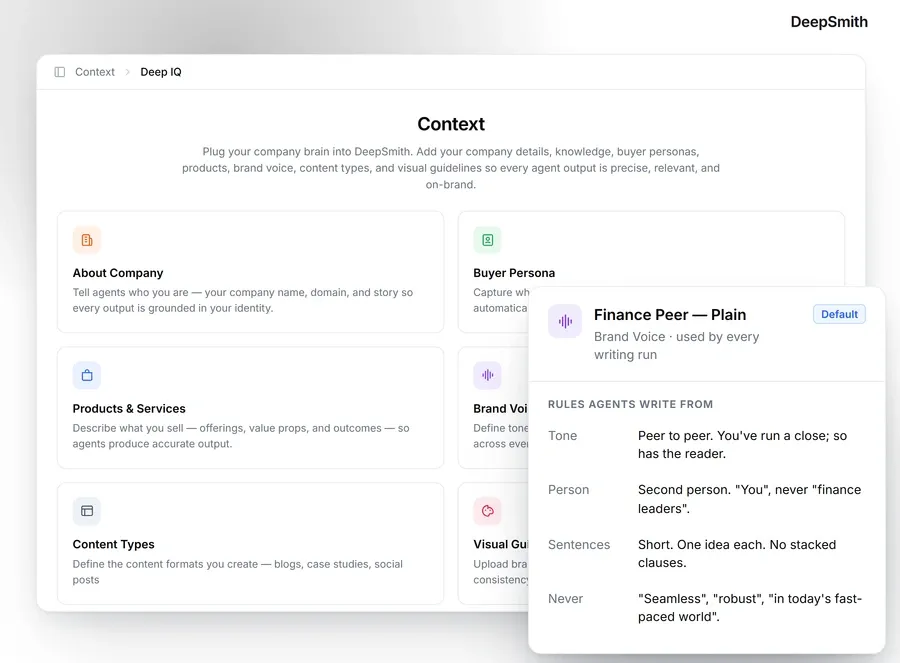
The documented production pipeline covers research, briefing, drafting, quality checks, internal linking, image creation and getting the piece ready to publish. The result is an editable, near-final article that you can review and then publish to WordPress, Webflow, Strapi, Sanity or Contentful, or export. Because the goal is a publish-ready article and not a first draft to rescue, a person still reviews it before it goes anywhere. It doesn't replace expert evidence, source checking or editorial responsibility.
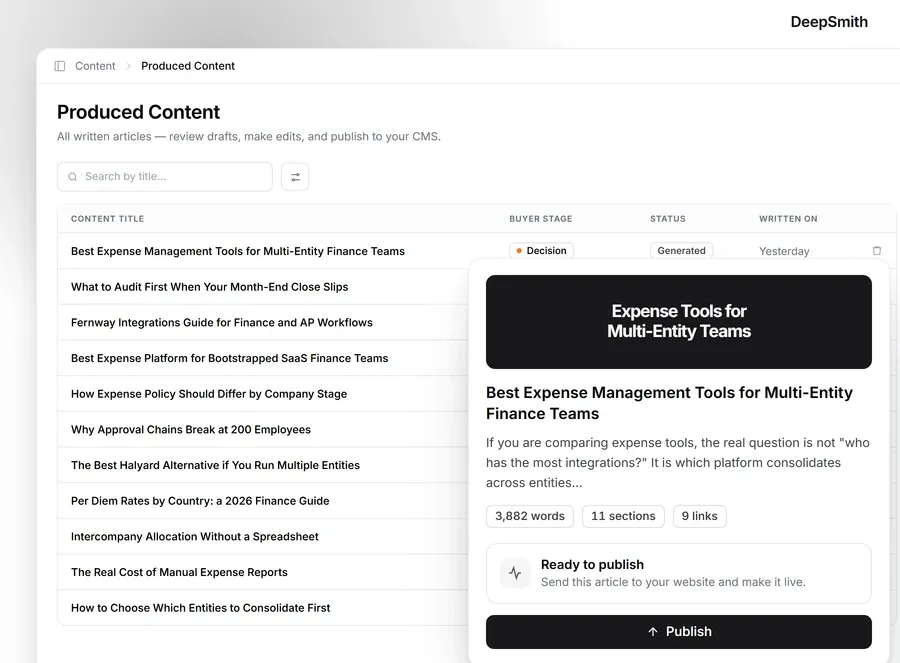
This fits best when your bottleneck runs across producing articles, making them search-ready and moving them through the steps around them. If you have a dependable writing operation and only need targeted checks, starting with an optimization capability is reasonable. If you only need occasional help with text, a broader platform may be more than you need. And if you have both a backlog and repetitive optimization work, it's worth testing the connected route, ideally by looking at how platforms handle the last stretch of finishing work after the first draft. A look at tools that both track and write shows what else is out there on that side, and the non-writing automations worth asking for are a good checklist.
If you got here searching for surfer vs ai writer or clearscope vs ai content tools, the product specifics live elsewhere. Our Clearscope review and the comparison of content automation against on-page optimization cover product details, and the wider list of AI content tools that publish to your CMS is a good place to see the field.
How to run a fair test
Whichever way you lean, test with your own work before you commit. This is a suggested approach, not a published benchmark or a customer study. Pick one question first: can we improve existing content more consistently, can we get acceptable drafts from approved evidence with less effort, or can we cut the total work from brief to approved article? Write down how you work now, because otherwise fast generation can look like progress while it moves the work into editing.
Use real, representative work, give each option the same sources and brand rules, and keep the original drafts. Track the active time at each stage (research, briefing, drafting, edits, fact checking, links and formatting, approvals) and the waiting time between handoffs. Score every article against the same short list: does it answer the reader's question, does every claim that matters have support, are the product facts current, does it sound like you, and is it ready to publish. Cost per approved article is your labor cost plus tool and outside production costs, divided by the number of approved articles, using your own numbers. If you want a fuller walkthrough, a two-week trial of an AI content platform lays out how to set one up.
Which should you choose?
Find the row that sounds most like your week.
| Your situation | Start with | Why |
|---|---|---|
| Reliable writers, but the same coverage and structure problems keep showing up | Optimization | Fix and improve what you're already producing |
| Good briefs and sources, but not enough drafting capacity | AI writing | The shortage is usable text |
| A big backlog of new content and repetitive optimization work | Both, ideally in one workflow you can test | Tie the writing to coverage and publishing needs |
| A valuable library that needs real refreshes | Optimization, with writing help as needed | Decide what needs to change before you rewrite |
| Fast drafts followed by a lot of cleanup | Better evidence, context and workflow before more generation | Speed on the first output isn't solving the whole problem |
| Unclear audience, weak evidence or an unresolved technical problem | Fix that first | Scoring or generating text won't touch the cause |
DeepSmith's strongest case is the combined-gap row, where you need production with optimization and shared context built in. If that's you, you can try it on a real article during the 7-day free trial and judge the result against your own review time. You can start a DeepSmith free trial and run one of your own briefs through it, no long-term contract needed.
Related guides
- How to Generate Article Outlines With AI That Match Search Intent: Prompt AI for outlines aligned to the intent of the query.
- Why AI Drafts Fail Content Optimization Checks and How to Fix Them: Diagnose why AI drafts fail optimization checks, such as missing terms, weak structure, thin sections or off-intent angles, and apply a specific fix for each cause before rechecking.
- How AI Content Platforms Work, From Brief to Published Page: Follow the stages an AI content platform runs, from taking a brief and researching, through drafting, editing and linking, to review and publishing, and see what happens at.
- AI SEO Agents or AI Writing Assistants: Which One Does What?: Tell AI SEO agents from writing assistants by task, inputs and outputs: agents audit, monitor and act on data, while assistants draft and edit text, so you know.
- Content at Scale Review: Features, Pricing, and Whether It Is Worth It: Reviews Content at Scale (also RankWell and BrandWell), a long-form SEO writer that turns a keyword or URL into a full article with WordPress publishing.