You searched "AI mentions but doesn't cite me," landed here, and you already know the sting. ChatGPT says your brand name in an answer, Perplexity name-drops you in a paragraph, and not one of them links back to your site. The good news: this is the most fixable stage of AI search, because the engine already knows you exist. Your job now is narrower than you think. You are not trying to become famous. You are trying to convert mentions to citations, one prompt and one page at a time.
Here is the frame that makes this doable. A mention is the engine recognizing your name. A citation is the engine trusting your page enough to link it. Those two things move independently, so a brand can get named more often while getting cited less. Those unlinked AI mentions are near-misses, not dead ends. The whole game is closing that gap. We call the gap your citation-to-mention ratio, and this guide is a step-by-step way to raise it. Think of every step here as one piece of the same mention vs citation fix.
One number to keep in your back pocket: ChatGPT cites a source in roughly 87% of its responses but names a brand in only about 20.7% of answers. The citing habit is there. The engines want a page to point at. The question underneath all of this is simple: how do I get AI to cite my site? Let's answer it, one step at a time.
Step 1: Pull your mention-vs-citation baseline across the four engines
You can't fix what you haven't measured, so start here. Build a set of 30 to 100 questions your buyers actually ask, grouped by funnel stage and persona. For each question, capture the answer from ChatGPT, Perplexity, Google AI Mode, and Gemini on a clean profile with no personalization and no browsing history. Then tag every response three ways: brand mentioned yes or no, brand cited yes or no, and which sources got cited instead of you.
From those tags, compute three numbers. Mention rate is the percentage of prompts that name you. Citation rate is the percentage that link you. And the citation-to-mention ratio is citation rate divided by mention rate, which is your real conversion metric.
How do you know this step is done? You have a spreadsheet, captured weekly, that lets you plot all three numbers over time. That baseline is the difference between guessing and knowing.
Where people go wrong: sampling only one engine. ChatGPT leans heavily on Wikipedia and training data. Google AI Overviews lean on the top-10 organic results. Perplexity leans on real-time, earned-media sources. Optimize for only one and you miss most of the surface. Track all four from day one.
This is also the step where a tracker earns its keep. Running 100 prompts across four engines by hand, every week, is exactly the repetitive work that quietly falls off your calendar. DeepSmith's AI visibility module runs your prompt set on a schedule, returns mention versus citation for each prompt, and shows you the exact sources the engines cite instead of you. That last part feeds Step 2 directly.
Step 2: Reverse-engineer the sources that get cited instead of you
Now look at the pages that beat you. Every one of your unlinked AI mentions has a page that got the citation you wanted, and that page is your teacher. For every prompt where you are mentioned but not cited, list the sources the engine did link. For each one, write down its shape: is it a list, a table, a definition, a stat, a comparison? What is the word count? Does it have an FAQ block, an author bio with real credentials, a visible last-updated date, outbound links to primary sources?
Do this across a cluster of prompts and a pattern appears. You start to see the exact structural recipe the engines keep reaching for in your topic. That recipe is your target.
You know this step worked when you can describe, for each topic cluster, the format the engines consistently prefer. Not a vague feeling, a specific list.
Where people go wrong: stopping at "they cited Wikipedia" and shrugging. The lesson isn't to copy Wikipedia. It's to notice the properties Wikipedia has, definition-first, fact-dense, neutral, well-sourced to primary references, and frequently updated, then build those properties into your own pages. Diagnosing why a competitor gets cited is more useful than resenting it.
Step 3: Fix retrievability before anything else
Take a breath, because this step is unglamorous and it catches almost everyone. Before an engine can cite your page, it has to fetch your page. If the door is locked, nothing else you do matters.
Check that the AI crawlers are not blocked in your robots.txt: GPTBot, OAI-SearchBot, ChatGPT-User, PerplexityBot, ClaudeBot, Google-Extended, and Applebot-Extended among them. Confirm those user agents get a 200 response, not a 5xx or a timeout. Verify your content is present in the raw HTML, not only after JavaScript hydration, because many crawlers won't run your scripts. Confirm your key pages are actually in Google's index. Audit your XML sitemap, canonicals, and hreflang.
How do you know it worked? Your server logs show hits from those named user agents, and your priority pages return 200 with the real content in the initial HTML.
Where people go wrong: blocking AI crawlers at the CDN or firewall level, then wondering why citations never come. It happens more than you'd think. If the engine can't reach the page, no amount of formatting will save it. This one is worth checking first, and it's often a same-day fix.
Step 4: Make every priority page extractable
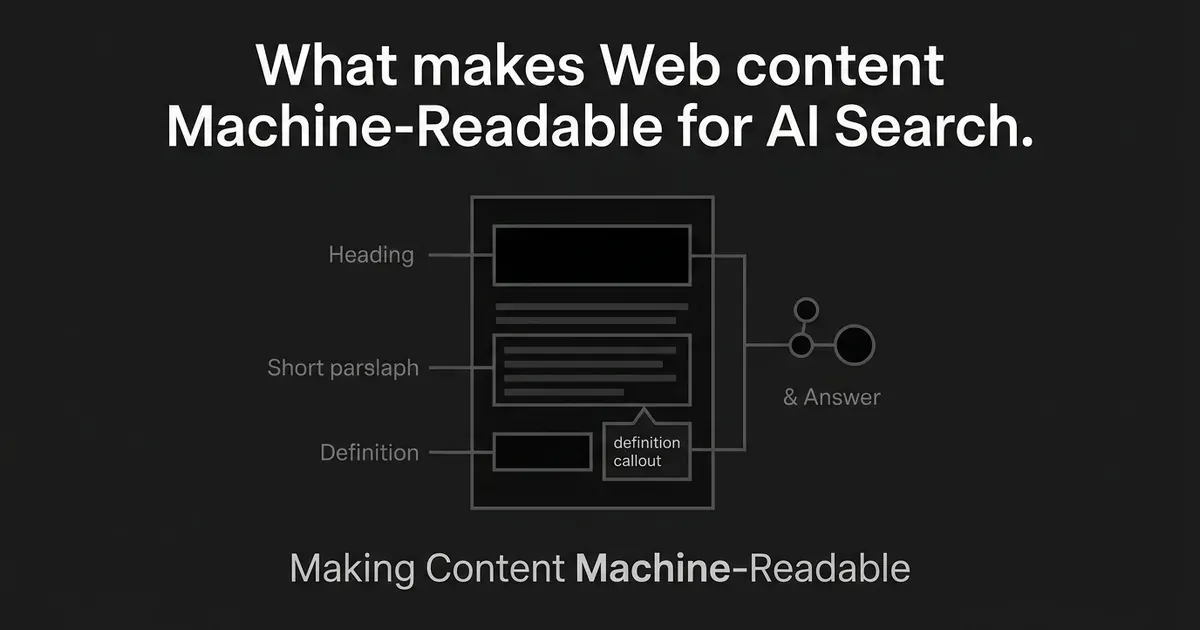
Here's where the writing craft comes in, and it's the highest-leverage work on the list. Engines don't cite walls of prose. They lift clean, self-contained answers they can attribute. So your job is to make the answer easy to lift.
For each priority page, do five things. Put a 30 to 50 word self-contained answer in the first 50 words. Add a clear definition block near the top. Insert a comparison table wherever the topic invites one. Turn any process into numbered steps. Add a short FAQ block with three to five questions. And surface your key statistic with its date and source right there on the page.
There's real evidence behind this. In the Princeton and Georgia Tech GEO study, adding statistics to a page lifted its AI visibility by about 41%, adding citations from authoritative sources lifted it by 30 to 40%, and adding quotations lifted it by around 30%. Structure and evidence are not decoration. They are the citation levers.
You know this worked when a page passes the lift test: paste its URL into a clean ChatGPT or Perplexity session and the engine can reproduce your key claim, with attribution. If it can, you've built a citable surface.
Where people go wrong: polishing the title tag and meta description and calling it done. Engines extract from the body of the page, not the search snippet. The snippet gets you the click on Google. The body gets you the citation in AI.
Building pages like this at volume is slow by hand, and it's where a production engine helps. DeepSmith's Content Studio writes from your stored brand context, so every draft arrives with a definition-first opening, comparison tables, an FAQ block with schema, citations to primary sources, and a visible last-updated date already in place. You're reviewing for judgment, not rebuilding structure on every piece.
Step 5: Engineer your brand as an entity, not just a page
This is the step most content teams skip, and it's quietly one of the most important. Engines that resolve entities, like ChatGPT, Gemini, and Claude, need to see your brand as one consistent thing across the web, not a random string of characters.
So make yourself consistent. Same logo, same founding date, same one-line description, same category, same founders and headquarters, everywhere you appear. Claim a Wikidata entry if you meet the eligibility bar. Pursue a Wikipedia article only if you genuinely clear notability and neutrality. Add sameAs schema linking your Organization to your Wikipedia, Wikidata, Crunchbase, LinkedIn, and social profiles, so the machines can connect the dots.
You know it worked when a search for your brand on Wikidata returns a clean canonical record, and the entity-resolving engines treat you as a known thing rather than a guess.
Where people go wrong: treating Wikipedia like a marketing channel. Notability and neutrality are real gates, and promotional edits get reverted fast. Earn the entity, don't spam it.
Step 6: Add the trust signals engines use as tie-breakers
When two pages are equally extractable, the engine cites the one it trusts more. So this step is about giving it reasons to trust you.
Add a real author bio with credentials, a headshot, and sameAs links to verifiable profiles. Show your published and last-updated dates in the page metadata and in the visible HTML. Add outbound citations to primary sources, government data, peer-reviewed studies, original research. Add the schema that describes your content: Article, Organization, Person, FAQPage, BreadcrumbList. And surface third-party validation, your G2 or Capterra presence, awards, certifications, press logos, on your about page and in your footer.
Freshness carries real weight here. Across cited pages, 76.4% were updated within the last 30 days. A visible "last updated" date and a genuine quarterly refresh are trust signals, not busywork.
You know this worked when a manual review of five priority pages shows every one of those signals present and valid.
Where people go wrong: stuffing schema onto thin content and expecting magic. Schema is a label for what's on the page, not a substitute for it. Which brings us to a mistake worth calling out on its own.
Common mistake: treating schema as the strategy. One study of 1,885 pages that added schema found a slight negative change of about 4.6% in AI Overview citations. Schema helps engines parse and disambiguate your page, but it does not earn the citation by itself. The substance, definitions, statistics, structured formats, and third-party validation, is what earns it. Treat schema as hygiene, not as your plan.
Step 7: Build your off-site citation footprint
Here's a truth that stings a little: your own website is only part of the answer. In the Perplexity corpus, earned media, the reviews, listicles, news mentions, and third-party coverage, accounts for roughly 82% of citations, while brand-owned properties contribute only 5 to 10%. One measurement even found a 239% median lift in citations when the same content moved from a brand's own site to a third-party outlet.
So build the footprint. Earn placements on the domains AI engines lean on for your category: review aggregators like G2, Capterra, and TrustRadius; industry and trade publications; analyst reports; YouTube walkthroughs and demos; genuine participation on Reddit and Quora; podcasts with linked show notes; and Wikipedia or Wikidata where you qualify. Brief your PR and partnerships people with citation impact in mind, because every one of those placements is a potential source.
You know it worked when the share of citations going to third-party domains rises month over month, and you show up as a recommended option on at least two review aggregators.
Where people go wrong: buying placements on irrelevant high-authority sites. Engines weight topical relevance and entity coherence above raw domain authority, so a mention on the wrong site does nothing. And once an article is published, the distribution assets, the LinkedIn post, the newsletter mention, the social thread, are exactly where a tool like DeepSmith's Apps Library keeps that off-site motion from stalling, turning one article into channel-native versions in the same voice.
Step 8: Track the conversion rate and iterate
You've done the hard work. Now make it a loop instead of a one-time push. Track four numbers every week: mention rate, citation rate, the citation-to-mention ratio, and AI-referred sessions. Then attribute each change to what you actually did, a new comparison page, a Wikipedia edit, a G2 review campaign, a refreshed source page. Re-run your full prompt set monthly.
Give it time. Perplexity and Google AI Overviews can reflect on-page changes in days to a couple of weeks, ChatGPT with browsing a little longer, and the underlying model longer still. Plan a 90-day window before you judge results.
You know it worked when the citation-to-mention ratio trends up over that window and AI-referred sessions show up in your analytics as a real, converting line. Picture the shift: from "named in 8% of tracked prompts, cited in 1%" to "named in 35%, cited in 12%." That is what winning looks like here.
Where people go wrong: celebrating mentions while citations stay flat. Mentions are the upper funnel. Citations are the conversion. A pro tip to close on: track the ratio, not the raw mention count, and read the two numbers together. When mentions climb but citations don't, the engine knows you and doesn't yet trust you, and that tells you exactly which steps above to revisit.
What to do next
You don't need to do all eight steps this week. You need the first one. Pull your baseline, find the five prompts where you're mentioned but not cited, and fix the most extractable page first. Momentum matters more than perfection here, and this is a compounding game: every citable page and every earned placement makes the next one easier.
If your standing frustration has been "AI mentions but doesn't cite me," notice how much of the mention vs citation fix is ordinary, doable work: measure the gap, learn from the pages that win, open the door for the crawlers, make your answers liftable, and earn a few real placements off-site. None of it requires a bigger team. It requires a smaller first step, done this week, then repeated. That is how you convert mentions to citations without burning out.
If you'd rather not run the tracking, the page rebuilds, and the measurement loop by hand, that's the whole reason DeepSmith exists. It tracks where you show up across the engines, produces publish-ready pages built to be cited, and shows you which of your pages are actually earning citations, all from the same data. You can start a free trial and see your real numbers before you decide anything.
Whatever you choose, the takeaway is the same. The mention is the hard part, and you've already earned it. Converting it is just steps, and now you have them.