If you're shopping for AI tools right now, you've probably noticed that almost everything gets called "agentic," from the ad platform to the CRM add-on to the reporting dashboard, and somewhere in the pitch deck the word always shows up. But agentic AI vs generative AI is not a marketing slogan, it's a real difference in how a system behaves, and knowing which one you're actually buying changes what the tool can do for you and what it can do to you if it goes wrong.
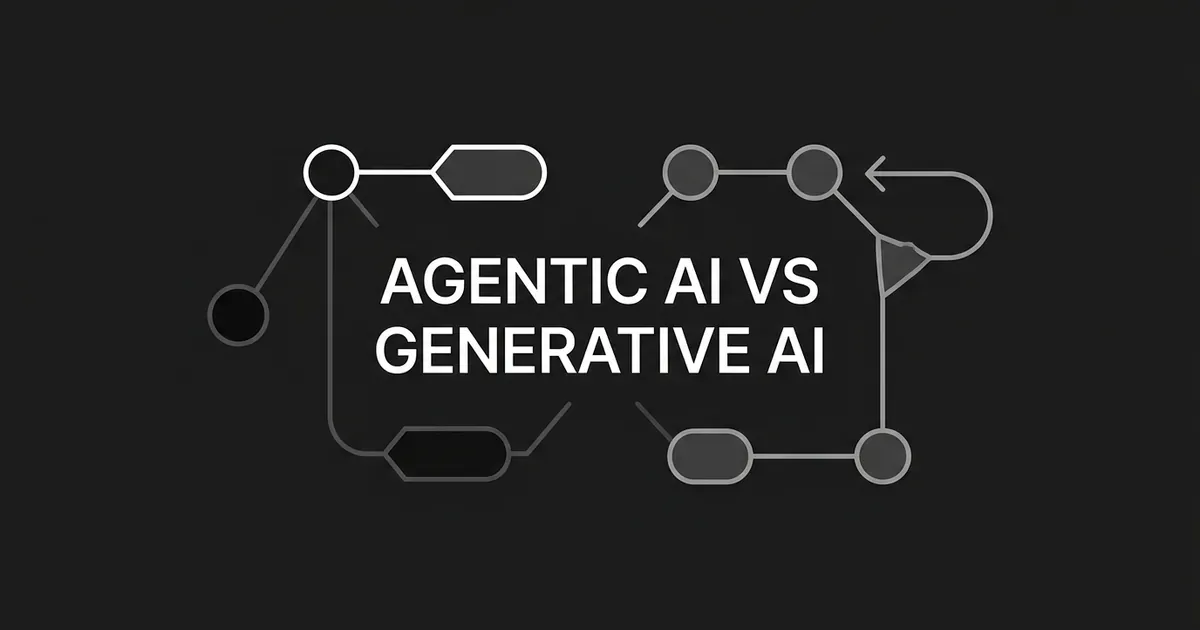
Here's the short version. Generative AI creates or transforms something in response to your prompt: a draft, an image, a summary. Agentic AI goes further. It takes a goal, works out the steps, uses other systems to gather information or take action, and keeps going until the job is done or it needs you to step in. Generative AI is about what a system can produce. Agentic AI is about how a system behaves while it's trying to reach an outcome.
A quick way to see the shape of it:
| Generative AI | Agentic AI | |
|---|---|---|
| Starts from | a prompt or a request | a goal and some rules |
| Produces | a draft, image, or summary for you to use | a completed task, a change made, or a decision carried out |
| Acts without you | rarely, it waits for your next move | can, inside the limits you set |
| Fits best | one-off creative or written work | a job with several steps that repeats |
IBM's comparison of agentic versus generative AI covers the same split in more technical depth, if the table above leaves you wanting the engineering version.
Neither one is better across the board, and getting agentic AI vs generative AI right is really about matching the tool's behavior to the job, not picking a winner. Generative AI is the right pick when you want a draft you'll review yourself. Agentic AI is the right pick when the work involves several connected steps and you'd rather it run without you moving information between tools by hand. The rest of this piece walks through how to tell them apart in a demo, and how to apply that test the next time a vendor tells you their product is agentic.
What generative AI does in marketing
Generative AI takes an input, a prompt, a brief, a request, and produces something new from it. In a marketing context that usually looks like:
- Writing five subject line options for an email
- Drafting social copy for three different channels from one brief
- Producing an image concept for an ad
- Summarizing a campaign dashboard into a short update
- Turning a product brief into a rough campaign concept
- Drafting a customer email using account details you supply
- Suggesting audience segments or a few campaign ideas to consider
The pattern is prompt, output, review, revise. You or a workflow around the tool decide what happens with what it made. That's true even when the tool is connected to real data. A reporting assistant that reads your dashboard and writes you a summary is still generative if you're the one who opens the dashboard, asks for the summary, and decides what to do about it. Being connected to data isn't what makes something agentic. Deciding and acting on that data is.
This is a completely normal, useful category. Most of what marketing teams do with AI today, drafting copy, summarizing reports, generating creative variations, sits here. Microsoft draws the distinction between generation and prediction that sits underneath all of this: a generative system makes something new rather than just scoring or predicting one value. The tool speeds up the parts of your day that involve writing or transforming something. It doesn't try to run the campaign for you.
What agentic AI actually adds
An agentic system is built to pursue a goal through a sequence of decisions, not just answer one prompt. Underneath, it usually has a few working parts:
- A model that does the reasoning
- A goal and some rules for what it's trying to achieve and what it's not allowed to do
- Tools it can use, like an ad platform, a CRM, an analytics system, or a messaging tool
- A loop that lets it choose a next step, look at what happened, and decide whether to keep going
- Some memory of the task, what it already tried, what it learned
- Guardrails, permission limits, approval gates, and a way to flag you when it hits one
Put together, that's a system that can monitor a campaign against a cost target, pull data from a few sources to work out why performance moved, decide whether to change a bid or a budget, make that change through the ad platform, and then check back later to see if it worked. It can pause and ask you for approval when a change crosses a risk threshold you set. OpenAI's practical guide to building agents walks through these same working parts, model, instructions, tools, and the loop that ties them together, in more technical depth than a buyer usually needs but worth skimming once.
The generative model is usually still in there somewhere, writing a message, summarizing what it found, drafting a change log. It's just one component inside a bigger process that plans and acts. This is the part that trips people up when they're comparing generative AI vs agents: the agent probably contains a generative model, so "it can write things" tells you nothing about which category you're looking at. If you want the same distinction applied specifically to content tools, see how agents differ from AI writers.
Who decides what happens next
This is the cleanest way to spot the difference in a demo. With a generative tool, you give the instruction, it gives you the output, and you decide the next move. With an agentic one, you give it a goal, and it works out the steps on its own, inside limits you've set.
Say you're running search ads. A generative assistant will write you headline variations, summarize how the campaign did last week, or suggest a bid change for you to make. An agentic system, given a target cost per acquisition and a budget ceiling, will watch the campaign, notice when it's drifting from target, decide what to change, and make the change itself through the platform, then watch what happens next. You're not typing a new prompt every time something shifts. You set the goal once and the system keeps working toward it.
Neither behavior is inherently better. A generative assistant that waits for you is exactly what you want when you want creative control over every headline. An agentic system that acts on its own is what you want when the campaign needs constant small adjustments you don't have time to make by hand.
What each one is allowed to touch
The other place the gap shows up is permissions. Generative tools mostly read: they pull in a dashboard, a CRM record, a brief, to produce an output. Agentic tools can write: change a bid, update a CRM record, send a message, publish a report.
This distinction matters a lot more than it sounds like it should, because "read" and "write" carry very different risk. A tool that drafts a CRM update for a rep to review is generative-flavored, even if it's smart about the draft. A tool that identifies a lead, checks its status, and updates the CRM record itself is agentic, and it now has operational consequences if it gets the update wrong.
When you're evaluating a tool, ask for the actual list: what can it read, and separately, what can it change, send, or publish without you in the loop. Vendors will happily tell you what their system can see. Make them tell you what it can do.
What happens when the first plan doesn't work
Adaptation is the third tell. A generative tool, faced with something unexpected, an API error, a metric that moved the wrong way, a budget threshold, will usually just explain the situation and suggest what you should do about it. An agentic one is supposed to have a defined response: retry, pick a different approved action, ask for clarification, pause, or escalate to you.
Test this directly. Ask the vendor to walk you through what happens when the audience is too small, the ad platform's API errors out, or two data sources disagree with each other. If the honest answer is "it flags it for a human," you're looking at something closer to a smart assistant than an agent, and that might be exactly the right tool for the job. If the answer involves the system choosing among a few approved next steps on its own, that's the goal-driven AI part of an agentic workflow actually doing its job.
State matters here too. Does the system remember what it already tried during this run, or does every check start from zero? Ask about retention: how long it keeps that context, where it's stored, and whether you can see or edit it. A vendor saying "it has memory" tells you very little without those details.
The test to run before you believe the word "agentic"
Vendors use the term loosely, so the label on the box isn't reliable evidence. Before you take "agentic" at face value, run through this:
- Give it an outcome, not a recipe. State the result you want and the constraints around it, not a list of steps. If the tool needs you to specify every click, it's automation with an AI interface, not an agent.
- Check what it can see. Ask what it can pull in on its own, without you copying data into it: ad performance, CRM records, analytics, prior actions. A system that can't observe the relevant systems can't make a grounded decision about them.
- Ask for the tool list and split read from write. Recommend a bid change and change the bid are two very different capabilities. Get the full list.
- Ask to see the control loop. How does it interpret the goal, choose its first step, decide what to do with each result, and know when it's done or needs you?
- Test what happens when the plan breaks. Give it a scenario where the obvious approach won't work and see what it actually does.
- Check autonomy boundaries in plain terms. Which actions happen without you, which need approval, and what are the spending or messaging limits.
- Ask about the audit trail. Can you see what it decided, what it did, and reverse it if it was wrong?
For a closer look at what AI agents can automate versus what still needs a person watching, it's worth reading before you sign anything.
A tool that holds up under this test is doing something a chat window with a single lookup tool cannot. That's the real agentic AI marketing difference: not whether it uses a model, but whether it can independently choose a next step, act on it through a connected system, and show you what it did.
When each one wins
Generative AI is usually the better fit when the task is bounded and you want to review the result before it goes anywhere: drafting campaign variants, summarizing a report, turning research into a brief, proposing ideas to test. The output is easy to check, the task doesn't need to change any external record, and you'd rather keep the creative call yourself.
Agentic AI earns its place when the job involves several connected steps, the data lives across more than one system, and the next move depends on what the system finds along the way. Continuous campaign monitoring, lead routing that pulls from CRM and behavior data, a recurring report that needs to chase down a data problem before it publishes, these are jobs where a human is currently the one shuttling information between tools, and that's exactly the gap an agent is built to close.
There's a third option worth naming: plain, fixed automation, no dynamic decision-making at all. When the workflow is stable, the rule is easy to write down, and the cost of a wrong decision is high, a deterministic rule can beat an agent on safety and cost. Don't reach for autonomy because it sounds more advanced. If a fixed sequence solves the problem and doesn't need a model choosing anything, it's often the cheaper and safer buy. If you're weighing whether to build that logic yourself or buy a system that already does it, that's a build vs buy call worth making deliberately rather than defaulting to whichever tool pitched you last. And separately, whether an agentic workflow is worth it for a lean team at all deserves its own gut check, not just a feature checklist.
Where the "agentic" label breaks down
A few habits are worth watching for, because they show up constantly in vendor pitches.
"It generates content, so it's agentic." Generation is compatible with both categories. A tool that only writes copy on request is generative no matter how good the copy is.
"It has an API integration, so it's agentic." An integration that only retrieves data, or runs a fixed sequence, isn't the same as a system that decides what to do with what it finds.
"It runs on a schedule, so it's agentic." Scheduled, rule-based automation can run every day without ever making a judgment call.
"Human approval means it's not really agentic." The opposite is usually true. Requiring approval for a risky action, sometimes called a human-in-the-loop step, is responsible design, not a sign the system lacks agency.
Consulting research paints an optimistic picture of the upside too. McKinsey has estimated that agentic workflows can meaningfully speed up campaign creation and testing, but that's a forecast built on selected examples, not a guarantee for every rollout, and it says nothing about whether a given vendor's version of "agentic" actually clears the bar this article just walked through.
There's a real cost to getting this wrong. A mistake in a generative draft gets caught by a reviewer before it does anything. The same kind of mistake, made by a system that can act on it, can change a budget, contact a customer, or update a record before anyone notices. That's why the guardrails matter more as a system's ability to act grows: permission limits, approval gates for anything risky, and a record of what happened that you can actually check. If you want a closer look at how teams handle this on the content side specifically, the governance guardrails for agent-produced work translate directly to what you should expect from an agent touching your ad accounts or your CRM.
Data quality is the other quiet failure point. An agent can't make good decisions from incomplete, stale, or inconsistent data any more than a person can. Before you hand a system write access to your ad account or your CRM, check whether your identifiers, event definitions, and consent fields actually line up across the systems it's supposed to connect. Adding more connections without fixing that first tends to add complexity rather than remove it.
The decision rule
Once you've run the test above, the agentic AI marketing difference stops being a marketing term and starts being something you can check for yourself. Don't judge a tool by whether it has a chat window or whether its landing page uses the word "agentic." Judge it by what it can observe, what it can decide, what it can actually do, and what it shows you afterward. A tool that only produces something for you to review is generative, and that's a perfectly good thing to buy when the task calls for it. A tool that takes a goal and works its way through connected systems to reach it, inside limits you set, is agentic.
The same test applies if you're evaluating how a brand shows up in AI answers, not just how a campaign runs. A dashboard that tells you your citation rate is generative-adjacent: useful, but it stops at the report. A system that also finds where you're missing and turns that gap into a finished piece of content is closer to agentic, because it acts on what it found instead of just describing it. That's the difference we build DeepSmith around: it doesn't just tell you where you're invisible in AI search, it produces the content to close the gap, from the same underlying data. If you want to see how that test plays out on your own visibility numbers, DeepSmith's free trial gives you real data and a real draft before you decide anything.