You type a prompt. Ten seconds later you have fifteen hundred words. They read well.
Then you spend the next three hours checking the numbers, hunting for sources, fixing the structure, adding internal links, and rewriting the parts that sound like every other AI article online.
That gap is the whole story of prompting vs AI agents. The draft arrived fast. The work didn't disappear. It just moved onto your desk.
If that feels familiar, you're not doing it wrong. You're running into a real limit of how one-shot generation works, and almost everyone hits it.
Here's what you'll get from the next few minutes. You'll know what a single prompt can and can't reliably do. You'll understand what a goal-driven agent adds, in plain terms. You'll see what the research actually supports, without the hype. And you'll have a short test for deciding which one your next article deserves.
Let's take it one piece at a time.
One prompt gets you a draft, not a defensible article
A single prompt is built to produce a plausible answer, not a verified one.
That's the crux of it. When you ask a model to write an article, it produces the main answer in one pass. It's fast and it's fluent. But nothing in that pass proves the model researched the topic, checked its claims against current sources, attributed anything correctly, noticed it contradicted itself, or went back to fix a weak section.
Fluency and truth are different things. A paragraph can be smooth and still be wrong.
NIST has a word for this. It calls the confident presentation of false or erroneous content confabulation. The same category covers output that drifts from what you asked for, or that contradicts something the model said three paragraphs earlier.
In marketing content, one small unsupported line causes real damage:
- A product description promises a feature you don't actually ship.
- A statistic gets repeated with no traceable source behind it.
- A comparison flattens the differences that mattered to the buyer.
- A fact that was true last year is written as though it's timeless.
- The whole page sounds authoritative while giving the reader no way to check any of it.
None of that makes prompting useless. Far from it. Prompting is excellent for brainstorming, outlines, rewrites, summaries, and format changes. These are simply the AI content generation limits you need to plan around: a one-shot pass optimizes for a good-sounding response, not for evidence you'd be willing to defend in a leadership review.
Your next step here is small. Take the last AI draft you published. Pick the three most specific claims in it. Can you name the source for each one, right now, without searching? If not, you've just found where your process actually ends.
What a goal-driven agent adds
An agent changes the unit of work. A prompt asks for an output. A goal defines a result that has to be achieved.
"Write a 1,500-word article about topic X" is an output instruction. It says nothing about evidence quality, reader questions, source requirements, brand boundaries, or how anything is supposed to know when the article is finished.
"Create an accurate, evidence-backed article that answers this buyer question, covers the required subquestions, uses approved product claims, and makes the important claims easy to verify" is a goal. Now there's a standard to research against, draft against, check against, and revise against.
That's what goal-driven AI content means in practice. You start with the information job, not the prose request.
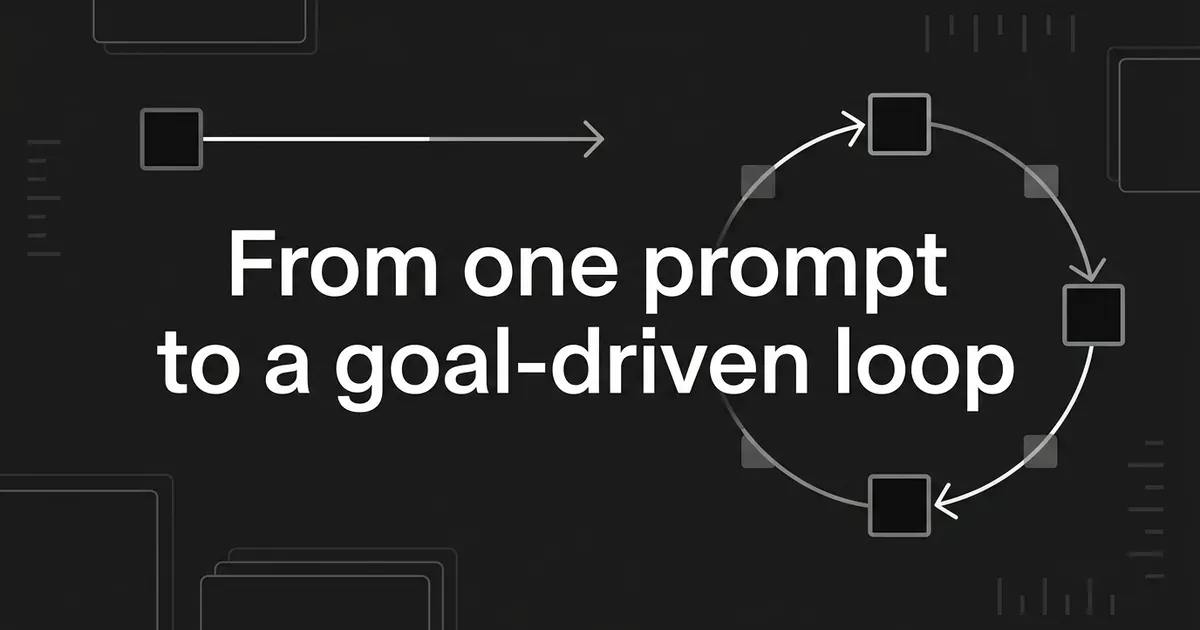
An agent is the system that chases that job. OpenAI's practical guide describes three core parts: a model that reasons and decides, tools it can call to fetch information or take action, and instructions that set the guardrails. The important word is loop. Define the goal, gather evidence, act, look at what came back, decide what's still unresolved, then revise or stop.
An agent is not just a longer prompt. Four things change once that loop exists.
Research stops being decorative. In a one-shot request, "research this topic and write an article" is a preface. The model may or may not have looked anything up. An agent treats research as an unfinished part of the goal. It can spot what it doesn't know yet, search, compare what it finds, and search again when the first pass came back thin.
Drafting becomes an intermediate state. In one-shot generation, the draft is the deliverable. In a loop, it's a working artifact you can inspect. Does it answer the buyer's question early? Are the main claims supported? Did it introduce something the sources never said? Do the sources actually back the sentences sitting next to them? Do two sections contradict each other?
Checking becomes its own job. Generation and evaluation are different tasks, and useful loops separate them. One pass writes. A second pass, model, rubric, or tool grades that writing against explicit criteria. The draft then gets revised because it failed a check, not accepted because it read nicely.
Revision becomes evidence-led. This is the part people skip. Evidence-led revision doesn't mean making the prose sound more confident. It means adding the missing source, narrowing a claim that was too broad, cutting the attractive statistic nobody can trace, resolving the contradiction, or moving the answer above the background. The RARR research describes exactly this pattern: research what a model said, find the attribution, then post-edit the unsupported parts while keeping as much of the original as possible.
There's one more thing a loop needs, and it's easy to forget. A stopping rule. An agent shouldn't search forever. It stops when the required claims are supported, the important objections are addressed, source quality is acceptable, and whatever uncertainty is left has been either resolved or disclosed.

Why grounding and checking beat polished prose
Here's the honest framing: an agent doesn't eliminate hallucinations. It creates more chances to catch them.
That's a smaller claim than the one you'll see in most tool marketing, and it's the one that holds up.
The mechanism is simple. A model working from pretrained memory alone has nothing to check itself against. A model that can consult approved company context, your website, current research, and source documents has external ground truth to compare against. Evidence gives the loop something to test a sentence on, instead of asking the model to trust its own prediction.
Citations are where this gets practical, and where most teams stop too early. Three different things hide behind the word:
- Citation presence. A link appears somewhere on the page.
- Citation correctness. The source actually supports the claim it sits next to.
- Citation completeness. The important factual claims are supported, not just the two easy ones.
Presence is the weakest of the three, and it's the one that's easiest to fake. This matters more now that answer engines are in the mix. Google's guidance describes AI Overviews and AI Mode as surfacing relevant links so people can find information quickly and reliably, and notes that different AI features may use different models and techniques, so the responses and links vary. You can't control that variance. You can control whether your key answers are clear and whether your important claims are actually supported.
A research-and-check loop improves the conditions for citation quality. It researches before drafting, keeps the evidence attached to each claim, checks whether the source supports the final wording, and revises what it can't support. None of that guarantees correct citations. Retrieval fails. Sources are weak. Models misread evidence.
Your next step: before your next piece goes live, pick your five most load-bearing claims and check each one for correctness, not presence. If a link doesn't support the exact sentence it's attached to, it's decoration.
The evidence is promising, not magical
The research on iterative generation is genuinely encouraging. It is not a guarantee, and anyone selling it as one is overselling.
Here's what's actually been measured.
Self-Refine studied a loop where a model generates an output, gives feedback on its own output, then uses that feedback to refine it. Same model doing all three jobs, with no extra training. Across seven tasks, using GPT-3.5, ChatGPT, and GPT-4, humans and automatic metrics preferred the refined outputs over conventional one-step generation, with a reported average improvement of roughly 20 percentage points in task performance.
Read that carefully. Seven evaluated tasks, not every content workflow. Not a benchmark of marketing articles. Not a promise that your blog posts get 20% better.
Chain-of-Verification describes a related pattern: draft an answer, plan verification questions, answer those questions independently, then produce the final response. The reported experiments showed reductions in hallucination across list questions, closed-book question answering, and long-form generation. It didn't establish that verification eliminates hallucination, and it gave no universal effect size.
FRAMES tested retrieval on 824 multi-hop questions that need information from several documents. Accuracy rose from 0.408 with single-step inference to 0.66 with multi-step retrieval. The same study noted performance stayed relatively low even after five iterations, and that the setup required six non-parallelizable inference calls per question. Multi-step retrieval helps on hard multi-document questions. It's slow, and it isn't a cure.
BrowseComp ran 1,266 difficult browsing problems, built to be hard for models but easy to verify. GPT-4o scored 0.6% without browsing and 1.9% with it. OpenAI o1 reached 9.9%. Deep Research reached 51.5%.
That table is worth sitting with for a second. Turning browsing on moved GPT-4o from 0.6% to 1.9%. Strategic search, reasoning, and evidence synthesis moved the number far more. Access to a search tool is not the same as knowing how to use it.
ALCE evaluated systems that retrieve evidence and generate answers with citations, scoring fluency, correctness, and citation quality. On the ELI5 dataset, even the best systems lacked complete citation support half the time. That's a system explicitly designed to cite well, still leaving half its claims uncovered.
So what should you take from all this? Not a number. A direction. Generation and evaluation are different jobs, and letting a system do both tends to produce a better result than doing one and calling it finished. That's the defensible version of the claim, and it's plenty.
When agents are worth it, and when a prompt is plenty
So why use AI agents at all, when a prompt is faster and cheaper? Because the AI content generation limits above cost you real hours every week, and sometimes the extra process buys those hours back. Sometimes it doesn't.
Agents come with real costs, and pretending otherwise helps nobody.
- More time and money. Multiple model calls, retrievals, evaluations, and revisions cost more than one generation. That's only worth it if it saves more editing, research, or factual risk than it costs.
- Compounding errors. An agent can pick a weak source early, misread it, and carry the mistake through every step after. More steps mean more chances to fix things and more chances to break them.
- False confidence. A system that says it verified something can sound trustworthy without being trustworthy. "Verified" has to mean claims were checked against relevant evidence and passed stated criteria, not that the model wrote a paragraph that sounded like verification.
- Nothing to measure against. No system improves against an undefined standard. If nobody on your team can describe what a good result looks like, more steps just add activity.
Anthropic's own guidance on building agents is refreshingly conservative here: start with simple prompts, evaluate them, and add multi-step agentic systems only when the simpler thing falls short. Fixed workflows win when the task is well defined and predictability matters. Agents earn their keep when the required steps are open-ended or hard to anticipate.
The one-shot vs agentic AI question is really a question about risk and repetition. Here's a test you can run in five minutes.
- How much research does this article need? One supplied document, a prompt is fine. Current sources, comparisons, and synthesis, an agent starts to make sense.
- How costly is an unsupported claim here? Product claims, regulated topics, customer promises, and competitive comparisons need stronger checks than a casual opinion piece.
- How much rework follows the first draft? If you spend more time fixing structure, sources, links, and voice than shaping the editorial point of view, your current process isn't really saving time.
- Can you measure quality? Define the checks before you add complexity. Not after.
- Is this work recurring? A goal that shows up across fifty articles is worth systematizing. A one-off usually isn't.
- Is the task open-ended? If you can't predict the path in advance, letting the model direct its own research beats a rigid sequence.
- What's your role in it? The best outcome isn't removing your judgment. It's moving your attention to angle, claims, positioning, and accountability.
Keep prompting for low-risk, well-defined tasks. Move toward agents when correctness depends on current external facts, when several sources are involved, when brand constraints are strict, and when the same manual review keeps repeating. When you frame one-shot vs agentic AI that way, most decisions answer themselves.
What actually changes for your team
The shift is operational as much as technical, and this is the part that shows up in your calendar.
A prompt gives you a draft. A goal-driven system can connect the whole chain: the buyer question worth answering, the evidence needed to answer it, the brand and product context that constrains the answer, the checks required before publishing, the content gap that motivated the work in the first place, and the finished article with its distribution assets.
Think about where your hours currently go. You're not just approving editorial direction. You're writing briefs, checking heading structure, confirming product claims, hunting for internal links, reviewing sources, formatting, and then preparing the LinkedIn post that never quite gets written. Every one of those that becomes systematic gives you back time for the decisions that genuinely need your context.
This is the idea behind how DeepSmith is built. Opportunity Agents read your AI visibility and Content Map data and return ideas with the data point that justifies each one attached, so a backlog item arrives with its evidence rather than as a guess. Deep IQ stores your company, product, persona, brand voice, and content type context once, so nothing has to be re-briefed per article. The Writer researches, links, and grounds each piece in that context, and Autowrite runs a planned idea on its scheduled date so it lands in your review queue without anyone opening the app.
The point isn't that a machine wrote an article. It's that your content operation has a repeatable way to turn an evidence-backed goal into something reviewable.
You still review it. That doesn't change, and it shouldn't.
If you're still asking why use AI agents for content, here's the short version. Prompting is the right call when the task is simple and being wrong is cheap. Goal-driven AI content earns its extra cost when the work is a recurring information job that needs research, evidence, revision, and a consistent standard. The question was never whether agents sound more advanced. It's whether the extra process gives you something you'd be comfortable publishing under your own name.
Start small. Pick one recurring article type, write down what "done" means for it, and see how much of your review time is spent on things a defined standard could have caught. That list is your business case.
When you're ready to see what goal-driven AI content looks like end to end, from visibility gap to published piece, start a 7-day free trial and run one topic through it.