Someone on your team asked what is agentic content automation, and you nodded, and then you quietly wondered the same thing yourself. That's normal. The word "agentic" got popular before anyone agreed on what it meant.
Here's the good news. You don't need a computer science background to get this. The whole AI agents vs AI writers question comes down to one small idea: who decides what happens next.
That's the hinge. Once you see it, the vendor language stops being noise.
By the end of this piece you'll be able to define agentic content automation in a sentence, explain the difference to your CEO without a slide, spot when an agent is overkill, and understand why any of it matters for getting your pages cited in AI answers.
Let's take it one step at a time.
What is agentic content automation, in one sentence?
Agentic content automation is content production where an AI system plans the work itself, calls tools on its own, checks what it found, and keeps going until the task is done or a stop rule fires.
Read that again and notice what's missing. There's no prompt in it.
That's the point. In agentic content automation, you hand over a goal, not a set of instructions for one output.
It helps to picture three rungs on a ladder rather than two boxes.
Rung one: one-shot AI writing. You type, the model types back. You are the planner, the researcher, the editor, the linker, and the publisher. The model writes sentences. You do everything around them.
Rung two: sequenced workflows. The steps are fixed in advance by code. A model does the drafting in step three and the rewriting in step five, but the path never changes. It's predictable, and predictable is often exactly what you want.
Rung three: goal-driven content agents. The model decides what to do next. It picks its own tools, reads what comes back, and uses that feedback to decide whether to keep working.
Rung two is the real boundary. Rung three is where goal-driven AI content lives, and it's what people usually mean when they say agentic AI content.
If your current setup lives on rung one, you're in good company. Most teams are there. Moving up is a decision, not a moral failing.
What an AI agent actually is (and what it is not)
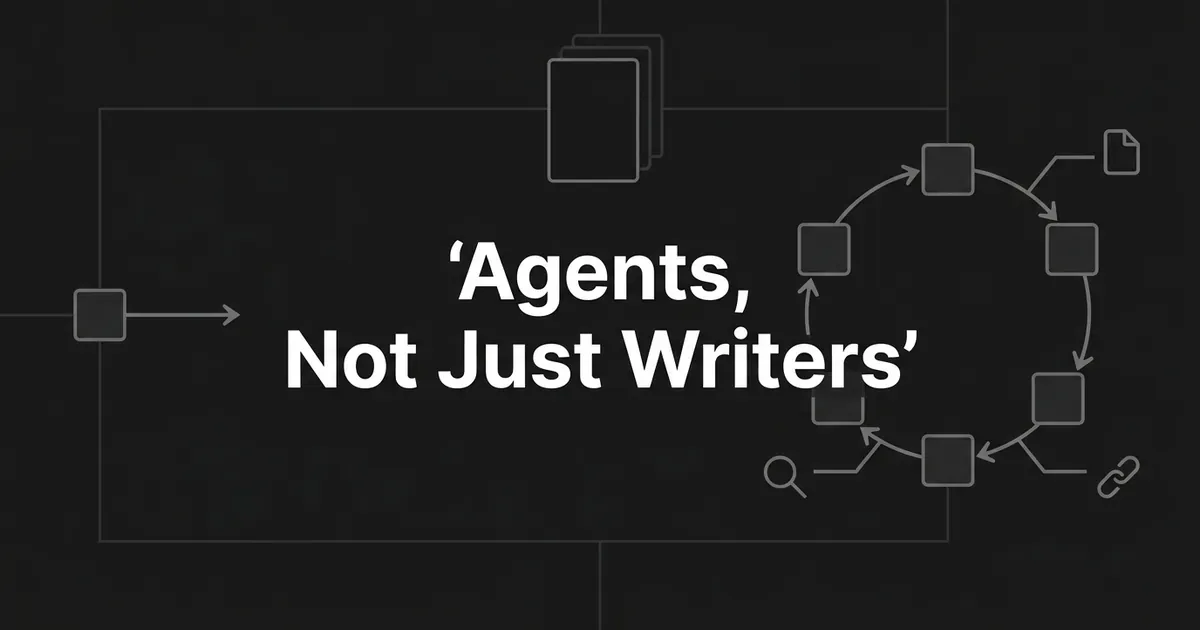
An AI agent is a model that plans, calls tools on its own, and uses feedback from those tools in a loop until a stopping condition fires. An AI writer is a model that turns one prompt into one response.
That's the whole distinction. Everything else is detail.
The people who build these systems say the same thing in slightly different words. Anthropic's engineering guidance draws the line between workflows, where models and tools are orchestrated through predefined code paths, and agents, where the model dynamically directs its own process and tool use. OpenAI's guide for building agents describes three parts: a model that reasons, tools it can call to take action, and instructions that set the guardrails.
Both describe the same shape. A loop that runs until an exit condition is reached. That condition might be a finished task, a maximum number of turns, an error, or a structured output the system was waiting for.
Both also say agents should pause for a human at checkpoints. High-stakes or irreversible actions are not meant to run unattended.
Now map those three parts onto content work you already recognize:
- The model drafts, edits, and evaluates prose. This is the part you've already met.
- The tools are the rest of the job. Web search. A sitemap query. An internal-link index. A trusted-sources list. An SEO and AEO scorer. An image generator. A CMS or a publishing webhook. Which tools the system can reach decides whether it produces something publishable or only something draftable.
- The instructions carry the goal. Not "write a blog post." Something more like: get cited for a tracked prompt, close a coverage gap against a named competitor, or fill the decision-stage hole in a topic cluster.
Notice that the tools list is mostly not writing. That's where the hours go, and that's where the difference shows up.
One more piece of precision, because it will save you an argument. A single tool call does not make a model an agent. It makes it tool-using. The line sits in the control dimension, not the tool dimension. If you're the one deciding the next move, you're the agent in that system, no matter how many tools are on the table.
AI agents vs AI writers: who runs the workflow
The clearest way to hold the AI agents vs AI writers comparison in your head is to stop comparing the prose. Both systems use a model to write sentences. Compare the operations instead.
| What's happening | One-shot AI writer | Goal-driven content agent |
|---|---|---|
| Who plans the work | You, in the prompt | The agent, against a goal in its instructions |
| Calls tools on its own | No | Yes, dynamically, in a loop |
| Reads feedback from those tools | No | Yes: search results, existing pages, scores, link coverage |
| Who iterates | You, by re-prompting | The agent, up to a stop rule |
| Stops when | You decide it's done | A stop condition fires |
| What you get | A first draft | A finished, structured, linked article |
Look down that first column. Every "you" is a slot in your calendar.
That's the real cost of one-shot writing, and it's why the price on the pricing page never matches the cost per article. The model isn't charging you for the planning. You're paying for it in hours.
Before and after: the same article, two ways
Let's make this concrete, because abstractions are hard to act on.
Before. You open a chat window and type: write a 1,200 word article on agentic content automation using my product positioning. Ninety seconds later you have a draft. It's fluent and generic, with a vague intro and no links.
Then the real work starts. You paste it into a doc. You rewrite the opening so it sounds like your brand. You check it against your existing cluster so you're not repeating a post from March. You pick internal pages to link to and go find their URLs. You write alt text. You write a meta description. You make a cover image somewhere else. You paste it all into the CMS, set the slug, set the tags, and queue the social posts.
Hours, not minutes. And almost none of it was writing.
After. You drop an idea into a content system: earn citations for "what is agentic content." The instructions already carry your depth, your length, your internal-link count, your external-link count, your brand voice, and your trusted-sources list.
The agent reads the brand context. It scans your existing topics. It checks what competitors published for that same question. It decides what the piece has to cover, drafts an answer-first outline, evaluates that outline against an AEO checklist, generates a cover image, builds the metadata, pulls internal links from your sitemap, and adds external links from your trusted list. A publish-ready article lands in your queue.
You review it. For editorial judgment, not for header structure.
The difference isn't the sentences. It's who ran the workflow.
When a one-shot AI writer is still the right tool
This section matters, so don't skip it. Agentic is not automatically better.
Both Anthropic and OpenAI say the same thing to developers: build the simplest thing that works. For plenty of tasks, one well-aimed model call with good context beats an agent. Fixed workflows give you predictability for well-defined work. Agents trade latency and cost for the ability to handle open-ended tasks.
There's a failure mode too. When a system loops on its own, one bad tool call can derail the whole run, and errors compound as the loop continues.
So here's a simple rule you can use this week.
Reach for a one-shot AI writer when you already know what you want. Idea expansion. Reworking a paragraph. A short explainer. A rewrite in a different tone. You're the planner, and that's fine, because the planning is small.
This isn't a knock on any one product, by the way. ChatGPT can run a web search and hand you sources when you ask it to. What we're comparing is the usage pattern, not the tool.
Reach for goal-driven AI content when the goal is defined by something outside the prompt. A citation gap. A hole in a topic cluster. An AEO score you're trying to move. A competitor's position. A publishing date that has to be hit whether or not you have a free afternoon.
If you can write the goal down and the goal is not "write this article," an agent has something to work with.
Why agentic AI content matters for getting cited
Here's where the two threads meet.
Getting cited in AI answers is mostly a structure and eligibility problem, and structure is exactly the work that falls off the end of a one-shot draft.
Before we go further, separate two words that get used as if they mean the same thing. A mention is the model naming your brand in an answer. A citation is the model attributing something to your page, usually with a link. Those are different problems with different fixes. If you're never mentioned, you have a topical authority problem. If you're mentioned but never cited, you have a structure and evidence problem, because nothing on the page is easy to lift cleanly. Goal-driven AI content is most useful against the second one.
Google's own guidance for site owners is refreshingly boring on this. There are no additional requirements to appear in AI Overviews or AI Mode. No new machine-readable file. No AI text file. No special structured data type. To be eligible as a supporting link, a page needs to be indexed and eligible to appear in Google Search with a snippet.
The fundamentals are still the fundamentals:
- Let crawlers in, through robots.txt and through your CDN or host.
- Make content findable through internal links on your own site.
- Give people a good page experience.
- Make sure the important content exists as text, not only inside an image or a script.
- Support the text with quality images and video where they help.
- Make sure your structured data matches what a person actually sees on the page.
On top of that, pages that get pulled into AI answers tend to share a shape. A direct answer near the top of each section instead of buried in narrative. Headings written as questions or clear noun phrases. Named, attributable evidence. A visible date when something substantive changes. A tight definition early, so an extractive system can lift it cleanly. A comparison table where the question is a "best tools" or "X vs Y" question.
Read that list again with your last AI draft in mind. How much of it did the draft handle by itself?
That's the honest case for agentic AI content. The work is not glamorous. It's structural, repetitive, and easy to skip at 5pm on a Thursday. A system that plans against a goal doesn't skip it, because the checks are part of the loop rather than a step you remember on a good day.
The chain looks like this in practice:
- Define the gap. Track a set of prompts across the platforms your buyers actually use. For each one, record whether you were mentioned, whether you were cited or linked, and how you were described.
- Pick an opportunity with evidence attached. You get mentioned for a prompt but never linked. A competitor owns a question you have no page for. A "best tools" prompt has no page from you at all.
- Set the goal, not the prompt. Depth, length, internal-link range, external-link range, brand voice, trusted sources, funnel stage.
- Let the system run. Research, draft, structure, links, image, metadata.
- Review for judgment. Is the angle right? Is the claim ours to make? Those are your calls.
- Measure again next cycle. Monthly is a realistic rhythm for a small team.
This is the pattern DeepSmith is built around, which is why AI visibility and content production sit in one platform rather than two. Tracked prompts show which questions you're losing. Content Studio's pipeline handles research, drafting, optimization, internal linking, the cover image, and the metadata in one run, grounded in the brand context stored in Deep IQ so the draft sounds like you. Autowrite takes a planned idea and produces it on its scheduled date, so the calendar keeps moving during a busy week.
The tool is one way to do this. The pattern is the thing worth taking away.
The honest limits of autonomous content agents
Time for the part vendors skip. Autonomous content agents are useful, and they are not magic.
What they do. Plan against a content goal. Run a research loop. Draft. Evaluate the draft against a checklist. Iterate. Insert internal links from a known sitemap. Pull external links from a trusted list. Generate a cover image and metadata. Hand off to a human, or publish.
What they don't do.
They can't make an AI engine cite you. No publisher controls that. Google says plainly that indexing and serving are not guaranteed, even for an eligible page. Bing's AI performance reporting is equally careful: it shows which content was cited, and it says outright that it does not measure ranking, authority, performance, or importance.
That reporting is worth knowing about anyway, as long as you read it for what it is. It tells you which of your pages were cited, roughly how many pages get cited per day, and the phrases the model used when it went looking. It does not show you individual answers, exact prompts, or why one page was picked over another. It's a summary, not an explanation. Treat it as a signal to investigate, not a scoreboard.
They can't tell you which questions matter. Autonomous content agents work from the prompt set your team defines. Garbage in, confidently formatted garbage out.
They aren't a quality upgrade on every task. For a quick rewrite or a bit of thinking out loud, a one-shot writer under your direction is still faster and often better.
They aren't a shortcut past SEO basics. The same page has to be crawlable, indexable, and genuinely useful either way.
So the honest promise is narrower than the marketing, and still worth having. An agent raises your odds and lowers your time cost for producing citable content at volume. It does not buy you a citation.
Where to start this week
You don't need to rebuild your content operation. You need one honest look.
Take your last published article and ask two questions. Which parts of it did a model produce, and which parts did you produce by hand afterward? Then ask which of those manual parts repeat on every single piece.
That second list is your agent's job description. It's usually research, structure, internal links, metadata, and images. It's usually not the editorial judgment, and it shouldn't be.
Start there. One list, twenty minutes, this week. You're closer than you think.
If you'd like to see what a goal-driven pipeline produces on your own topics, start a free DeepSmith trial and watch one article go from an idea to a publish-ready draft.