An AI agent in marketing is software that takes a goal, such as launching a campaign or qualifying a lead, then gathers the relevant data, decides what to do next, acts through your connected tools, checks the result, and asks a person for input when the decision is sensitive or unclear. That is different from typing a prompt and getting one answer back. An agent keeps going: it plans, acts, checks what happened, and plans again, until the job is done or it needs you.
If you have typed what is an AI agent marketing into a search bar and gotten five different definitions back, this settles it plainly. We will walk through what is happening inside a marketing agent while it works, what real AI agent examples marketing teams are already running look like across campaigns, lifecycle email, and lead handoff, and where a team should keep its hands firmly on the wheel.
What is an AI agent in marketing?
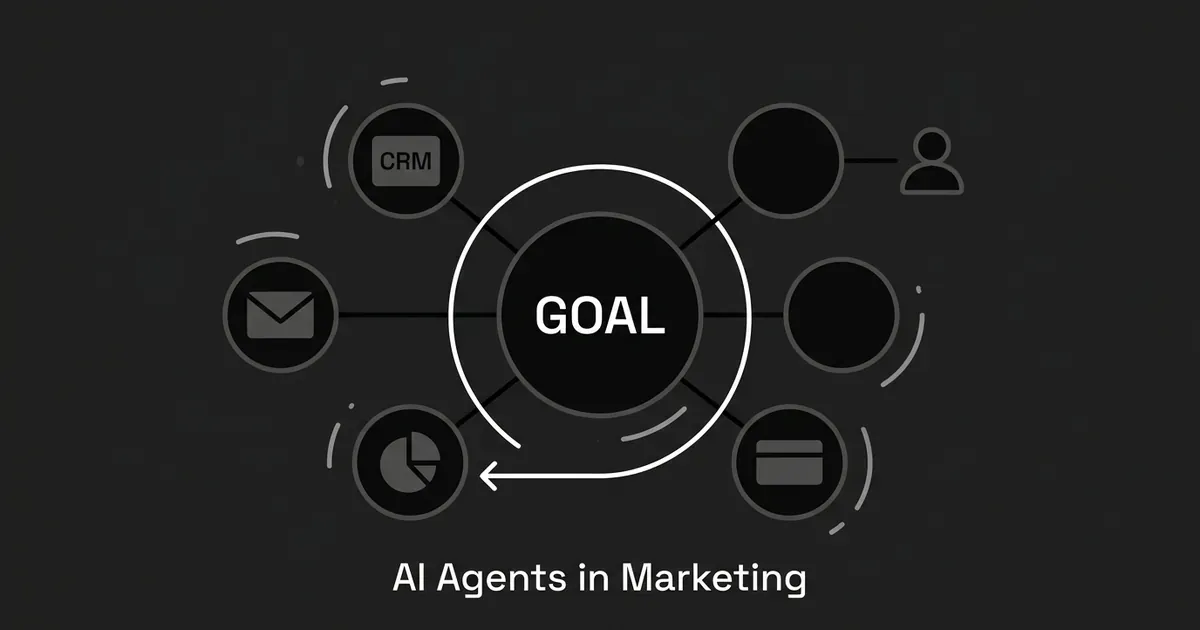
An AI agent in marketing takes a goal such as increasing qualified pipeline, launching a campaign, or closing a content gap, then gathers relevant customer and campaign data, chooses the next actions, carries them out in connected systems, checks the results, and asks for human input when a decision is sensitive, uncertain, or outside what it is allowed to do.
Five parts make that possible, and it helps to picture them as five separate ingredients rather than one black box.
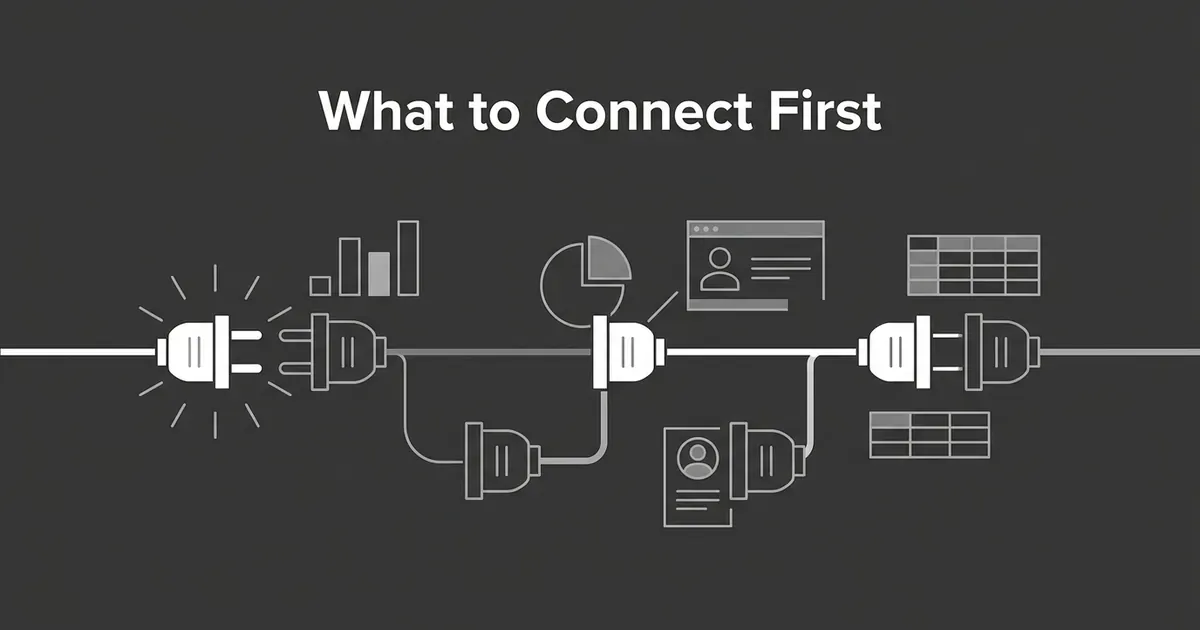
There is a model, usually a large language model, that reads the situation and decides what to do. There are instructions: the agent's role, its brand rules, and the boundaries it has to work inside. There are tools, the actual connections into your CRM, ad platforms, email system, analytics, and content library, because an agent that cannot touch your systems cannot act on your behalf. There is context and memory: customer data, campaign history, brand guidelines, and whatever state the workflow is currently in. And there is a loop that ties it together: the agent looks at what it knows, decides what to do, does it, looks at what happened, and decides again.
A simple way to hold all of this in your head is: goal, then context, then plan, then a tool call, then a result, then the next decision, then completion or a handoff to you. What makes this different from a one-shot AI feature, the kind that writes one email and stops, is that the agent figures out what needs to happen next on its own and uses your actual systems to make it happen.
How does a marketing AI agent work day to day?
A run usually starts with a trigger. That might be you typing in a goal like "launch a campaign for this audience," a new brief landing in your project system, a lead crossing an intent threshold, or a scheduled reporting time arriving. A well-built agent is not handed a blank check here. The trigger should come with an intended outcome, the audience it applies to, the budget or resources available, and some boundary on what the agent may actually do.
From there the agent gathers context instead of working off the prompt alone. Depending on the task, that might mean pulling customer profiles, website and email activity, CRM notes, the campaign brief and its history, your brand guidelines and approved terminology, your existing asset library, or channel rules like character limits. The result is only as good as this context. Stale CRM fields or an incomplete customer record will produce a confident decision that is still the wrong one.
Next the agent works out what needs to happen and in what order. A campaign agent might decide it needs an audience defined, channel-specific assets built, a brand check run, and then an approval step, before anything ships. This plan is not always fixed in advance, and that is really the whole point of using an agent instead of a simpler tool. When every step is already known and always happens in the same order, a fixed workflow is simpler, cheaper, and easier to audit. Agents earn their place when the number or order of steps genuinely cannot be predicted ahead of time.
With a plan in hand, the agent makes decisions, but only within limits someone set for it. It might decide which audience segment fits a campaign, whether a lead looks sales-ready, or which message variant is pulling ahead in a test. A campaign agent might be trusted to adjust a subject line on its own but not to change a budget. It might draft an ad but need a person to publish it. Then it acts, through the tools it has been connected to: writing copy, updating a CRM record, creating an audience, launching a test, or requesting the approval it needs before going further.
After acting, the agent checks what happened. A tool response, an updated campaign status, or new engagement data tells it whether the task is actually done and what to do next. On a live campaign this becomes a real feedback loop: watch performance, compare variants, adjust, check again, with stopping conditions like a retry limit, a budget ceiling, or a required approval built in. And when the agent hits something sensitive, irreversible, contradictory, or simply outside what it is allowed to decide, it should pause and hand the decision back to a person rather than guessing.
It is worth pausing on one distinction here, because the word "agent" gets used loosely. A fixed workflow follows the same predefined path every time a trigger fires. An agent directs its own process: it interprets the situation, chooses among available actions, and adapts as results come in. A single-turn AI feature that writes one piece of copy or summarizes one report is not, on its own, an agent, even when it is genuinely useful. And an agent can still live inside a workflow, called at one stage to handle the part that needs judgment while the rest of the process stays fixed. What actually matters is who decides the next step, the code or the system.
What can AI agents actually do in marketing?
Most AI agents explained in general terms stay abstract right up until you ask what they actually build, send, or approve on a given day. The scenarios below describe documented, vendor-described capabilities and illustrative operating patterns. They show what a well-built marketing agent can plausibly do, not proof that every agent performs identically or that results transfer automatically to your team.
Campaign creation from a brief. You submit a goal, audience, offer, and channel list. The agent reads the brief and your brand context, defines or pulls the relevant audience, builds channel-specific versions of the campaign, adapts copy and tone for each one, checks the output against your brand rules, and routes it for approval, or publishes it directly if it has been given that authority. What makes this agent-like rather than just a copy generator is that it is coordinating audience, assets, channel adaptation, and approval around one stated goal, not producing a single piece of text.
Lifecycle email and nurture management. When a subscriber goes quiet, a lead's engagement changes, or a sequence needs refreshing, the agent reviews engagement history and lifecycle stage, chooses the next message or re-engagement step, picks a subject line, offer, and timing, and updates the sequence. It keeps watching opens, clicks, and downstream behavior, and adjusts future messages based on what it sees. Because sending messages automatically touches brand, consent, and frequency risk all at once, manual override and monitoring need to stay available here, not just in theory.
Lead qualification and sales handoff. A prospect visits a pricing page, watches a demo, and asks an integration question. The agent combines that behavior with firmographics and account context, estimates how sales-ready the prospect looks, routes a qualified lead to the right rep with a summary of what it saw, or places a cooler lead into a nurture path instead. This is one illustrative pattern drawn from documented agent behavior, not a guarantee that every system reads intent identically.
Live campaign optimization. As a running campaign produces new data, the agent watches performance across email, paid, and social, compares creatives and audiences, runs or manages tests, and promotes what is winning while phasing out what is not. It can surface a recommendation, such as shifting spend toward a better-performing channel, or make the change directly if its authority allows it. Budget reallocation is exactly the kind of action that should sit behind a defined limit and an approval step, because a confident agent is not the same thing as a correct one.
Audience segmentation, personalization, and localization. Agents can refine segments as new behavior arrives, activate high-intent audiences, and suppress disengaged ones. They can choose among available content, offers, and creative variants for a known account based on what has worked with similar accounts before, and re-evaluate that choice as behavior changes. And when a campaign approved in one market needs versions elsewhere, an agent can generate localized copy, flag culturally sensitive phrasing, and notify the regional team, though translation quality and legal review still need a person who knows the market.
Brand and compliance review, feedback analysis, and reporting. An agent can check new copy against your brand guidelines and terminology, flag off-brand or prohibited phrases, and route the material back for a fix, which is a strong example of an agent assisting a brand team rather than replacing its judgment on ambiguous calls. Similarly, an agent can continuously read new survey responses, support tickets, and reviews for recurring themes and churn risk instead of waiting for the next quarterly analysis, and can pull campaign data into a briefing tailored to whoever is reading it, a CMO's risk-and-progress view looking different from a brand director's asset-status view even though both draw on the same underlying data.
What should marketers still control?
Handling execution is not the same as owning the outcome. Across every one of these examples, the marketer keeps the business objective, the definition of the audience and what data is acceptable to use on it, the brand promises the company is willing to make, the budget ceiling and risk tolerance, and the approval requirements for anything that publishes, spends, contacts a customer, or touches sensitive content. The agent can execute a strategy well. It does not become accountable for that strategy, and treating it as if it does is where teams get into trouble.
That accountability needs actual controls, not just good intentions. Give an agent the minimum access it needs for its task, and keep read access separate from write, publish, send, and spend permissions, so one system does not end up with the run of every tool you own. Require approval for the genuinely high-impact moves: publishing anything external, sending a high-volume send, changing a total budget, contacting a high-value prospect, or making a claim that touches legal, health, or financial territory. Set real limits on spend, message volume, and retries, since rate limits are what stop a small error from becoming a runaway loop. Give the agent your actual approved facts and terminology so it has something concrete to check against rather than filling a gap with an invented claim. And keep a log of what it saw, decided, and did, so a strange outcome can actually be traced back to its cause instead of shrugged off.
The clearest escalation instruction is not "ask a human if uncertain." That is too vague to act on. A working escalation path names who receives the request, what they see when it arrives, what decision they are actually making, and how the agent picks the work back up once they answer.
Where do marketing AI agents fall short?
Autonomous does not mean unsupervised, and it helps to say out loud exactly which decisions are automatic and which stay with a person, because autonomy is a spectrum rather than an on-off switch. An agent might draft and classify on its own all day while still needing a human sign-off before anything sends or publishes.
The label itself is inconsistent across the market. Some products call a guided, mostly fixed workflow an "agent." Others mean a system that plans dynamically and chooses its own tools. The question worth asking about any tool that uses the word is what it can actually do, what data it can reach, which actions it can take on its own, and exactly where approval sits in the process.
More autonomy also means more surface area for something to go wrong. A wrong read on an audience can lead to a wrong message, which can lead to a wrong action, and a small mistake early in a run can compound if nothing checks it along the way. That is exactly why data quality is not a side issue: stale CRM fields, incomplete behavioral history, duplicate records, and missing consent produce decisions that look confident and are still wrong, and connecting more systems to an agent does not fix that on its own.
Nuance is still genuinely hard for these systems. An agent can check an explicit rule, like a banned word or a required disclaimer, reliably. It struggles more with irony, cultural context, or a creative choice that is unusual on purpose, which is why localization and brand review still need a person who actually understands the market. And it is worth saying plainly that the marketing examples circulating right now are mostly vendor documentation describing what a product can do, not independent proof of a universal lift in conversion, revenue, or output. Longer runs, more tool calls, and more checks also cost more and take longer, so more autonomy is a trade, not a free upgrade, and the simplest system that actually solves the problem is usually the right one to start with.
How should a marketing team start?
Once the AI agent examples marketing teams reach for most often start to feel familiar, picking a first use case gets easier. A good first use case has a clear goal with a measurable finish line, a process with real repetition or multiple steps rather than one action, data you actually trust, well-defined tools and permissions, low downside if the first attempt is wrong, a natural point for someone to approve the work, a feedback signal the agent can check itself against, and a person who is actually going to review what it does. Campaign reporting, asset adaptation, brand-rule checks, feedback classification, and draft nurture recommendations tend to fit that shape well. Automatic budget changes, external publishing without review, high-volume customer contact, and regulated claims do not, at least not until you have watched the agent work on lower-stakes tasks long enough to trust its judgment.
DeepSmith's Opportunity Agents are a small, concrete example of this pattern in practice: they read a team's AI-visibility or content-coverage data and return specific content ideas, each one carrying the data point that justifies it, rather than a general brainstorm. That is an agent moving from analysis to a recommendation a marketer can act on, one narrow example among the many shapes this pattern can take. Start small, watch it work, and widen its authority only as it earns your trust.