If you are running content at a seed or Series A SaaS company, the problem was never really "we need more words." It is that every article still runs through you. You write it yourself on a weekend, or you brief a freelancer who spends a month learning your product and still gets a feature wrong, or you paste a prompt into a basic AI writer and spend an hour fixing a draft that sounds like nobody in particular. None of that is a system for ai content production for saas, it is you doing the work by hand with extra steps.
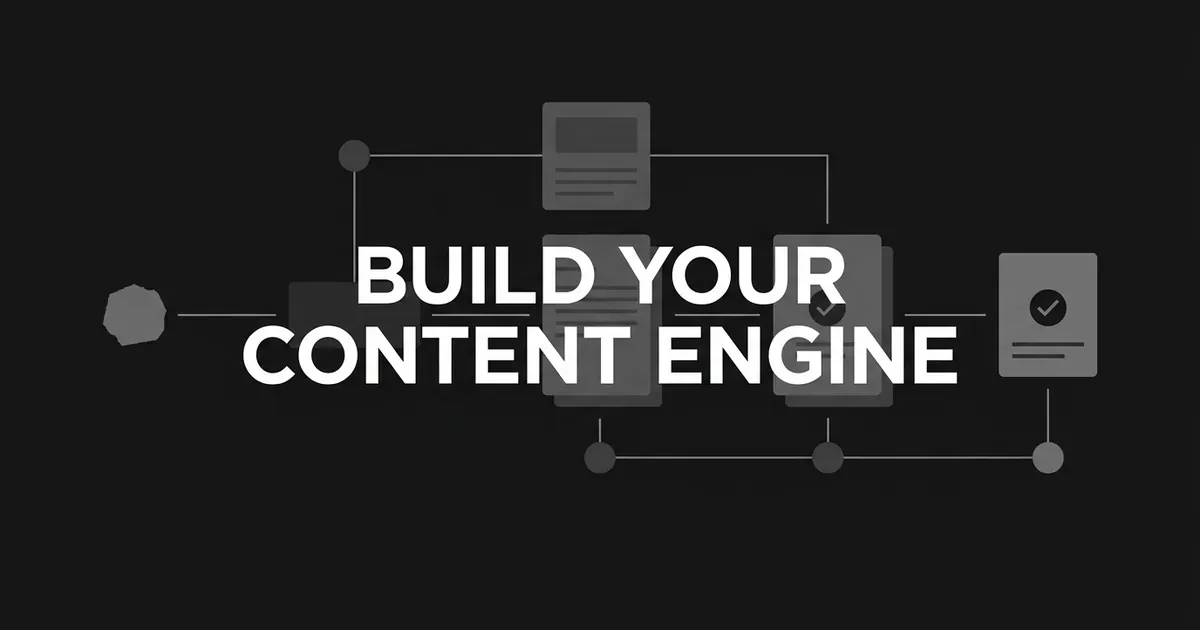
This guide walks through building an actual production engine: a repeatable way to turn an approved idea into a researched, on-brand, product-accurate article without you rewriting every sentence. It is not about letting a model publish whatever it wants. A workflow that can scale saas content with ai still needs a place to store what is true about your company, a way to check a draft before anyone reads it, and a human who signs off before it goes live. Build those three things once and you get a plg content engine that keeps running even on the weeks you are heads down in the product.
By the end you will have seven pieces in place: stored context, a production contract, a real backlog, separated research and drafting, automated checks, a human approval gate, and scheduling that does not bypass review. Put together, that is what an ai content production for saas team can actually run week after week, instead of a pile of one-off prompts.
Step 1: Build one source of truth for your company, product, audience, and voice
What to do. Stop re-briefing every writer and every prompt from scratch. Write down, once, the things you currently explain from memory: your positioning and differentiators, the claims you want to make and the ones you want to avoid, what each feature actually does (not what you wish it did), your buyer personas and their goals and objections, and your brand voice down to sentence length and tone. Add a list of trusted sources you are comfortable citing, and the content formats you actually publish, like how-to guides or comparisons.
For a product-led SaaS company this needs to be specific enough to answer real questions: what does the product do, who is it for, what problem does each feature solve, what does the product not do, which integrations are actually live, and which claims need a human to check before they go out. A single paragraph that says "friendly and helpful" is not a source of truth. It is a mood board.
How to tell it is done. A new writer, or a model, should be able to produce a usable brief without you restating your positioning, your product facts, and your voice. The document should say both what is true and what is off limits: what the product is, what it is not, and what it must never imply. Treat it as a living asset. When you ship a feature, rename something, or change a price, update this before you write another article, not after.
DeepSmith's Deep IQ stores exactly this: your products, personas, voice, and brand rules as structured context that every article pulls from automatically, so a writer or an AI production run does not start from a blank prompt. That solves the re-briefing problem, but it does not solve accuracy by itself. The context still has to be maintained by someone on your team.
Common mistake: writing a long brand voice paragraph and assuming that covers it. A source of truth needs operational rules, approved product facts, audience detail, and an explicit list of claims to avoid. "Sound more human" tells a writer nothing about what they can and cannot say about your product.

Step 2: Write a production contract before you generate anything
What to do. Every article needs a short, standard brief before a single word gets written. It should name the working title, the intended reader, the funnel stage, the one question the article must answer, whether and how the product fits in, which product facts are required, which claims need verification, the content type, roughly how long it should run, how many internal and external links it needs, what the metadata and cover image need to cover, who reviews it, who approves it, where it publishes, and what date it is scheduled for.
Keep this contract separate from your general brand context. The contract describes this one article. The brand context describes your company. Mixing the two into a single sprawling prompt is how you end up with instructions nobody remembers to update.
How to tell it is done. The system should refuse to start writing when the essentials are missing. At minimum you should know who the piece is for, what question it answers, which product facts it can use, who reviews it, and where it lands. A completed contract also makes review possible later, because your editor can compare the finished piece against what was actually assigned instead of guessing at an unstated bar.
Where people go wrong. Teams often start generating articles before deciding what "good" means for their content, which produces fast drafts and a slow, argumentative review process. The other common failure is jamming strategy, product claims, and style rules into one giant prompt that nobody maintains. Use a short reusable template with explicit fields instead. Templates handle repeated structure. They do not replace a source of truth or an approval step.
Step 3: Turn approved ideas into production-ready assignments
What to do. Keep one backlog of ideas that have actually been approved to write, and give each idea a reason for existing, not just a working title. Useful evidence includes a real buyer question, a gap in what you currently cover, a product use case nobody has written about, a competitor angle worth answering, keyword or search demand data, a tracked AI-search prompt you want to win, or existing content that needs expanding.
Keep this separate from broad topic strategy. Deciding what to write about next, and running a full audit of your topic clusters, is a different project from turning an already-approved idea into something ready to produce. This guide is about the production engine at the center of a plg content engine, not the strategy work that feeds it.
How to tell it is done. An idea is ready for production once your team can say who needs it, what question or problem it solves, why your company is a credible source on it, what the finished piece should let the reader do, which product facts are relevant, and what evidence backed the decision to write it at all.
DeepSmith's Content Ideas module builds this backlog from your own product and persona context plus your tracked AI-search prompts: it surfaces topics tied to real demand, coverage gaps, or prompts you are currently losing, and turns them into write-ready items with the reasoning attached. That is a genuine head start on getting from an approved opportunity to something a writer can pick up, and it is one of the pieces that makes a plg content engine practical for a team this size. It does not decide your whole marketing strategy for you, and it will not guarantee a specific amount of traffic or a citation in any particular AI answer, so keep those expectations separate from what the tool actually does.
Step 4: Split research and planning from drafting
What to do. Do not ask one model call to "write a great article" and hope research, planning, and fact-checking happen somewhere inside that single pass. Break it into stages: research relevant sources, identify the claims and subquestions the piece has to cover, build an outline that matches how the reader will actually use the article, map the required product facts to the right sections, keep sourced facts and company-specific claims clearly distinct, and only then draft.
For a how-to guide specifically, the outline should use action-based headings and steps in the order a reader would actually do them, with each step carrying the action itself, a way to tell it is done, and where people typically go wrong. Weight your sources by authority: official documentation, primary research, and first-party technical material should carry more weight than an unsourced summary somebody wrote to rank. This is the stage where an ai content workflow saas team actually holds together or falls apart, since a shaky outline shows up in every section drafted from it.
How to tell it is done. Before drafting starts, a reviewer should be able to see the article's main answer, the sequence of steps, what kind of evidence backs each external claim, which product facts get used and where, and any open questions that still need a human answer. A system built for on-brand ai content at volume should never quietly paper over a gap with plausible-sounding language. If the source material does not establish a number, a date, an integration, or a specific product behavior, the draft should flag it as unresolved rather than invent one.
DeepSmith's Writer runs this as a staged pipeline: it researches, plans an outline, drafts, adds internal and external links, generates a cover image, and prepares publishing metadata, and its own interface shows the research sources, the section map, and the resulting word and link counts for a given run. Treat those example numbers as illustrations of what one run looked like, not as a guarantee for every article you produce, since depth, length, and link counts vary by what a given piece actually needs. This kind of staged approach tracks general engineering guidance on breaking automated work into distinct, checkable steps instead of one large, unsupervised model call.
Step 5: Add automated checks before a human ever sees the draft
What to do. Treat quality assurance as its own gate, not a hopeful side effect of a good prompt. Check product accuracy: feature names correct, behavior described accurately, integrations current, no capability implied that does not exist, no invented statistic or customer result. Check brand accuracy: the piece reads in your stored voice, at the right register for the persona, and does not sound like a generic AI essay. Check editorial quality: the article answers its main question early, headings describe an action or a decision, steps run in the right order, and the FAQ answers real questions instead of repeating the headings above it. Check search and technical quality: heading structure holds together, metadata is present, internal links point somewhere relevant, external links point at sources worth citing, and alt text actually describes what an image shows. Check provenance: claims trace back to a source or an approved fact, and anything uncertain gets flagged instead of stated as settled.
How to tell it is done. A draft does not move to human review just because the grammar is clean. It is ready when the automated checks have passed, or produced a specific, visible list of exceptions for a person to look at. A gate should stop or reroute an article when a required field is missing, a product claim conflicts with your source of truth, or the piece still contains an unresolved placeholder.
Google's own guidance is worth keeping in view here: it evaluates content on whether it is original, useful, and demonstrates real expertise and experience, not on whether a human or a model wrote it, and it treats automation used mainly to manipulate rankings as a violation of its spam policies. NIST's guidance on generative AI risk points the same direction operationally: document your source inputs, know your system's limitations, test before you scale volume, and keep monitoring after you publish.
Pro tip: make the QA output a short exception list, not a vague score. "Product limit conflicts with the current pricing page" tells an editor exactly what to fix. A number like "quality: 82" tells them nothing.
Step 6: Make human approval a real release gate
What to do. Name a reviewer and an approver for every content type you publish. On a small team the same person can hold both roles, but the responsibilities should still be explicit rather than assumed. That person should be answering: is this useful to the reader it was written for, is the product information accurate today, does it reflect how we actually position ourselves, are the claims supported or properly qualified, does it sound like us rather than a generic AI essay, and are there any legal, security, or reputational issues worth a second look. Use a risk-based bar: a general educational piece needs a lighter pass than anything touching pricing, security, compliance, or a specific customer claim.
How to tell it is done. Every article carries a real status: in production, automated QA passed, needs revision, approved to publish, published, or needs an update. Your approver should be able to say what changed after their review and whether the source of truth itself needs an update because of something the review turned up. This is the step that actually keeps on-brand ai content at volume possible, since nothing goes live without someone confirming it still sounds and reads like you.
This is where the "no autonomous publishing" line matters more than any feature name. DeepSmith positions its output as a near-final draft rather than a first draft you have to rescue, but the workflow still expects your team to read it, edit if needed, and publish it themselves. Faster production is the win here, not fewer people in the loop. The differentiator worth caring about is stored context plus a human who still says yes, not a system that skips the person entirely.
Step 7: Schedule production, publish through your stack, and repurpose after approval
What to do. Once the earlier steps are stable, automate the repetitive scheduling and packaging around them. A practical sequence looks like this: approve an idea and finish its production contract, assign it a date, run the pipeline, send the result through automated QA, have a human review and approve it, publish through your existing CMS, review whatever distribution assets came out of it, adapt or approve the channel-specific versions, record the publish and revision dates, and feed anything that kept going wrong back into your source of truth or your gates. General guidance on building automated workflows draws the same line: automate the repeatable steps and add a checkpoint wherever the decision is reversible or risky.

The return arrow is the part teams skip. A production engine is not just the left-to-right path from an approved idea to a published article, it is that path plus the habit of sending whatever went wrong back into the source of truth or the gate that should have caught it, so the same mistake does not repeat on the next run.
DeepSmith's Content Studio organizes this as New Ideas, Planned Content, and Produced Content, and its Autowrite feature can be configured at planning time so an article actually gets produced on its scheduled date and lands in Produced Content ready for someone to look at, with nobody needing to be in the app when it runs. From there the platform supports a blog-style preview, an editor for the body and metadata, cover-image regeneration, and direct publishing to WordPress, Webflow, Strapi, Sanity, or Contentful, plus custom webhooks and a Markdown or HTML export if you need neither. Scheduling here automates the production step, not the approval step. Autowrite keeps the pipeline moving; the piece still needs to clear your release gate before it goes live.
DeepSmith also states that a finished article arrives with channel-ready social posts already written, and its Apps Library can turn one article into platform-native versions for LinkedIn, X, newsletters, Reddit, and several other channels. Still review each one for the right tone, the right length, and whether it genuinely reads differently on that platform rather than being the same paragraph pasted somewhere new.
Running it week to week
Once this is live, keep a short weekly habit: update product facts, pricing, and feature names as they change, look back at any article that needed heavy edits and ask why, add whatever kept tripping up review to your QA checklist, and check that your production pace has not outrun your team's ability to actually review it. Once a month, sample a handful of published pieces for accuracy, compare what your automated checks flagged against what a human actually changed, and tighten or loosen the rules that turned out to be noisy or too soft.
A production engine that can generate ninety articles a month is not automatically a system your two-person team can responsibly approve at that pace. Match your volume to your review capacity before you match it to what the software allows, since the whole point of trying to scale saas content with ai is to get more published without your review queue turning into the new bottleneck.
If you are starting from nothing, do not try to stand up all seven steps at once. Document your source of truth first, run one content type through the whole pipeline for a small batch, watch what breaks or gets rewritten heavily, tighten your gates, and only then turn up the schedule. An ai content workflow saas team can trust should earn more automation by proving its checks hold, not by assuming they will.
If you want to see this working with your own product and voice in it rather than a demo, DeepSmith's free trial runs on real brand context and produces real drafts before you pay for anything.