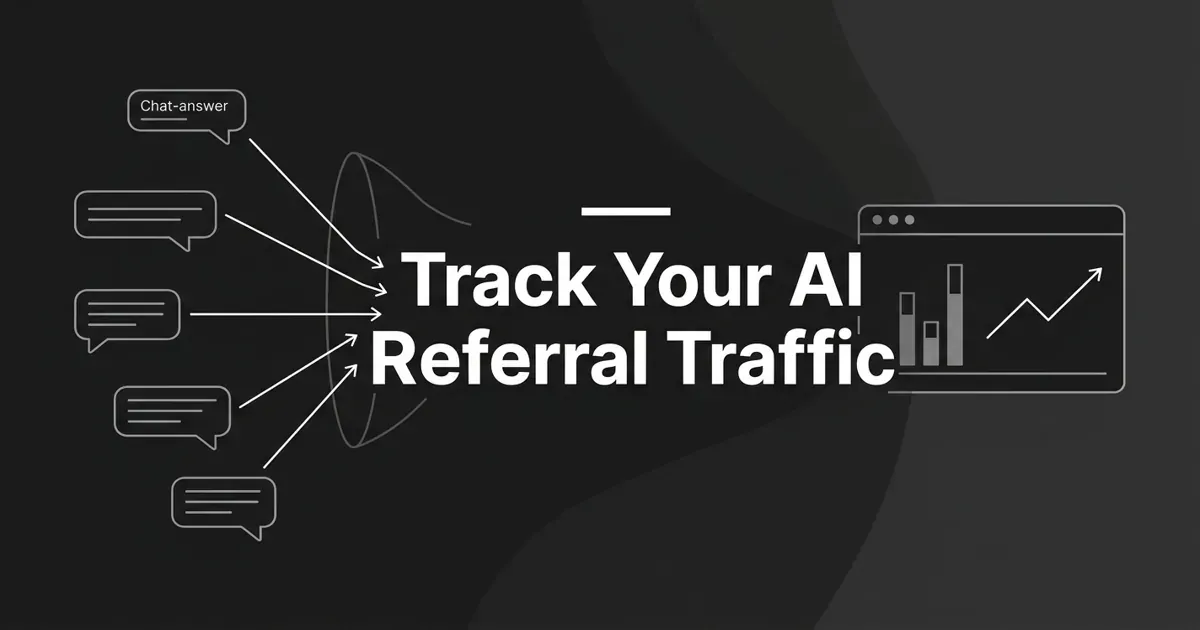
You searched your brand in ChatGPT, saw yourself in the answer, and thought: is anyone actually clicking through? That question is the whole job. The good news is you can answer it. AI referral traffic tracking is simply counting the real human sessions that land on your site after someone clicks a link inside an AI answer, then seeing which engine sent them and what they did next.
Take a breath, because this is more doable than it feels. You do not need a data team. You need one tool that can track visits from AI answers as their own channel, separate from organic search, so the number stops hiding inside your generic Referral report.
Let's get the vocabulary straight first, because two things get confused here and the mix-up wastes weeks.
AI referral traffic is a person who clicked a link in a ChatGPT, Perplexity, Gemini, or AI Overviews answer and arrived on your page. That click carries a Referer header naming the source, and that header is what every tool below turns into a row in a report. This is what we are measuring today.
AI visibility, or citation tracking, is different. That measures how often an engine mentions or cites your brand in an answer, whether or not anyone clicks. It sits upstream of the click. Some tools do both, and we will flag which ones, because knowing the difference between the two saves you from buying the wrong thing. If you want the deeper definition, the split between citations and brand mentions is worth a five-minute read on its own.
One more honest note before the list. AI bot crawls from GPTBot or PerplexityBot are automated fetches, not human visits, and they are out of scope here. We are counting people, not robots.
How we picked these tools
A roundup is only as trustworthy as its criteria, so here are the ones we used to rank every AI referral traffic tracking tool, stated up front.
- Native AI channel grouping. Does the tool isolate AI referrals as their own channel, or does it dump them into generic Referral and leave you to write a regex?
- Engine coverage. How many of the big four (ChatGPT, Perplexity, Gemini, AI Overviews) does it detect out of the box? Claude and Copilot are a bonus.
- Session-level detail. Can you see sessions by engine, landing pages, and ideally what those visitors did once they arrived?
- Time to first number. How fast can you measure AI search traffic after signup? Manual regex filters score worst here.
- Marketing-team fit. Does it speak to your workflow, reporting to leadership and planning content, not just raw analytics?
- Honest limitations. Every tool here has a trade-off, and we name it.
One caveat that applies to all of them: AI tool pricing shifts two to three times a year, so reconfirm the numbers on each vendor's page before you buy.
The tools at a glance
| # | Tool | Category | What it counts | Engine coverage (reported) | Starting price |
|---|---|---|---|---|---|
| 1 | DeepSmith | AI visibility + content production | Per-prompt and per-page visibility, mentions, citations, competitor citations, plus production | 10 engines by tier: ChatGPT on Pro, Perplexity on Grow, Gemini on Scale, all 10 on Enterprise | $99/mo, 7-day trial |
| 2 | Plausible Analytics | Privacy-first web analytics | Native AI Sources channel, auto-grouped | ChatGPT, Perplexity, Claude, Phind (auto); others user-defined | $9/mo |
| 3 | Matomo | Open-source web analytics | AI Assistants referrer channel, human sessions split from bots | ChatGPT, Claude, Copilot, Gemini, DeepSeek, Perplexity, Mistral | Cloud from $19/mo; on-prem free |
| 4 | Microsoft Clarity | Free behavior analytics | AI Platform channel groups, AI Visitors report | Detected via referrer; no published list | Free |
| 5 | Fathom Analytics | Privacy-first web analytics | AI referrers as named sources | Whatever the browser sends | $15/mo |
| 6 | GA4 (manual channel group) | Free web analytics | AI traffic, once you build a custom channel group | Whatever your regex covers | Free |
| 7 | Profound | Specialized AI visibility analytics | Prompt-level citation and mention analysis, Agent Analytics | ChatGPT, Perplexity, AI Overviews | Reviewer-cited from $99/mo |
| 8 | Peec AI | AI search analytics for marketers | UI-scraped prompt visibility, daily tracking, source data | ChatGPT, Perplexity, Gemini | $95/mo |
| 9 | Similarweb AI Chatbot Traffic | Market intelligence | Per-site AI chatbot referral traffic and top landing pages | ChatGPT, Perplexity, Claude, Copilot, Gemini | Custom |
| 10 | Adobe Analytics | Enterprise web analytics | Derived field surfacing LLM and AI-referred sessions | ChatGPT, Claude, Copilot, Perplexity (per Adobe research) | Custom enterprise |
Prices reflect what each vendor most recently published or what reviewers cited. Recheck before publication.
1. DeepSmith

Best for: marketing leads who want to measure AI visibility and produce the content that wins more of it, in one place.
Here is why DeepSmith earns the top slot. Most tools on this list answer half your question. They count the clicks, or they track the citations, and then you are on your own for the harder part, which is making more of both happen. DeepSmith is the one tool in this set that closes the whole loop: it tracks how AI engines answer questions about your brand, shows you the gaps, and produces the on-brand content to close them, all from the same data.
On the measurement side, you get Mention Rate, Citation Rate, and Share of Voice per engine, with a per-platform breakdown, a competitor leaderboard, and the sources AI cites most. The Prompts view shows per-prompt mention and citation rates with full answer history, and Discover Prompts generates a starter set from your product and persona context, so you are not staring at a blank tracker on day one. The Pages view tells you which of your pages AI actually cites and which prompts drive those citations. That is the upstream signal behind every future click.

Then it keeps going where the analytics tools stop. Content Studio turns a tracked gap into a finished article: a New Ideas backlog fed by your prompts and competitor activity, a Writer that researches and links and adds metadata, and Autowrite that produces on a schedule without you in the app. When a draft is done, you publish straight to WordPress, Strapi, Webflow, or a webhook. Every finished article even arrives with social posts ready to copy.

Pricing is refreshingly clear. Pro is $99 a month (or $80 billed annually) for 20 articles, 50 tracked prompts, and 5 seats, covering ChatGPT. Grow at $199 adds Perplexity, Scale at $399 adds Gemini, and Enterprise covers all ten engines, adding Claude, Google AI Overviews, Google AI Mode, Grok, Meta AI, Microsoft Copilot, and DeepSeek. A 7-day free trial gives you real data and real drafts before you pay. No long-term contracts.
One honest limitation, because you deserve it. DeepSmith reports the AI engines referring and citing you inside its visibility module, not as a full replacement for your web analytics session counter. If you want a single tool to tally every session on the whole site, pair DeepSmith with a web analytics tool like Plausible or Matomo below. It also does not control or guarantee rankings, citations, or traffic. What it does is show you where you stand and hand you the content to improve it.
2. Plausible Analytics

Best for: privacy-first teams who want AI reporting without bolting on a regex.
Plausible is lightweight, cookieless analytics with one feature that matters a lot here. Its Sources and Channels reports include an AI Sources group that automatically detects and categorizes traffic from ChatGPT, Perplexity, Claude, and Phind. No manual setup, no cookie banner, no PII. You add the script and the AI channel is just there.
Engines beyond those four, like Gemini or Copilot, can be added as user-defined channels. Plans start at $9 a month for 10,000 pageviews, with a 30-day free trial and no card required.
The limitation is honest: Plausible is a web analytics tool first and an AI analytics product second. You get clean session counts by engine, but not per-prompt analytics or competitive share of voice. For pure, private counting of your traffic from ChatGPT analytics and the other big referrers, it is one of the fastest paths there is.
3. Matomo

Best for: privacy and regulatory teams who need first-party AI traffic data, on their own servers if required.
Matomo is open-source analytics you can self-host under GPL or run in the cloud. Its AI Assistants channel auto-detects traffic from ChatGPT, Claude, Copilot, Gemini, DeepSeek, Perplexity, and Mistral as a separate referrer channel. Better still, Matomo separates bot crawls from human sessions, so those GPTBot fetches do not quietly inflate your numbers.
Cloud starts at $19 a month with a 21-day trial. On-premise is free under GPL, with paid support available, which is why EU-residency and regulated teams love it.
The trade-off is small: you activate the AI Assistants module, and until you do, AI traffic falls into standard referrer grouping. That is a one-time setup step, not an ongoing chore.
4. Microsoft Clarity

Best for: any team that wants free session replay, heatmaps, and an AI channel out of the box.
Clarity is free behavior analytics from Microsoft, and it recently added AI Platform channel groups plus an AI Visitors report. So on top of counting AI sessions, you can watch what those visitors actually do on the page. That pairing of counting plus behavior is rare at a price of zero.
Clarity also published a study across roughly 1,200 publisher sites showing AI-referred visitors signed up at a much higher rate than visitors from traditional organic search. Treat that as a quality signal, a reason to care about these visitors, not as the core number you are here to track.
The limitation: the free tier evolves fast, and reports can shift without much notice. Clarity does not publish an official per-engine list either. Still, for a free way to measure AI search traffic alongside heatmaps, it is hard to beat.
5. Fathom Analytics

Best for: privacy-first teams who want named AI referrers with almost no configuration.
Fathom is a clean, privacy-focused alternative to GA4. It detects AI referrers like perplexity.ai, chat.openai.com, gemini.google.com, copilot.microsoft.com, and claude.ai and lists them as named sources in your dashboard. You can see and drill into each one directly.
Pricing starts at $15 a month, or $12.50 billed annually, for up to 100,000 pageviews, with a 7-day unlimited trial.
The honest gap: Fathom does not aggregate those referrers into one dedicated AI channel the way Plausible does, and there is no per-prompt or competitor view. If you want named referrers you can inspect, Fathom is great. If you want zero-config AI grouping, Plausible edges it.
6. GA4 with a manual AI channel group

Best for: budget-conscious teams already living in Google Analytics.
You almost certainly have GA4 already, and yes, it can track visits from AI answers. The catch is that AI traffic lands in the default Referral channel by default. To give it its own home, you build a custom channel group with a regex matching chat.openai.com, chatgpt.com, perplexity.ai, gemini.google.com, bard.google.com, copilot.microsoft.com, and claude.ai.
Done right, your traffic from ChatGPT analytics finally sits in its own row instead of hiding in generic Referral. It is free, it is familiar, and you own the data.
The limitation is real, though, so go in clear-eyed. There is no native AI grouping, so you maintain that regex yourself, and it breaks silently the moment an engine changes its URL pattern or stops sending a Referer header. GA4 also will not separate AI bot crawls from human sessions on its own. If you have the bandwidth to babysit a regex, GA4 is a fine starting point. If you do not, one of the tools above will save you the upkeep.
7. Profound

Best for: enterprise teams with the budget for the deepest AI visibility reporting.
Profound is a specialized AI visibility platform built for SaaS and tech B2B teams, with modules for Answer Engine Insights, Prompt Volumes, Shopping, and Agent Analytics. For prompt-level depth, it is about as granular as measurement-only tools get. A team that only wants rich measurement and has the budget will find a lot to like.
On pricing, reviewers cite a Starter plan around $99 a month and a higher tier around $399 annually, while Profound's own page points to customized pricing. So confirm the current number before you commit. It covers ChatGPT, Perplexity, and AI Overviews.
The limitation: it sits at the premium end for its feature breadth, and it has no built-in content production, so you will pair it with another tool to actually create what wins more citations. This is the gap DeepSmith is built to close.
8. Peec AI

Best for: marketing teams that want prompt-level visibility with a daily refresh.
Peec AI queries real AI engines with real prompts rather than approximating through an API, and it refreshes daily. You get prompt-level visibility, brand sentiment, source tracking, and multi-project support, which suits agencies. It covers ChatGPT, Perplexity, and Gemini.
Pricing is $95 a month for Starter and $245 for Pro, with unlimited users on every plan, which is a genuinely nice touch for a growing team.
The trade-off: engine coverage is narrower than the broadest trackers, and UI scraping relies on stable interface patterns that engines change from time to time. As a purpose-built LLM referral analytics tool with fast refresh, though, it is competitively priced.
9. Similarweb AI Chatbot Traffic

Best for: brands benchmarking their AI traffic against named competitors.
This one answers a question the others cannot: how much AI traffic are your competitors getting? Similarweb's AI Chatbot Traffic tracker shows per-site visits from ChatGPT, Perplexity, Claude, Copilot, and Gemini, with the prompts driving clicks and top landing pages. If you need to walk into a leadership meeting and say competitor X pulls Y visits from AI engines, this is the tool.
Pricing is a custom subscription, and it sits at the enterprise end.
The limitation: it is market intelligence, not a session-level analytics tool for your own site. Use it for competitive benchmarking, and pair it with one of the web analytics tools above for your day-to-day counting.
10. Adobe Analytics

Best for: enterprises already standardized on the Adobe stack.
If your organization runs on Adobe, you may not need a new vendor at all. Customer Journey Analytics offers a derived field that surfaces LLM and AI-referred sessions inside the platform you already use. Adobe's own published research on AI referral traffic focuses on ChatGPT, Claude, Copilot, and Perplexity.
Pricing is a custom enterprise license, and this is enterprise-only.
The limitation: the derived field is implementation work, not a turnkey toggle. You will need some CJA setup to surface the data. For teams already invested in Adobe, that work is usually worth avoiding a second tool.
How to choose the right one for you
Feeling the options blur together? Here is the shortcut, matched to what you actually need.
You already use GA4 and just want to count AI referrals. Build the custom channel group. It is free and you own the data. Add a named-referrer safety net in case an engine stops sending the Referer header.
Privacy or data residency is non-negotiable. Go with Plausible or Matomo. Both detect AI referrers natively, Plausible auto-groups four engines and Matomo detects eight or more, and on-prem Matomo covers EU-residency needs.
You want free, and you want behavior too. Microsoft Clarity gives you AI channel groups plus heatmaps and session replay at no cost.
You need more than counting: per-prompt visibility, share of voice, competitor benchmarking. DeepSmith covers all three, with per-prompt mention and citation rates, share of voice per engine, and a competitor leaderboard, and it adds content production on top. If you want a measurement-only, purpose-built LLM referral analytics tool, Profound is the deepest enterprise option, and Peec is a strong mid-market pick.
You are benchmarking against named competitors. Similarweb AI Chatbot Traffic is the one tool that gives you competitor traffic share at scale.
You want to count AI referrals and produce the content that earns more of them. That is DeepSmith. It is the only tool here that combines AI visibility tracking with a publish-ready production pipeline, so measurement turns into action instead of a screenshot. Pair it with Plausible or Matomo for raw session counts, and you have the full picture.
Not sure where to start? Start with the free option that fits, get one real number this week, then upgrade when you know what you are missing. Momentum matters more than picking the perfect tool on day one.
Start closing the loop, not just counting it
Counting AI referrals is the first step, and it is a good one. But counting alone does not move the number. The teams pulling ahead are the ones who see where AI answers send traffic, spot the gaps, and ship the content that wins more of it, on repeat.
That is exactly what DeepSmith is built to do. Start your free DeepSmith trial and see your real AI visibility data, and real drafts, before you pay a cent.