You typed your own brand's core question into ChatGPT, and a competitor got the citation. That stings, and it also feels like a black box. Why them? Why not you?
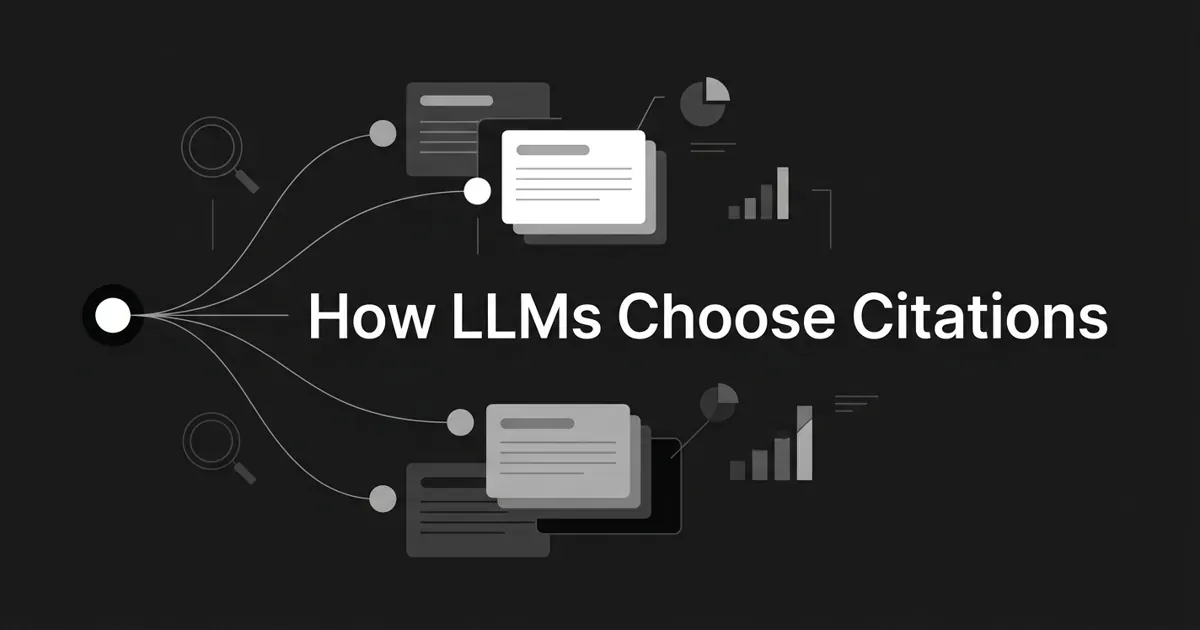
Here is the good news: it is not a black box. The path from a user's question to a cited link runs through a handful of clear stages, and you can influence most of them. Once you can see the stages, the question "how do LLMs choose citations" stops being mysterious and starts being a checklist.
This guide walks the whole path with you. We will trace how AI decides what to cite, from the moment someone asks a question to the moment your URL shows up as a source. Along the way you will get a practical answer to how to get cited in AI answers, grounded in what the studies actually show rather than guesswork. By the end, you will know exactly which levers move at each step, and which ones are out of your hands so you can stop worrying about them.
No jargon dumps. One stage at a time. Let's start.
The short answer: one question becomes six chances to get cited
Every AI answer engine runs a user's question through six stages, and you can win or lose a citation at each one.
Here is the whole pipeline in plain English:
- Query fan-out. The engine rewrites the single question into many smaller questions.
- Retrieval. It searches a source pool for pages that answer each smaller question.
- Chunking. It splits each retrieved page into small passages.
- Passage extraction. It scores those passages and keeps the best-matching ones.
- Reranking. It reorders the survivors, and position bias decides which one gets named.
- Grounding. It attaches a citation to a specific claim in the answer.
ChatGPT, Perplexity, Google's AI Overviews and AI Mode, Gemini, and Claude with search all follow this same shape. What changes between them is which index they search, how they score candidates, and where they attach the link. The mechanics differ. The map does not.
So when someone asks "how do LLMs choose citations," the honest answer is that there are six answers, one per stage. You do not have to win all six perfectly. You have to stop losing at the stages you control. That is a much smaller, calmer job than trying to game a mysterious algorithm, and it is the job this guide hands you. Understanding how AI decides what to cite is really just understanding these six stages well enough to spot where you are leaking citations.
One more reassurance before we go deeper. None of this is a public, engine-confirmed formula. The engines do not publish their exact recipe. Everything here is the best current model built from independent studies and the engines' own crawler docs. Treat it as a working map, not a leaked spec, and you will make good decisions.
Stage 1 and 2: how AI rewrites your question, then goes looking
AI engines do not search the web with your question. They rewrite it into many questions, then search a source pool with each one.
This is the single most important thing to understand about how AI answer engines pick sources, so let's slow down here.
Query fan-out: your real competition is a sub-question
When someone asks "best CRM for small teams," the engine does not run that phrase. It expands it into a batch of related sub-queries: "CRM pricing for small business," "CRM that integrates with Gmail," "HubSpot vs Pipedrive," "what is a CRM," and more. Each sub-query runs its own search, and the engine fuses the results.
How many sub-queries? For a normal question, usually somewhere between three and a dozen. For deep research modes, it can climb into dozens, and in some scenarios hundreds of parallel searches. Google's AI Mode goes even finer, fanning out to specific passages across many pages rather than whole pages.
Here is why this is such good news for you. You are not fighting the whole world for the head term. You are competing for one specific sub-question. A page that cleanly answers "CRM with Gmail integration under $50 per user" can win that sub-query even if it never ranks for "best CRM." Small and specific beats big and broad.
The lever you control is your site's shape. A topic cluster with one page per sub-intent wins more of these sub-queries than a single mega-article trying to cover everything. Each H2 on a page should map to a question a real buyer would ask. If you have been meaning to split one sprawling guide into focused pages, this is your reason.
Retrieval: being in the pool is the price of admission
Once the engine has its sub-queries, it pulls candidate pages from a source pool. This is the retrieval half of how AI answer engines pick sources, and each engine draws from a different pool.
ChatGPT's search retrieves through Bing's infrastructure. Perplexity crawls the open web with its own bot and favors fresh, specialist, and community sources. Google's AI Overviews and AI Mode pull from Google's own index plus the Knowledge Graph. Gemini leans heavily on Google Search and the Knowledge Graph across several surfaces. Claude pulls from a narrower web index when search is on.
You cannot be cited if you are not in the pool. So the first job is boring and non-negotiable: be retrievable. That means allowing the right crawlers, shipping server-rendered HTML that AI crawlers can read, keeping a clean sitemap, and fixing orphan pages. These are the same technical basics that get you into Google, and they double as the ticket into the AI search layer.
Two specifics worth knowing. OpenAI separates its crawlers: OAI-SearchBot indexes pages for ChatGPT's search results, while GPTBot crawls for training. Blocking OAI-SearchBot removes you from ChatGPT citations; blocking GPTBot does not. And Perplexity is a special case. Cloudflare has documented Perplexity using undeclared, stealth crawlers with rotating identities on top of its declared bot, which means a simple robots.txt rule may not keep it out or, if you want it in, may not be the whole story.
One honest caveat: being retrievable is necessary, not sufficient. A page can sit in the index and never get cited. This stage only decides whether the engine can see you. The next four decide whether it picks you.
Stage 3 and 4: your page competes as a passage, not an article
The engine never matches your whole page to a question. It matches one small passage. The chunk you wrote is the unit that competes.
This is where a lot of good content quietly loses, so let's make it concrete.
Chunking: the engine reads your page as a list of passages
Before an engine can match your content to a question, it splits your page into retrieval-sized chunks, most commonly a few hundred tokens each. It then treats each chunk as its own competing unit.
Sit with that for a second. The engine does not see your 3,000-word guide as one brilliant argument. It sees a stack of independent passages, each standing alone. If your single best claim is buried in paragraph 17, that paragraph is probably its own isolated chunk, cut off from the setup you wrote above it. It has to win on its own, with no run-up.
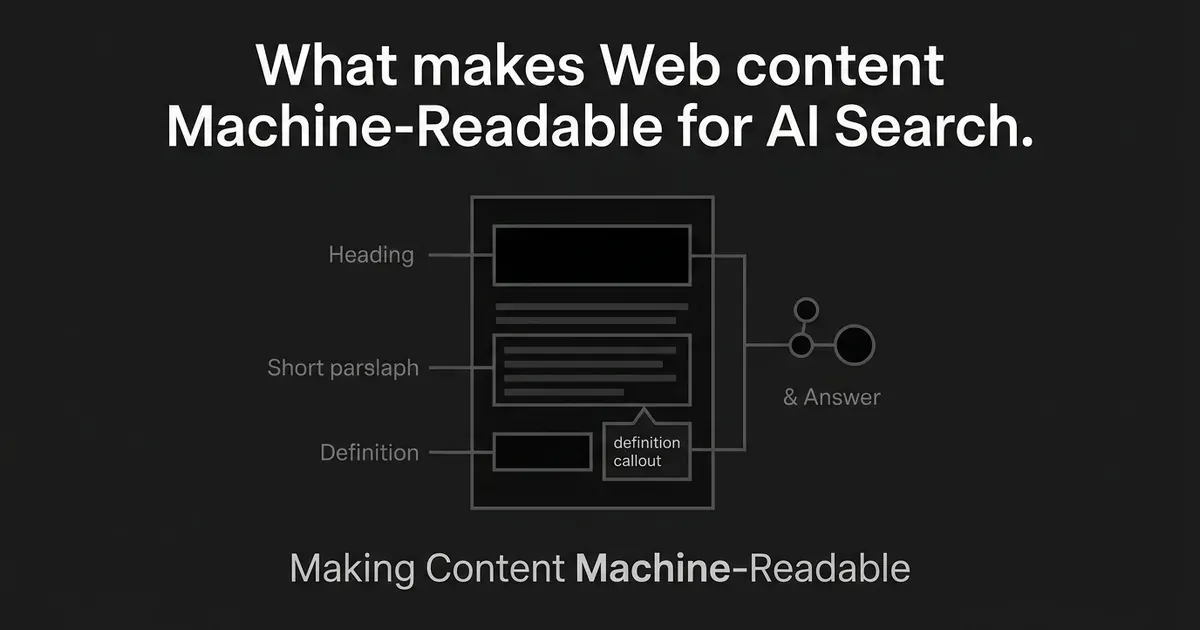
The fix is structural, and it is the same fix that helps human skimmers. Write each H2 as a self-contained mini-answer. Lead with the answer, then explain. Keep paragraphs short. If a passage can be lifted out of your page and still make sense, it can be cited out of your page too. This is the heart of structuring content so AI systems quote it, and it is worth building into your default template.
Passage extraction: the engine scores every chunk and keeps the best
Now the engine scores each chunk against each sub-query and keeps the highest-scoring passages. Only those survivors go forward to write the answer.
The score blends a few things: semantic similarity (does this passage mean the same thing as the question), keyword overlap, source authority, freshness, and structural signals like headings, lists, and tables. You do not need to compute any of that. You need to make your best passages easy to score high.
Four moves do most of the work:
- Put the direct answer in the first 50 to 100 words of the page and of each section. Extractors weight the top of a chunk heavily.
- Phrase a heading as the exact question a user would ask. A heading that mirrors the prompt is one of the strongest single signals you can send.
- Use lists and tables for anything comparative. Structured content is extracted more often than the same facts written as a paragraph.
- Add schema markup so engines can read your structure. One analysis of pages adding schema found a meaningful lift in AI citations, on the order of a third more likely to appear. Schema is a multiplier, not a permit, but it is a cheap one.
If you only change one thing this week, make it the first sentence of your top pages. Lead with the answer. That single habit feeds both of these stages at once.
Stage 5 and 6: position bias, and how the citation actually gets attached
Even after retrieval, the engine reranks the survivors, and a hard positional bias decides which page gets named. Then it attaches the citation to a specific claim.
Position bias: the top of your page does almost all the work
Here is a number that should change how you write. In one analysis tracking where citations come from on a page, roughly 80% of citations were pulled from the first 10% of the page. The middle 80% of the page produced only about 10% of citations. The last 10% produced the rest.
That lopsided pattern is not random. It lines up with a well-documented behavior researchers call "lost in the middle," where language models underweight information stuck in the middle of a long stretch of text. The opening of your page and the opening of each section are the prime real estate. The middle is a dead zone for citations, even when the content there is excellent. It is a big part of why AI cites a page's opening and overlooks the same fact three screens down.
So front-load. Put your answer, your keywords, and your key entities near the top: in the title, the URL, the H1, the first H2, and the meta description. Save the nuance, the definitions, and the navigation for lower down where they help readers without competing for the citation slot. This is also why pages that rank on page one still miss AI citations: they answer the question eventually, just not at the top.
Grounding: the citation attaches to a claim, so make claims clean
At the final step, the engine links a specific span of its answer back to a source. Some engines do this as they write, inserting inline markers that resolve to a retrieved page. Others do it in a separate pass afterward, matching each finished claim to the most likely source.
Either way, the page that wins the citation is the one whose passage maps most cleanly onto a sentence in the answer. This is why the "atomic statement" pattern works: one claim, one supporting sentence, phrased so it could be quoted and pointed at. An essay that wraps its point in three clauses of hedging is hard to attach a citation to. A clean, declarative sentence is easy. When you understand why AI cites a page, this is often the deciding detail: the engine could find one quotable sentence and point at you.
A reality check to keep you grounded. Citation correctness is not solved. A Tow Center for Digital Journalism study of eight generative search tools found only about 65% of citations were correct overall, with failures like hallucinated URLs, wrong attribution, and citing a page that did not contain the claim. Perplexity did best in that study. So "cited" does not always mean "cited accurately," and a stray wrong citation is not proof you did something wrong.
How the five major engines differ (and why one dashboard is not enough)
All five major engines run the same six stages. They differ in their source pool, their scoring priorities, and how many citations they hand out per answer.
You do not need to memorize each engine's internals. You do need to know that winning one is not the same as winning another. Here is the shape of the differences, drawn from side-by-side studies.
| Engine | Where it pulls from | Citation habit |
|---|---|---|
| ChatGPT | Bing infrastructure | Fewest citations per answer; leans on high-authority and reference sources |
| Perplexity | Open web via its own crawler | High citation density; favors fresh, specialist, and community sources |
| Google AI Overviews | Google index plus Knowledge Graph | Highest citation count; heavily overlaps the organic top results |
| Google AI Mode | Same as AIO, with passage-level fan-out | Most skewed toward top-of-index, enterprise sources |
| Gemini | Google Search plus Knowledge Graph | Sits in the middle; privileges entity-rich, trusted sources |
Two data points bring this to life. Google's AI Overviews now overlap the organic top ten by around 54%, and that overlap grew from 32% over 16 months, so classic ranking still pays off there. But across engines as a whole, only about 12% of AI-cited URLs also appear in Google's top ten for the same prompt. Ranking in Google helps. It is nowhere near enough on its own.
The engines also differ in how generous they are with links. On average, Google AI Overviews attach around 5.2 citations per answer, Perplexity around 4.3, Gemini around 3.4, and ChatGPT around 2.1, with roughly 87% of ChatGPT answers citing at least one source and the rest answering from memory. More citations per answer means more open slots to win. That is one more reason your share can look completely different from one tool to the next. In fact, on one shared set of prompts, only about 11% of sites were cited by both ChatGPT and Perplexity, a stark reminder that these are separate races, not one leaderboard.
The lesson is not to chase all five at once. It is to know that a page winning AI Overviews may be invisible in ChatGPT, and to track your citation share per engine rather than assuming one universal score. Platform-specific work pays off, and you can build a citation strategy for each engine once you know where you actually stand.
One caveat to hold lightly: engines change these mechanics by the quarter. OpenAI split its crawlers recently, Google keeps expanding AI Mode, and Perplexity's crawling keeps shifting. Treat any engine comparison as a snapshot, not a constant.
What you can actually influence at each stage
You cannot rewrite an engine's ranking model. You can send it cleaner signals at every stage, and a small set of them do most of the work.
Let's turn the whole pipeline into a short list of moves you own. One per stage.
- Fan-out: build a topic cluster with one focused page per sub-intent. Do not try to win every sub-query with one giant article.
- Retrieval: allow the right crawlers, ship server-rendered HTML, and keep your index healthy so the engine can see every important page.
- Chunking: write each section as a self-contained mini-answer with short paragraphs, so any passage can stand alone.
- Passage extraction: lead with the answer, mirror the user's question in the heading, use lists and tables, and add schema.
- Position: be the first sentence, not the fifteenth. Front-load your answer, keywords, and entities.
- Grounding: write atomic, declarative statements the engine can quote and attribute.
Now the signals underneath those moves, because a few of them surprise people. Across the large public studies, relevance beats authority: a page that directly answers the question can beat a more famous page that only circles it. Structured content beats prose. Brand mentions across the web correlate with AI citations far more strongly than backlinks do, which is a real shift from classic SEO. Freshness helps, with recent content over-represented in AI citations. And Domain Authority, the metric many teams still watch, barely predicts AI citations at all. It is a Google ranking signal, not a citation signal, so build brand authority instead of chasing backlinks.
Two more signals are worth building in on purpose. Pages with named, credentialed authors and quotable expert statements get cited more often, with one study putting the lift around 41%. And recency carries real weight: research finds roughly half of AI-cited content is under 13 weeks old, so a page you have not touched in two years is fighting uphill. Neither is a magic switch. Both are cheap to add to a page you are already refreshing.
There is a "what hurts" list too, and it is short. Promotional, marketing-heavy language correlates negatively with getting cited. Thin pages with no author, no structure, and no clear entity get passed over. If your top pages read like a sales deck, that is the first thing to soften. For the full craft of it, the E-E-A-T signals that answer engines reward are worth a dedicated pass.
Here is the honest part. Doing all of this, across every page, for five engines that each change quarterly, is more than most lean teams can track by hand. That is the exact problem DeepSmith was built for: it shows you which of your pages get cited, on which prompts, across which engines, and which competitor pages are taking your share, then it produces the on-brand content to close the gaps from the same data. You still bring the judgment. The tracking and the production run underneath. If you would rather not maintain a spreadsheet of citations across five engines, that is the whole idea.
So here is how to get cited in AI answers, in one breath: win the top of the page with a direct answer, win the structured fields with schema, win the source pool with crawler access, and win the brand with third-party mentions. Everything else is tuning.
Where to go from here
You came in wondering why a competitor got the citation and you did not. Now you can trace the whole path: the engine fanned your question into many, searched its pool, chopped the candidate pages into passages, scored them, reranked the survivors, and attached a citation to the cleanest claim. At each of those steps, you know the one lever that is yours.
You do not have to fix all of it this quarter. Pick your highest-intent pages. Lead each one with a direct answer. Break the walls of text into clean, quotable passages. Then measure what actually gets cited, and repeat. That loop, run page by page, is how to get cited in AI answers over time rather than in one lucky hit.
And the timing is on your side. Around a quarter of people have already tried AI-powered search, and roughly 40% of Gen Z now reach for AI or social over a traditional search box, so the citations you earn today compound as more of your buyers ask AI first.
Take it one page at a time. Momentum matters more than perfection here, and you are already ahead of most teams simply because you can see the machine now. When you are ready to stop guessing and start tracking, you can see where you show up in AI answers and close the gaps with a free DeepSmith trial.