Three acronyms. Everyone in your feed swears each one is the future of search. Then someone in a leadership meeting asks which one your team is doing, and you realize you are not even sure they are different things.
Take a breath. That confusion is normal, and it is not your fault.
The reason aeo vs geo vs seo feels like alphabet soup is that the industry never agreed on clean definitions. People use the terms interchangeably in one blog post and treat them as rivals in the next. So the question you actually care about, "do i need aeo geo and seo, or is this the same thing with three new names," rarely gets a straight answer.
Here is the straight answer. They are not rivals. They are three layers of the same job: getting your content found and cited by the systems people use to get answers. By the end of this, you will know what each one is, where they overlap, where they diverge, and which one deserves your energy first. One decision at a time.
SEO, AEO, and GEO Are Nested Layers, Not Competitors
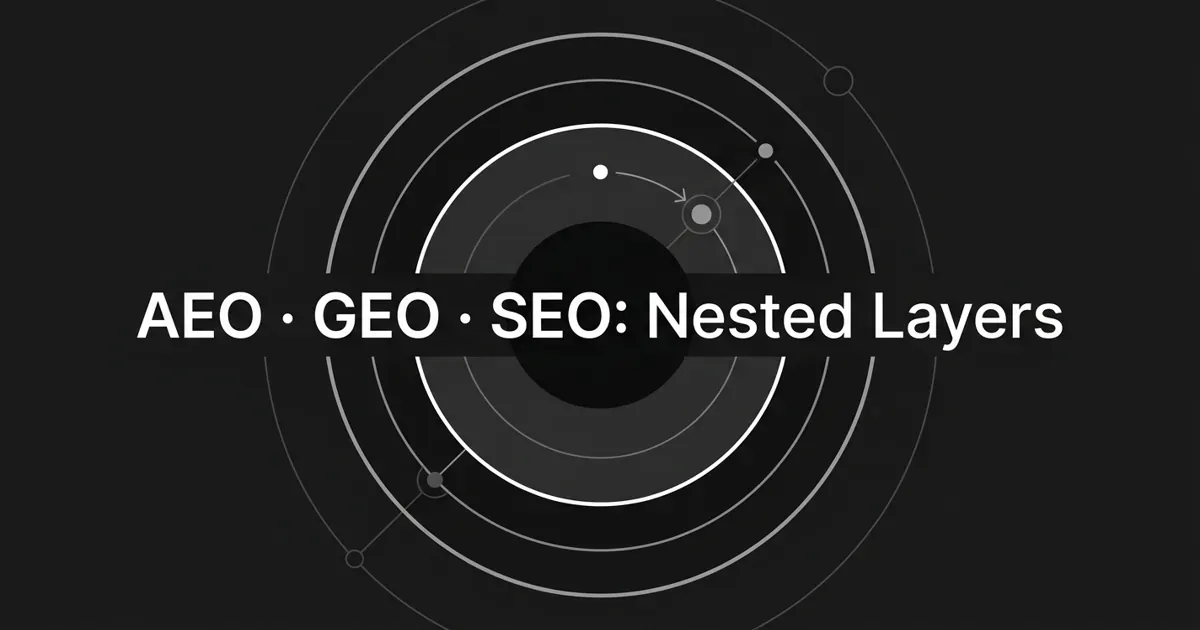
Start with the reframe that makes everything else click: these three stack on top of each other. They do not compete.
SEO is the foundation. It gets your pages to rank in search engines like Google and Bing. AEO is the next layer up. It gets your content pulled out as the direct answer to a question. GEO is the broadest layer. It gets your content picked up as a source when an AI engine writes its own answer.
Picture a set of nesting dolls. GEO contains AEO, and AEO contains SEO. Do the foundation well and you are most of the way to the other two.
The data backs this up, and it is the most reassuring number in this whole article. Roughly 93.67% of Google AI Overview citations link to pages that already rank in the top ten organic results. Nearly 99% of the URLs shown in Google AI Mode come from the top twenty. In other words, the AI engines are mostly citing pages that already earned their spot the old-fashioned way.
So if you have been quietly worried that AI search makes your SEO work obsolete, let it go. It does the opposite. Strong SEO is the leading indicator of AI visibility. Practitioners have a rule of thumb for this: about 80% of GEO is just good, fundamental SEO. That is shorthand, not a measured fact, but it points at something real. You are closer than you think.
Your next step: before you chase a single AI citation, check whether your key pages actually rank. If they do not, that is layer one, and it comes first.
What Each Discipline Actually Optimizes For
The cleanest way to understand the difference between aeo geo and seo is to look at what each one counts as a win.
SEO wins when a page ranks and earns a click. The unit of success is a ranked URL. The selection is algorithmic: the search engine sorts pages and picks an order.
AEO wins when your content becomes the answer. Think featured snippets, voice assistant replies, and the single direct response an AI gives before it lists anything else. The unit of success is being the extracted answer. The selection is closer to winner-takes-all. Usually one source gets the spot.
GEO wins when your content becomes one of the sources an AI blends into a generated answer. The unit of success is a citation or a mention inside a synthesized response. The selection is probabilistic. Most AI answers pull from several sources at once, so you are competing to be included, not to be the only one.
That last distinction is the heart of geo vs aeo, and it trips up a lot of smart people. AEO is about owning the snippet. GEO is about being one of the sources cited when the machine composes its own paragraph. The tactics overlap heavily. The success metric is what changes.
There is a content-shape difference too, and it is a big part of the difference between aeo geo and seo in practice. SEO content tends to be long, keyword-aware, and authority-building. AEO content is short and precise, structured so a clear answer sits right at the top. GEO content is rich and contextual, broken into reusable chunks an AI can lift and recombine. Same underlying page, three ways of shaping it.
You will hear people frame generative engine optimization vs seo as a clean break, as if one replaces the other. It does not. GEO simply adds a layer on top of what SEO already does: it asks you to become a citable source, not just a rankable page. If the naming still feels slippery, that is because it is. Some writers use AEO and GEO as synonyms. Others draw a hard line. A working definition you can act on beats waiting for the industry to agree.
Your next step: for each of your top pages, ask which win you actually want. A click, a snippet, or a citation. The answer tells you which layer to optimize next.
The Tactics Overlap More Than You Expect
Here is the good news that saves you the most work: most AEO and GEO tactics are format changes you make to content you already have. You are not starting three separate programs. You are adding two lightweight layers to one.
The shared foundation across all three is the same stuff good content teams already care about. Clear structure. Real expertise and trust signals. Schema markup so machines understand your page. Depth that earns authority. Get these right and every layer benefits at once.
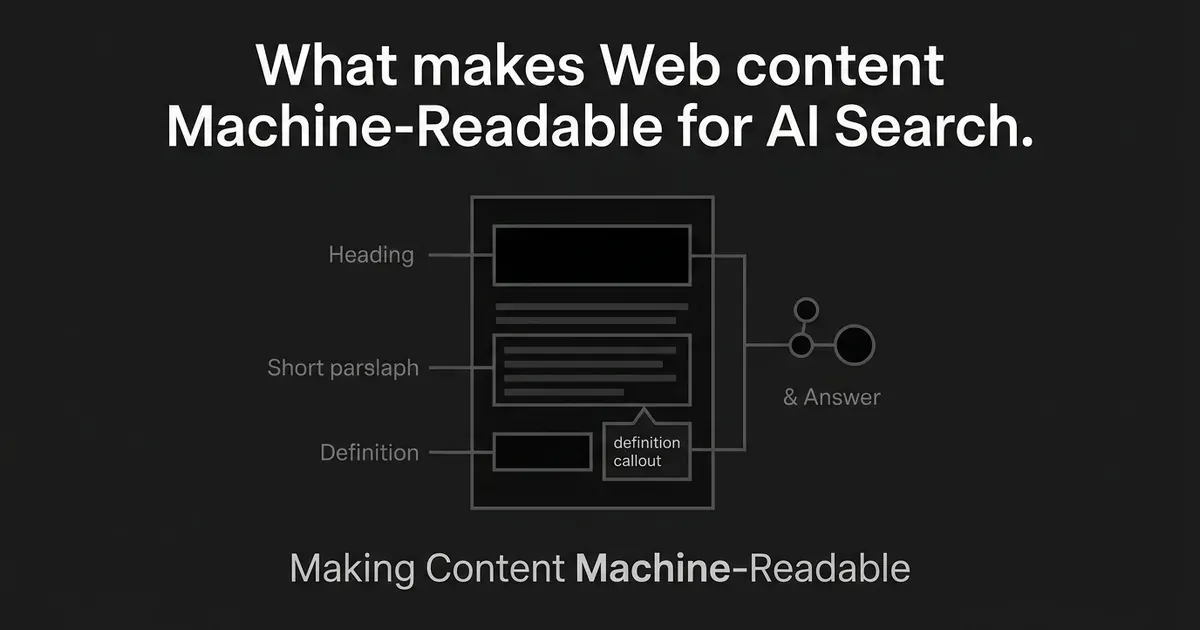
The AEO layer is mostly about shape. Put a direct answer in the first 30 to 60 words of a section. Write headings as the questions your readers actually ask. Keep paragraphs atomic, one to three sentences, so an engine can lift a clean chunk. Add trust blocks near the top: an author with credentials, a last-updated date, a source or two. None of this requires new research. It requires reformatting.
The GEO layer is where the genuinely new work lives, and it is worth naming honestly so you can plan for it. The original academic research on generative engine optimization, published by a Princeton-led team, tested specific methods and measured how much each lifted visibility inside AI answers. Citing authoritative sources performed best. Adding statistics and data came next. Including expert quotations and using precise, technical terminology both helped meaningfully. The headline finding was a visibility boost of up to 40% from the top methods. Treat that as an upper bound from controlled tests, not a promise for your blog. Results vary by topic and competition.
GEO also asks for something SEO never did: presence beyond your own site. About 84% of AI citations come from earned media, third-party publications rather than pages you own. So being listed and discussed on the sites AI trusts, from industry directories to community threads, is part of the job now. This off-site citation network is the clearest line in the geo vs aeo comparison. AEO you can win mostly by reshaping your own pages. GEO often needs you out in the wider web too. This is the layer that takes the most effort and the most time.
Your next step: pick your three most important pages and add the AEO layer this week. Direct answer up top, question headings, a trust block. It is the cheapest win available to you.
Why This Shift Is Happening Now
If you are wondering whether this is hype worth ignoring, the usage numbers answer that fast.
ChatGPT holds around 76.89% of the AI chatbot market and serves roughly 900 million weekly active users. Google's AI Overviews have gone from appearing in about 18% of searches to nearly 26% in under a year. Gartner expects traditional search volume to fall about 25% by 2026 as people move questions to AI assistants.
That does not mean search is dying. It means the front door is changing. More of your buyers are getting their first answer from a machine that reads sources and writes a reply, and most of those replies cite several pages at once. Around 88% of AI summaries pull from three or more sources. The engines are hungry for citable content, and they are handing that visibility to whoever structures for it.
This is also why framing generative engine optimization vs seo as an either-or is a trap. The same shift that pulls readers toward AI answers is powered by the pages that rank underneath them. Fewer people click through when an AI answers on the spot, so the reward moves from the click to the citation. You still need to rank. You just need to be quotable once you do.
Now the part that should make you feel hopeful rather than behind. Roughly 47% of brands still have no GEO strategy at all, and only about 14% of marketers track their AI search performance. The gap is wide. That gap is not a threat. It is your opening. The teams that move while most are still confused are the ones who lock in citations early.
Your next step: run one of your core buyer questions through ChatGPT or Perplexity today. See who gets cited. That five-minute check turns a vague worry into a concrete starting point.
Which One Should You Invest In First?
Here is the simple decision rule, and it is the same across almost every credible guide: start with SEO, layer AEO on top, add GEO once the first two are working.
The order is not arbitrary. It follows the effort and the payoff.
SEO comes first because it is the foundation the other two stand on. Remember the 93.67% figure. If your pages do not rank, they will not get cited. Skipping straight to GEO is building on sand.
AEO comes second because it is the cheapest next step. Most of it is reformatting content you already have, and it works fast. The typical AEO timeline is two to eight weeks, far quicker than the three to six months SEO usually needs to move.
GEO comes third because it asks for the most new work. Off-site citations, original data, third-party presence: these compound, but they take three to six months to build. That is a real investment, so you want the foundation solid before you make it.
You can also weight your effort by where you stand. If you are starting from zero, put most of your energy into SEO with a light touch on the other two. If your SEO is already working, split your attention more evenly across all three. And if competitors are showing up in AI answers while you are invisible, tilt hard toward AEO and GEO until you close that gap.
So, do i need aeo geo and seo, all three? For most teams in 2026, yes, but sequenced, not all at once. The marginal cost of adding AEO and GEO to a healthy SEO program is low. The cost of running them as three separate strategies is high. Treat them as one workflow with three finish lines.
Your next step: name which stage you are in right now. Foundation, layering, or catching up. Then commit your effort to that stage for the next month. Momentum matters more than perfection.
How to Measure Success Across All Three
You cannot manage what you cannot see, and each layer needs its own scoreboard.
SEO you already know how to measure: rankings, organic traffic, conversions. AEO you measure by extraction: do you own the featured snippet, does the voice answer read your content, are you the direct response. GEO has its own headline metric called Share of Model. You calculate it simply. Take your citations, divide by the total citations across the brands answering a question, and multiply by 100. It tells you what slice of the AI conversation is yours.
Two supporting numbers sit under it. Citation rate is how often an AI links to your pages as a source. Mention rate is how often it names your brand without a link. Both matter, because AI citation accuracy is still inconsistent, and a mention without a link is a softer win than a mention with one. Track the trend over weeks, not the reading on any single day, since answers shift as engines update.
Here is the catch that surprises most teams. Google Search Console does not track any of this. It never sees the ChatGPT answer or the Perplexity citation. So measuring GEO means either a manual routine, querying twenty to fifty of your buyer questions across engines and logging who gets cited, or a purpose-built tool that watches it for you.
This is where platforms like DeepSmith fit. It tracks mention rate, citation rate, and share of voice across ChatGPT, Perplexity, Gemini, Claude, and Google AI Mode, shows which of your pages the engines actually cite, and then helps you produce the content to close the gaps it finds. The point is not the specific tool. The point is that AI visibility is now a measurable thing, and you should not be flying blind on it.
Your next step: pick twenty questions your buyers ask, run them across two AI engines this month, and write down who gets cited. That baseline is your Share of Model. Everything you do next is measured against it.
One Job, Three Finish Lines
Let's bring it home. SEO, AEO, and GEO are not three competing bets you have to choose between. They are one job, getting found and cited, with three finish lines: a ranked page, an extracted answer, and a synthesized citation.
The teams that win in 2026 are not the ones chasing the newest acronym. They are the ones who stopped treating these as separate strategies and started running them as a single workflow. You do not need a bigger team to do that. You need a clear order: foundation first, format next, citations after.
If you only change one thing this month, make it this. Add the answer-first layer to your top pages, then start measuring where AI actually cites you. That is the whole game, and you can begin today.
When you are ready to see where your brand shows up across AI answers and produce the content to close the gaps, you can start a free DeepSmith trial and get real data on your own pages.