Your buyers are asking ChatGPT before they ask Google. They type a question, read the answer, and often never click a single link. If your brand is not named in that answer, you are invisible to them, and you probably have no idea it is happening.
That is the gap the best LLM monitoring tools for marketers are built to close. They watch how AI engines answer the questions that matter in your space, show you when you are named and when a competitor is named instead, and point you at the pages doing the work. Think of it as rank tracking for a world where the "ranking" is a sentence inside an answer.
This is not a fringe channel anymore. OtterlyAI's 2026 research puts roughly 15% of all website traffic as coming from AI agents and bots, and ChatGPT alone accounts for around 56% of AI search referral traffic, with Gemini and Perplexity trailing behind. Your buyers have already moved. The only question is whether you can see what they see.
If this feels like one more thing to learn, take a breath. You do not need a data team or a single line of code. You need one dashboard that watches the right models and tells you what to do next.
This guide compares four options a marketing lead can actually run: DeepSmith, Otterly, Profound, and maxAEO. Some are self-serve software, one is a consultancy, and they fit very different teams. Let's find yours.
How we chose these tools
A roundup is only as trustworthy as its criteria, so here is exactly what we weighed. Use the same six checks when you demo anything on this list.
- Multi-model coverage. Real LLM monitoring for marketing teams means tracking at least three of the surfaces buyers use: ChatGPT, Perplexity, Google AI Overviews and AI Mode, Gemini, Claude, and Copilot. One engine is a blind spot.
- Marketer-friendly UX. Dashboards, prompt-level visibility, share of voice, sentiment, and source analysis, with no engineering setup. If you need a developer to read it, it is not built for you.
- An action layer. Does the tool only show you data, or does it tell you what to write or fix next? Awareness without a next step is just a nicer way to feel behind.
- Speed to first insight. How long from signup to a populated dashboard? A tool you have to fight for a week rarely gets adopted.
- Pricing you can actually approve. Transparent, mid-market-friendly pricing beats a "book a demo" wall when you are trying to move this quarter.
- Stakeholder-ready reporting. Exports, a Looker Studio connector, an API, or webhooks, so the insight reaches the people who never open the tool.
One more distinction worth knowing before you buy. Some cheaper tools query the model through its API instead of the consumer chat interface. API output does not always match what a real user sees, and it usually strips out the citations and links that make monitoring useful. The tools below that we recommend test the experience your buyers actually get.
What LLM monitoring actually measures
Before you compare tools, it helps to know what they are counting. Put simply, they monitor brand across LLMs marketers rely on, then turn scattered answers into a scoreboard you can act on. Four numbers carry most of the weight.
Mention rate is how often the AI names your brand at all when asked a relevant question. It is your baseline presence. If you are not mentioned, nothing else matters yet.
Citation rate is how often the AI cites one of your pages as a source, with a link. A mention is being talked about; a citation is being trusted as the source. Citations are the closest thing AI search has to a backlink, though the link dynamics differ by engine.
Share of voice is your visibility relative to competitors for the same set of prompts. This is the number that tells you whether you are winning or quietly losing ground.
Sentiment is how the AI describes you when it does mention you. Being named is good; being named as the expensive or complicated option is a different story.
Good tools also show you the source domains AI engines cite most in your category, so you can see who is feeding the answer and where you need to earn your way in. When you know these four numbers per engine and per prompt, you can stop guessing and start fixing the specific gaps that cost you buyers.
The tools at a glance
DeepSmith leads this table because it is the only option here that both monitors and produces the content that closes your gaps. The rest each earn their place for a specific kind of team.
| Tool | Category | Free trial | Entry price | Engines in base plan | In-platform content production | Best for |
|---|---|---|---|---|---|---|
| DeepSmith | AI visibility plus content production | 7-day | $99/mo Pro ($80/mo annual) | 1 (Pro) scaling to 10 (Enterprise) | Yes (Writer, Autowrite, Apps Library) | Teams that want to monitor and produce in one place |
| Otterly | AI search analytics plus GEO recommendations | Yes | $29/mo Lite (annual) | 4 default; Claude, Gemini, AI Mode as add-ons | No (recommendations only) | Marketers focused on measurement and fixes |
| Profound | Enterprise AI visibility plus agentic workflows | None (demo-gated) | $99/mo Starter (annual) | 1 (Starter) scaling to 10 (Enterprise) | Yes (Agents workflows) | Enterprises needing depth, security, and scale |
| maxAEO | AEO consultancy | None (book a call) | Not published | Scope of engagement | No (strategic service) | Leaders who want done-with-you strategy |
1. DeepSmith

Best for: content and marketing teams that want to see where they show up in AI answers today, find the prompts and topics they are losing, and ship the content that closes those gaps, all in one workflow instead of three stitched-together tools.
Here is what makes DeepSmith different. Most tools on this list hand you a diagnosis and leave you to find the cure somewhere else. DeepSmith is one platform for AI search analytics and content production, so the same data that shows your gap also powers the article that closes it. You measure and you fix in the same place.
On the monitoring side, the AEO module tracks how your brand shows up when people ask AI engines the questions that matter in your space. You define the questions, it checks them on a schedule, and it reports back mention rate, citation rate, share of voice, and sentiment with trends, a per-platform breakdown, a competitor leaderboard, and the sources AI cites most. Not sure which questions to track? Discover Prompts generates a starter set from your product, persona, and buyer-stage context, so you are not staring at a blank field on day one.
The Prompts view gives you per-prompt mention and citation rates with full answer history. The Pages view shows which of your pages AI actually cites and each page's share of your total citations. Competitor citations shows who wins your prompts, on which exact pages, and how each rival performs by platform. This is the competitive picture most marketers are missing.

DeepSmith also connects monitoring to what you should do about it. Content Map turns your site and your competitors' sites into one map of the topic clusters you all write about, classified by topic and funnel stage, so you can see coverage gaps where a rival publishes more and untapped topics where you have nothing at all. Opportunity Agents then read that map and your AI visibility data and return ideas with the evidence attached, landing in New Ideas as a backlog you can defend. So the gap you spot in the dashboard becomes a specific idea in your backlog, not a vague sense that you are behind.
Then comes the part no pure monitoring tool offers. When you find a gap, Content Studio turns it into a finished, on-brand article. The Writer researches, structures, links internally and externally, and adds a cover image and publish-ready metadata. Autowrite takes it further and produces the article hands-off on its scheduled date, landing it in Produced Content with no one in the app. Everything is grounded in Deep IQ, your stored brand context: positioning, products, personas, brand voice, and visual guidelines, so output sounds like you instead of like generic AI. When the piece is done, the Apps Library turns it into LinkedIn posts, newsletter sections, and social threads, so distribution stops being the step that always falls off.

DeepSmith covers ten engines: ChatGPT, Gemini, Perplexity, Claude, Google AI Overviews, Google AI Mode, Grok, Meta AI, Microsoft Copilot, and DeepSeek, with coverage rising by plan. Pro tracks ChatGPT, Grow adds Perplexity, Scale adds Gemini, and Enterprise covers all ten. Pricing is public: Pro at $99/mo, Grow at $199/mo, and Scale at $399/mo, with lower effective rates on annual billing and a custom Enterprise tier. There is a 7-day free trial with real data and real drafts before you pay, no long-term contracts, and no cancellation fees. For agencies, Multi-Workspace runs each client fully isolated with its own context and billing.
An honest limitation: DeepSmith is a newer product with a smaller third-party review footprint than Profound or Otterly. You do not have to take reviews on faith, though: the 7-day trial runs on your own brand data and real drafts before you pay, so you can judge the output directly. Its engine coverage also scales with plan tier, so a team that needs Gemini from day one is on Scale, and Claude, Copilot or Google AI Mode sit on Enterprise, not Pro. That said, Pro tracks ChatGPT, where the majority of AI referral traffic already lands, and each higher tier bundles more engines at no per-engine add-on fee, so you are not paying a separate SKU for every surface the way you would elsewhere. The production features are only as strong as the brand context you load, so teams that skip Deep IQ setup get more generic output. The fix is fifteen minutes of onboarding, but it is real work you have to do.
2. Otterly
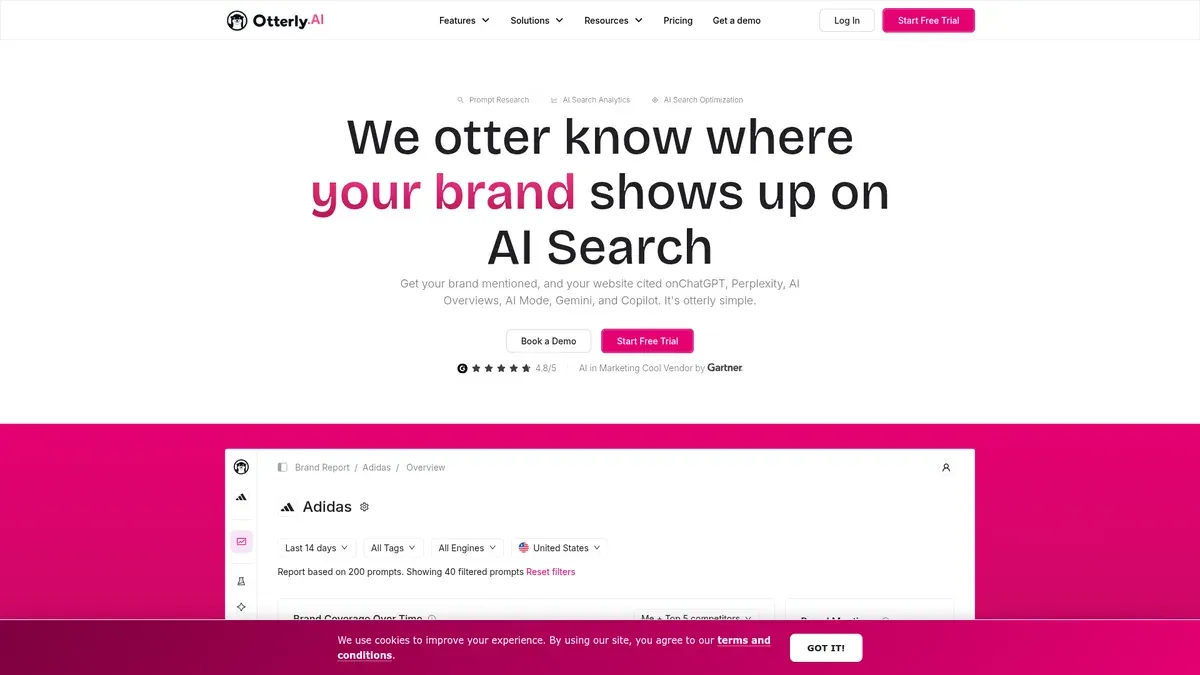
Best for: marketers and SEO teams who want affordable, prompt-level AI visibility monitoring with clear fix-it guidance, and are happy to produce the content somewhere else.
Otterly is a strong, measurement-first choice, and its entry price is the friendliest on this list. AI Prompt Research surfaces the prompts buyers actually ask, AI Search Analytics tracks mention rate, citation rate, sentiment, and share of voice, and the Brand Visibility Index gives you one composite score to benchmark against competitors. Its GEO recommendations are the action layer: concrete guidance to make existing pages more citation-ready. A Content Audit checks crawlability and how AI bots reach your pages.
Reporting is a real strength. Standard and Premium plans add a Google Looker Studio connector plus API and MCP access, which makes Otterly easy to fold into a wider marketing stack. It tracks across 50-plus countries and languages with daily frequency, so if you run a multinational brand, that geographic granularity matters.
Pricing on annual billing runs $29/mo for Lite, $189/mo for Standard, and $489/mo for Premium. The default four engines are ChatGPT, Google AI Overviews, Perplexity, and Microsoft Copilot.
An honest limitation: Claude, Google AI Mode, and Gemini are paid add-ons rather than part of the base price, so full coverage costs more than the headline number suggests. And there is no content production inside Otterly. The GEO recommendations tell you what to fix, but you write it elsewhere, which means a second tool and a second workflow.
3. Profound

Best for: mid-market and enterprise teams that need deep prompt-volume data, server-side AI crawler analytics, enterprise security, and the option to run agentic content workflows in the same platform.
Profound is the enterprise-grade pick, and it goes deeper on data than anything else here. Its Answer Engine Insights cover the familiar visibility scoring, but Prompt Volumes is the standout: keyword-style volume and trend data drawn from real user prompts, which helps you find high-intent questions and content gaps with actual demand behind them. Profound reports running more than 6 million prompts per day across ten answer-engine platforms, and its customers report up to an 11% lift in AI visibility within 30 days, per Profound's own published figures.
Agent Analytics connects to your server logs through integrations like Vercel, Cloudflare, and Fastly, so you can see which AI crawlers hit your site, how often, and which pages they fetch. That is a level of technical visibility most marketer-focused tools do not attempt, and it is genuinely useful if your team includes or works closely with engineering. The Agents layer automates AEO content workflows, research through publish, with human checkpoints, and Profound Sheets handles bulk prompt analysis for very large prompt sets. On engines, Profound reaches up to ten in Enterprise, including ChatGPT, Perplexity, Claude, Gemini, Copilot, Grok, and DeepSeek.
If procurement has a checklist, Profound is the only tool here that publicly clears it: SOC 2 Type II, GDPR-ready, HIPAA, and SSO/SAML on Enterprise, with a dedicated Slack channel and a 24-hour SLA.
Pricing on annual billing is $99/mo for Starter and $399/mo for Growth, with Enterprise quoted on request.
An honest limitation: there is no public free trial, and pricing is gated behind a demo at every tier, so time-to-value is slower than a self-serve tool. Starter also restricts you to a single engine and one seat, so real multi-model AI monitoring marketers expect only starts at Growth, and the multi-engine tiers cost more than mid-market rivals.
4. maxAEO

Best for: CMOs and senior marketing leaders who want strategic AEO guidance and a done-with-you engagement rather than a self-serve dashboard.
maxAEO is the odd one out here, and that is worth saying plainly. It is not monitoring software. It is a boutique consultancy for marketing leaders, built around senior strategists, with the promise that "AI decides which brands to recommend, we make sure it's you." Its named coverage scope spans ChatGPT, Perplexity, Claude, Gemini, DeepSeek, Grok, Mistral, and Google AI Overviews.
If you would rather hand the whole problem to experts than learn another dashboard, this is a legitimate path. You get strategy and hands-on work instead of a tool to operate yourself.
An honest limitation: there is no dashboard, no monitored-prompt tier, no self-serve plan, no API, and no published pricing. Engagement is by conversation, starting with a booked call, and outcomes depend on the engagement rather than a software contract. If your goal is a dashboard you log into and run yourself, maxAEO does not fit that scope.
How to choose the right tool for your team
There is no single winner here, only the right fit for your situation. Here is the honest version.
You are a solo marketer or a small team on a tight budget. Start with Otterly Lite at $29/mo for the cheapest real dashboard, or DeepSmith Pro at $99/mo if you want on-brand production in the same workflow. Both let you self-serve today.
You run an agency with multiple clients. DeepSmith's Multi-Workspace model keeps each client isolated with its own context and billing, which is purpose-built for this. Otterly's Standard and Premium plans also support unlimited workspaces if measurement is all you need.
You are an in-house content team that wants to monitor and produce in one place. This is DeepSmith's core case. You see the gap and ship the fix without bolting a writer onto a tracker.
You are an enterprise with security and compliance requirements. Profound is the clear answer. It is the only tool here that publicly clears SOC 2, HIPAA, and SSO/SAML, with the prompt-volume depth larger teams need.
You are a leader who wants strategy handled for you. maxAEO gives you a done-with-you engagement instead of a tool to run.
Notice the pattern: match the tool to how much you want to do yourself, and how much you want production baked in versus bought separately. That single question narrows the field fast.
Start with your real AI visibility today
You do not need to solve all of this at once. You need to see where you stand, then take one step. If you want a dashboard that shows your gaps and the production engine that closes them, in the same place, start a free DeepSmith trial and get real data and real drafts before you pay. One workspace, fifteen minutes, and you finally know where you show up.