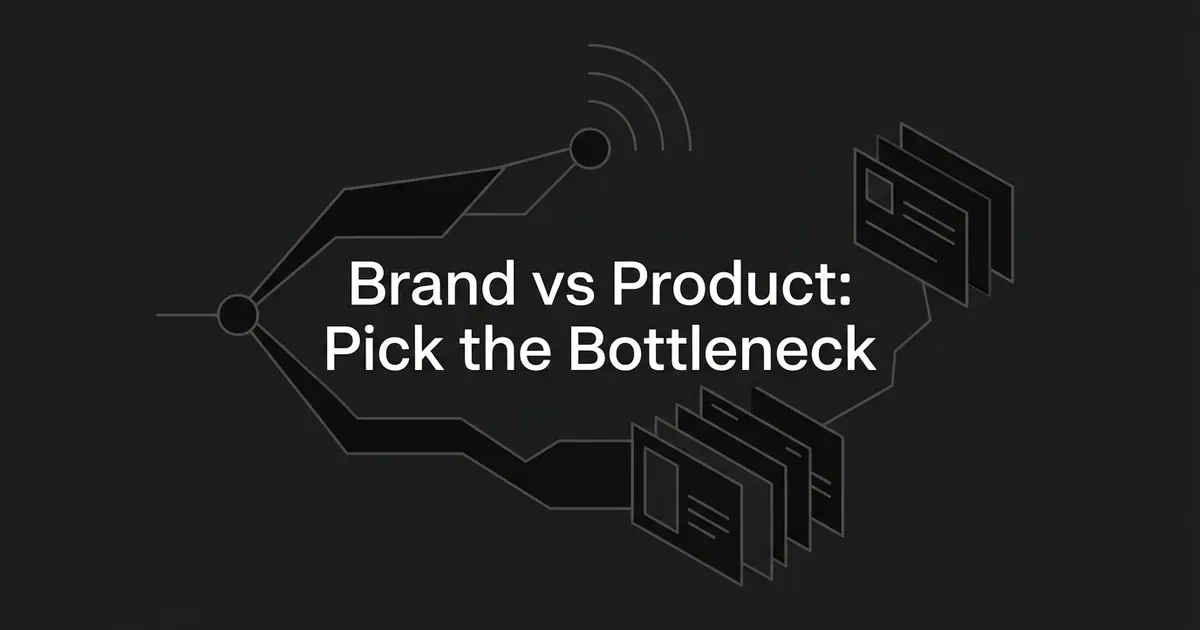
If you are a small team arguing about what to write next, the argument is usually brand marketing vs product marketing in disguise. Someone wants a piece that makes the company memorable. Someone else wants a piece that explains exactly how the product works. Both are right, and neither wins forever. The rule that actually helps is this: put your next block of writing time against whichever job is closest to your real bottleneck right now, and keep a small stream going for the other job so it never disappears completely.
Here is the short version of how the two differ.
| Brand-building content | Product-education content | |
|---|---|---|
| Main job | Make the company memorable and trusted | Make a specific product understandable and usable |
| Reader's state | Not yet comparing vendors | Has a problem and is weighing options |
| Main question it answers | Why does this problem matter, and who do I trust on it | Can this product solve my problem, and how do I use it |
| Time to see results | Slow, builds up over months | Often faster, closer to a trial or a decision |
Keep that table in mind. The rest of this piece is about how to use it.
What brand marketing actually does
Brand marketing's job is to make your company known, recognizable, and trusted before anyone is ready to evaluate a specific feature. It is not about being vague or emotional. A brand piece can go deep on a real problem, share genuine research, or take a clear stand on how the category should work. What makes it brand content is that its subject is bigger than one feature or one transaction.
Done well, brand content:
- frames a problem before the reader has named it themselves
- teaches the market a new way to think about an issue
- builds a recognizable point of view over time
- gets the company into the short list of names a buyer already trusts, before they are actively shopping
A reader does not need to be close to buying anything to get value from this kind of piece. That is the point. You are earning a place in someone's head for later, not asking for a decision today.
What product marketing actually does
Product marketing's job is narrower and more concrete: make one specific product understandable, credible, and usable for a defined buyer. Where brand content can wander into a whole category, product content stays close to the thing you actually sell.
Product-education content usually:
- explains what the product does and who it is for
- walks through a real workflow or use case, not just a feature list
- clears up integrations, limits, requirements, or pricing
- answers the objections a buyer is already forming in their head
- helps someone move from curious to trialing to actually using the thing
One clarification matters here, and it is the fastest way to end most fights over brand content vs product content. A feature page is product content, but it is not the whole of product marketing. Product marketing also covers competitive research, launches, and sales enablement. This article is only about the content side of that job: what you publish, not the whole function behind it.
The most useful reframe, honestly, is to stop asking "is this piece brand or product." Ask instead: what is this piece supposed to change in the person reading it. A product page can make your company look more competent, which is a brand effect. A broad educational piece can create demand for your specific product, which is a product effect. The line is real, but it is not a wall.
The outcome each one is trying to change
Brand content changes the odds that the right person will recognize, remember, or trust your company later. Product content changes the odds that someone will understand, choose, and actually use what you sell, right now or soon.
This distinction saves you from a common measurement mistake: judging a brand piece by how many trials it produced this week, or judging a product guide only by its total traffic. Each lane has a different job, so each one needs a different way of knowing whether it worked.
Where the buyer is when each one lands
Brand content does its best work before someone has narrowed things down to a short list of products. It reaches people who are still learning about a problem or forming an opinion about a category. Product content does its best work once someone has a real need and needs proof: does this fit my team, my budget, my technical setup, my actual workflow.
The line between the two is not a hard wall either. Someone might discover your company through a broad, useful article, then move straight into a product guide to check whether you actually solve their problem. Your job as a content team is to make that path easy to find, not to force the reader to guess what to read next.
The time horizon that makes both fair
Brand-building effects build up slowly and often will not show up in a report you pull next week. Product-education effects tend to show up faster, closer to a trial, a demo, or a sales call, though a good product guide can also build long-term trust the same way a brand piece does.
Advertising research on the long and short of marketing spending describes this same tension in a bigger context: relying only on short-term online metrics as your main measure of success can quietly damage the longer-term work. That does not mean short-term numbers are useless. It means a brand piece and a product piece need to be judged on different clocks, and grading one against the other's timeline is where the internal argument usually comes from.
When brand-building content should win
Brand content deserves the bigger share of your content time when most of these are true for you right now:
- Almost nobody outside your own network has heard of the company
- Buyers do not search for your category yet, because they do not think of it as a category
- A competitor already owns the conversation around the problem you solve
- Your product pages get little traffic, mostly because there is no upstream demand feeding them
- You are entering a crowded space where every feature claim sounds the same as everyone else's
In these cases, the job is not to publish generic thought pieces for their own sake. It is to write something useful and specific enough about the problem that a reader remembers who wrote it, and starts to associate your company with that problem going forward.
When product content should win
Product content deserves the bigger share when most of these are true instead:
- Buyers already understand the category and the problem, they just cannot explain how your product actually works
- You keep answering the same questions about features, setup, integrations, or pricing on sales calls
- You have decent traffic, but trials or demos are weak
- People start a trial but never reach the point where the product actually helps them
- Sales conversations stall on objections that a page could have already answered
If this is where you are, more broad awareness content will mostly just bring in more confused visitors. It will not fix the part of the funnel that is actually stuck.
The bridge: content that does both jobs
Most lean teams do not have the luxury of writing purely broad pieces and purely narrow ones in separate lanes. The most efficient content usually does both jobs at once. A "how to solve this problem" guide can introduce the category and walk through a real, practical workflow in the same piece. A comparison of approaches, not products, can teach the reader something true about the category while making your own approach clearly distinct. A case study can build trust and give product proof in the same 1,200 words.
The failure mode to avoid is dressing up a straight product pitch as neutral education and hoping the reader does not notice. Bridge content works because it starts with the reader's real problem and only shows where your product fits once that problem is actually understood.
One primary lane, one maintenance lane
Here is the practical operating model for a small team that cannot staff separate brand and product functions. Pick the lane that matches your current bottleneck and give it most of your writing capacity for this planning cycle. Keep a smaller, steady stream going in the other lane so it never drops to zero.
A team that writes only broad brand pieces ends up known but hard to evaluate: people have heard of you, but nobody can explain what you actually do. A team that writes only narrow product pages ends up invisible to new buyers: the pages are accurate, but almost nobody finds them in the first place. The maintenance lane is what keeps you from swinging between those two failure states every time leadership changes its mind.
Write down, for every piece you plan, who it is for, what question it answers, and which lane it belongs to. That one habit resolves most of the arguments about brand marketing vs product marketing before they start, because you are deciding by the reader's actual question instead of by which department feels underserved this month.
How to measure without killing the other lane
Brand content and product content need different scorecards, and mixing them up is most of why teams argue about content priorities brand vs product in the first place.
For brand work, look at things like non-branded search visits, growth in how often people search for your category or problem, mentions of your company in relevant conversations, and whether new qualified people are finding you at all. Give it months, not days, before you decide it failed.
For product work, look at qualified visits to your use-case and comparison pages, how many readers move from a page into a trial or a sales conversation, whether people who start a trial actually reach the point where the product helps them, and whether a page is cutting down the same objections your sales team keeps hearing.
The one rule that prevents most bad decisions: never compare a one-week conversion number against a six-month awareness goal as though they measure the same thing. Decide what a piece is supposed to do before you publish it, so you know what success even looks like when you go back and check.
Research from the Content Marketing Institute on enterprise teams found that measurement is one of the most common struggles across the board, with more than half of marketers pointing to a lack of resources and over half struggling to measure results at all. If your team argues about brand content vs product content every quarter, the real problem is often that nobody agreed in advance what each piece was supposed to prove.
The verdict for your team
If your company is largely unknown and buyers do not yet understand why your category matters, put your next block of writing time into brand-building work. If people already understand the problem but cannot tell you what your product does or how it fits their day, put that time into product education instead. If you just launched something new or repositioned the company, lean toward product content, but wrap it in enough category framing that the reader understands why the change matters, not just what changed.
And if you genuinely cannot tell which one is your bottleneck, that is worth fixing before you write anything else. A tool like DeepSmith's Content Map can show you, by topic and buyer stage, whether your existing content is thin on awareness, thin on product education, or lopsided toward one and starving the other, so the next decision about content priorities brand vs product is based on your actual coverage instead of a guess. Seeing the gap plainly is often faster than debating it in a meeting.
Whichever lane wins this cycle, do not let the other one go to zero. The argument between brand marketing vs product marketing never really ends, it just changes which side deserves more of your time this quarter.