If you are the one running product marketing at your company, you already know the problem. Competitor pricing pages change, reviews pile up, sales calls surface new objections, and launch checklists have a dozen owners, and none of it stops just because you also have a product to build. You cannot manually revisit every competitor's site, every review thread, and every launch dependency each week and still have time left to think about positioning.
This guide walks through how product marketers use AI agents product marketing teams can actually rely on: a system that watches the sources you approve, turns raw signals into evidence, and hands you a recommendation instead of a pile of screenshots. You will see how to define the decision an agent should support, set up a source of truth it can trust, build a competitor watchlist, run a repeatable teardown, turn evidence into positioning and sales enablement, build a launch readiness system, add approval gates, and monitor what happens after launch. By the end you will have a working shape for product marketing automation AI that keeps a human in charge of every judgment call while the agent does the repetitive watching and sorting.
What you need before you start: a specific product or launch decision, a current source of truth for product and positioning facts, a list of approved competitor and customer data sources, a place for alerts and recommendations to land, and one person who owns approval on anything that goes public.
What an AI agent actually does here
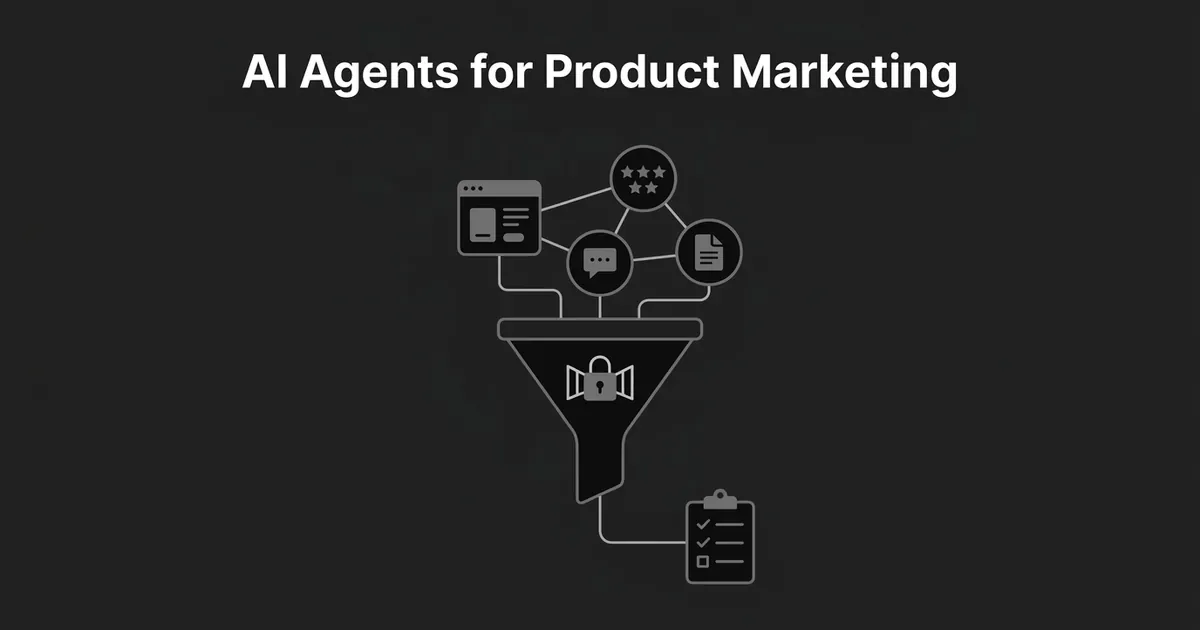
An agent is not a chatbot you ask a question once. In an operational workflow, it interprets a goal, pulls information from the systems you connect it to, reasons across multiple sources, uses tools, and keeps watching for changes instead of stopping after one answer. A useful loop for product marketing looks like this: observe the approved sources, classify what is new, synthesize it against your existing positioning and product facts, recommend a specific action, escalate to a human when the evidence is ambiguous or the action is public-facing, execute the approved work, then verify and log what happened.
That flexibility is the whole point, and also where the risk sits. A fixed automation follows the same rule every time. An agent can handle a competitor's page changing shape, a review complaint phrased ten different ways, or a sales call bringing up a new objection nobody scripted for. Because it can choose among tools and interpret ambiguous evidence, the workflow needs explicit boundaries around what it can decide on its own and what always comes back to a person.
Good candidates for agent autonomy include detecting page changes, grouping similar complaints, extracting recurring objections from calls, comparing new evidence against your stored positioning, and drafting a battlecard update for someone to review. Keep human approval for anything that changes pricing, declares a competitor claim true on incomplete evidence, publishes a public comparison, or touches a customer, prospect, or confidential deal record directly.
Pro tip: ask every agent finding to carry four things: the source, the observed change, the interpretation, and a confidence level. A summary without those four is not something a human can safely approve.
Step 1: Define the decision the agent must support
What to do. Start from a decision, not a vague research request. "Research our competitors" produces a dump of information nobody reads. "Which competitor changes require a battlecard update this week" produces something actionable. Other useful starting decisions: why are we losing deals to a specific competitor, which buyer segment has the clearest unmet need, is this feature ready for a public launch, which tracked buyer questions are competitors winning in AI answers.
Write a short brief for the agent: the objective, the scope (which competitors, markets, personas, product areas, time window), the approved inputs, the expected output format (alert, comparison table, battlecard input, risk register), the evidence requirement (every finding keeps a source excerpt), the escalation rule, and what a useful result looks like.
How to tell it is done. A teammate who was not in the room can read the brief and answer what the agent may investigate, what it must return, what it must not infer, and who makes the final call.
Where people go wrong. Starting with a tool or a model instead of a decision. A broad prompt produces a large information dump that someone still has to read and interpret by hand, which defeats the purpose of building the workflow at all.
Step 2: Set up the source of truth and permissions
What to do. Create one controlled layer holding your product facts, positioning, personas, claims, competitor list, and launch goals, separated from assumptions and unconfirmed signals. It should include your company positioning and category, product and feature descriptions, differentiators, the claims you can make and the ones you must avoid, buyer personas with their goals and objections, your competitor list, launch goals and dependencies, approved terminology, and your trusted external sources. Give the agent read access by default and add write access only where the action is reversible and has already been approved.
This is where DeepSmith's Deep IQ does its job. It stores your company positioning, product and service details, buyer personas, brand voice, visual guidance, content types, and trusted sources in one place, so an agent working on competitive research has something authoritative to check a claim against instead of guessing which version of your positioning doc is current. Deep IQ gives the workflow a shared source of truth; it does not replace a human checking the output before it goes anywhere public.
How to tell it is done. The agent can answer basic product and persona questions consistently, tells an approved company fact apart from an external observation, and cannot publish or modify anything sensitive without a person signing off first.
Where people go wrong. Dumping every document into one folder and hoping the agent figures out which version is authoritative. Duplicate, outdated, and contradictory source material produces findings nobody can trust, which is worse than not automating the task at all.
Step 3: Build the competitor intelligence watchlist
What to do. Sort your competitors before you start monitoring them: direct competitors selling something similar to the same buyer, adjacent ones solving part of the same problem a different way, status quo (the manual process or spreadsheet you are actually replacing), and aspirational companies whose positioning or distribution is worth watching for context. For each one, decide what signals actually matter: product and packaging changes (new pages, changelog entries, pricing shifts, integrations), positioning and demand signals (category language, headline claims, customer proof, content themes), customer and market evidence (review complaints, discussion threads, win-loss reasons), and company signals (press releases, hiring activity, partnerships). Treat hiring and job postings as a hypothesis about where a competitor might be investing, not proof of a roadmap decision.
The agent's job here is mechanical: pull new or changed records from the sources you approved, deduplicate repeats, extract the exact text, date, and source, classify the signal, compare it against your current product and launch plans, assign a confidence level, and either recommend an action or mark it monitor-only.
This is one of the two or three places in this workflow where AI agents product marketing teams set up genuinely save time. DeepSmith's AEO module already tracks the buyer questions you define and reports mention rate, citation rate, share of voice, sentiment, and which pages competitors get cited on for those questions. Discover Prompts can generate a starter set of tracked questions from your product, persona, and buyer-stage context, so you are not staring at a blank list. Content Map complements this by mapping your site and your competitors' sites onto one shared topic taxonomy, rechecked every 24 hours, so coverage gaps and untapped topics show up automatically instead of after someone manually audits sitemaps.
How to tell it is done. Every competitor has a defined monitoring scope with a business reason attached, and the agent can produce a short alert that contains evidence, interpretation, confidence, and a recommended action, not just a headline.
Where people go wrong. Monitoring everything continuously. A watchlist with no decision rules behind it produces alert fatigue fast, and you end up ignoring the channel entirely within a month. Track only the signals connected to an actual product, positioning, launch, or sales decision.
Step 4: Run a repeatable competitor teardown
What to do. Use a fixed template every time instead of asking an open-ended "tell me everything about this competitor" question. Compare the competitor against a defined buyer and buying situation, not in the abstract. A useful teardown covers the target customer and use case, category language, core promise and differentiators, relevant product capabilities, pricing and packaging (including what is not publicly stated), proof points and reviews, the onboarding path, distribution channels, common complaints and strengths, likely sales objections, where the competitor is stronger, weaker, or just different, and how fresh and confident the evidence is.
The agent should preserve the evidence rather than jumping straight to a conclusion. If a competitor's pricing is not public, the output should say pricing was not found, not estimate a number. Structure the result as an executive summary of three to five findings, a change log, a comparison matrix with unknowns clearly marked, repeated buyer language pulled from reviews or calls, strengths and friction points grouped by workflow, positioning implications labeled as recommendations rather than facts, sales implications, launch implications, a confidence rating, and a next action with an owner.
This is where Opportunity Agents earn their place in the workflow. Instead of brainstorming ideas from scratch, you can run one against your AEO or Content Map data and get back evidence-backed opportunities, each carrying the specific data point that justifies it, whether that is improving visibility for a tracked prompt, taking a competitor's citations, or closing a coverage gap. You can constrain a run to a 30, 90, or 180-day window and add instructions, and every run is logged so you can go back and see exactly what the agent saw when it made the recommendation.

How to tell it is done. The teardown produces a dated, comparable record with evidence, marked unknowns, clear implications, and a next action, and a sales or product teammate can understand the result without rerunning the research themselves.
Where people go wrong. Treating the comparison table as a truth table about the product itself. Public pages are incomplete, marketing claims use different definitions than yours, and the agent has no access to the actual competitor product. Mark things unknown or not comparable rather than filling in a gap with a guess.
Step 5: Turn evidence into positioning and enablement decisions
What to do. The agent can spot a pattern, but product marketing still decides which pattern matters and what the company actually says about it. Turn the teardown into four decisions. The positioning decision names the target buyer, the urgent problem, the alternative they are weighing, the frame that makes the problem clear, the differentiated value you can credibly deliver, and the proof that backs it. The messaging decision builds a hierarchy that stays consistent across the launch page, sales materials, and support, using real customer language where it is accurate without copying a competitor's phrasing or claiming something you cannot support.
The sales-enablement decision turns approved findings into battlecard updates, objection and response guidance, comparison questions, honest product limitations, and pricing guidance, all linked to approved proof. A good battlecard states plainly where the competitor might actually be the better fit; that fairness is what makes sales trust it enough to use it on a call. The product and launch decision assigns explicit actions to product, sales, marketing, support, and customer success, each with an owner, due date, dependency, and evidence behind it.
How to tell it is done. The team has approved positioning, a current battlecard, a short list of unresolved questions, and a visible line connecting the competitive evidence to the launch work in front of you.
Where people go wrong. Letting the agent turn a correlation into a strategy. A cluster of negative reviews about one feature is a real signal, but it does not by itself prove that fixing that feature will move conversion. Confirm the pattern with enough customer and business evidence before it becomes a roadmap decision.
Step 6: Convert the decisions into a launch readiness system
What to do. Launch readiness is cross-functional work, not a content calendar with dates on it. A complete checklist covers market and customer readiness (personas, market need, beta feedback, known objections), product readiness (specs, testing, documentation, known limitations), positioning and go-to-market readiness (positioning statement, messaging, pricing, distribution, success metrics), sales and support readiness (battlecards, training, escalation rules), execution readiness (launch date, owners, dependencies, a rollback plan), and post-launch readiness (feedback collection, adoption tracking, a scheduled post-mortem). Substantial launches often start planning six to twelve months ahead; treat that as a guideline to scale down for a smaller release, not a fixed rule.
The agent can convert a launch brief into a checklist, flag missing owners or dependencies, compare the brief against your product and persona source of truth, catch inconsistent claims across launch assets, summarize beta feedback, and produce a daily status summary. It should never decide a launch is ready just because every task shows green. Readiness also depends on evidence quality, unresolved risk, and whether the teams involved actually agree, which is a judgment call, not a checklist output.
Once positioning and messaging are approved, DeepSmith's Content Studio can carry the operational work forward: an approved idea moves from New Ideas to Planned Content, through the Writer, into Produced Content, where you review, edit, and publish. Autowrite can produce a configured article on its scheduled date and land it in Produced Content automatically, which is useful for the researched how-to, comparison, or buyer-stage pages that support a launch. It is not a substitute for product or legal approving what the piece actually claims about the product.
How to tell it is done. The launch has one checklist with named owners, dependencies, evidence, and decision gates, sales and support can describe the product accurately without checking with you first, and everyone knows what gets measured after release.
Where people go wrong. Automating the checklist without ever defining what "ready" actually means. A finished task is not the same thing as a validated outcome.
Step 7: Add approval gates and test the workflow before launch
What to do. Test the agent against representative tasks before letting it run broadly across your whole competitor list. Build an evaluation set that covers more than a prompt and an expected answer: the task, the operating environment, the tools it can use, the data it is allowed to touch, the expected steps, scoring criteria, positive examples, and negative cases like missing data, outdated sources, or a conflicting product fact. Score it across five categories: did it complete the task and meet the goal, did it use the right tools and sources in the right order, did it respect permissions and approval requirements, was it practical on cost and latency, and does the same task produce a reliable result across repeated runs.
Use automated checks for format, required fields, source presence, and prohibited claims. Save human review for ambiguous interpretation and high-risk launch decisions, and keep a sample of production runs around for ongoing review after the workflow goes live.
Set specific approval gates before you turn anything loose: the agent can collect and summarize competitor changes, but a human approves any claim about strategic intent; it can record public pricing, but a person approves any recommendation to change your own pricing; it can propose a battlecard update with evidence, but product marketing approves before it reaches sales; it can flag a missing launch task, but the launch owner approves any date change; it can prepare a publish-ready draft, but the product owner approves the facts and claims before anything goes out publicly.
How to tell it is done. The workflow has a pass or fail rubric, a test set that includes negative cases, a named reviewer, logged runs, and clear conditions under which the agent pauses and asks instead of guessing.
Where people go wrong. Judging only the final answer. An agent can land on a plausible-sounding conclusion through a path that skipped verification, used a source it should not have, or quietly invented support for a claim. Check how it got there, not just what it produced.
Step 8: Monitor launch results and feed findings back into the next cycle
What to do. Start measurement before launch, not after. Pick a small set of metrics tied directly to the launch goal, and define your baseline, observation window, owner, and the action you take if performance is weak. Track adoption and activation (activation rate, feature adoption rate, time to value, stickiness), market and revenue signals (qualified pipeline, win rate against named competitors, common win and loss reasons), and experience signals (support volume, sentiment, feature requests, unresolved escalations). One industry source reports a 17% median SaaS activation rate and a 13% to 20% stickiness range; treat those as external reference points to sanity-check against, not a target to hit, since your own baseline before this launch is what actually matters.
AI-search visibility belongs in this list too, and it is worth watching separately from traffic. Google's own reporting can show impressions from AI features on your pages. Eligibility to appear does not guarantee that a page gets crawled, indexed, or shown for a given question. When visibility is part of the launch goal, DeepSmith's AEO metrics (mention rate, citation rate, share of voice, sentiment, visibility trend) give you a monitored signal instead of a one-time check, and the Pages and Competitor citations views show exactly which pages are earning citations and where a competitor is still winning a tracked question.
After launch, the agent's job is to collect the defined metrics, compare them against the pre-launch baseline, group issues by persona and severity, separate symptoms from likely causes, and route high-impact findings to the right owner for approval. It should not declare success from one metric. Early signups or traffic do not prove adoption, retention, or that the product actually solved the problem you launched it for.
How to tell it is done. You have a post-launch readout connecting outcomes to evidence, a clear owner assigned to each corrective action, and a written record of what you would do differently next time.
Where people go wrong. Calling the launch a win off a single number. Mention rate, citation rate, impressions, clicks, and conversion are different signals, and conflating any of them with actual revenue impact is how a team ends up repeating the same mistake on the next launch.

What to do next
Pick one recurring decision to start with, something like a weekly competitor-change review or a launch-readiness check on your next release. Wire up a small number of approved sources, define the escalation rule, and run it with a human approval gate before you expand it to more competitors, more teams, or more channels. The value of AI competitive research comes from the evidence trail it builds over time, not from the first alert it sends you.
If you are already spending hours a week stitching competitor evidence into a positioning doc or a launch checklist by hand, DeepSmith gives you the source-of-truth layer, the AI-search visibility tracking, and the production pipeline in one place, so the workflow described here has somewhere to run instead of staying a set of good intentions in a shared doc. Start a free trial and connect your first competitor watchlist today.