Build vs Buy: Should You Build Owned Content or Acquire an Existing Audience
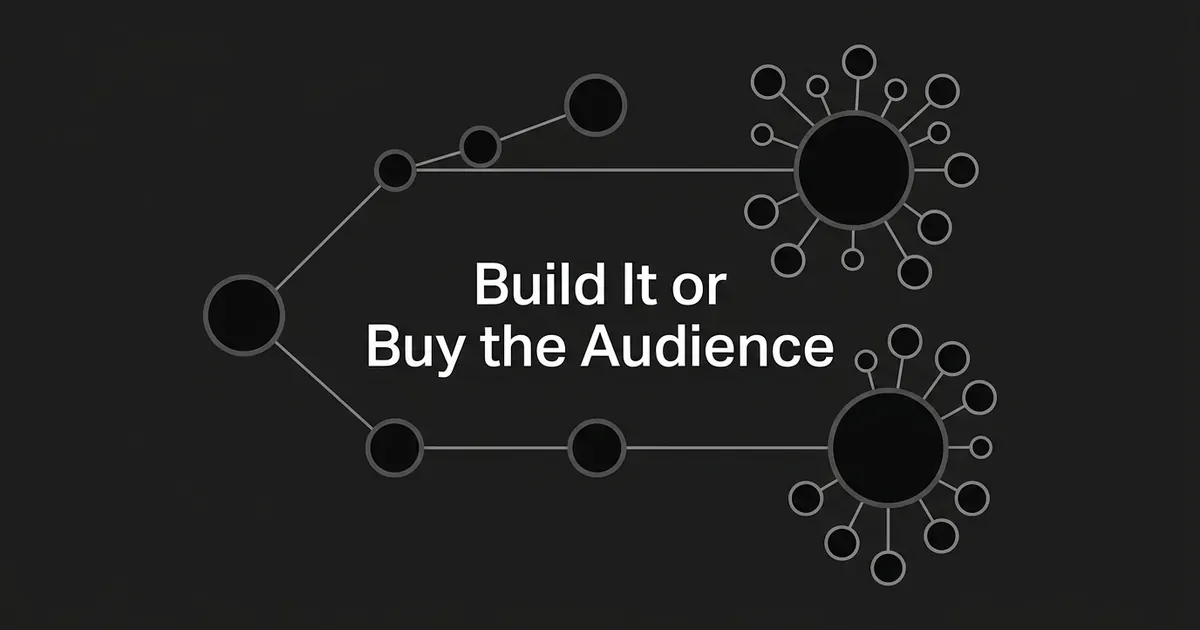
You have two ways to get an audience for your SaaS company. You can build one from your own site, post by post, until people start finding you on their own. Or you can buy one: a niche blog, a newsletter, a media property that already has readers, rankings, and an email list attached to it. Both are real strategies, and founders weighing build vs buy content decisions usually assume the question is about speed or money. It is really about fit. Buy the audience only when it already looks like your ideal customer. Build your own when it does not, even if that means waiting longer for the payoff.
Here is the short version before you get into the weeds.
| Decision axis | Build from scratch | Buy a niche property | Build a newsletter | Buy a newsletter |
|---|---|---|---|---|
| Upfront cash | Low cash, high time | High capital cost | Low to moderate cash | Purchase price plus transition cost |
| Speed to reach | Slowest, starts at zero | Can be fastest if the reach holds | Grows through referrals, still starts at zero | Fast access, but engagement can drop after the handover |
| Fit with your product | You choose it, so it is highest | Only as good as the overlap with your actual buyer | High if it is built around your product's problems | Depends on why people subscribed in the first place |
| Main risk | You run out of patience before it compounds | You pay for reach that does not transfer | Publishing goes quiet and the list stalls | The audience mismatch shows up in the unsubscribe rate |
What building, buying, and a newsletter actually mean
These three get talked about as if they are the same decision with different price tags. They are not.
Building means starting your own content system from nothing. You pick the topics, the point of view, the domain, the place people sign up, and how you eventually turn a reader into a lead. That can be a blog, a resource library, product education, original research, or a newsletter fed by your own channels. The thing you are accumulating is not pageviews. It is search visibility, editorial trust, and a list of people who came to you on purpose.
Buying a niche media property means acquiring someone else's publication along with everything attached to it: existing traffic, rankings, backlinks, an email list, maybe a following on social, and a track record with advertisers or affiliates. You are not really buying traffic. You are buying a bundle of assets and a set of expectations that readers already have about what this publication does for them.
A newsletter deserves its own line because it behaves differently from a blog. A blog earns discovery through search and links, and it keeps working after you publish it, though competitors and algorithm changes can chip away at that over time. A newsletter is a standing invitation to show up in someone's inbox on a schedule. Its value depends on whether people open it, click it, and act on it, not on how many names are on the list. A subscriber is not automatically a buyer, and a big list with low engagement is worth less than a small one that clicks through every week.
Building from scratch costs time before it costs money
The direct cash cost of building content looks small if you only count what you pay a freelancer per post. That undercounts it. There are really four costs stacked on top of each other: production (writing, editing, SEO, design, publishing), your own time or your team's time briefing and reviewing drafts, the tools that run the pipeline, and the stretch of months where you are funding all of that before it produces real pipeline.
A 2026 benchmark on B2B content marketing costs puts founder-written content at no direct cost but 5 to 10 hours of your week, freelance blog posts at roughly $200 to $800 each, and a working seed-stage content program in the range of $1,500 to $5,000 a month depending on scope. A Series A company scaling that up reports closer to $4,000 to $8,000 a month. Add keyword research, competitive analysis, and distribution on top of the writing, and the same source says you can expect another 30 to 50 percent on top of what the words alone cost.
Run that out over a year and a $2,000 to $6,000 monthly program adds up to $24,000 to $72,000 before you have changed anything about the scope. Hold that same range for three years and you are looking at $72,000 to $216,000 in direct spend, on top of whatever hours you or your team put in. That is not a prediction of what your program will cost. It is a way to put a number next to the alternative before you decide the acquisition price sounds cheap by comparison. A content planning framework that favors fewer, sharper pieces over a raw publishing quota is usually what keeps that budget from being wasted on volume that never converts. Turning that plan into a repeatable week, with batching research and writing into one block, is often what makes the schedule survive past the first month.
The part that does not show up in any of those numbers is that none of it is guaranteed to work on your timeline. A Semrush synthesis on how long SEO takes says four to twelve months is the common range before you see meaningful, durable results, with low-competition terms moving faster and conversion-oriented pages taking at least six months. Google's own guidance says it rewards content made for people first, not content made to game rankings, and that its ranking systems keep changing. There is no finish line where the algorithm locks in your position. Building buys you an asset that is genuinely yours, but it only pays off if you can sustain a realistic content cadence long enough for it to compound, and it does not buy you a guaranteed date when it starts paying for itself.
Buying a niche site trades cash for a head start, not a guarantee
An acquisition takes a chunk of that future building cost and turns it into a number you pay once, upfront. In exchange you get whatever the seller already has: indexed pages, backlinks, an email list, a name people recognize in that niche. Empire Flippers, a marketplace that trades in exactly these kinds of sites, describes content businesses under $5 million in revenue being priced on a multiple of monthly seller discretionary earnings, historically averaging in the high twenties to mid thirties times monthly profit depending on the year and the size band, with a reported 2020 average sale price around $94,000 for smaller sites. Those figures are historical and specific to one marketplace, not a going rate you should expect to pay today, but they tell you the shape of the bill: whether you buy a niche site or an entire publication, a content acquisition strategy is a capital decision first. Before you spend on one, it is worth running the same content gap analysis you would use to justify building instead, so the case for buying rests on evidence rather than the seller's traffic screenshot.
Buying does not stop the spending once the purchase closes. You still need someone running it: an editor, contributors, technical upkeep, an email platform, and probably some repositioning so the publication makes room for your product without turning into an ad for it. And a purchase does not come with any of the guarantees people assume it does. Rankings are not permanent for the buyer any more than they were for the seller. Google's own migration guidance treats a change of ownership as an active event that it crawls harder, not something that quietly slides past unnoticed, and traffic can slip during and after that transition. The original audience showed up for a specific promise from a specific editorial voice, and the more you change either one, the more of what you paid for starts to evaporate.
The right question is not whether buying beats building post for post. It is whether the qualified pipeline, signups, and time saved from the acquired asset will repay the purchase price and the ongoing cost of running it faster than building the same strategic position yourself. That means tracking qualified visits, email clicks, demo starts, and retained customers on both sides of the comparison, not pageviews or total subscriber counts, which tell you almost nothing about whether either path is working.
A newsletter is its own decision, not a smaller version of either one
If you are weighing acquire audience vs build content as a binary, a newsletter usually gets folded into whichever side it resembles, and that is a mistake because it runs on different economics than a blog does.
A newsletter gives you something a blog cannot: a direct, recurring channel where you can watch opens, clicks, replies, and unsubscribes in real time instead of waiting months to see whether a page ranks. Mailchimp's benchmark data across billions of delivered emails puts average open rates across all industries around 35 percent and click rates around 2.6 percent, with meaningful variation by industry and, in practice, by list source and topic fit. Those numbers are directional. A list built from your own audience around a problem people actually have will usually outperform them; a list stitched together from a lookalike acquisition usually will not, at least at first.
List size is close to useless on its own. A widely cited beehiiv example describes a 12,000-subscriber newsletter with a 45 percent open rate and strong click-through as more valuable to a buyer than a much bigger, less engaged list, and that is the right instinct even though it is one anecdote rather than a market rule. What matters is the order: total subscribers, then deliverable subscribers, then active subscribers, then subscribers who click, then subscribers who match your actual customer profile, then subscribers who take a real action. Only the last two categories tell you whether you have an asset or a spreadsheet. Watching your share of voice against competitors before and after the acquisition is one way to tell whether that audience is actually paying attention to you or just sitting on a list.
There is also a permission boundary worth knowing before you treat a list as a thing you can simply hand over. The FTC's CAN-SPAM guidance is explicit that once someone has opted out, their address cannot be sold or transferred as part of a list sale. An acquired list is a set of relationships with expectations attached, not a database you own outright the moment the wire transfer clears.
The axes that actually decide this
Once you strip away the framing, four tensions are doing the real work in this decision.
Speed versus fit. Buying can be faster, but only if the audience already sits in your ideal customer profile. An adjacent audience feels like a shortcut and often is not one: you inherit attention without inheriting demand, and you spend the months you saved trying to convince readers who never asked for your kind of answer.
Capital versus labor. Buying converts a recurring cost into a single upfront one. Building spreads the cost out but eats founder or team time every week for as long as it takes to compound. If cash is tight but you can commit consistent effort, building is usually the safer bet financially even though it feels slower. If you have capital and an urgent gap in your visibility but no one to actually run a publication, buying can turn expensive fast.
Existing authority versus your own. A bought site starts with credibility someone else earned. A built one earns credibility tied directly to your product, your customers, and your point of view, and the more you bend an acquired publication's subject or tone toward your own product, the more you risk weakening the exact thing you paid for.
Control versus dependence. Building your own list and library gives you more direct control over the relationship, but you are still leaning on search engines, email providers, and platforms either way. Buying does not remove that dependence. It adds a transition on top of it, because the asset's performance was tied to its old domain, its old sender reputation, and its old creator's identity, none of which automatically survive a change of hands.
When each option actually wins
Build when you have a genuinely distinctive point of view that no existing publication owns, when the market is young enough that you can help define its language, when your product needs real explanation to earn trust, and when you can commit steady effort even without much cash. Building is also the right call whenever no acquisition target has a strong overlap with your actual buyer. A large audience that is not your audience is not a shortcut. Owning a niche this way usually looks more like topic clusters built around a specific problem than a scattered list of one-off posts.
Buy when a specific publication's readers already look like your customer list, when you are facing a real deadline you cannot wait out, when you have the capital to fund both the purchase and the ongoing cost of running it, and when the audience is engaged enough that its value is more than a raw subscriber count. Buying only pays off if you can keep the trust that got built before you showed up, which usually means resisting the urge to turn the publication into a pitch for your product on day one.
Choose a newsletter specifically, separate from either path, when you need a recurring, measurable relationship more than a large search footprint, and you can commit to a cadence you will actually keep. Sizing that commitment against your real week, the way an editorial calendar built for actual capacity does, matters more than picking an ambitious publishing target you will abandon in month two.
If you want both speed and long-term ownership, a hybrid can work: use an acquired property as a distribution head start while you build your own product-aligned content and email relationship underneath it. Keep the acquired publication doing what it did before, introduce product mentions only where they genuinely answer a reader's question, and measure whether the acquired readers turn into real, qualified contacts rather than assuming the handover worked because the traffic held steady.
Every version of this build vs buy content question comes back to the same test: does the asset already look like your buyer, or are you hoping it will grow into one. Whichever path you choose, the harder part is keeping it running once the decision is made. A founder who builds or goes hybrid still needs a repeatable way to find the next topic, keep every article accurate to the product, and get the piece written without becoming the bottleneck personally, and that is where lean content operations built for a team of one earn their keep. DeepSmith's Content Map shows where your own coverage is thin against competitors, and Opportunity Agents turn that gap into a specific, evidence-backed idea rather than a guess. Content Studio then carries a planned idea through research, writing, and publishing, with Autowrite able to run the whole thing on a schedule so the pipeline keeps moving even on the weeks you are heads down on the product instead. None of that decides build versus buy for you. It just means whichever one you pick does not quietly stall out six weeks in. If you want to see how that works on your own site, you can start a free trial.