

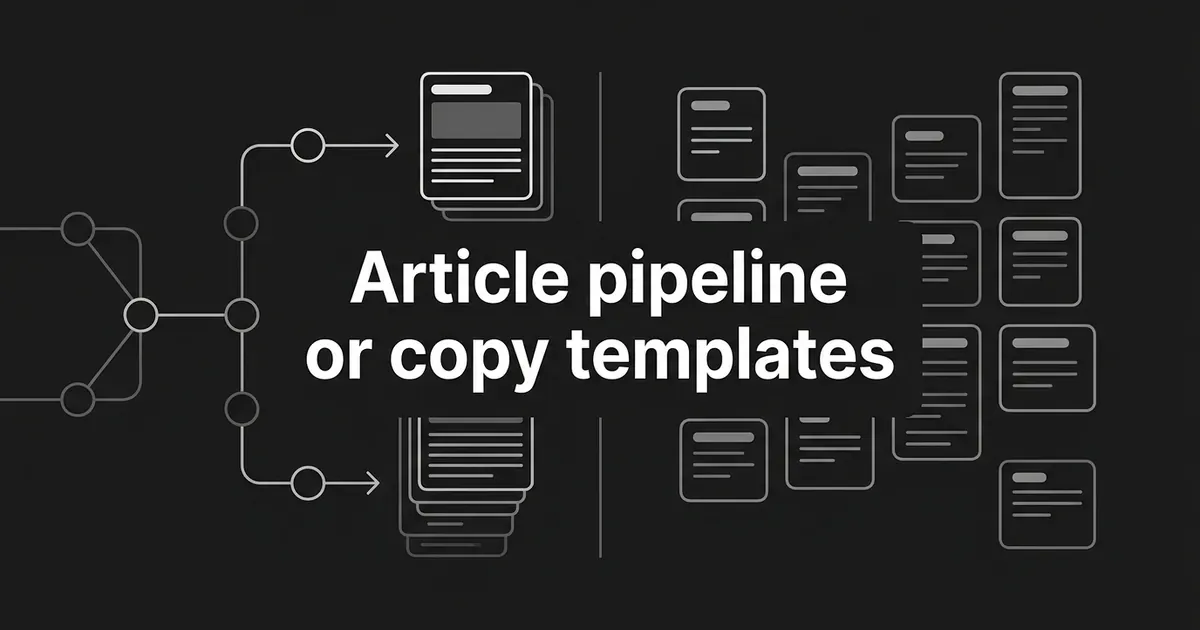
Byword is built to research keywords, write long SEO articles and publish them to a CMS, while Rytr is a low-cost template writer for short marketing copy and blog sections, with no documented SEO research or publishing. Byword suits teams that publish articles in volume, and Rytr suits individuals who need quick copy. DeepSmith is a strong alternative to both for teams that care about AI search, because it tracks where your brand appears in AI answers and writes the publish-ready articles that close the gaps.
If you're weighing Byword vs Rytr, you're really choosing between two different kinds of tool. Byword runs a pipeline for SEO articles, from keyword research through drafting and internal linking to publishing in a connected CMS. Rytr gives you templates for short copy such as emails, ads and product descriptions, plus blog sections you build up one piece at a time. Both cost far less than an agency, so the decision usually comes down to the job you need done. DeepSmith sits alongside both for teams that also want to know how AI engines describe their brand, and want the articles that fix it written in the same place.
Byword vs Rytr: the short answer
- Choose DeepSmith if you want to see where your brand shows up in AI answers and get publish-ready, on-brand articles that close the gaps, from $99 a month with a 7-day free trial.
- Choose Byword if you need keyword research, long-form drafts, internal linking and CMS publishing for SEO articles, from $99 a month for 25 articles.
- Choose Rytr if you mostly need short marketing copy from templates at a low price, from a free plan or $7.50 a month billed yearly.
| DeepSmith | Byword | Rytr | |
|---|---|---|---|
| Paid entry plan, billed monthly | $99/mo (Pro) | $99/mo (Starter) | Premium $29/mo (Unlimited not listed) |
| Paid entry plan, billed yearly | $80/mo | $83/mo | $7.50/mo (Unlimited) |
| Output at entry tier | 20 articles/mo | 25 articles/mo | Unlimited characters (Free: 10K characters/mo) |
| Free trial or free plan | 7-day free trial | 5 free articles, no card | Free plan, 10K characters/mo |
| Long-form article generation | Yes | Yes | Partial |
| Short-form marketing copy | Partial | Partial | Yes |
| Keyword research | - | Yes | Not listed |
| Internal linking | Yes | Yes | Not listed |
| Brand voice | Yes | Yes | Yes |
| CMS publishing | Yes | Yes, Starter and up | Not listed |
| Scheduled publishing | Yes | Yes | Not listed |
| AI visibility tracking | Yes | Partial | Not listed |
| API | Yes, read-only | Yes, Standard and up | Yes, usage-based |
| Review rating | 4.8/5 on G2 | 3.5/5 on G2 | 4.7/5 on G2 |
Pricing and features as of September 2026, from each vendor's site and public reviews.
Byword

Byword is a self-serve AI article writer from Byword AI Ltd in London. It launched in November 2022 and relaunched as version 2 in January 2026. You give it a keyword, a title or an outline and it returns a full article in about 60 to 90 seconds, with internal links, images, metadata and schema included. Around that sits keyword and SERP research, a live SEO score, a trainable brand voice, a knowledge base you can upload documents to, scheduled generation and direct publishing to WordPress, Webflow, Ghost, HubSpot and Medium. For volume, it runs campaigns from lists of keywords and programmatic templates filled from a CSV file. Our Byword review goes through the product in more depth.
It's built for SEO teams, agencies and niche-site publishers who want a lot of search-focused articles on per-article pricing and who will edit and fact-check the output themselves. The standout is that the whole path from keyword to published page lives in one tool. The real limits are that Free and Starter are solo plans and the API starts on Standard, and that independent reviews are few and mixed. G2 shows 3.5/5 from 3 reviews and Trustpilot 2.8/5 from 7, with older reports of repetitive passages and weak link choices. Byword also has no native tracking of AI answers.
Rytr

Rytr is an AI writing assistant from Rytr LLC, launched in 2021 and owned by Copysmith since an October 2022 announcement. You pick a use case, a language and a tone, type a short input, and edit the result in a document-style editor with continue, expand, shorten and rephrase actions. Rytr says it offers 40+ use cases, including emails, ads, captions, product descriptions and SEO meta titles. My Voice mirrors a sample of your writing, a Copyscape-based checker handles plagiarism, and a Chrome extension comes with every plan.
It suits individuals, freelancers and small businesses that want fast, inexpensive first drafts. The standout is the price, with a free plan and paid plans from $7.50 a month billed yearly. Long articles are built section by section, and use-case inputs are limited to 25 to 500 characters, so a full post takes manual work. Our list of Rytr alternatives covers the other options in this price range. Rytr's product pages don't document keyword research, SERP analysis, content scoring, internal linking or CMS publishing. Reviews are strong on ease and price (G2 4.7/5 from 820 reviews, checked in September 2026), and the usual complaint is generic output that needs editing.
DeepSmith: the alternative that tracks AI answers and writes the fix

Byword and Rytr both help you produce text, and neither one tells you where your brand stands in AI answers. Byword links its AI visibility page to a separate product called Trakkr, and only its MCP documentation mentions checking AI-search citations. Rytr doesn't document tracking or optimization for AI answers at all. Byword does give you a full SEO pipeline, and the gap it leaves is that nothing in it shows which questions AI engines are answering without mentioning you.
DeepSmith puts tracking and production in one platform. AI Visibility checks the questions you define on a schedule and reports mention rate, citation rate and share of voice by engine, which of your pages get cited, and which competitor pages win the citations you don't. Opportunity Agents turn those gaps into content ideas, and each idea carries the data point that justifies it. The Writer then turns a planned idea into a finished article that is researched, linked, and delivered with a cover image and publish-ready metadata. AEO formatting, such as crisp answers near the top and a citation-ready structure, is built into every article. Deep IQ stores your brand voice, personas and product facts, so each draft is grounded in them. Autowrite can carry an article all the way to published without anyone in the app.
Plans run $99 a month for Pro (20 articles, 50 tracked prompts, ChatGPT), $199 for Grow (40 articles, 100 prompts, adds Perplexity) and $399 for Scale (90 articles, 200 prompts, adds Gemini), with annual billing at $80, $160 and $299 a month. Enterprise covers all ten engines. If Byword is your main alternative, we compare the two directly in DeepSmith vs Byword.


SEO research and optimization
Byword is clearly ahead of Rytr here. Its Keyword Explorer shows volume, difficulty, CPC, trends and intent, and Research adds SERP insights, content gaps and cluster analysis. Optimize compares a page against the top 10 ranking results and, with Google Search Console connected, flags pages whose position or clicks have dropped. Keyword Explorer and content optimization start on Starter, and Free gets a basic research dashboard. Byword's own Surfer SEO comparison page calls its scoring implicit and says Surfer's SERP analyzer gives deeper competitive intelligence, so it's fair to treat the optimization as useful rather than as a dedicated scoring tool.
Rytr documents none of this. It has SEO meta title and meta description use cases and a Blog Idea and Outline generator, and its comparison pages mention a native SEO toolkit, but no product page describes keyword data, ranking-page analysis or content scoring. On Byword vs Rytr features for SEO articles, this is where the two differ most.
What DeepSmith does: The Content Map crawls your site and your competitors' sites and classifies every page onto a shared topic taxonomy and buyer stage, so coverage gaps and untapped topics show up as measurements. Opportunity Agents read that data and your AI visibility data and return ideas with the evidence attached. Keyword coverage, heading structure, schema markup, internal linking and metadata are part of the writing pipeline.
Long-form articles and short-form copy
Byword wins on long articles and Rytr wins on short copy. Byword turns a keyword, title or title plus outline into a complete article, with formats that include guides, listicles, reviews, how-tos and comparisons, at one credit per article. Its short-form support is partial. The app pages don't show ad or email templates, though its MCP server can turn an article into LinkedIn, Twitter, email, takeaway or FAQ schema versions at one credit each.
Rytr is the reverse. Its 40+ use cases cover email, ads, captions, calls to action, product descriptions and landing page copy, and 20+ preset tones are on every plan. My Voice matches one tone on Unlimited and several on Premium. For blog posts it works by outline, then a Paragraph per heading, then Continue Ryting on 100 to 1,000 selected characters. That's workable for a short post, and it's slow for a full article. If you're comparing Rytr vs Byword for blog work, the output length you need usually decides it, and our piece on long-form and short-form content covers how to choose. Other budget AI writing tools are compared in our Jasper vs Rytr vs WordHero page.
What DeepSmith does: The Writer produces a finished, brand-grounded article rather than a first draft to rescue. Every article also arrives with social posts already written, and the Apps Library turns it into versions for LinkedIn, X, Medium, Substack, newsletters, Reddit and more in the same brand voice. DeepSmith's short-form output is those channel versions of an article rather than standalone ad templates.
Brand voice, knowledge and internal linking
Byword goes further than Rytr on grounding and linking, and the two are closer on voice alone. Byword offers six preset tones or a custom voice trained from uploaded files, URLs or pasted text, plus banned words, preferred terms and an AI-phrase filter. Its knowledge base takes PDF, DOCX and TXT files up to 10MB and retrieves from them during generation. For internal linking, it indexes your sitemap and inserts 1 to 12 links per article, with custom phrase-to-URL rules, and re-indexes once every 14 days. That linking is available on all plans, including Free.
Rytr's My Voice analyzes a writing sample and mirrors its tone, with separate tones per client on Premium. It doesn't document a knowledge base of company or product facts, and it doesn't document internal linking. The gap shows most when you want an article to mention your real product accurately and link to your own pages. Our guides to automating internal linking and to grounding AI content in your brand voice and product facts explain why those two features matter at volume.
What DeepSmith does: Deep IQ holds About Company, Products, Buyer Personas, Brand Voice, Visual Guidelines and Content Types as structured context that every article is written against. Internal linking is powered by the Content Map, so links point to pages that exist on your site.
Publishing and automation
Byword has the clear edge. Its changelog lists scheduled generation, WordPress auto-publish and a scheduled status for publishing. It publishes to WordPress, Webflow, Ghost, HubSpot and Medium, and Shopify is listed as native on one page and as coming soon in its docs. CMS integrations start on Starter, the REST API is on Standard and Scale, and a remote MCP server exposes about 40 tools with optional review gates. Webhooks, Zapier and Make connections round it out, though Make is marked as coming soon in the docs.
Rytr doesn't document CMS publishing or scheduling. The Chrome extension works inside WordPress and other web editors, and a separate usage-based API gives 10,000 free credits, then pay as you go. Teams that publish on a calendar will do the transfer by hand. For a wider look at tools that publish automatically, see our roundup of AI content tools with CMS auto-publish.
What DeepSmith does: Planned Content gives each idea a date, and Autowrite writes it on that date and lands it in Produced Content. From there you publish to WordPress, Webflow, Strapi, Sanity or Contentful, or to your own webhooks. The REST API and the MCP server read your workspace data for use in your own tools, and webhooks send signed callbacks when content status changes.
Pricing and value
Rytr costs far less, and Byword gives you more for an SEO workload. According to Byword's pricing page, Starter is $99 a month ($83 billed yearly) for 25 articles with extra articles at $3.50, Standard is $299 ($249) for 80 articles with three seats and API access, and Scale is $999 ($833) for 300 articles. Unlimited is a $1,999 platform fee for bring-your-own model keys. Credits roll over, and every account starts with 5 free articles and no card.
Rytr's pricing page lists a Free plan with 10K characters a month, Unlimited at $7.50 a month billed yearly, and Premium at $24.16 billed yearly ($29 monthly, per Rytr's comparison pages). The word "unlimited" covers generated characters only. More than one language, multiple voices and custom use cases are Premium only, and plagiarism checks are capped at 50 or 100 a month. Rytr's terms say subscriptions are not refundable except at its discretion, and the annual plan carries a 12-month commitment.
What DeepSmith does: One price covers tracking and writing. Pro is $99 a month with 20 articles, 50 tracked prompts and 5 seats, Grow is $199 with 40 articles, 100 prompts and 7 seats, and Scale is $399 with 90 articles, 200 prompts and 10 seats. There are no long-term contracts, and the 7-day free trial gives you real data and real drafts before you pay.
From insight to action
Byword is nearer to this than Rytr, though neither closes the loop. Byword's AI visibility support is partial: the docs reference citation data through the MCP server and a Trakkr snapshot, but they describe no monitored engines and no method for optimizing a page to be cited. Rytr documents neither tracking nor optimization for AI answers. In both cases you would find out where you're missing from AI answers somewhere else, then come back to write.
What DeepSmith does: DeepSmith runs the loop in one place. AI Visibility shows where the brand is mentioned or cited across engines and which competitor pages win the citations. Opportunity Agents turn that into ideas with the evidence attached, the Writer produces the article with AEO formatting built in, and Produced Content publishes it. Since the same data feeds each step, you can see which of your pages gets cited afterward.
Which should you choose
- DeepSmith fits a content or marketing team that wants to know where its brand appears in AI answers and to publish on-brand, publish-ready articles that close those gaps, with tracking and writing on one self-serve plan and a 7-day free trial.
- Byword fits an SEO team, agency or niche-site publisher that needs keyword research, high-volume long-form drafts and CMS publishing on per-article credits, and has editors ready to fact-check the output.
- Rytr fits a freelancer or small business that wants inexpensive short copy and blog sections from templates, in a tone it can train on its own writing.
You can try DeepSmith free for 7 days and see real visibility data and real drafts before you pay. Start a free trial.


