You picked Rytr because it was cheap and fast. That was a good call at the time. Short snippets, quick captions, a product description before lunch.
Then the job got bigger. Your leadership wants a real content engine. Someone asked what your AI search strategy is. And you are staring at a backlog you cannot clear one snippet at a time.
If that is where you are, you are not behind. You have just outgrown the tool.
This guide walks you through nine Rytr alternatives, from budget-parity picks to real step-ups in long-form quality, SEO, and AI-search work. We will be honest about who each one suits, including where a competitor beats us. You only need to pick one, and by the end you will know which.
Let's take it one tool at a time.
How we picked these Rytr alternatives
A roundup is only useful if you know how the list was built. Here is exactly what we weighed, and why each thing matters for a marketing lead.
- Production quality and format range. Does it write structured articles and marketing assets, or only short snippets? This is the single biggest gap between Rytr competitors and Rytr itself.
- SEO and AI-search readiness. Keyword and SERP research, optimization, GEO and AEO formatting, and whether the tool measures if AI engines actually cite you.
- Brand accuracy and voice. Can you store your brand, product, persona, and style once and reuse it, instead of re-briefing every draft?
- Strategy-to-production connection. Do research, ideas, briefs, drafting, review, publishing, and distribution actually join up into a workflow you can repeat?
- Volume and economics. Real throughput, seats, and prompt or credit limits, not just a sticker price.
- Team fit and integrations. Collaboration, approvals, CMS publishing, and the connections your stack already needs.
- Honest scope boundaries. What a vendor does not claim, what is capped, and where someone else is the better answer.
One thing we will not do is pretend there is a lab test proving one tool writes better prose than another. No such independent benchmark exists here. Every quality judgment below is a reasoned fit call based on documented workflow, and we say so where it matters.
Prices are a snapshot from September 2026. Several vendors use promotional annual rates or credit systems, so we keep the billing basis attached to every number.
Two of these are budget-parity picks. The rest are step-ups. If you want tools like Rytr in the same shape and roughly the same spend, skip ahead to entries 8 and 9.
The 9 best Rytr alternatives at a glance
| Rank | Tool | Best fit | Price snapshot | Main tradeoff |
|---|---|---|---|---|
| 1 | DeepSmith | Teams that want AI-search intelligence wired into publish-ready production | $99, $199, $399 monthly; $80, $160, $299 monthly billed yearly | Lower tiers cap articles, prompts, seats, and engine coverage |
| 2 | Writesonic | SEO, GEO, AEO, and AI-search execution | $79, $199, $399 monthly equivalent billed annually | Entry price is annual-equivalent; brand-voice depth is not stated |
| 3 | Jasper | Brand-governed marketing teams and larger operations | Pro $69 monthly, $59 billed yearly; Business custom | Seat limits, credit-based agents, 12-month Business commitment |
| 4 | Frase | SEO-led research-to-publish workflows | $49, $129, $299 monthly; $39, $103, $239 billed yearly | Article, audit-page, site, and seat caps vary a lot by plan |
| 5 | Scalenut | SEO operations with GEO plus strategist review | $59, $89, $199 monthly; promotional annual rates of $24, $36, $80 | Annual prices are a limited offer; weekly prompt refresh on low plans |
| 6 | Copy.ai | GTM workflows across marketing, sales, and revenue ops | Chat $29 monthly; Growth $1,000; Expansion $2,000; Scale $3,000 | Workflow credits vary per run; GEO and AEO are not stated |
| 7 | Anyword | Performance copy chosen by predicted response | $49 and $99 monthly; $39 and $79 billed yearly | Built around prediction, not a full content pipeline |
| 8 | Simplified | Budget all-in-one copy, design, social, and publishing | AI Writer from $20 monthly; platform Starter from $79 monthly | Pricing layers are inconsistent across public pages |
| 9 | ChatGPT | Flexible drafting on a small budget | Reported Free $0, Go $8, Plus $20, Pro $100 or $200 monthly | You build the brief, SEO, linking, QA, and publishing yourself |
1. DeepSmith: best for connecting AI visibility to production
Best for: marketing leads who need to answer two questions at once. Where are we losing visibility in AI answers, and how do we produce the content that closes that gap?
Here is the problem most tools like Rytr leave you with. You can generate words all day, and still have no idea whether ChatGPT or Perplexity ever names your brand. So you buy a tracker, then a writer, then a research tool, and now you are the integration layer between three dashboards.
DeepSmith is an AI search analytics and content production platform in one. It is a production engine, not a writing assistant. The output is meant to be a finished, brand-grounded article you can publish, not a first draft you rescue.
The ranking here is earned by one thing: the connection between measurement and action. AI Visibility finds the prompts, mentions, citations, and competitor pages. Content Map and Opportunity Agents turn that evidence into ideas. Content Studio turns an idea into a published article and the social posts that go with it.

Pricing
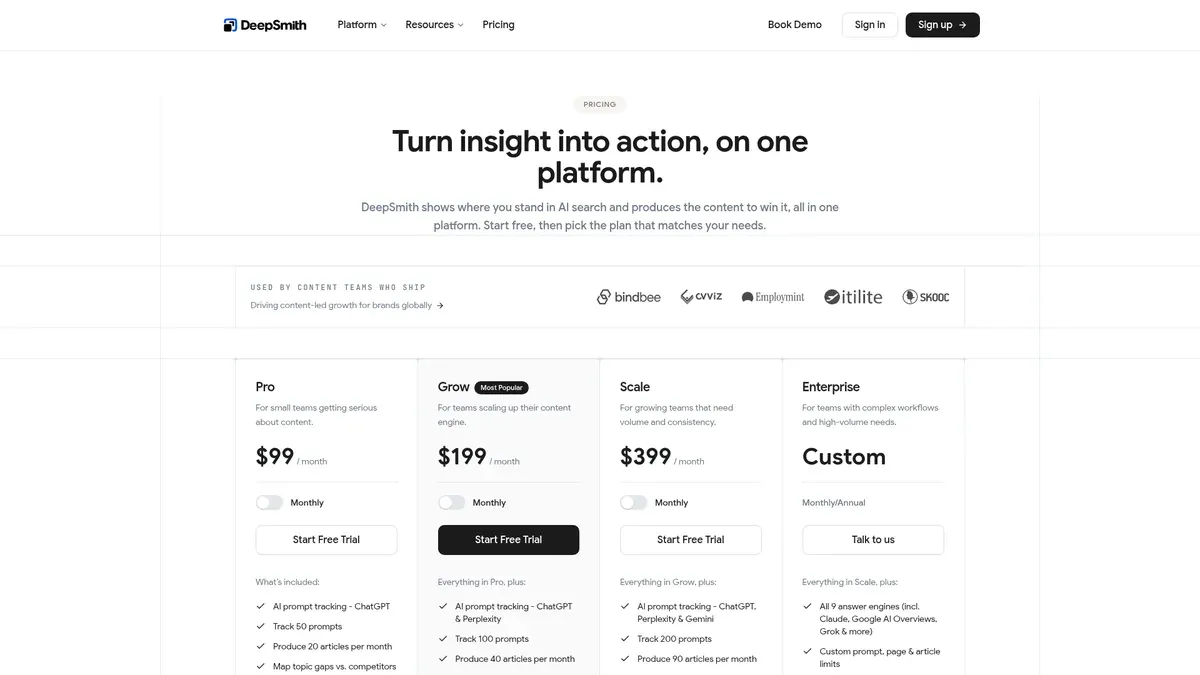
Pro is $99 a month, or $80 a month billed yearly, with 20 articles, 50 tracked prompts, 5 seats, and ChatGPT tracking. Grow is $199, or $160 yearly, with 40 articles, 100 prompts, 7 seats, and Perplexity added. Scale is $399, or $299 yearly, with 90 articles, 200 prompts, 10 seats, and Gemini added. Enterprise is custom and covers all ten engines. There is a 7-day free trial, no long-term contract, and no cancellation fee.
Key features
- AI Visibility. Mention rate, citation rate, share of voice, sentiment, and visibility trend, plus full answer history, the pages being cited, and the competitor pages winning citations you want.
- Tracked prompts and Discover Prompts. Define the questions your buyers ask, collect answers on a schedule, and let Discover Prompts generate a starter set from your product and persona context.
- Content Map. Your site and your competitors' sites crawled into one shared taxonomy, classified by topic and by funnel stage. It surfaces coverage gaps and untapped topics. Sitemaps refresh every 24 hours, so new pages fold in on their own.
- Opportunity Agents. Agents read your own data and return ideas with the evidence attached. Take a competitor's citations, turn mentions into citations, close a decision-stage gap against up to four competitors at once. Every idea arrives with the data point that justifies it.
- Content Studio and Autowrite. New Ideas is the backlog, Planned Content is the calendar, and the Writer produces a finished article with internal and external links, a cover image, and publish-ready metadata. Autowrite runs it on the scheduled date with nobody in the app.
- SEO and AEO during creation. Keyword coverage, heading structure, schema, internal linking, and metadata are part of the pipeline, not a cleanup pass afterwards.
- Deep IQ. Store positioning, claims to make and avoid, products, personas, brand voice, visual guidelines, and content types once. Every module uses the same context, so voice drift stops being your problem.
- Publishing and distribution. Publish straight to WordPress, Webflow, Strapi, Sanity, or Contentful, or use webhooks. Repurpose turns each article into LinkedIn, X, newsletter, Reddit, and other channel-native posts.

The honest limitation
The cheaper plans do not open all ten engines. Pro tracks ChatGPT, Grow adds Perplexity, Scale adds Gemini, and all ten engines come with Enterprise or Custom. Articles, prompts, and seats are tiered too.
If you only need occasional short-form copy, that scope is more system than you want, and one of the lighter picks below will serve you better. If you need AI-search measurement tied to production, the scope is the whole point. The 7-day trial gives you real data and real drafts before you spend anything.
2. Writesonic: best for SEO, GEO, and AEO execution
Best for: a team that wants the writing platform itself to watch AI-search visibility and create content built to earn citations.
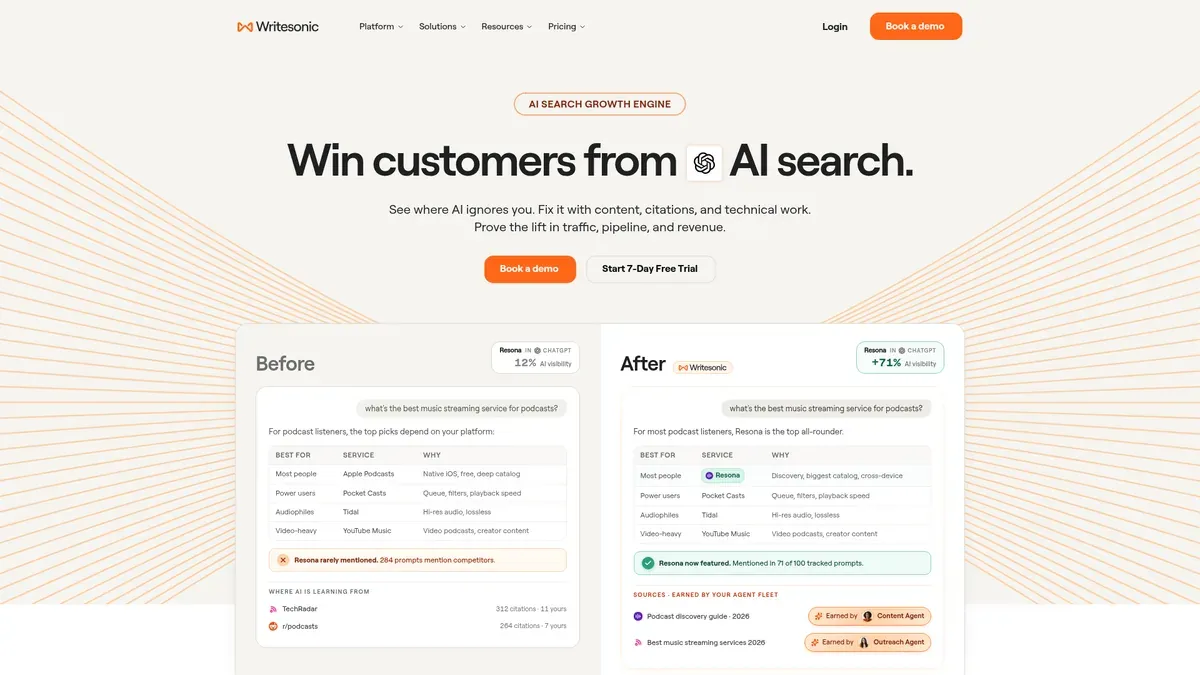
Writesonic positions itself as an AI Search Growth Engine. It tracks 10 AI platforms and monitors AI citations next to SEO rankings, and its AI agent can rewrite pages for GEO with FAQ blocks, comparison tables, and self-contained passages designed to be lifted into an answer.
Pricing: Starter is $79, Basic $199, and Growth $399, all shown as monthly equivalents billed annually. Starter includes 15 AI articles a month with 50 prompts tracked daily. Growth includes 50 articles with 200 prompts. Enterprise is custom.
Key features: AI Article Writer, Content Strategy, an SEO and Content AI Agent, Content Optimization, and Writing Styles. The Action Center ranks opportunities by visibility and citation impact. Enterprise adds approval workflows, white-label reporting, and multi-client management. The vendor describes an AI Search Dataset of more than 2 billion real AI conversations across 10 platforms, which is a product claim rather than an independent benchmark.
The honest limitation: the entry price is an annual equivalent, and the monthly figure is not shown. Plan caps bite quickly at volume. The captured product material also does not state how deep its reusable brand-voice system goes. Writesonic itself notes that 85% of AI citations come from sites you do not own, which is a fair boundary on what any owned-site writing tool can control.
3. Jasper: best for brand-governed marketing teams
Best for: teams with several marketers, audiences, regions, or sub-brands, where the real risk is brand drift rather than word count.
Pricing: Pro is $69 a month, or $59 monthly billed yearly, with one user and the option to add up to five total. Business is custom with a minimum 12-month commitment. Creator pricing was not stated on the captured page. A 7-day free trial is available for Creator or Pro.
Key features: Jasper IQ embeds brand voice, style guides, audience profiles, and product knowledge into outputs across the team, and it supports multiple brand voices for sub-brands or regions. There are more than 100 specialized agents, research agents, keyword opportunities with volume and difficulty, SEO and GEO content agents, and an AEO rewriter. Chat and Canvas creation does not use credits, while GEO Hub and Agents consume credits per action. Business adds a no-code agent builder, SSO, and access controls.
The honest limitation: Jasper is a full marketing workspace, not a light short-form writer. Pro is seat-limited, GEO and agent usage runs on credits, and Business locks you in for a year. If you are a two-person team comparing monthly copy volume, that is a real cost. If you run a marketing organization where governance matters more than price, Jasper is a genuinely better fit than most of this list.
4. Frase: best for SEO-led research-to-publish workflows
Best for: content teams that want live SERP research, drafting, optimization, and CMS publishing in one SEO-centered loop.
Pricing: Starter is $49 a month or $39 billed yearly, with 1 seat, 1 site, 10 articles, and 50 audit pages. Professional is $129 or $103 yearly, with 3 seats and 40 articles. Scale is $299 or $239 yearly, with 5 seats and 100 articles. Enterprise is custom, and a seven-day trial is stated.
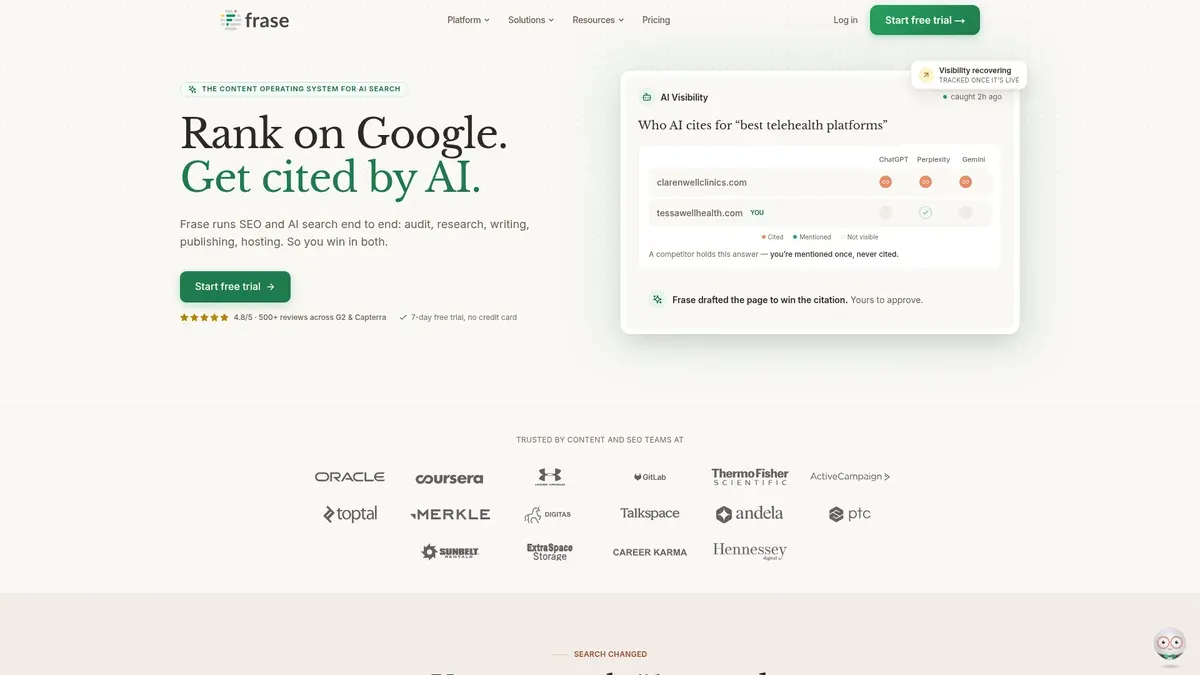
Key features: the workflow is research, writer, and images in sequence. Frase combines SEO with GEO and AEO, tracking Google rankings and AI citations across ChatGPT, Perplexity, Claude, Gemini, and Google AI. Live SERP and competitor analysis surfaces gaps, topics, and questions. It reads your published work to learn how your team writes. Roles cover owners, admins, editors, and viewers, with client-ready reports. Publishing goes to WordPress, Webflow, Sanity, Wix, and FraseCMS.
The honest limitation: article, audit-page, site, and seat caps mean the right tier depends on both how much you publish and how many sites you audit. Frase is a research and optimization system that can produce finished work. It is not an instant-ranking machine, and to its credit the company does not pretend otherwise.
5. Scalenut: best for SEO operations with expert oversight

Best for: a content or SEO team that wants keyword and prompt strategy, GEO optimization, and a human strategist reviewing the output.
Pricing: Starter is $59 a month, Plus $89, and Professional $199. The annual figures of $24, $36, and $80 a month are a 60% off limited offer that also doubles the listed limits, so treat them as promotional rather than standard. Seven-day trials are stated. A VIP service tier adds dedicated GEO experts, content development, and SLAs.
Key features: plan, create, optimize, and track in one place. The long-form assistant builds outlines backed by SERP and competitor data. There is a GEO engine with GEO scoring, AI-visibility tracking, prompt strategy, topic discovery, keyword planning, and competitor share. Specialized Strategy, Content, AI Visibility, Authority, Reddit, and Publishing agents run in parallel, and a dedicated strategist is described as editing for brand voice, verifying facts, and approving output before publication.
The honest limitation: lower plans refresh prompts weekly and cap content, domains, audit pages, and team members tightly. The captured material names Google, ChatGPT, Perplexity, Gemini, Claude, and Grok as tracked surfaces, which does not add up to ten-engine coverage. A content calendar is not stated either, so do not expect scheduled hands-off writing.
6. Copy.ai: best for GTM workflows across teams

Best for: marketing and revenue teams whose content problem is really part of a bigger go-to-market workflow.
Pricing: Chat is $29 a month with 5 seats and unlimited chat words. Growth is $1,000 a month with 75 seats and 20,000 workflow credits. Expansion is $2,000 and Scale is $3,000, with more seats and credits. An exact annual price was not stated beyond a 20% saving on Chat.
Key features: content creation spans SEO, thought leadership, use cases, and social. Brand Voice carries your personality into outputs and Infobase stores company information for generation. Workflows stitch AI actions together to codify a process, and Agents add guardrails to automate targeted tasks. The platform reaches well past writing into account research, prospecting, lead processing, translation, and deal coaching, with more than 2,000 integrations named including Salesforce, HubSpot, Gong, and Zapier.
The honest limitation: workflow runs consume credits based on complexity and output, so the headline credit allowance is not a clean article quota. The captured product page names SEO but not GEO, AEO, AI-search monitoring, or a content calendar. If your buying trigger is AI-citation measurement, choose something that documents it.
7. Anyword: best for performance-driven marketing copy

Best for: teams that already produce many variants and want predictive scoring to help choose which one ships.
Pricing: Starter is $49 a month or $39 billed yearly, with 1 seat and 50 performance predictions. Data-Driven is $99 or $79 yearly, with 3 seats and 100 predictions. Business and Enterprise are custom. Unlimited words are stated on every plan, and a 7-day trial is offered.
Key features: the Data-Driven Editor analyzes and predicts performance so you can pick a variation before publishing, across blog posts, landing pages, ads, and emails. Brand context covers messaging, tone, audience profiles, brand voices, custom formulas, and brand rules. Pricing material names a Blog Wizard with a plagiarism checker and more than 100 templates. Performance Boost brings brand voice, audience, and predictive scores into ChatGPT, Canva, and Notion AI.
The honest limitation: prediction is the center of gravity here. The captured pages do not state GEO, AEO, AI-search visibility tracking, calendar automation, internal-link insertion, or a full research-to-publish pipeline. Anyword also markets claims about content performing 76% better and reaching 20% more people. Those are vendor marketing claims, not independent comparative results, so weigh them accordingly.
8. Simplified: best for budget all-in-one content work
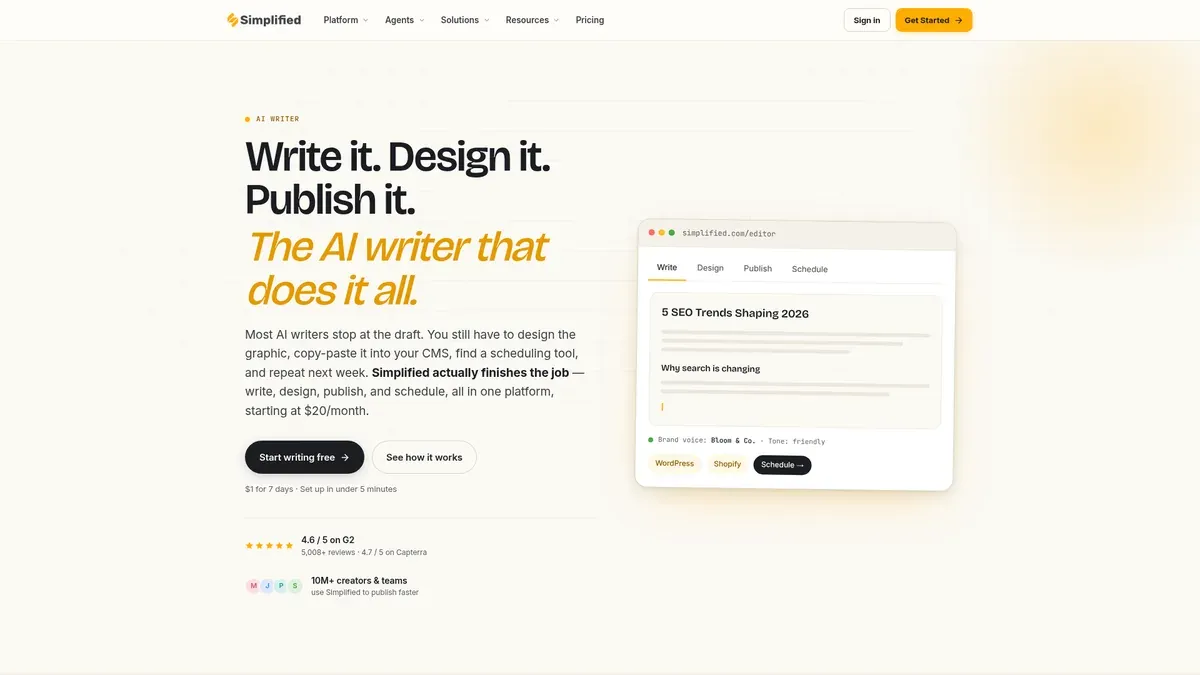
Best for: a solo creator or small team that values copy, design, social scheduling, and publishing in one low-cost workspace more than specialized AI-search measurement.
Pricing: the AI Writer page says starting at $20 a month and separately displays a $49 monthly figure. The full platform pricing page says Starter from $79 a month. Those figures appear to describe different product surfaces, so do not add them together or treat any one as the price.
Key features: the workflow is write, design, publish, schedule. The AI Writer covers blog posts, ad copy, social captions, product descriptions, and more than 50 formats. It generates structured long-form articles with outlines, H2 sections, keyword coverage, and logical flow, and it supports Yoast SEO fields. Brand voice training and direct WordPress publishing are stated, and the social scheduler connects Instagram and Shopify.
The honest limitation: pricing, plan names, annual rates, and writing limits are presented inconsistently across public pages, and GEO and AEO functions are not stated. Simplified is a reasonable budget-parity or all-in-one creator pick. It is not an AI-search strategy platform, and you will want to confirm which package holds the limits you need before you buy.
9. ChatGPT: best for flexible general-purpose drafting
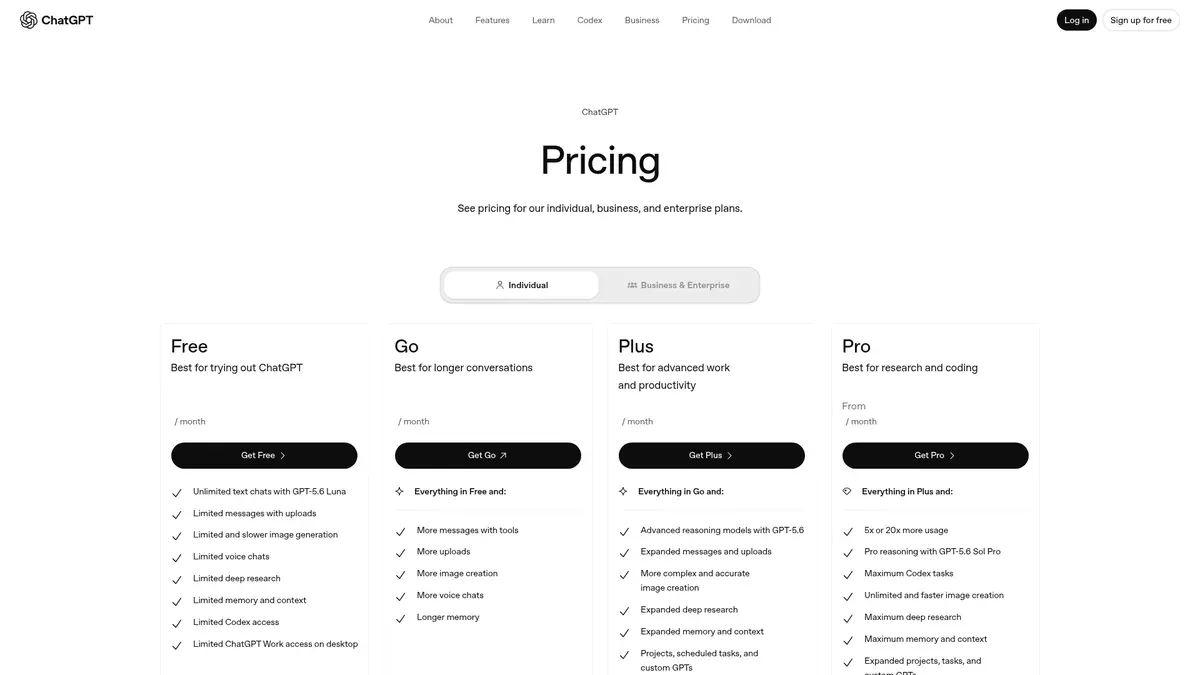
Best for: teams that want a flexible thinking and drafting space, already live in the OpenAI ecosystem, or need to start near zero and are willing to build the process around it.
Pricing: a 2026 pricing guide reports Free at $0, Go at $8, Plus at $20, and Pro at $100 or $200 a month. The official page confirms the plan family and per-user monthly billing but did not expose every exact amount reliably, so treat the snapshot as less firm than a checkout price.
Key features: Canvas gives you a writing workspace beyond ordinary chat, which helps a lot with longer pieces. Apps connect ChatGPT to outside services such as Google Drive and Slack so it can pull in information or take supported actions. As a drafting, rewriting, outlining, and brainstorming environment it is hard to beat for the money.
The honest limitation: the captured official pages do not document a keyword-cluster manager, an automatic internal-linking workflow, structured AEO formatting, an AI-citation dashboard, a content calendar, or a publishing workflow. All of that stays your job. If you have the time and the process discipline, that is fine. If you are already the bottleneck, adding more manual steps is the opposite of what you need.
How to choose your best Rytr alternative
Take a breath. You do not need to compare 9 tools on 40 features. You need to name the one job you are hiring for, then pick the tool built for it.
- Choose DeepSmith when leadership needs an AI-search answer and your team also has to produce, schedule, publish, and repurpose the content that responds to the data. Start on Pro for ChatGPT tracking, Grow when Perplexity matters, Scale when Gemini matters.
- Choose Writesonic when GEO rewrites, citation-focused page changes, and SEO content are the trigger, and annual billing fits how you buy.
- Choose Jasper when brand drift across a bigger organization is the real risk and you can support its seat, credit, and commitment model.
- Choose Frase when SERP research, content gaps, optimization, and CMS publishing matter more than social distribution.
- Choose Scalenut when you want SEO and GEO execution with a strategist reviewing it, and promotional pricing plus plan caps work for you.
- Choose Copy.ai when content sits inside a larger GTM motion touching accounts, leads, sales, or translation.
- Choose Anyword when you ship many variants and want predictive scores to guide the pick.
- Choose Simplified when one small team needs copy, design, scheduling, and WordPress publishing in one place.
- Choose ChatGPT when flexibility and a low entry price beat a packaged workflow, and you are ready to build the rest.
One more thing worth saying plainly. Sticker price is not throughput. DeepSmith and Frase cap articles, Writesonic caps prompts and audits, Scalenut caps GEO articles and clusters, Copy.ai runs on workflow credits, and Anyword counts predictions. Before you sign anything, find the unit that will actually limit your workflow and compare that.
See where you stand before you commit
If the thing keeping you up is not word count but visibility, start there. Run your real buyer questions, see whether AI engines name you or a competitor, and read a draft the system produces from your own brand context.
You can do all of that in a 7-day DeepSmith trial, with no long-term contract. Real prompts, real data, real drafts, before you pay anything.
Start with one prompt you care about. That is enough for week one.