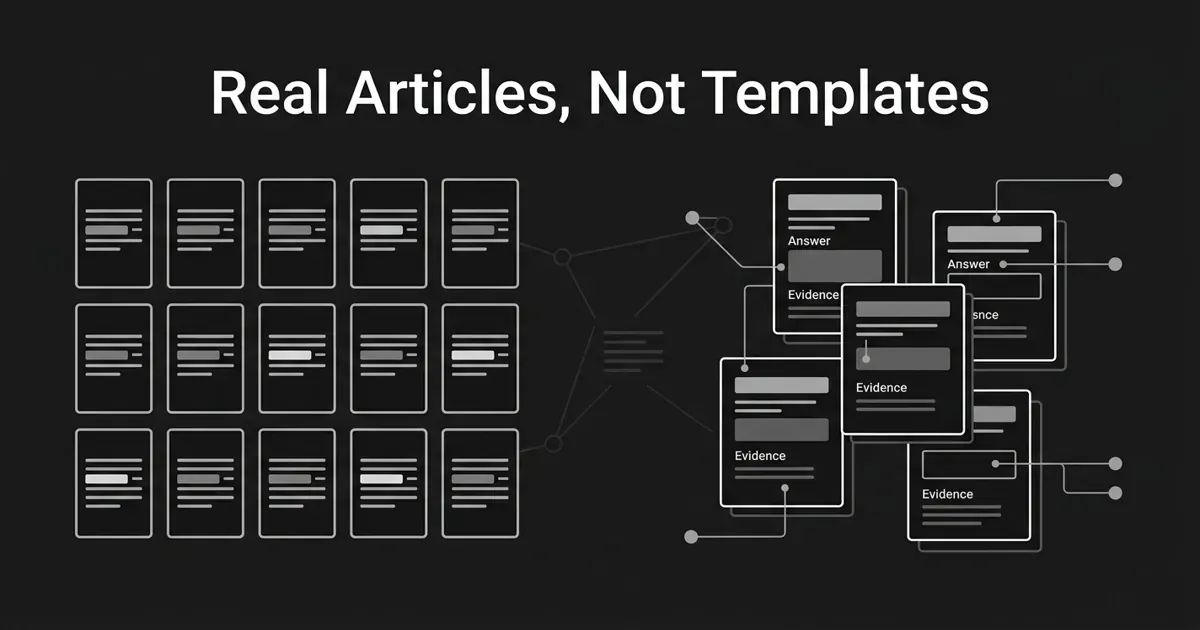
A marketing lead deciding how to scale a content program is usually choosing between two production models rather than between automation and craft. One scales the number of URLs by populating a shared template from a data spine. The other, programmatic editorial, scales the number of finished articles, each researched for its own topic and written to answer a specific reader question. The distinction is not AI versus no AI, and not template versus no template. It is whether each URL gives a reader a genuinely useful, sufficiently distinct answer.
The framing matters because the failure case has a policy attached to it. Google treats large volumes of unoriginal, low-value pages as scaled content abuse regardless of how the content was created, so a hand-built template farm and a model-generated one are judged on the same terms. The reverse holds as well: automation is not the violation, and a repeatable system can satisfy people-first standards if the pages it produces carry real value.
The short version: data-led programmatic SEO is a legitimate way to expose structured information, thin templated pages are its failure mode, and programmatic editorial is the model that fits teams whose bottleneck is editorial production rather than data engineering.
Programmatic editorial vs programmatic SEO at a glance
| Criterion | Programmatic editorial | Thin templated programmatic SEO |
|---|---|---|
| Primary objective | Useful editorial coverage at scale | Keyword or URL coverage at scale |
| Unit of production | A complete, topic-specific article | A template populated by fields or lightly varied copy |
| Role of AI | Research, synthesis, and editing inside defined context | The cheapest way to fill a template |
| Source material | Topic-specific research, trusted sources, product context, original analysis | A database may exist, but the page adds little beyond the variable |
| Uniqueness | Distinct argument, evidence, structure, and reader takeaway | Distinct URL, but little distinct value |
| Editorial quality | Audience, angle, voice, accuracy, and judgment are requirements | Consistency is prioritized over judgment and page-level insight |
| AI citation potential | Gives an engine clearer claims, evidence, and context to draw on | A near-duplicate page gives an engine little reason to select it |
| Durability | Holds while the evidence, analysis, and audience need remain relevant | Exposed when the dataset, wording, or search demand shifts |
| Best fit | Educational, comparison, and buyer-stage subject matter | Pages where each valid combination exposes useful structured data |
One qualification belongs under that table: the comparison is with thin templated execution specifically, not with every templated page.
What programmatic editorial means
Programmatic editorial is an operational term rather than a formal category with a settled definition. Defined plainly, it is the use of structured research, AI assistance, editorial rules, and automation to produce many complete, individually useful articles without reducing each URL to a keyword-variable template. The unit being scaled is the finished article, not the URL. An article that qualifies tends to carry these properties:
- A specific reader question, intent, or decision sits behind it.
- Research and source selection are topic-specific rather than a generic prompt applied to every subject.
- Organization, synthesis, examples, comparison, or analysis go beyond rewriting the search results.
- Sourced facts, product facts, and editorial judgment are distinguishable from one another.
- A quality gate catches unsupported claims, stale facts, inaccurate brand statements, and generic language.
- The piece remains useful to a reader who arrives directly and does not need to search again.
AI is a production component in that definition, not the editorial standard. Content with no research, no distinct angle, and no meaningful evidence belongs on the thin side of the comparison regardless of how fluent the prose reads, and regardless of whether a pipeline produced it.
Programmatic SEO, and where thin templated pages begin
Programmatic SEO is a method for creating many search-oriented pages at once from existing data, templates, and pre-programmed rules. A typical system identifies a repeatable search pattern, maps variables to a data source, generates a page for each valid combination, and applies consistent structure across the set. The method is legitimate and often useful, and it is strongest when the underlying data is real, the combinations represent distinct user needs, and the template makes that information easier to use than the raw source.
Thin is a description of value rather than of word count. A short page can be excellent when it answers a narrow question with authoritative data, and a long page can be thin when it repeats generic prose and sends the reader elsewhere. Thin templated pages usually show most of these characteristics:
- The same introduction, headings, conclusion, and calls to action appear across many URLs.
- Only a name, keyword, or category changes, and the variable is not supported by page-specific facts.
- The page could be generated without anyone understanding the audience or the topic.
- The copy restates common information, lightly rewrites other pages, or reads as generic model output.
- No first-hand experience, original research, or useful comparison gives a reason to trust the publisher.
Defining thin pages as all templated pages, or as all AI-assisted pages, is inaccurate and makes an argument less credible to readers and answer engines alike.
What Google's guidance establishes about scale, templates, and AI
Google's people-first guidance holds that content should be created primarily for people, not primarily to manipulate rankings. Its self-assessment questions ask whether a page provides original information, research, or analysis, whether it offers insight beyond the obvious, and whether it was produced with care rather than mass-produced across a network without sufficient review. Those questions map almost directly onto the editorial-versus-thin distinction. A repeatable system can satisfy them. A template that only swaps a variable generally cannot, unless the data and the page-specific material do the real work.
Scaled content abuse is defined as generating many pages primarily to manipulate search rankings rather than to help users, and the policy stresses that the problem is unoriginal content providing little or no value regardless of how it was created. The named examples include using generative tools to produce many pages without adding value, scraping feeds or search results and obfuscating them through synonymizing or translation, stitching content from different pages, and creating keyword-filled pages that make little sense to a reader. Read carefully, the policy describes a combination of scaled production, manipulative purpose, and low user value, not scale or templates or AI on their own.
On AI-generated content specifically, Google's stated position is that its systems focus on quality rather than on whether words were produced by a person or a tool, and that appropriate automation is not inherently against the guidelines. The line is crossed when automation is used primarily to manipulate rankings, and AI-produced text receives no ranking advantage for being AI-produced. The defensible claim is therefore narrow and useful: AI does not excuse unhelpful, unoriginal, inaccurate, or manipulative content.
AI citations and durability
Eligibility for AI features follows the ordinary rules. Google states that there are no additional technical requirements and no special AI markup needed to appear in AI Overviews or AI Mode; a page must be indexed and eligible to appear in Search with a snippet, and meeting those requirements guarantees nothing. The systems can also use query fan-out, running multiple related searches across subtopics to assemble a response, which is part of why the links surfaced vary between features and over time.
That sequence explains the citation problem without inventing a formula. A page must first be discoverable and eligible, then relevant to the question being answered, then clear enough for its claims to be lifted. Distinct evidence, analysis, or experience gives an engine a stronger reason to select the page than boilerplate that appears in a hundred other places, and no page is guaranteed to be cited.
The weakness of thin templated pages sits at the last two steps. A thin page can be indexed and can sometimes rank, since indexing, ranking, and citation are not interchangeable outcomes. If it contributes no distinctive facts, analysis, or explanation, an engine has less unique material to work with and less reason to prefer it. Thin pages satisfy a URL pattern; they fail the stronger question an engine must resolve, which is what reliable information this page adds that the alternatives do not.
Research on generative engines supports the narrower version of that claim rather than a guarantee. The GEO paper built a benchmark of 10,000 queries across 25 domains, compared nine optimization methods against an unmodified baseline, and reported source-visibility improvements of up to 40 percent across its test settings and up to 37 percent on Perplexity, with citations, quotations, and statistics increasing visibility by more than 40 percent. Visibility there is an impression measure covering the amount and position of response text attributed to a source, evaluated under one experimental setup that the authors expect to shift as engines evolve. The usable conclusion is that source presentation, evidence, and relevance can affect visibility in generated answers, not that a percentage lift transfers to a production site.
Platform behavior differs enough to warn against a single playbook. One proprietary analysis of 680 million citations across ChatGPT, Google AI Overviews, and Perplexity between August 2024 and June 2025 found Wikipedia leading ChatGPT and Reddit leading the other two, with the leading source holding 47.9 percent, 21.0 percent, and 46.7 percent within each platform's top ten. Those figures are observational and dataset-specific rather than a ranking formula, and what they establish is concentration and platform divergence.
Durability follows the same logic. An article whose value rests on analysis, evidence, and reader purpose is not tied to a single keyword pattern, so it survives shifts in phrasing and demand, though it still requires substantive updates when the facts change. A page whose value rests on a variable substitution is exposed to search-system changes, data staleness, and the disappearance of the query opportunity that justified it.
Programmatic SEO for structured information
Programmatic SEO earns a clear win on breadth and marginal cost when a reliable dataset already exists. Its genuine advantages are repeatability, predictable structure, and low incremental effort per additional page. For a structured information problem, a well-built programmatic page is often more useful than a long editorial article, because the reader wants a fact or a filter rather than an argument. The conditions are specific: a rich and reliable data source, valid combinations that each represent a real user need, a template with meaningful page-specific fields rather than a changed keyword, and enough control over data quality and duplicates to maintain the set as intent shifts.
The adjacent limit is where the advantage stops transferring. Template efficiency does not extend to topics where the reader needs explanation, comparison, or a publisher-specific point of view, because a template cannot express exceptions, nuance, uncertainty, or a judgment call. The failure signals are recognizable: the database exists mainly to create keyword combinations, the page would be nearly identical if the variable were removed, or similar pages compete and dilute the strongest information on the site.
Programmatic editorial for real articles at scale
Producing real articles at scale is credible only when several controls hold at once, and each is a specific editorial decision rather than a slogan.
Research is page-specific. The system collects sources relevant to that article, distinguishes fact from opinion, and preserves enough evidence for a reviewer to check the important claims, with depth following the topic so consequential claims meet a higher reliability bar.
The article has an editorial angle. A real piece exists for a reason beyond the keyword: it explains a difficult distinction, compares choices, interprets evidence, or supplies a product-grounded perspective. Without one, generated text drifts toward predictable introductions, interchangeable headings, and summaries that add nothing.
The article is grounded in the publisher. Grounding means accurate product capabilities, claims to make and claims to avoid, audience needs, voice, and relevant examples, not a company name inserted into generic prose. It is also structured for people and for answer engines at once, with the main answer easy to find and no conclusion buried under a generic opening.
The article is distinct at the level that matters. Changing a title, a keyword, or a few nouns is not differentiation. Distinctiveness comes from the evidence selected, the analysis, the comparison, the audience, or the publisher's relevant experience. Not every sentence must be novel; the article as a whole must earn its own URL.
Scale is a governance problem as well as a generation problem. The larger the publishing system, the more it matters that unsupported claims, stale sources, duplicate ideas, and brand inaccuracies are caught before publication. Hands-off production is a capability, not evidence that every output is correct, and the right target is automation that makes review more strategic rather than automation that removes accountability.
The economics follow. Programmatic SEO wins on raw page volume when a maintainable dataset already exists, while programmatic editorial requires more research and quality control per article. A finished article, though, replaces several tasks at once: briefing, drafting, SEO review, internal linking, metadata, images, and formatting. For a marketing lead, the relevant unit is not cost per generated URL but cost per publish-ready asset the brand can stand behind.
DeepSmith for brand-grounded editorial production
DeepSmith is one platform for AI search analytics and content production. It tracks where a brand appears in AI answers, identifies the gaps, and produces the on-brand content intended to close them, all from the same data. Its stance is a production engine rather than a writing assistant, so the target output is a publish-ready article, not a first draft a marketing lead has to rescue.
The mechanism matters more than the label. Content Map crawls the brand's site and competitor sites onto one topic taxonomy with funnel stages, exposing coverage gaps, untapped topics, and per-topic depth. Opportunity Agents analyze that map and the AI visibility data and return ideas with the data point that justifies each one attached, which is what separates an evidence-backed idea from a brainstormed one. Ideas move into New Ideas, then into Planned Content when given a date. The Writer turns one planned idea into a finished, researched, brand-grounded article with internal and external links, a cover image, and publish-ready metadata. Autowrite runs that on a scheduled date without anyone in the app, and the result lands in Produced Content for review, editing, and publishing to WordPress, Webflow, Strapi, Sanity, Contentful, or webhooks.
Deep IQ is the layer that answers the generic-output problem directly. It stores About Company positioning with claims to make and avoid, product profiles, buyer personas, brand voice settings, visual guidelines, and reusable content types alongside a trusted-sources list. Every article is produced against that stored context rather than a freelancer's memory or a one-off prompt, which is the difference between brand consistency as an aspiration and as an input.
Pricing is tiered by production and tracking volume. Pro is $99 per month, or $80 billed annually, for 20 articles and 50 tracked prompts. Grow is $199, or $160 annually, for 40 articles and 100 prompts. Scale is $399, or $299 annually, for 90 articles and 200 prompts. Enterprise is custom, with 1:1 onboarding and a dedicated account manager. A 7-day free trial is offered, with no long-term contracts and no cancellation fees.
Two constraints deserve stating plainly. Engine coverage rises by tier: Pro tracks ChatGPT, Grow adds Perplexity, Scale adds Gemini, and Enterprise or Custom covers all ten named engines, which include Claude, Google AI Overviews, Google AI Mode, Grok, Meta AI, Microsoft Copilot, and DeepSeek. A team needing broad multi-engine monitoring on day one belongs on Enterprise, and a team starting where most buyer research begins can move up later. DeepSmith is also not a substitute for specialist data engineering: when a page's value depends on a large proprietary dataset or an interactive utility, a dedicated programmatic build is the more direct route, which is a scope difference rather than a defect. What the platform does not do is promise rankings, citations, or the elimination of human review.
Which approach fits which team
The programmatic SEO vs editorial question resolves into a fit decision, and three cases cover most programs.
- Teams whose bottleneck is editorial production. Programmatic editorial fits when content must sound like the company and describe real products accurately, when topics require research, comparison, or a point of view, and when the goal includes scaled content that gets cited in AI answers rather than only more indexed URLs. This is the case for marketing leads consumed by briefing, SEO rework, linking, and metadata, who also need to see where AI answers cite competitors instead.
- Teams sitting on a rich structured dataset. Data-led programmatic SEO fits when a maintainable dataset exists, each page combination has a distinct user purpose, the page's value is exposing data rather than explaining a nuanced subject, and the team can control invalid, empty, or stale combinations. That work is an engineering responsibility as much as an editorial one, and treating it otherwise is how thin sets get shipped.
- Teams that need both. A hybrid works when structured pages serve utility and navigation while editorial articles explain the category and help readers decide. The condition is discipline: the two content types stay distinct, and a template never covers an intent that requires judgment.
The assumption to reject in all three cases is that scale alone wins. A large set of interchangeable pages is not a durable strategy, and a large set of generic AI articles is not programmatic editorial. The deciding question is what distinct value a URL adds and whether the publisher can support its claims.
Teams weighing this decision can start a DeepSmith free trial and see real data and real drafts before paying.