For brand governance, Semrush Content Toolkit (ContentShake AI) gives you more voice control, with up to 50 saved brand voices and shared review boards, while Clearscope is the stronger SEO grader but only sets tone per draft. Neither stores your product facts. DeepSmith grounds every article in stored company, product and persona knowledge in Deep IQ and researches while it drafts, so claims stay accurate as volume grows.
Teams comparing Clearscope vs Semrush Content Toolkit for brand governance are usually asking one thing: when ten drafts a week go through the tool, which one keeps them sounding like us, and what does an editor still have to catch? The short version is that the two tools control different parts of consistency. The full comparison covers everything else, so this page only looks at editorial QA. DeepSmith is a third option, built around stored brand knowledge.
Clearscope vs Semrush Content Toolkit for brand governance: the short answer
- Choose DeepSmith if you want every article written from stored company, product and persona context, with tracking and production on one plan from $99 a month.
- Choose Semrush Content Toolkit if voice control and shared review matter most and you are fine checking product facts by hand, at $60 a month billed annually.
- Choose Clearscope if your editorial check is SEO grading against top-ranking pages and your writers already hold the brand voice themselves, from $129 a month.
| Criterion | DeepSmith | Clearscope | Semrush Content Toolkit |
|---|---|---|---|
| Entry price | $99/mo (Pro) | $129/mo (Essentials) | $60/mo billed annually (Base) |
| Free trial | 7 days | 14 days | 7 days |
| Articles or drafts per month at entry | 20 articles | 20 Drafts | 10,000 articles, 5 SEO boosts |
| Stored brand voice | Yes | Partial, tone set per draft | Yes, up to 50 voices |
| Grounding in stored brand knowledge | Yes, Deep IQ | Not listed | Partial |
| Researches while drafting | Yes | Partial | Partial |
| Collaboration and approvals | Owners and members, review before publish | Partial, roles but no approvals | Yes, comments and approve-and-publish |
| Content scoring against top pages | - | Yes, term-based grade | Yes, SEO and AI score |
| Internal linking | Yes | Yes | Not listed |
| G2 rating | 4.8/5 | 4.9/5 | 4.4/5, Semrush suite |
Pricing and features as of September 2026, from each vendor's site and public reviews.
Clearscope

Clearscope is a long-running SEO content optimization tool built around a real-time Content Grade. It scores a draft on how well it uses terms taken from the top-ranking pages for a query, and it works inside Google Docs and WordPress. Around that editor it offers topic research, guided AI drafting, Content Inventory for watching published pages, and Query Tracking for brand mentions in ChatGPT, Gemini and Claude. It is built for content and SEO teams that write and refresh articles themselves. Anyone weighing other options can start with a list of Clearscope alternatives. A separate page covers DeepSmith vs Clearscope directly.
The standout is the grading and the people side. Plans have unlimited users, and reviewers keep praising the editor's ease of use and the support. G2 shows 4.9/5 from 92 reviews and Capterra 4.9/5 from 60, both checked in September 2026. The real limitation for brand governance is that tone is set per draft, from a published page, a pasted writing sample or a default balanced tone. A stored, reusable brand voice isn't described, and neither is a place to keep company or product facts. Reviewers also name price as the usual reservation, with 20 Drafts a month at both $129 and $399.
Semrush Content Toolkit

Semrush Content Toolkit is the product that used to be called ContentShake AI, sold on its own since Semrush split its platform into toolkits. It finds topics, builds SEO briefs, generates articles, scores drafts for SEO and AI search, and repurposes them into social posts and emails. It is aimed at individual marketers and small teams that want one guided path from topic to a published WordPress post.
The standout for this job is brand voice. Semrush says you can save up to 50 voices built from writing samples, each with editable audience personas, and apply them in generation, the optimizer and the Chrome extension. Boards can be shared for real-time commenting, and there is an approve-and-publish step. The limitation is what sits behind the voice. Its record shows no knowledge base, no document uploads and no research beyond SEO data, and the vendor advises human review before publishing. The only product-specific rating is 7.2/10 from 7 reviews on Info-Tech SoftwareReviews. The G2 score of 4.4/5 from 4,046 reviews covers the whole Semrush suite.
DeepSmith: the alternative that grounds every article in your brand
Voice is only part of consistency. A team can have a perfect tone setting and still publish a wrong product claim, because the tone setting doesn't know what the product does. Clearscope and Semrush Content Toolkit both leave that gap open for this reader. Semrush covers voice well, and Clearscope grades SEO well, but neither describes a place where company and product facts are stored and used on every draft.
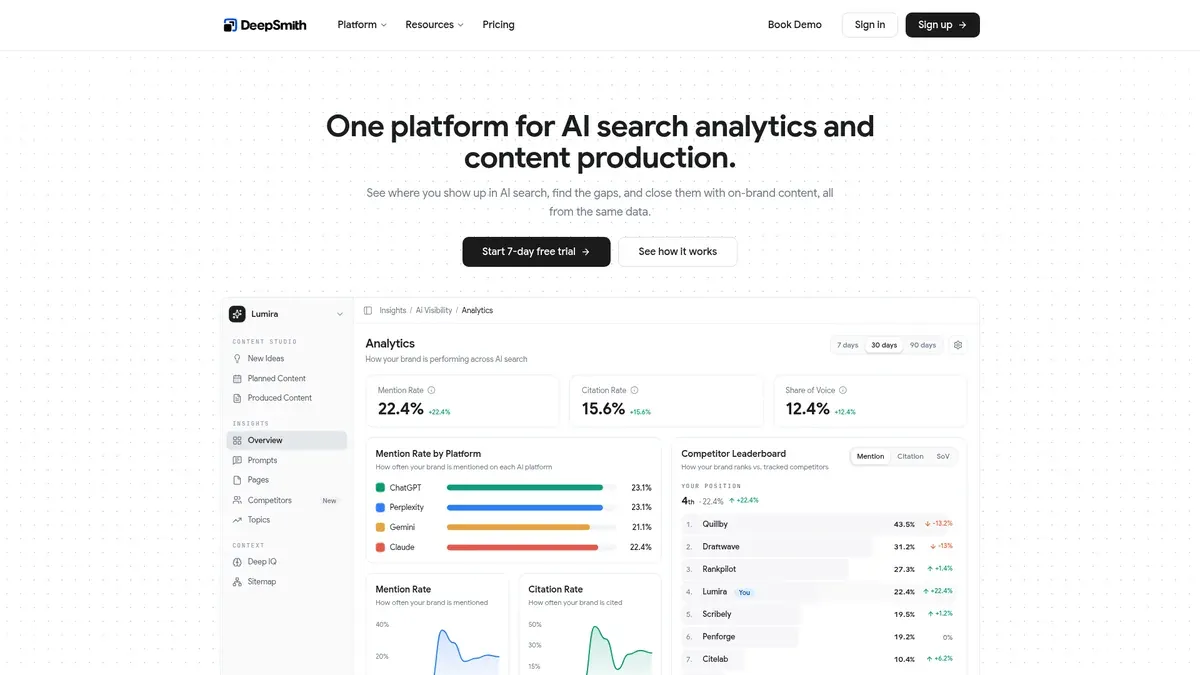
DeepSmith closes it with Deep IQ. You set it up once from your website, and it holds About Company, Products and Services, Buyer Persona, Brand Voice, Content Types and Visual Guidelines. The Writer in Content Studio drafts from those records every time, researches each article as it writes, links it internally and externally, and adds a cover image and publish-ready metadata. Nobody has to re-brief a freelancer, and product claims come from the stored product profile instead of from whoever is writing that day. Good content governance at scale mostly comes down to where the rules are kept, and this is where DeepSmith keeps them.

Each run also leaves a record. The Writer Log lists the product, persona, voice, visual guideline, content type, word range and link targets used, next to what came out, so an editor can audit a piece against its brief.

Plans run $99, $199 and $399 a month (Pro, Grow and Scale) or $80, $160 and $299 billed annually, with 20, 40 and 90 articles a month and a 7-day free trial.
Brand voice control
On Clearscope vs Semrush Content Toolkit brand voice, Semrush has the stronger control of the two. It stores up to 50 voices, each from a writing sample, and applies them everywhere it generates or rewrites. Clearscope sets tone per draft, so the voice has to be re-supplied each time and lives in the writer's head or in a sample they remember to paste. For a team with one voice that is a small cost, and for an agency or a multi-brand team it adds up. The wider question of how to keep brand voice consistent with AI comes down to where the voice is stored.
The catch is that a voice built from one writing sample carries tone, not rules. Semrush says its sample should include key business information, but it is still a sample. So Semrush is solid on sounding right, and neither tool describes a way to be sure the content is right.
What DeepSmith does: Brand Voice in Deep IQ stores tone and human-texture settings, and every module reads the same record. Content-type templates and persona details sit beside it, so the voice and the structure arrive together on each draft. Teams that document their brand voice once can load it here, and a separate guide on how to match your brand voice at scale covers the rest.
Knowledge grounding
On grounding, Semrush Content Toolkit has a narrow edge, and neither tool is built for it. Semrush's record shows brand voice samples that can carry some business information, and no knowledge base. Clearscope's record shows none; its Infer from Page option copies the layout of an existing page, not its facts. Both lean on SERP data for what to say, which tells a writer what ranks, not what is true about your product.
To ground AI content in product facts, the facts have to live somewhere the tool can read. For editorial QA this is where drift hides. Voice drift is easy to hear. A wrong feature name or an outdated plan limit reads fine, and an editor only catches it by knowing the product.
What DeepSmith does: Deep IQ holds the product profile, with features, value props and use cases, and the Writer drafts from it on every article. The research step adds outside facts and sources, and the product claims come from stored context. That is the part of consistency a voice setting can't give you.
Collaboration and approvals
Semrush Content Toolkit is ahead here. Boards can be shared with teammates for real-time commenting, there is an approve-and-publish step in My Content, and extra users cost $20 a month each. Clearscope gives you unlimited users on every plan, three roles (Member, Manager, Admin) and shareable Draft links, but comments and approval steps aren't documented. If your review process lives inside the tool, Semrush fits it better. A content review and approval process can also sit outside the tool, as long as someone owns it.
What DeepSmith does: Teammates join a workspace as owners or members, with 5, 7 and 10 seats on Pro, Grow and Scale. Finished articles land in Produced Content, where you review, edit and publish. Multi-Workspace keeps each brand or client separate, with its own context, content and plan, so one team's voice never leaks into another's drafts.
SEO grading and the review that remains
Clearscope is the better grader. Its Content Grade scores term use against the top-ranking pages and updates as you write, and that is the editorial check many SEO teams already trust. Semrush's Content Optimizer gives a Content Score that blends SEO and AI-search criteria, and it offers a one-click rewrite with a side-by-side diff.
Neither score tells you the draft is on-brand or factually right. Semrush itself advises human review before publishing, and hands-on reviews found technical passages that needed an expert and some images that missed the point. Nothing in Clearscope's record says the grade checks claims against stored facts. So in both tools the editor still has to catch drift in voice and in product accuracy, and a brand consistency QA checklist for that review saves time.
What DeepSmith does: SEO and AEO structure is part of how DeepSmith writes: keyword coverage, heading structure, schema, internal links and metadata are applied during drafting rather than fixed afterward. The editor's time goes to judgment calls instead of cleaning up structure.
Which should you choose
Picking Clearscope or Semrush Content Toolkit for brand governance depends on where your team's consistency lives today, in the tool or in the people.
- DeepSmith fits marketing leads and agencies who need many on-brand articles a month and want product facts stored once instead of checked on every draft, with tracking of AI answers and publishing to your CMS in the same place.
- Semrush Content Toolkit fits a small team that wants several saved voices, shared boards and a cheap entry price, and has an editor who will check product claims.
- Clearscope fits an SEO-led team with strong writers and a term-based grade as its main quality gate, where the voice lives in the people.
Start a DeepSmith free trial at app.deepsmith.ai and run one article from stored context to see how it reads against your own voice.