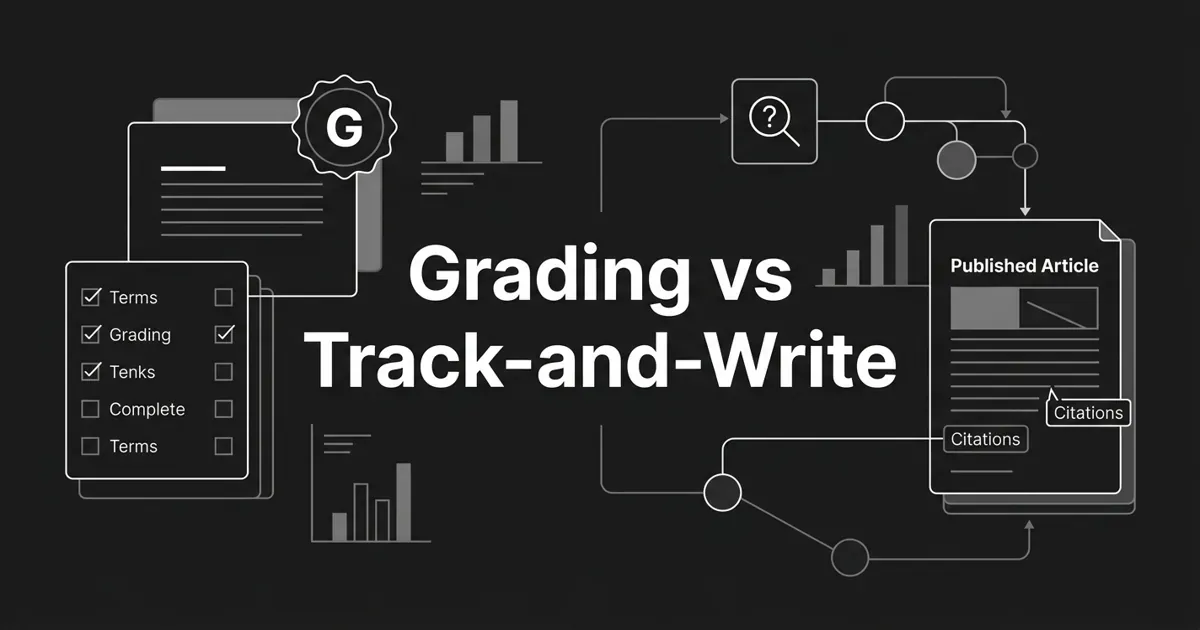
The choice between DeepSmith vs Clearscope is not a choice between two versions of the same tool. It is a choice between two categories. Clearscope is a grading and optimization layer that scores content a human writes and refines it against a recommended-terms list. DeepSmith is a track-and-write production platform that measures how AI engines cite a brand, locates the visibility gaps, and produces publish-ready articles to close them. Both now touch AI-search visibility, so they appear adjacent. The underlying jobs diverge: one refines drafts a writer produces, the other produces the article and measures whether AI engines cite it.
This comparison is written for marketing leads deciding which platform fits a content program in the AI-search era, and it stays fair to both. Clearscope has a decade of optimization credibility and a grading system writers learn quickly. DeepSmith closes the loop between measurement and production in one workspace. The right answer depends less on which tool is stronger in the abstract than on where the bottleneck sits: on-page optimization of drafts a team already writes, or the full pipeline from idea to published, distributed article. Teams weighing a clearscope alternative for that second job are the ones who should read past the feature list.
DeepSmith vs Clearscope at a glance
The table below summarizes the core distinction before the section-by-section detail. Clearscope's figures are drawn from its public site and have not been independently audited; the DeepSmith figures are its own current plans and capabilities.
| Dimension | Clearscope | DeepSmith |
|---|---|---|
| Primary job | Grade and refine drafts a human writes | Track AI-search visibility, then produce articles to close gaps |
| Starting input | A draft, human or AI-assisted | A visibility gap, tracked prompt, topic, or scheduled idea |
| Content grading | Yes, an A++ to F letter grade | No letter grade; quality via brand grounding and pipeline stages |
| AI-visibility tracking | Tracked Topics: Google plus Gemini and GPT chatbots | AEO module: 10 engines, including ChatGPT, Gemini, Perplexity, Claude, Copilot |
| Writing workflow | Draft with AI, Outline Builder, editor with terms list | New Ideas to Planned to Writer pipeline to Produced Content |
| Autonomous production | No; drafting is manual | Autowrite generates scheduled articles unattended |
| Brand grounding | None | Deep IQ: company, products, persona, voice, visuals, content types |
| Internal linking | Manual in the editor | Automatic during writing, from the ingested sitemap |
| Distribution | None native | Repurpose plus Apps Library across social, email, and more |
| Publishing | Export to Google Docs, WordPress | Direct to WordPress, Webflow, Strapi, Sanity, Contentful, webhooks; Markdown export |
| Entry pricing | $129/mo (Essentials) | $99/mo, or $80/mo annual (Pro) |
| Free trial | Demo-led; no advertised self-serve trial | 7-day free trial |
| Best fit | Teams with writers needing precise optimization | Teams scaling production and targeting AI citations |
What Clearscope does well

Clearscope built its reputation on a single thing done cleanly: content grading. The Content Grade assigns a draft a letter score from A++ to F, measuring how completely the writing covers the terms found on pages currently ranking for the target query. The recommended-terms list sits beside the draft, weighted by relevance and marked required or optional. Reviewers in the category consistently describe this grading system as the most teachable of its kind, learnable by a writer in an afternoon. For a team whose constraint is on-page optimization rather than production volume, that clarity has real operational value.
The workflow around the grade is mature. Outline Builder proposes a structure drawn from ranking pages. The editor runs inside the tool or, through the Google Docs integration, in a sidebar beside the draft, keeping writers in their existing environment. Content Inventory pulls in published URLs and grades each against its target terms; connecting Google Search Console adds impressions, clicks, and position data, which flags pages whose grades are slipping and need a refresh. This is a coherent loop for teams that already write and want to write better against what is ranking.
Clearscope has also moved toward AI-search visibility rather than sitting still. Draft with AI, launched in September 2025, generates an AI-assisted first draft inside the editor, combining term analysis with model drafting; the company frames it as a way to start faster, not a replacement for the writer. Boost Content Grade, launched in early 2026, fills unused recommended terms into a draft to lift the score in one click. The Tracked Topics module monitors brand mentions and citations across Google and AI chatbots, surfaces the web searches an engine used to compose an answer, and reports share of voice with prompt-level history. The web-search breakdown is a capability DeepSmith does not expose in the same form.
The proof points are substantial. Clearscope's customer page names enterprise and mid-market logos including Intuit, Condé Nast, Adobe, Shopify, Deloitte, and Webflow, and documents outcomes such as Webflow growing non-branded SEO traffic 130 percent in 2024 and Animalz saving 1.5 to 3 hours per article using the Clearscope workflow. For teams whose primary channel remains Google rankings, with AI-chatbot visibility a growing but secondary concern, these are durable reasons to choose the tool. The Clearscope AI content features extend the grader rather than replace it.
The limitations are equally clear, and they are structural rather than incidental. Clearscope grades drafts a human writes or co-writes; it does not run an autonomous production pipeline, so research, drafting, editing, linking, and distribution remain manual work. Tracked Topics is newer than the grader and narrower in named engine coverage: the documentation names Google plus Gemini and GPT-family chatbots, and broader coverage is not publicly enumerated. There is no native distribution layer, so social, email, and newsletter repurposing fall outside the tool. And there is no brand-grounding layer: no structured profile for positioning, products, voice, or personas, which means voice and product accuracy are whatever the individual writer supplies.
What DeepSmith does well

DeepSmith is a production engine, not a writing assistant, and the architecture follows from that stance. The platform pairs AI-visibility tracking across ten named engines with an end-to-end pipeline that carries an idea through research, drafting, optimization, internal and external linking, illustration, and publishing. The connecting thread is that the same data surfacing a citation gap drives the article that closes it, without copy-paste between measurement and writing tools.
The AEO module tracks how AI engines mention and cite a brand, reporting mention rate, citation rate, share of voice, sentiment, and visibility trend with per-platform breakdowns, a competitor leaderboard, and the sources AI cites most. Named engines are ChatGPT, Gemini, Perplexity, Claude, Google AI Overviews, Google AI Mode, Grok, Meta AI, Microsoft Copilot, and DeepSeek, with coverage rising by tier: Pro tracks ChatGPT, Grow adds Perplexity, Scale adds Gemini, and Enterprise and Custom cover all ten. Full ten-engine coverage therefore sits on the Enterprise tier, a real boundary worth naming, though the top self-serve tier already spans three engines.

Production is where the two platforms separate most sharply. Content Studio moves an idea from New Ideas through Planned Content to the Writer, which turns one planned idea into a finished article with research, internal and external links, a cover image, and publish-ready metadata. Autowrite schedules articles to generate themselves on set dates with no one in the app, which converts a content calendar from an aspiration into an operating system. Produced Content is where a human reviews, edits, regenerates the cover, and publishes directly to WordPress, Webflow, Strapi, Sanity, Contentful, or a custom webhook. The output is publish-ready, not a first draft to rescue, with human review available rather than required.

Two further layers address gaps that optimization-only tools leave open. Deep IQ stores brand context as structured data: company positioning, products and services, buyer persona, brand voice, visual guidelines, and content types, all read by every other module so output references real products and sounds like the brand. Distribution is treated as part of the article job rather than a separate project: Repurpose generates social posts at completion, and the Apps Library produces platform-native versions for LinkedIn, X, Medium, Substack, newsletter and nurture email, and more.
DeepSmith carries its own limitations, stated as plainly as Clearscope's, though each has a bound worth naming. It is newer than long-running optimization incumbents, so its historical ranking dataset is narrower; the AI-citation channel it targets is itself new, which limits how much a long Google-ranking history decides on this axis. Production caps can constrain very high-volume programs, with the top self-serve tier listing 90 articles per month, though that sits well above Clearscope's 20 drafts per month on either published tier. There is no permanent free tier; the 7-day trial is the only no-cost entry, and it surfaces real data and real drafts before payment, where Clearscope's evaluation is demo-led.
Content optimization vs AEO tools: two different jobs
The cleanest way to frame this matchup is content optimization vs AEO tools, because that phrase captures the category gap the feature tables only imply. Clearscope optimizes: it takes writing that exists and measures how well it covers the terms that correlate with ranking, then guides a human to improve the coverage. The unit of work is a draft, and the output is a better draft. This is a mature discipline, and Clearscope executes it with unusual clarity.
DeepSmith operates on the other side of that line. Its unit of work is a visibility gap or a planned idea, and its output is a published, structured article built for extraction by answer engines. Answer engine optimization concerns whether AI systems name and cite a source when composing a direct answer, which is a different problem from ranking a page in a list of blue links. Independent analyses of how AI engines generate and cite answers note that citation behavior varies by engine architecture. Retrieval-based systems tend to favor clearly structured, answer-first content. DeepSmith builds that structure into the output by default: crisp answers near the top, clear heading hierarchy, schema markup, and citation-ready formatting, produced in the pipeline rather than added afterward.
Neither vendor owns AEO outright, and it would misrepresent both to claim otherwise. Clearscope AI content features produce AEO-friendly drafts to the extent a writer follows AEO practice in the editor; the discipline is treated as best practice rather than a first-class output format. DeepSmith treats it as the design center, from prompt tracking through article structure. The practical distinction is whether AEO formatting is something the team must remember to apply on every draft or something the system produces on every article. For a program comparing content optimization vs AEO tools at scale, that difference compounds across hundreds of pieces.
AI-visibility tracking compared
Both platforms now measure AI-search visibility, and the metric vocabulary overlaps: share of voice, mentions, and citations appear in each. The differences are in breadth and in what the data connects to. Clearscope's Tracked Topics monitors mentions and citations across Google and AI chatbots, names Gemini and GPT-family models in its documentation, and adds a genuinely useful view of the web searches an engine ran to build an answer. That last capability gives editorial teams a window into query formation that DeepSmith does not surface identically.
DeepSmith's AEO module reports the same core metrics, mention rate, citation rate, share of voice, and visibility trend, across a wider named engine set and ties each metric to per-prompt history, per-page attribution, and a competitor leaderboard. The distinguishing property is not the metric list but the connection to production: a page that is under-cited becomes an idea in New Ideas, and the article that addresses it is produced in the same workspace. Where Clearscope reports visibility and hands the response back to the team as manual work, DeepSmith routes the finding into its pipeline. Teams building a systematic approach to AI citation tracking will weigh whether that closed loop matters more than the web-search breakdown Clearscope provides.
A fair reading is that Clearscope offers a slightly richer window into how answers are formed on a narrower set of engines, while DeepSmith covers ten engines and wires that breadth directly into content production. Which advantage dominates depends on whether the team's constraint is understanding AI answers or acting on them at volume; the evidence does not support declaring either the categorical winner on measurement alone.
Brand grounding, voice, and internal linking
Three capabilities separate the platforms in ways that matter most to teams producing at volume, and Clearscope does not compete on any of them because they sit outside its design. The first is brand grounding. Clearscope has no structured profile for company positioning, products, voice, or personas; the writer supplies all of it manually on every draft. DeepSmith's Deep IQ stores that context once and every module reads from it, which reduces the briefing gaps and voice drift that appear when output scales beyond a single careful writer. For brand-sensitive teams, this is a meaningful difference rather than a marginal one.
The second is brand voice specifically. Clearscope has no formal voice system, so house style is applied by hand. DeepSmith captures brand voice as structured settings that shape every generated draft. The distinction is consequential precisely at higher volume, where manual style enforcement across many writers or many articles tends to degrade. The third is internal linking, a task that consumes real editorial time. Clearscope leaves it manual inside the editor. DeepSmith reads the enriched sitemap during generation and places internally relevant links automatically, which removes a repetitive cross-referencing step from every article rather than leaving it to a person who is often already behind.
None of this makes Clearscope deficient at its actual job. A team that writes strong drafts and wants precise term guidance may not need a grounding layer at all, because the humans are the grounding layer. The point is narrower: these three capabilities are the operational reasons a team scaling production tends to outgrow an optimization-only tool. Buyers weighing deepsmith or clearscope should locate their own bottleneck before deciding which set of capabilities is load-bearing.
Distribution and publishing
Distribution is where the platforms diverge on scope rather than depth. Clearscope's workflow ends at export: a finished draft moves to Google Docs or publishes to WordPress, and everything after that, the LinkedIn post, the newsletter section, the social thread, is the team's responsibility in separate tools. For many teams, distribution is precisely the step that falls off when the calendar gets busy, which is why the boundary is worth noting.
DeepSmith folds distribution into the article job. Repurpose generates social posts at completion, and the Apps Library adapts one article into platform-native versions across LinkedIn, X, Medium, Substack, email, and other channels, each matched to the channel's tone and length. Publishing is broader as well: direct to WordPress, Webflow, Strapi, Sanity, Contentful, or custom webhooks, with Markdown and HTML export as a fallback, against Clearscope's Google Docs and WordPress paths. For an agency or a multi-brand team, DeepSmith also isolates each brand in its own workspace with separate context, content, and billing, a capability Clearscope does not advertise. The advantage here is scope of workflow rather than quality of any single output, and it is earned by covering steps Clearscope leaves to other tools.
Pricing compared
Pricing structures reflect the category difference. Clearscope's public tiers are Essentials at $129 per month, which includes 50 tracked prompts, 50 pages, 20 topic explorations, and 20 drafts, and Business at $399 per month, which raises prompts to 300 and pages to 300, adds a dedicated account manager, and holds drafts flat at 20. Enterprise is custom. The threefold jump from Essentials to Business is driven by tracked prompts and pages while the draft allowance stays flat, a signal about where Clearscope expects the value to sit. The pricing page states no contracts and shows no annual discount, and the sales motion is demo-led with no self-serve trial advertised.
DeepSmith lists four tiers: Pro at $99 per month or $80 on annual billing with 20 articles, Grow at $199 or $160 annual with 40 articles, Scale at $399 or $299 annual with 90 articles, and custom Enterprise. Article production, tracked prompts, seats, and engine coverage all scale by tier, and a 7-day free trial offers real data and real drafts before payment. At the entry point, DeepSmith Pro at $99, or $80 annual, sits below Clearscope Essentials at $129, though the comparison is imperfect because the tools do different work: one meters drafts graded, the other meters articles produced. The more useful lens is total cost per article once briefing, optimization, linking, and distribution labor are counted, where an integrated pipeline and an optimization layer produce different economics. Independent surveys of generative-AI adoption in marketing suggest teams are still deciding how much of the workflow to automate, which makes the underlying operating model, not the sticker price, the decision that matters for anyone weighing a clearscope alternative.
Which should you choose
The honest recommendation is situational, because the tools are strong at different jobs.
Choose Clearscope if a team already has writers, in-house or freelance, and the bottleneck is on-page optimization rather than production volume. It fits teams that want a grading system any writer can learn quickly, that edit inside Google Docs, and that treat Google rankings as the primary channel with AI-chatbot visibility as a secondary layer. If native distribution, brand grounding, and autonomous production are not requirements, Clearscope covers the core job cleanly and has the customer proof to back it.
Choose DeepSmith if the constraint is the full pipeline, research through publish and distribute, and the goal is to ship more content without adding headcount. It fits teams for whom AI-engine citations are a primary or fast-growing channel, that want the gap they measure and the article that closes it in one workspace, and that need distribution and multi-brand isolation as standard rather than as separate projects. The decision between deepsmith or clearscope resolves cleanly once a team names whether it is optimizing writing it already produces or trying to produce more of it.
Some teams reasonably use both: Clearscope to grade and refine cornerstone content, DeepSmith to run a scaled, AI-search-targeted production program. The overlap on visibility tracking is real, but the primary use cases stay distinct, optimization depth on one side and production scale on the other. For teams that have concluded the bottleneck is production, the DeepSmith free trial surfaces real visibility data and real drafts before any commitment, the fastest way to test the closed loop against a current workflow.