Clearscope is a content optimization and search-visibility platform built for teams that publish on a regular schedule and need a repeatable way to research, brief, optimize, and monitor SEO content. The short version: it earns its price when a team uses the reports, the editor, and the ongoing content monitoring every month. It is a harder sell for anyone who only needs occasional keyword suggestions, or who wants Clearscope content optimization to double as full technical SEO and content production in one subscription, the last of which is where a platform like DeepSmith produces the articles rather than only scoring them.
This clearscope review looks at what the platform does, what it costs, where it holds up, and where it falls short, so you can decide if the premium price fits your team.
What Clearscope Does
Clearscope is a B2B SaaS platform focused on content optimization and search discoverability. Bernard Huang and Kevin Su founded the company in 2016, and the product still centers on the same loop: pick a topic, look at what is already ranking for it, draft or import your content, optimize it against that evidence, then track how it performs after you publish.
In practice, you choose a target query, review the research the platform surfaces, look at competing pages and their headings, terms, and questions, then draft or import the article. From there you optimize it in the editor using real-time suggestions, share the report or draft with writers and editors, publish through your normal CMS, and add the page to Content Inventory to track it over time.
Clearscope has also expanded past Google-only optimization into AI-search visibility. The homepage and product pages describe tracking across Google, ChatGPT, and Gemini, with Claude mentioned on the homepage too. The pricing page is more specific and ties prompt tracking to ChatGPT and Gemini, so confirm exactly what your plan covers rather than assuming every AI engine is included everywhere.
It is worth being clear about what Clearscope is not. It is not pitched as a full technical SEO suite, a backlink tool, or a way to manage paid search. It is a focused layer for content research, optimization, and ongoing monitoring, and it does that one job in depth.

Content Reports and Competitive Analysis
The core of Clearscope is its content report. Give it a target query, and it analyzes the top-ranking pages for that query and recommends terms, structure, and rough length. It is built to show what the current search landscape covers, so you can see where a draft is thin before you publish.
Reports break down into a few views: Competitors shows the competitive landscape, Term Map shows how ranking pages use important terms, Outline pulls their heading structures, and Research surfaces People Also Ask questions, authoritative references, Reddit threads, and Wikipedia material.
This is genuinely useful. A writer sees expected coverage and structure before drafting instead of guessing, and an editor can spot gaps without opening ten competitor tabs by hand.
The catch is that these recommendations come from what is already ranking, not from any judgment about what makes content good. They are not a substitute for real expertise, first-party data, fact checking, or a distinct point of view. Follow them mechanically and you risk writing something that covers the same ground as everyone else.

Clearscope Editor
The editor gives real-time feedback as you write or revise a draft: a Content Grade that can go up to A++, suggested terms ranked by importance, flags for terms you have not used, AI Term Presence indicators showing which terms appear in Gemini and GPT responses, a recommended word count based on competing pages, and Flesch-Kincaid readability scores.
For an editor reviewing drafts, this is where the time savings show up most. You can check whether a draft covers the important concepts without a separate spreadsheet or manual comparisons, and the feedback appears while the piece is still being written.
Worth remembering: a high grade measures coverage against Clearscope's analysis, not the actual quality of the writing. It cannot tell you if a piece is accurate, original, well-argued, or likely to convert a reader. Treat the Content Grade as one signal, not proof a piece is ready to publish.
AI Drafting, Query Discovery, and Tracked Topics
Clearscope also offers AI-assisted drafting and editing, including a feature called Draft Builder, so it is not purely a scoring tool. The evidence does not show it reliably produces publish-ready articles without real human editing though. One independent reviewer at Marketer Milk described using Clearscope's reports and Google Docs workflow while skipping the AI drafting features entirely, which suggests the core value holds up even without the AI writer.
Query Discovery is built for exploring topics rather than starting from one keyword you already picked. It covers Google, Gemini, GPT, and Claude, surfacing search volume, search intent, AI visibility, Google Ads competition, cost-per-click data, and competitor gaps. It is a useful way to prioritize beyond raw search volume, though the public materials do not spell out how deep its keyword database goes or how it compares to a dedicated keyword tool.
Tracked Topics monitors topics you select across Google and AI chatbots, and can automatically pull the top five topics tied to a connected Google Search Console property to start tracking. Reports include GSC-based Share of Voice, AI Mentions and AI Citations percentages, prompt-level mention and citation data, the full AI response, which model produced it, and which pages it cited. Documentation names current Gemini and GPT models here specifically; confirm current coverage for your plan since the public pages do not map every platform to every tier clearly.
This AI visibility reporting is a real strength if you want to know whether content is ranking in Google but invisible in AI answers, or the reverse. It is not proof that a specific change caused a specific citation, and one tracked prompt is not a guarantee of covering every way people actually ask.
Content Inventory, Collaboration, and Support
Content Inventory is the ongoing monitoring workspace, built for a library of published articles. You can connect multiple Search Console properties, get monthly re-evaluations, view GSC metrics next to Content Grade, build custom filtered views, assign target queries, see impressions and average position, get internal-link suggestions, view the top 30 competitors for a page, add annotations, and receive a weekly Monday Alert. Pages here are capped by your plan's allotment, so library size matters when picking a tier.
Every plan includes unlimited users and projects. Reports and drafts can be shared, and recipients view them through Guest Mode without creating a Clearscope account, which matters for agencies and freelance contributors who should not need a paid seat just to see a report. Clearscope integrates with Google Docs, WordPress, Microsoft Word, and Google Search Console; the Marketer Milk review specifically praised the Google Docs workflow and shareable reports. There is no evidence of a broad native publishing network beyond these, so do not expect Clearscope to handle every channel on its own.
Support is unusually visible for this price point: free live training, onboarding, strategy sessions, and priority support with published weekday hours. That reduces the risk of buying an optimization platform and never building a real process around it.
Clearscope Pricing
Clearscope pricing sits well above lightweight brief tools.
| Plan | Monthly price | Tracked prompts | Pages | Topic Explorations | Drafts | Notes |
|---|---|---|---|---|---|---|
| Essentials | $129/mo | 50 | 50 | 20/mo | 20/mo | Unlimited users and projects |
| Business | $399/mo | 300 | 300 | 50/mo | 20/mo | Adds a Dedicated Account Manager |
| Enterprise | Custom | Custom | Custom | Custom | Custom | Custom credits, crawler whitelisting, SSO |

Every plan includes prompt tracking across ChatGPT and Gemini, brand visibility tracking, search-intent recommendations, free training and onboarding, priority support, and unlimited sharing and exporting. There is a 14-day free trial, no contracts, and monthly plans cancel anytime. Annual pricing is not clearly published, so do not assume a discount until checkout confirms one.
Topic Explorations and Drafts run on credits: a Topic Exploration uses one Keyword Discovery credit, a draft uses one Draft credit, and unused monthly credits for either do not roll over. Extra pages and drafts are available as add-ons, though the public table does not make every quantity-to-price pairing clear enough to quote a precise per-unit rate.
At $129 a month, Essentials pays for itself when it replaces manual brief-writing, one-by-one competitor review, and manual draft scoring, and the unlimited-user allowance adds value if you regularly work with more than one writer or an outside agency. Business, at $399 a month, needs a stronger case: it fits organizations with a bigger tracked-content library, more prompts to monitor, and enough volume to use the higher limits. The real math is not price divided by article count, it is how many hours your team spends weekly on briefing, research, review, and refresh work; Clearscope pays for itself when those tasks happen every week across a real program, and less so when you publish a handful of pieces a month.
Strengths
The editor turns competitive research directly into live feedback while you write, which beats getting a static keyword list after the article is already finished. Unlimited users and projects, shareable reports, Guest Mode, and Google Docs and WordPress support make it genuinely workable for agencies and teams with outside contributors.
Content Inventory is a real differentiator: connecting GSC metrics, Content Grade, internal-link suggestions, competitor views, and annotations to your existing library gives you a reason to revisit old articles instead of only moving forward. And the AI visibility reporting through Tracked Topics puts Clearscope ahead of tools that only measure Google rankings, showing mention and citation data across AI systems too.
Support is unusually visible for a tool at this price. Live training, onboarding, and strategy sessions reduce the odds of buying a platform and never building a process around it, which is a common way optimization tools end up abandoned.
Where It Falls Short
The $129-a-month starting price is real for a freelancer, small site, or occasional publisher, and $399 a month for Business needs real usage to justify. Clearscope is also narrower than a full SEO suite: it is content-first, not a technical SEO, backlink, or paid-search replacement, so buyers needing those functions will still need other software.
The credit system needs active management, since unused Topic Explorations and Drafts do not roll over. There is also a risk of chasing the grade rather than the goal: recommendations come from what is already ranking, so treating a high Content Grade as the finish line can push writing toward the same coverage as every other article on a topic.
AI-search coverage described across Clearscope's own pages is not fully consistent either. The pricing page names ChatGPT and Gemini specifically, while the homepage also mentions Claude, so confirm what your plan actually tracks. Some feature boundaries are not documented publicly either: there is no clear evidence of a full content calendar, scheduled autonomous article generation, broad multi-channel distribution, or a structured brand-voice system, so do not plan around capabilities that are not confirmed.
User feedback is mostly positive but not entirely current. Capterra shows 4.9 out of 5 from 60 reviews, 98% positive, but many individual reviews date back to 2020 through 2022, so treat that as a directory signal rather than a fresh study. Reported positives include ease of use, helpful support, and useful briefing and outlining. Reported complaints include the price, occasional slowness, a basic keyword tool for some users, and a WordPress formatting issue.
Who Should Use Clearscope
Clearscope fits established content marketing teams with a regular publishing calendar, agencies managing multiple clients or outside writers, and publishers with a large archive needing ongoing refresh work. It also suits B2B and SaaS teams where topical coverage and editorial consistency matter, teams already working in Google Docs, WordPress, or Microsoft Word, and marketing leads who want reports that writers and editors can act on without much training. If you want to track both search performance and AI visibility from one tool, and can actually use the plan's allowances every month, Clearscope for teams like that is a strong fit.
Who Should Skip It
Clearscope is a weaker choice for solo bloggers publishing occasionally, freelancers who only need a handful of briefs a month, and new sites with little content and limited Search Console history. It also does not fit teams whose main need is technical SEO, backlink discovery, or paid-search management, or buyers who just want the cheapest possible keyword tool. If you want a fully automated system that researches, writes, schedules, publishes, and repurposes content without human review at any stage, Clearscope is not built for that, and you should plan to add other tools around it.
The best way to find out where you land is the 14-day trial. Build a few representative reports, share them with the actual writers who would use the tool, and check your existing library through Content Inventory. Watching your own team work with real reports for two weeks tells you far more than a demo.
Alternatives to Consider
A few other platforms are worth a look if Clearscope is not quite the right fit.
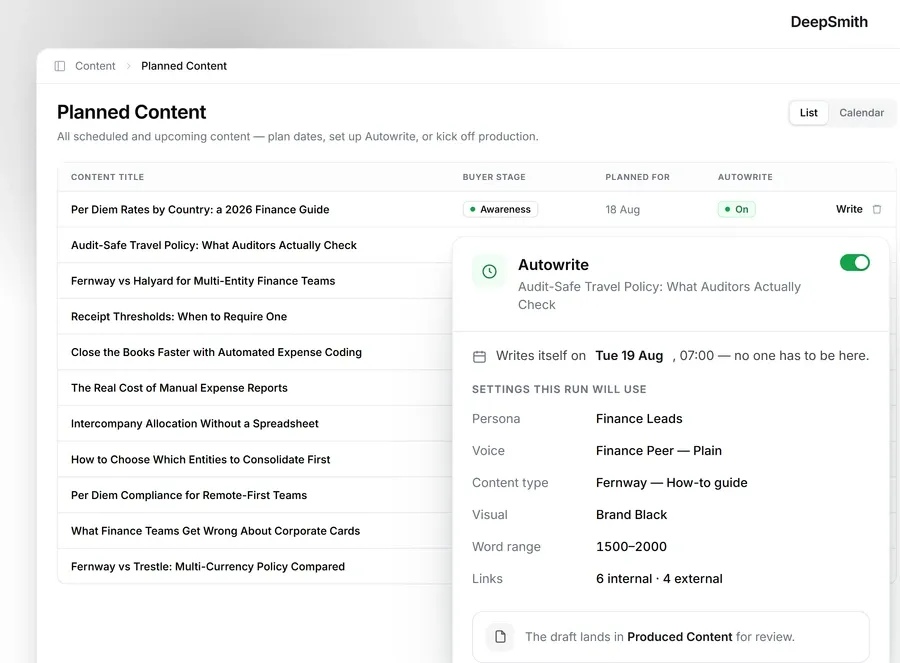
DeepSmith is the alternative on one specific axis: producing the content, not grading it. It tracks how ChatGPT, Gemini, Perplexity, and other AI engines answer questions about your brand, shows where you are absent from those answers, then writes publish-ready articles against those gaps from the same brand context, with Autowrite running scheduled pieces hands-off and publishing straight to WordPress, Webflow, Strapi, Sanity, or Contentful. Plans run $99, $199, and $399 a month, with a 7-day free trial. It does not do what Clearscope's editor does, so if live term coverage and Content Grade against ranking pages are what you are buying, this is not a swap.
Surfer is an SEO and AI-visibility platform covering content optimization, content creation, site auditing, competitor gap analysis, and brand knowledge, with published plans from around $49 a month billed yearly up to around $299 a month.
MarketMuse focuses more narrowly on topic authority, content planning, competitor gaps, roadmaps, briefs, and content inventory, and states plainly that it is not a CMS and does not manage or change your content directly.
Frase combines content research, drafting, SEO and GEO scoring, AI visibility, audits, briefs, calendars, and publishing workflows, with plans from around $49 a month up to around $299 a month billed monthly and AI visibility coverage that grows by tier.
Is Clearscope Worth It?
Clearscope is worth it if you run a real, recurring publishing operation and will actually use the content reports, the live editor feedback, the sharing features, and the ongoing monitoring every month. The premium price makes sense when it replaces hours of manual brief-writing, competitor research, and refresh prioritization on a regular basis.
It is not worth it if you only need occasional keyword help, you publish a handful of pieces a month, or you are hoping one subscription covers technical SEO, backlinks, and full content production and distribution at once. In that case the credits and higher-tier pricing will likely outpace what you get back.
The gap this review keeps landing on is production. Clearscope tells you a draft is thin and tells you a prompt did not cite you; the writing, the refresh, and the publishing stay on your team, and the credit limits on Drafts mean volume was never the point. On that one axis, content actually built and shipped to earn AI citations, DeepSmith is the alternative: it tracks mention and citation rates across ChatGPT, Gemini, Perplexity, and the rest, its Opportunity Agents hand back ideas with the visibility data point attached, and the Writer turns each one into a finished article with research, internal and external links, metadata, and a cover image, on a schedule if you want it hands-off. It is not an alternative on Clearscope's own specialty. There is no Content Grade, no term map against the pages ranking today, no Content Inventory scoring your existing library, and if that scoring loop is the job you are hiring for, Clearscope does it and DeepSmith does not.
Whichever direction fits your team, start with a trial and test it against your actual content. You can start a free trial and see whether tracking and production coming from one system changes what your team ships in a month.