A client forwards you a screenshot. A competitor is named in ChatGPT's answer to "best tools in our category," and they are not. The question lands in your inbox before you have a service to answer it with. This is now a weekly event, and it is the reason the best AEO tools for agencies are a different shortlist than the ones built for a single in-house brand.
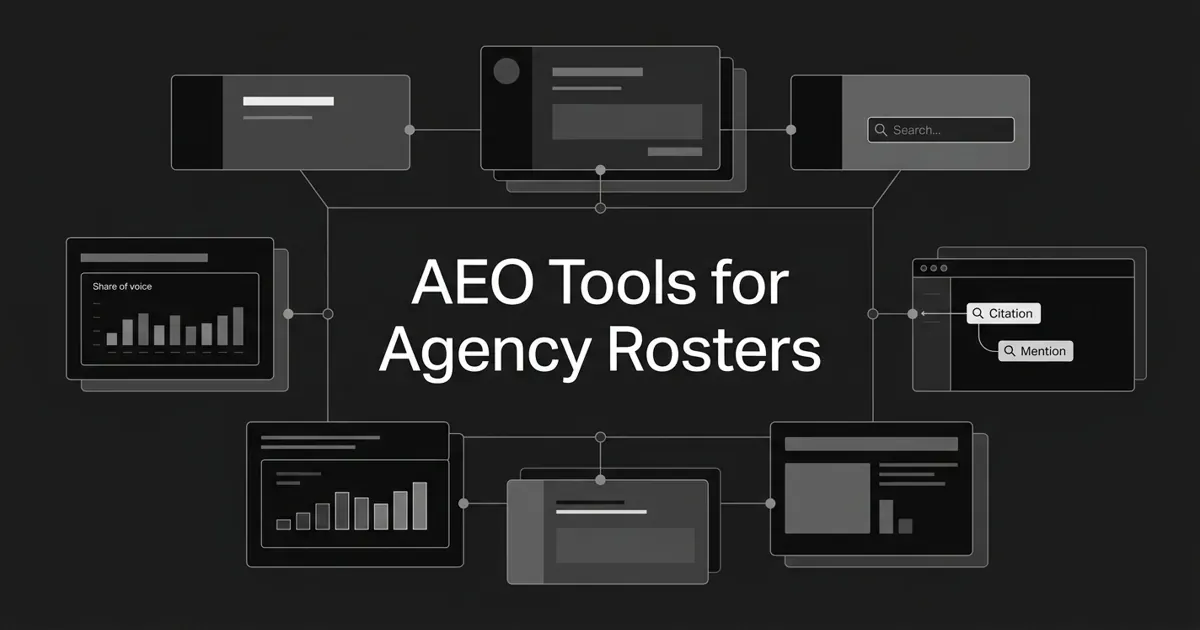
Answer engine optimization for agencies is a portfolio problem, not a single-brand one. You are tracking mention and citation rates for ten, thirty, or eighty clients, each with its own voice, its own competitors, and its own report that has to go out under your logo, not the tool's. A tracker that makes you log in per client, reset credentials per account, and re-skin a dashboard in a separate deck adds cost to every new logo you sign. That is the opposite of a productized service.
This guide ranks seven platforms an agency can actually buy and onboard a roster onto. Each was scored on multi-client fit, not on how well it serves one team. Where a competitor is the better call for your situation, we say so.
How we picked these tools
The criteria are the point. A roundup is only useful if you can see the test each tool was put through, so here it is.
- Multi-client management built in, not bolted on. Separate workspaces per client that isolate brand voice, prompts, and content, with one login for the agency and no per-seat cost that punishes roster growth.
- White-label or white-label-friendly reporting. The client sees a mention-rate, citation-rate, and share-of-voice report under your brand, not the vendor's.
- Per-client seats and roles. You can add teammates on the agency side and the client side without billing a second plan.
- Coverage of the engines clients actually ask about. ChatGPT, Perplexity, Gemini, Google AI Mode or AI Overviews, and Claude.
- A production path, not just a dashboard. The same tool tracks the gaps and ships the content that closes them, or it does not, and that gap becomes an honest limitation.
- Honest, published pricing. Self-serve pricing or a clearly published agency tier, no annual lock-in required to evaluate.
Anything that fails the first three by default is out of the main list, even if it is a capable tool elsewhere in the category. We cover a few of those in a "what we did not include" section, because you will search for them.
The tools at a glance
| # | Tool | Brand entry price (monthly) | Agency plan | Multi-client native | White-label ready | Production built in |
|---|---|---|---|---|---|---|
| 1 | DeepSmith | $99 (Pro) | Multi-workspace per client, billed independently, one account | Yes | Per-client branded reporting in each workspace | Yes, publish-ready articles |
| 2 | Profound | $99 (Starter) | Agency Growth add-on plus $399 per client workspace | Add-on per client workspace | Reports are Profound-branded | Yes, agents and drag-and-drop automation |
| 3 | Otterly AI | $29 (Lite) | Agency Partner add-on to Standard ($189) or Premium ($489) | Yes | Yes, via Looker Studio templates | No, monitoring and GEO audits only |
| 4 | Peec AI | $95 (Starter) | Essential $245 to Comprehensive custom | Yes, per project | Limited, Looker Studio at Advanced | No, recommendations only |
| 5 | Scrunch | $250 (Core) | Agency Core $500 to Agency Enterprise custom | Yes | Yes at Enterprise via API | Light, content delivery at Enterprise |
| 6 | AthenaHQ | Free or $295 Pro | Enterprise or Agency custom | Yes | Branded reports and dashboards | Recommendations only |
| 7 | Elmo | Free (self-hosted) | White-label deployments on request | Yes | Yes, full white-label by design | No |
Prices are monthly. Otterly, Profound, Peec, and DeepSmith all lower the effective monthly rate when billed annually, so model the annual number if you plan to commit.
1. DeepSmith

Best for: agencies that want to productize both tracking and content under one roof, hold every client's brand in structured context, and report per client without paying to put the tool's name on the cover page.
DeepSmith is the only platform on this list that tracks AI visibility and ships publish-ready content from the same data, with one account holding multiple client workspaces that are each billed and reported independently. That combination is the reason it leads. Most tools here do one half of the job. They tell you where a client is invisible in AI answers, then hand you back to a separate writing stack to fix it. DeepSmith closes the loop: the same product that finds the gap produces the on-brand article that closes it.
Start with the tracking side. The AI Visibility module reports mention rate, citation rate, and share of voice with trends, a per-platform breakdown, a competitor leaderboard, and the source pages AI cites most. Per-prompt views carry mention and citation rates plus full answer history. A Pages view attributes citations to the specific client pages winning them, and a competitor view shows who wins each prompt and on which page. That is the exact spread you want in a client report: proof of what you moved, benchmarked against the competitors the client actually names.

The multi-tenant design is what makes it an agency tool rather than a single-brand one. Each client runs in a separate workspace with its own branding, content, and reporting, all from one account. Workspaces are billed and limited independently, so you can put one client on Pro and another on Scale without splitting logins. Every draft is grounded in Deep IQ, the brand-context layer that stores each client's positioning, personas, product facts, brand voice, visual guidelines, and content types separately. That per-client isolation is the fix for the constant editing tax of keeping many voices on-brand. No cross-client bleed, no re-briefing every article.
Then the production path. Content Studio moves an idea from the backlog to a planned date to a finished article. The Writer turns one planned idea into a researched, internally and externally linked article with a cover image and publish-ready metadata. Autowrite can run it hands-off on the scheduled date and land it in Produced Content, where a strategist reviews and publishes straight to WordPress, Strapi, Webflow, or a webhook, with Markdown and HTML export as a fallback. Repurpose delivers channel-native versions for LinkedIn, X, Medium, Substack, newsletter and nurture email, Reddit, and more, so you hand the client a channel plan, not just a blog post. This is where the seat-sum math works: your strategists review for judgment instead of doing keyword density, headers, internal linking, and metadata by hand.

The pricing is public, no sales call to see it: Pro is $99 a month, Grow is $199, Scale is $399, or $80, $160, and $299 a month billed annually, plus custom Enterprise. There is a 7-day free trial and no long-term contracts. Engine coverage rises by tier. Pro tracks ChatGPT, Grow adds Perplexity, Scale adds Gemini, and Enterprise and Custom cover all ten: ChatGPT, Gemini, Perplexity, Claude, Google AI Overviews, Google AI Mode, Grok, Meta AI, Microsoft Copilot, and DeepSeek. Because each workspace is on its own plan with no per-client surcharge beyond the plan price, you match each account to the plan its scope needs and the roster cost stays legible.
DeepSmith tracks mention and citation across the covered engines and produces on-brand content. It does not control or guarantee rankings, citations, traffic, or revenue, and Autowrite still expects a human to review and publish.
One honest limitation: DeepSmith's white-label is at the per-workspace reporting level, not a domain-swap deployment on your own infrastructure. For most agency work that is the level that matters: each client sees its own brand on the report you hand over, which is what the deliverable actually requires. It only falls short when a client needs the platform served from your own domain, and for that narrow case Elmo is the better first look.
2. Profound

Best for: mid-market and enterprise agencies pitching AEO as a productized service who want a structured pitch-to-onboarding loop and do not need white-label on the dashboard itself.
Profound is built around winning and running client engagements. Its standout feature is Pitch Workspaces: spin up a trial workspace for a prospect with 25 custom prompts, use it to win the business, then convert it to a full Client Workspace. Agency mode gives you a centralized dashboard to create, extend, and disable those workspaces, plus consolidated billing across all of them on a single invoice.
The tooling around it is strong. Profound Agents offer drag-and-drop workflow automation tied to citation patterns, backed by an agent template marketplace. Agent Analytics reads crawler behavior at the CDN edge to show how AI crawlers actually hit a client's site. Brand plans run from a $99 Starter (ChatGPT only) to a $399 Growth tier that adds Perplexity and Google AI Overviews plus six optimized articles a month, up to a custom Enterprise tier covering ten engines.
The agency economics are explicit. Agency Growth is a $99 add-on to a Brand base, and each full Client Workspace is a $399-a-month add-on. That makes per-client cost easy to model, and it scales with your roster rather than with seats.
One honest limitation: reports are Profound-branded, not white-label. If a client report has to carry your logo, you re-skin it in a separate deck, which adds the delivery hours back that a productized service is supposed to remove.
3. Otterly AI

Best for: agencies already running Looker Studio as a reporting layer who want the cheapest path to per-client white-label dashboards across six engines and do not need content production in the same tool.
Otterly has the lowest entry price here. Lite is $29 a month, which makes onboarding a small client almost frictionless. The agency story sits on top of the Standard ($189) or Premium ($489) plans: subscribe, apply for Agency Partner status, and you unlock unlimited Workspace Management with a separate environment per client and one login, pitch workspaces for prospects, a single invoice, and branded reporting through a Google Looker Studio connector with pre-built templates.
That Looker Studio route is the white-label mechanism. If your agency already runs Looker Studio as its BI layer, this turns Otterly's data into a dashboard wearing your brand, daily. Engine coverage on the partner stack runs from four engines (ChatGPT, Google AI Overviews, Perplexity, Copilot) up to six on Premium (adding Gemini and Google AI Mode). There is a 14-day free trial.
One honest limitation: there is no in-platform content generation and no native white-label on Otterly's own interface. The white-label lives in Looker Studio, so if you do not already run a Looker Studio workflow, the headline reporting benefit costs you a new one to build.
4. Peec AI

Best for: agencies that want explicit per-project cost control and unlimited seats and intend to run the content side of the work elsewhere.
Peec's agency plans are built around projects, where each project is a client, and a shared credit pool you allocate across them. Essential is $245 a month for up to three projects, Growth is $495 for up to ten, Scale is $795 for up to twenty-five, and Comprehensive removes project caps for agencies running large rosters. The distinguishing feature is unlimited user seats on every plan, including entry-level Essential, so you can give every strategist and every client-side reviewer a login at no incremental cost.
The credit pool is the cost-control lever. Instead of paying a fixed price per client workspace, you decide how much of a shared budget each client project consumes, which gets cheaper per client as the roster grows. Peec tracks three active models per project across a set that publicly names six engines, including ChatGPT, Gemini, Perplexity, Google AI Mode, AI Overviews, and Copilot. Looker Studio integration for branded reporting arrives at the Advanced brand tier.
One honest limitation: there is no native content production. Optimization recommendations have to be executed by a human somewhere else, and there is no in-app white-label beyond the Looker Studio route.
5. Scrunch

Best for: agencies running brand-side AEO for clients who care about AI agent traffic and need SOC 2 Type II and SSO for procurement.
Scrunch publishes explicit agency tiers: Agency Core at $500 a month for multi-domain tracking and custom workspaces, and a custom Agency Enterprise tier. Its distinctive capability is the Agent Experience Platform, which detects AI agents at the edge and serves them AI-optimized, token-light content without affecting human visitors. For clients whose landing pages AI agents scrape constantly, that is a real service line most tools in this category cannot offer.
The enterprise credentials matter for a certain kind of client. Scrunch carries SOC 2 Type II, with SAML and OIDC SSO at Enterprise, plus Looker Studio, a query API, MCP, and CLI integrations. The brand-side Core plan at $250 covers ChatGPT, Perplexity, Google AI Overviews, and Copilot, and Enterprise expands to nine engines including Claude, Gemini, and Google AI Mode.
One honest limitation: the Core plan is single-workspace and limited to 125 prompts, so most agencies effectively need Enterprise to run active multi-domain tracking. Some of what makes Scrunch distinctive, including the Agent Experience Platform and full content delivery, is Enterprise-only.
6. AthenaHQ

Best for: agencies that want unlimited seats and a referral-driven acquisition loop and do not mind a credit model for tracked responses.
AthenaHQ leads with a Centralized Client Management dashboard that runs multiple brands from one platform with team permissions and a Google Analytics integration. It pairs that with an Athena-Referred Client Program, so agencies can refer and onboard new clients through the platform and earn on those referrals, an acquisition loop most competitors do not have.
Seats are unlimited on every plan, including the free Essential tier, so you can bring all your strategists in at no added cost. Essential is free with a bundle of monthly credits, Pro is a $295 self-serve tier with unlimited topics, and Agency or Enterprise is custom with dedicated onboarding. Engines include ChatGPT, Perplexity, Google AI Overviews, Gemini, Claude, and Grok. Pricing is credit-based, where a credit is one AI response.
One honest limitation: the credit model means your burn rate depends on how often you refresh prompts, so high-volume rosters should plan for Enterprise rather than the self-serve tiers. Content generation here is recommendation-level, not a full production pipeline.
7. Elmo

Best for: technically resourced agencies, or agencies with a dev partner, that want full infrastructure-level white-label, an auditable methodology, and zero per-prompt cost.
Elmo is the only true white-label AEO software on this list in the strict sense. It is open-source and self-hosted, so an agency can run it under its own domain, re-skin the entire product, and stand up multi-client dashboards with custom branding. The self-hosted version is free with no prompt cap, and the methodology behind every score is documented, so you can defend a number to a procurement reviewer by showing exactly how citations were counted this month.
It tracks ChatGPT, Claude, Perplexity, and Google AI Overviews in the open-source release. A managed cloud version is listed as coming soon. For an agency that wants to own the platform outright and never pay per prompt, nothing else here matches it.
One honest limitation: self-hosting means you operate the infrastructure, and support is GitHub-based community support. There is no managed cloud yet, so an agency without an engineering resource will struggle to keep it running.
What we did not include and why
A few tools show up when you search this category but failed the multi-client test, so they are worth naming.
- Ahrefs Brand Radar does single-brand tracking well but is awkward as an agency platform.
- Semrush AI Visibility Toolkit is an add-on whose agency licensing scales with seats, and the AI tracker is thin next to purpose-built AEO tools.
- Surfer AI Tracker and Writesonic bolt a visibility layer onto a content editor rather than offering roster-level multi-client management.
- Conductor ($1,500-plus entry), Bluefish AI (Fortune 500 positioning), and Evertune (around $3,000 a month) are enterprise-oriented rather than built for an agency running a 20-to-80 client roster.
- FogTrail is a legitimate true white-label AEO software alternative with custom-domain deployments if Elmo's self-hosting is too heavy, priced from $1,299 a month for ten brands up to $3,999 for unlimited.
How to choose the right AEO tool for your agency
Answer engine optimization for agencies comes down to matching the tool to your delivery model. Match the situation to the pick.
If your edge is reporting under your own brand and you already run Looker Studio, take Otterly's Standard plan plus the Agency Partner add-on. It is the cheapest path to per-client white-label dashboards across six engines.
If you are selling AEO at enterprise tier and want a structured pitch-to-onboarding motion, take Profound. Each Client Workspace is a managed $399 sale, pitch workspaces make prospecting a service, and the agent marketplace is a genuine differentiator.
If you run many small portfolios and want cost control per project, take Peec's Essential or Growth. Unlimited seats on every plan and a shared credit pool fit a roster of ten to twenty-five clients at low marginal cost.
If your clients care about AI agent traffic and SOC 2 procurement, take Scrunch Enterprise. The Agent Experience Platform and SSO credentials are rare in this category.
If you have engineering capacity and want infrastructure-level white-label with an auditable method, take Elmo self-hosted. You run the platform yourself.
For most agencies, the default is DeepSmith. It is the only tool that combines multi-workspace isolation, per-client branded reporting, ten tracked engines on Enterprise (ChatGPT and Perplexity from the $99 and $199 tiers up), and publish-ready content production in one platform. The reason it wins the roster math is the same reason it leads this list: your strategists review for strategy instead of doing SEO cleanup, internal linking, and metadata by hand, so you can add clients without adding headcount at the same rate.
One honest caveat that applies whichever tool you pick. AI visibility is volatile, and meaningful improvement from focused work tends to show up over a 30-to-90-day window. Most early citations come from third-party content rather than a client's own pages, so a real AEO service line is earned media, schema, and entity work as much as on-site content. Set that expectation with the client before the first report, not after.
Ready to run tracking and publish-ready content for every client from one account? Start a DeepSmith free trial and set up your first client workspace today.