If you lead content at an enterprise SaaS company, you have probably noticed that "publish more" is not really a strategy. The harder question is where content should do its heaviest lifting: in changing what buyers believe about the category, in reducing the risk of evaluating and adopting your product, or in turning your users into a source of trust and proof for each other. Those are three different jobs, and most enterprise saas content strategy work actually breaks down into one of them.
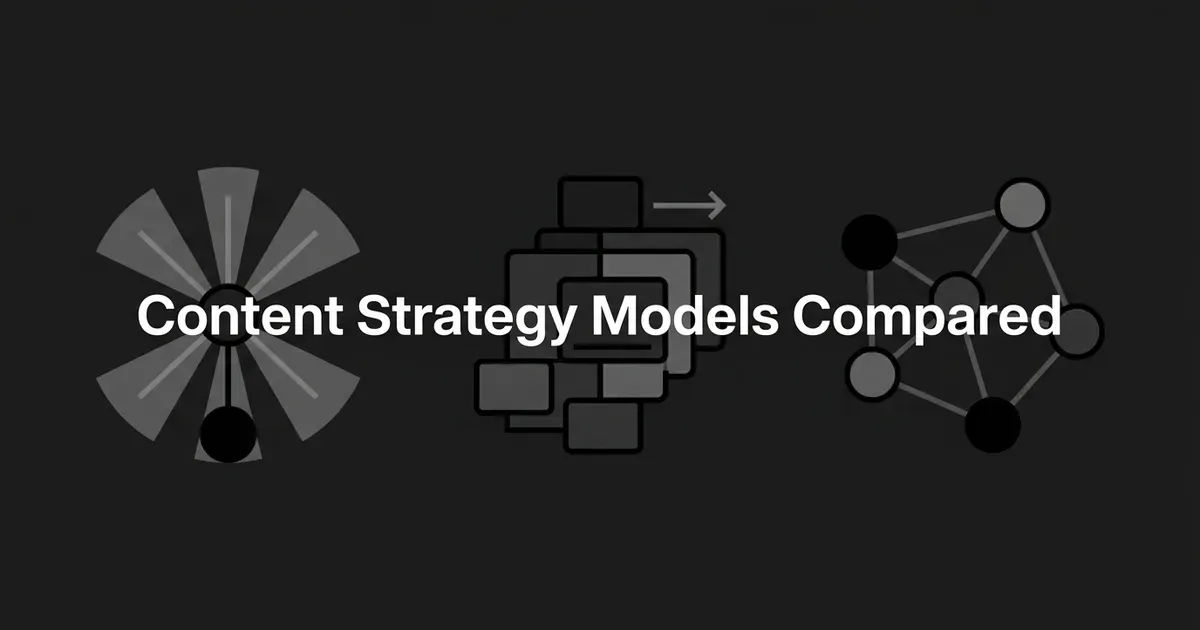
Enterprise SaaS companies generally organize content around one of three strategic centers of gravity. Thought leadership creates demand and reframes how buyers think about a problem. Product education reduces the risk of evaluating and adopting your product. Community turns users and practitioners into a source of learning, trust, and distribution for each other. None of these is automatically the right answer. The one that fits depends on what is actually slowing your pipeline down.
Here is a quick way to see the differences before you go deeper into each one.
| Model | Primary job | Main audience | Best-fit motion |
|---|---|---|---|
| Thought leadership | Define or reframe the problem, build credibility | Executives, strategists, hidden buyers | Enterprise sales, ABM, category creation |
| Product education | Help buyers and users evaluate, adopt, and expand | Practitioners, technical evaluators, champions | Sales-assisted, product-led assist, expansion |
| Community | Create value through peer interaction and proof | Users, developers, partners, champions | User-led adoption, ecosystem, installed-base growth |
Choose thought leadership when the constraint is category belief. Choose product education when the constraint is product complexity or adoption risk. Choose community when the constraint is trust, peer validation, or retention. That is a decision rule, not a law. Your company's stage matters less than your product's complexity, your buyers' actual behavior, and the expertise and installed base you already have.
Thought-leadership-led content
Thought leadership is content that offers a real point of view or real expertise on a problem your buyers face, not a lightly edited trend summary or a product announcement dressed up as insight. What makes it work is evidence, a clear read on the buyer's business challenge, and guidance the reader cannot get from a search engine summary.
This usually means original research and benchmark reports, executive essays with an actual argument, contrarian takes on assumptions your category treats as settled, economic or operational models, and interviews with practitioners who have opinions worth quoting. The job is to change how someone frames a problem before they have started shopping for a solution to it.
That matters more than it sounds, because most of your buyers are not actively evaluating anything at any given moment. A 2024 Edelman and LinkedIn report, based on a survey of nearly 3,500 management-level professionals across seven countries, found that 95% of business buyers were not actively seeking goods or services when surveyed, and that B2B buyers preferred to research on their own before talking to a vendor. A related 2025 Edelman and LinkedIn report found that hidden buyers, the people in a buying group who never talk to sales until late, actively read and evaluate thought leadership on their own. That makes thought leadership a buying-group strategy, not just something you do to build an executive's personal brand.
Strong thought leadership does three things in order. It helps the reader see a problem more clearly, it gives them a new way to interpret what that problem requires, and it makes your company relevant when they eventually start researching vendors. That sequence is why it fits sales-led and account-based motions especially well: when a business case has to be built across several stakeholders who never all sit in the same room, a shared piece of research or a shared point of view gives them something to argue from.
It works best for established category leaders defending their position, for companies entering a bigger or less familiar category, and for high-ACV products with long consideration periods. It works less well as your only content strategy engine when the actual obstacle is that people already believe in the category but do not know how to configure or prove value from your product. The failure mode to watch for is publishing a high volume of generic commentary with no original evidence behind it. The 2024 Edelman and LinkedIn research specifically flags that a lot of thought leadership is under-resourced or poorly measured, which argues for fewer, sharper pieces over a constant stream of undifferentiated opinion.
Product-education-led content
Product education teaches a buyer or user how to evaluate, implement, use, and get more value out of your product over time. Done well, it is not a disguised feature pitch. It connects to real workflows and answers the questions that come up while someone is actually trying to use the thing.
The scope is wider than most people assume. It covers explaining the underlying problem without assuming product knowledge, walking through the solution category and its tradeoffs, showing the product handling a realistic workflow, addressing implementation and security and governance questions, and teaching someone how to reach their first useful outcome. On the far end, it includes courses, certifications, and advanced training for admins and power users.
Gartner's April 2024 research summary found that only 25% of B2B buyers recalled having any genuinely valuable digital interaction with a supplier during their evaluation. Its recommendation was to build content that ties the product back to the buyer's actual business needs at every step, rather than assuming a features list speaks for itself. That is really the whole argument for this model: buyers do not just need to know your product is good, they need to know it fits their systems, their skills, and their risk tolerance.
Two well-known examples show how far this can scale in an enterprise setting. Salesforce Trailhead offers guided learning paths, access to Salesforce experts, and credentials that carry weight in someone's career, well beyond a documentation site. HubSpot Academy runs on-demand training and live workshops that teach inbound marketing and sales skills alongside the software itself. Both turn product knowledge into something portable enough that it builds an ecosystem of trained practitioners, not just a support library.
This model earns its place when the product has real implementation or configuration work behind it, when technical evaluators or admins can veto a purchase, and when there is a meaningful gap between the day someone buys and the day they actually get value. It is a strong fit for hybrid product-led motions, and for a growing installed base that needs scalable onboarding rather than one-to-one hand-holding for every new account. It is less useful when the product is simple to understand at a glance, or when the real blocker is that nobody in the category believes the problem is worth solving yet. The common failure here is letting product education drift into a pile of disconnected help articles that nobody maintains once the interface changes underneath them.
Community-led content
Community-led growth treats a group of users, practitioners, developers, or partners as a central source of learning, trust, feedback, and distribution, not just an audience that reads what you publish. The difference from an audience is participation. A newsletter list reads your content. A community creates value by interacting with each other, with or without you in the room.
A healthy community runs on four linked things. Members get real help, knowledge, or recognition. Prospective users see how other practitioners actually solve their problems, which is a kind of proof your own marketing cannot manufacture. Recurring questions and requests feed back into your product and your education content. And members who get real value end up teaching others and advocating for you, which becomes its own distribution channel.
Atlassian Community mixes forums, events, and learning resources where users help each other and share knowledge. Salesforce's Trailblazer Community combines learning, live events, groups, and product feedback across what the company describes as millions of participants, a company-reported figure worth treating as a scale claim rather than independently audited data. A more specific enterprise example comes from a 2022 SaaSiest interview with Neo4j's CEO and co-founder Emil Eifrem, who said 95% of Neo4j's revenue came from companies with at least a billion dollars in revenue, while developers and data scientists discovered and experimented with the product through community channels long before anyone with budget authority got involved. In that interview, he described the community as handling roughly 80% of top-of-funnel awareness and pre-sales support. That is an executive's own account of his company, not independent research, but it illustrates a real pattern: the people who find your product and the people who approve the purchase order are often not the same people.
Community-led content fits best where the product is used often enough, and by similar enough practitioners, that peer proof actually means something: developer tools, technical or specialized categories, platforms with a real partner or integration ecosystem. It needs enough installed-base density to sustain real interaction, and it needs a company willing to invest in moderation, programming, and recognizing members, not just hosting a forum and hoping people show up. It is a weaker fit when your users cannot safely discuss their setup with each other, or when the audience is too small to generate useful peer interaction yet. The failure mode worth watching for is launching a branded community with no clear benefit to members, then being surprised when engagement never shows up.
How buyer stage and sales motion decide the fit
These three models do not map cleanly onto a single linear funnel, and forcing them to often causes more confusion than it solves. Thought leadership is strongest in problem recognition and early consideration, when a buyer has not yet decided the problem is worth solving. Product education is strongest through solution exploration, technical validation, implementation, and expansion, once someone is actively trying to figure out if your product fits. Community can touch almost every stage, from discovery through advocacy, but only when members are actually getting something out of it.
Sales motion sharpens the picture further. In enterprise sales and account-based marketing, thought leadership creates relevance with a target account, product education equips the buying group to build their case, and community supplies peer proof and champions once a relationship starts. In sales-assisted or hybrid product-led motions, product education gets users to value quickly while thought leadership backs up the executive sign-off. In user-led or developer-led adoption, community and product education often generate real usage well before anyone with a budget enters the conversation. In installed-base expansion, product education surfaces new use cases while community builds the champions and peer momentum that make expansion feel low-risk.
Enterprise buying groups rarely move in a straight line. A technical evaluator might go back to a business-case question after a security review raises a concern, or an executive might get pulled into a decision a practitioner already made in practice. Your content should be built to answer the question a given stakeholder actually has right now, rather than assuming everyone is standing at the same point in a single funnel.
What each model can't replace
It helps to be honest about the limits, because none of these three does the other two's job. Thought leadership cannot replace technical proof, documentation, or a real implementation plan. It can get someone interested; it cannot get them through a security review. Product education cannot create category demand on its own. If a buyer does not yet believe the problem is worth solving, a beautifully made product walkthrough will not change their mind about that. Community cannot replace enterprise procurement, commercial support, or a clear value proposition. Peer proof helps someone trust a purchase; it does not process the purchase order.
This matters because the measurement for each model is different, and conflating them leads teams to judge the wrong thing. Thought leadership should be measured by qualified demand, target-account engagement, and pipeline influence, not by page views alone. Product education should be measured by evaluation progression, activation, time to value, and renewal, not by how many articles exist. Community should be measured by member contribution, adoption among participating accounts, and advocacy, not by follower counts or post volume.
A 2026 benchmark report on B2B SaaS content, drawn from 321 respondents at companies above roughly 50 million dollars in revenue, found that most published 11 to 20 blog posts per quarter and that high performers did not publish meaningfully more than everyone else. The same report found that 75% of respondents still measured content mainly by engagement, while only 54% tracked pipeline influence and just 33% used any attribution model. Treat that as one industry benchmark, not a universal standard, but the pattern it points to is real: a lot of enterprise content marketing approaches are still judged by attention rather than the outcome the model was actually built to produce.
Choosing your lead model
Good content strategy for enterprise software rarely runs on a single model forever. A mature enterprise SaaS company can eventually run all three, but they should not be collapsed into one undifferentiated calendar where every asset tries to do every job at once. The clearer path is to pick a lead model based on your current constraint, and let the other two support it rather than compete with it.
If category awareness is weak or your buyers do not yet feel urgency, lead with thought leadership and let product education and community grow underneath it. If evaluations stall, implementations drag, or adoption is weak once someone buys, lead with product education and use thought leadership to keep executive sponsors bought in along the way. If you already have a strong user base but advocacy, retention, or peer proof are the weak points, lead with community and let your best members become the evidence your thought leadership and education content can point to.
A coherent version of this often looks like a loop rather than a funnel. Thought leadership builds the business case. Product education makes the decision executable once someone is evaluating. Community makes the decision socially credible and keeps it durable after the sale. Customer stories that come out of the community then feed the next round of research and education content, and the loop starts again.
If you are trying to run this kind of system with a small team, the hardest part is usually not deciding which model to lead with. It is keeping each piece of content tied back to the job it was supposed to do, especially once you are publishing enough volume that internal linking and metadata become their own chore. DeepSmith's writing pipeline keeps content grounded in your stored product and brand context so a thought-leadership piece, a product guide, and a community story stay recognizably part of the same strategy instead of drifting into whatever a given writer felt like that week.
Whatever you choose, the test is simple. Name the buyer you are trying to move, name the belief or behavior that has to change, and measure the outcome that model was actually built to produce. A content calendar that cannot answer those three questions for a given piece is not really following a strategy yet, no matter how full it looks.