Most editorial mission statements read fine and do nothing. They sit on an About page, get quoted in a deck once a year, and never once help anyone decide whether to greenlight a story. A strong editorial mission statement is different. It works in the room where an editor has to say no to a pitch, and it gives them a reason that isn't just a feeling. If you're building or fixing one for your team, the test isn't whether it sounds inspiring. It's whether it can reject an idea.
This piece pulls together what separates a working editorial mission statement, one your team can actually use to decide what not to publish, from the vague kind that just describes an audience and stops there. We'll go through the seven things a strong one does, look at content mission statement examples that get it right and wrong, and end with a way to test yours against real ideas from your own backlog.
It names a real audience, not everyone
A mission that says "people interested in marketing" or "professionals who want to grow" hasn't picked an audience. It's picked a direction. The test is simple: swap the audience phrase for "anyone interested in this topic" and see if the sentence changes meaning. If it doesn't, you haven't named anyone specific enough to make decisions with.
A real audience is defined by role, situation, or a problem they're actually trying to solve, not by a broad label like "small business owners" or "content marketers." "Marketing leads responsible for growing content output while proving out AI search visibility" gives you something to check a pitch against. It tells you what depth to write at, what a reader already knows, and what would be too basic or too advanced for them.
Your content audience doesn't have to match your buyer audience exactly. You can serve people who benefit from what your team knows even if they're not close to a purchase decision. What matters is naming the group your publication is actually built to help, not the group you'd like to sell to. When you sit down to write the mission, start here, because everything else in it depends on knowing who you're writing for.
It defines the content promise
Naming an audience tells the team who might read the work. It doesn't tell them what to make. That's a separate job, and a lot of mission statements skip it, landing on something like "we help professionals succeed," which could describe almost any publication in any category.
The content promise says what you will actually publish: the topics, the questions you'll answer, the kind of work (reporting, analysis, practical guidance, reviews), and sometimes the formats that are core to what you do. A useful check is to ask whether a competing publication with completely different subject matter could use your exact sentence. If the answer is yes, the promise is too generic to guide anyone.
The strongest content promises sit at the overlap of two things: what your team actually knows well enough to teach credibly, and what the audience needs or is trying to figure out. Eater's version of this is instructive. It says its editors report from major food cities to help readers know where to eat, drink, and enjoy themselves, which tells a pitching writer exactly what kind of piece belongs and what doesn't.
It states the reader's outcome
A mission that stops at topics and audience still hasn't answered the most important question: why should this person care? The outcome is what a reader can know, decide, do, or accomplish after reading. Without it, a mission gives you a subject list, not a reason.
Useful outcome language is specific: make a better decision, do a job more effectively, understand something complicated, navigate a process they'd otherwise get stuck on. Vague language like "inform and inspire" might describe a broader purpose somewhere in your strategy deck, but it rarely tells an editor whether one particular pitch belongs, because almost anything can claim to inform.
PCMag's mission does this well. It says its labs based, independent reviews help readers make better buying decisions and get more out of their technology. That's specific enough to reject a review that doesn't actually help someone decide what to buy, even if the review itself is well written. For every idea that comes across your desk, you should be able to ask: does this deliver the exact benefit the mission promises, or does it just live in the same general topic area?
It expresses an editorial point of view
This is not your brand voice, and mixing the two up is one of the most common mistakes teams make. Voice is how you sound. A point of view is the basis you use to select, report on, interpret, and present material, and it's what tells an editor how to handle a story once the topic and audience already fit.
Relevant principles here include things like accuracy and verification, independence from commercial pressure, fairness in how sources and subjects are treated, and transparency about where information comes from. You don't need to reproduce a full standards manual inside your mission. You need the few principles that actually change what gets published and how a disputed call gets settled.
PCMag makes its independence explicit: editors select and review products on their own judgment, and the site discloses where affiliate commissions support the cost of testing. That single sentence gives an editor grounds to reject a sponsored placement dressed up as a review. Weak principles read like "we value accuracy," which nobody disagrees with and which changes no actual decision. Write the version that would actually change what your team does with a borderline pitch.
It creates boundaries and exclusions
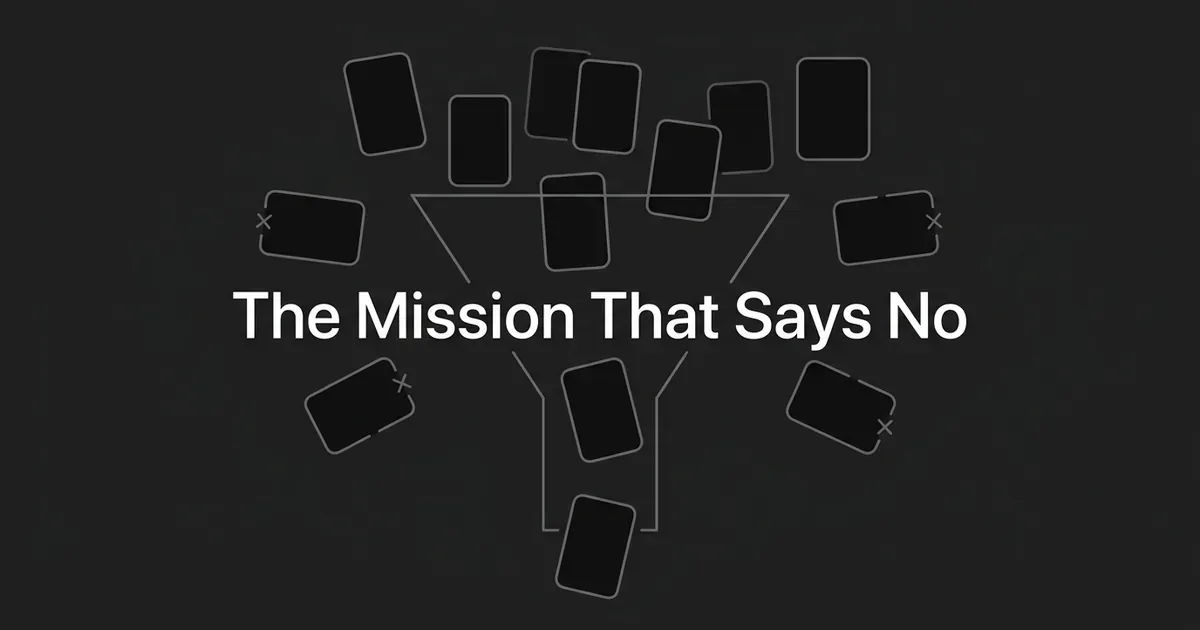
This is the real test of whether a mission statement is doing its job. If every topic your team could plausibly write about still fits the mission, the mission isn't filtering anything, it's just describing the category you work in.
A working mission draws a line around who it's for, what it covers, what level of expertise it assumes, and what kind of value a piece has to provide to earn a spot on the calendar. It doesn't need to list every excluded topic by name. The combination of audience, content promise, and outcome should already make most exclusions obvious without spelling each one out.
Here's a concrete way to check yours: take ten plausible ideas from your actual backlog and run them against the mission. If it can't help you turn down even a couple of them, the statement is too broad or too abstract to use. Compare Eater's food-city reporting mission, which clearly excludes a general lifestyle piece with no food angle, against something like The Gazette's old framing around guiding community deliberation on public issues. That second one is generic enough to describe almost any mainstream newspaper, which means it excludes almost nothing.
It stays concise without going empty
A mission statement needs to live in an editor's head, not just in a document nobody opens. That means it has to be short enough to actually recall and use in a planning meeting. But short and vague are not the same thing, and cutting the wrong parts to hit a word count is its own failure mode.
The Sky & Telescope example is a useful cautionary case. Its mission letter runs to roughly 235 words and covers its astronomy audience, practical guidance, imagery, and product reviews in real detail, but it's too long to function as something a team actually consults before greenlighting a pitch. It also opens by addressing the "devoted amateur" before widening to "enthusiasts of all levels," which blurs exactly the depth question a shorter, sharper statement would have settled.
The fix isn't just deleting words. It's knowing which words are load bearing. Keep the audience, the content promise, the outcome, and whichever principles actually change a decision. Cut the history, the organizational throat clearing, and the workflow detail, all of which belong in separate documentation, not in the sentence your team is supposed to remember.
It's distinctive enough to belong to one publication
A last, useful check: could a competitor copy your mission statement onto their own About page and nobody would notice? If so, it isn't doing enough work. A mission that could belong to any publication in your category isn't really governing anything, it's just naming the category.
Distinctiveness can come from several places: a specific niche within a broader subject, a particular combination of topics nobody else covers together, a defined reader outcome that's more precise than the norm, or a recognizable editorial method like independent testing or deeply reported context. Connecticut Weekender's mission works because it's tied to a specific geography and a specific kind of reader utility (finding things to do locally), which no general lifestyle site could claim without changing the sentence.
Among the content mission statement examples worth studying for what not to do, Redbook's old line, "style and confidence for the busiest, messiest, happiest years of your life," shows the tradeoff the other way. It's memorable and it has real emotional pull, but words like "confidence" and "messiest" invite whatever interpretation the reader brings, and the line leans on an audience stereotype rather than naming the actual content or outcome. Memorable and governing are two different jobs, and the strongest missions manage to do both.
Use it as a publish-or-reject test
Everything above only matters if the mission actually gets used. The mission belongs in planning meetings, in briefs, in commissioning conversations, and in the content audits where you decide what to update or retire, not just on an About page nobody reads twice.
For any proposed piece, run it through a short set of questions: Is this for the audience the mission names? Does it fit the subjects or problems the mission promises to address? Does it deliver the stated benefit? Does it meet the principles the mission sets out? If the answer to the core audience, content, or benefit questions is no, the idea should usually be rejected or reframed, not waved through because it's topically adjacent or because someone on the team is excited about it.
One simpler version of this test, used by teams who don't want a seven-point checklist: check the mission, and if the idea doesn't fit, leave it out. That bluntness is the point. A mission statement isn't there to automate judgment, it's there to give editors a shared starting point so disagreements about whether something belongs become visible and arguable, instead of staying as a vague feeling that a piece is or isn't "on brand."
It's worth being honest about what a mission statement can't do on its own. A 2018 systematic review of the research literature found evidence linking mission statements to organizational performance was scarce and inconclusive, so treat any claim that a mission alone drives traffic or revenue with real skepticism. What a mission reliably does is narrower and more useful: it clarifies purpose, aligns editorial decisions, and gives a team language for rejecting work that doesn't belong. It also isn't the whole governance system by itself. Ownership of the content lifecycle, standards for accuracy and review, and a process for updating old material all sit alongside it, not inside it.
What a strong mission statement is not
Getting this right also means being clear about what an editorial mission statement is not trying to be, because teams often stretch it to cover jobs it can't do well.
It isn't a company mission. A business mission describes what the organization exists to sell, in what market. An editorial mission describes the value a specific audience gets from your publication and the editorial choices required to deliver that value, which is a different question even when the two documents sit near each other.
It isn't an audience persona. "Busy marketing leaders at growing companies" describes a reader. It only becomes an editorial mission once you add what those leaders will get from the content and what it will help them accomplish, which is the piece a persona document usually leaves out.
It isn't a list of KPIs. Traffic, leads, and rankings measure whether the work is performing. They don't define what the work is for. A mission dominated by business metrics turns editorial meetings into sales meetings, and that's a different conversation.
It isn't a full standards manual, a vision statement, or a values list. Standards and legal guidance belong in their own documentation. A vision describes a future state you're working toward, while a mission describes the work you're doing now. Values name principles you consider important, but they only become editorially useful once you connect them to an actual publishing decision, the same way "we value accuracy" only means something once it's tied to how you handle an unverified claim.
And to be clear about scope, this isn't about brand voice or tone either. A brand voice guide governs how your organization sounds on the page. A mission statement governs who the content is for, what you publish, and which ideas get turned down. They're separate artifacts doing separate jobs, and combining them tends to weaken both.
The most useful way to think about what is an editorial mission statement is as a governance tool first and an inspiring line second. A working shorthand looks something like: for this audience, we publish this kind of content about these subjects so readers can achieve this specific outcome. That's a starting structure, not a formula to fill in word for word, and the finished version should sound like your publication rather than like a template anyone could have written.
How to prioritize once you have one
If you're rewriting a weak mission statement or building one from nothing, don't try to fix every characteristic in this list at once. Start with whichever piece is currently missing and doing the most damage. If your team argues constantly about whether a pitch belongs, you're probably missing boundaries. If pitches keep drifting off topic, the content promise is probably too vague. If the writing feels competent but forgettable, the distinctiveness piece is the gap.
Once the mission names an audience, a content promise, and an outcome you can actually check a pitch against, take it into your next planning meeting and test it against real ideas already sitting in your backlog. If it changes even one decision you'd otherwise have made on instinct, it's doing its job. If your team could swap it for a competitor's mission statement and nobody would notice, go back and make it more specific before you spend more time refining the language around it.