If you are looking at an entry level AI monitoring tool and an enterprise plan side by side, the gap between them can feel hard to explain. The enterprise plan has a longer feature list and a talk-to-us button instead of a number, and it is not obvious which of those extras you would actually use. The honest answer is that the gap is sometimes justified and sometimes not, and the difference comes down to what your team has to do with the data once you have it.
This guide looks at the enterprise AI monitoring price from the capability side. It does not list vendor prices or plan tables, since how plans are priced is its own topic. Instead it walks through coverage, integrations, governance, and support, which are the four things that usually explain why one plan costs more than another. Then it looks at how three monitoring vendors handle them and where DeepSmith fits.
Entry-Level vs Enterprise AI Monitoring at a Glance
Here is a capability-only view of the two ends, with the vendors this guide covers. Entry-level plans vary a lot by vendor, so the first row describes the general pattern and not any one product.
| Option | Coverage and scale | Integrations and workflow | Governance and support | Best fit |
|---|---|---|---|---|
| Entry-level monitoring | A defined prompt set and a narrower scope; exact engines and limits vary by vendor | Often a dashboard and exports; API and automation access may be gated | May lack enterprise SSO, audit controls, or a dedicated support contact | A small team setting a baseline or watching a focused set of buyer questions |
| OtterlyAI | Daily checks; plan bands for prompts and credits, with enterprise-scale allowances | Public API, data-stack, Zapier, Make, and Slack examples, reports and exports | Enterprise SSO, roles, optional enterprise SLAs, onboarding and customer success | Teams that want monitoring data to feed existing analytics or alerts |
| Profound | Public trial is limited and time-bound; a full paid-tier matrix was not established | Enterprise API access; configurable Agents that query data and publish to a connected platform | Enterprise SSO, role-based permissions, activity logs, priority support | Organizations that need governed access, audit history, and custom actions |
| Scrunch | Core and Enterprise differ in prompts, engines, and countries; custom scale on Enterprise | API, Looker Studio, query API, and MCP access on Enterprise | Enterprise SSO, role-based controls, SOC 2 Type II claim, dedicated account team | Teams that want enterprise monitoring plus citation and agent-experience work |
| DeepSmith | Engine coverage grows with each plan; Enterprise is custom and multi-region | Read-only API and MCP; event webhooks; Content Studio publishes to named CMS connections | 1:1 onboarding and a dedicated account manager on Enterprise | Marketing teams that want visibility findings connected to content production |
Entry-Level AI Monitoring
A small team can get a lot out of an entry level AI monitoring tool. A focused prompt set, a handful of engines, and a dashboard that answers a few basic questions is often enough to learn whether monitoring is useful at all. Is the brand mentioned? Is it cited? Which competitors show up? Which of your pages are being cited? If you can answer those and act on them, you have a working baseline, and that is a perfectly good reason to stay where you are.
The limits worth testing before you commit are the usual ones. Look at prompt caps, engine restrictions, whether you can track more than one region, how many people can use the tool, whether there is an API at all, whether there is any audit trail, and whether support is personal or a help center. None of these is a flaw in every plan, and a limit that does not matter to you costs nothing.
Several vendors open up some advanced features before the enterprise tier and keep others back, so the choice is rarely a plain two-way split.
Enterprise AI Monitoring: What the Premium Can Buy
When people ask about the enterprise AI monitoring price, they are usually asking about four things bundled together. It helps to separate them, because you may need one or two and have no use for the others.
Broader coverage and scale
More engines can help when your buyers and your stakeholders use several answer platforms. More countries, languages, brands, prompts, and checks per day only matter if they match what you plan to monitor. "Unlimited" and "custom" sound valuable, but the useful question is what you will actually track, how often, and whether anyone has time to read it.
Scrunch's public comparison shows the step up clearly. Its Core column lists 125 unique prompts, four engines (ChatGPT, Perplexity, Google AI Overviews, and Microsoft Copilot), and one country. The Enterprise column lists custom prompts, nine engines (ChatGPT, Claude, Perplexity, Gemini, Meta AI, Google AI Mode, Google AI Overviews, Microsoft Copilot, and Grok), unlimited countries, and custom numbers of brand workspaces and user licenses.
OtterlyAI describes Lite, Standard, and Premium bands of prompts and credits, with daily collection, and an Enterprise entry that starts from 1,000 search prompts. One thing to watch there is that its plan page gives two different answers about which engines the lower tiers include. The summaries say four of seven, while the comparison table marks every engine as included on every plan. If engine coverage matters to your decision, ask OtterlyAI to confirm it in writing before you rely on either version.
Integrations that make monitoring usable
An integration matters when it moves monitoring into something your team already uses, such as a data warehouse, a reporting process, an alert channel, or an automated task. It helps to keep these apart, because they are not the same thing:
- A downloadable report or export.
- Read access through an API or query API.
- A connector to a reporting or collaboration tool.
- Notifications or workflow triggers.
- A write-capable integration that can change or publish data.
For each one, ask what data it exposes, how often it updates, what permissions apply, and whether it only reads or can also act.
OtterlyAI documents a public API covering brand reports, prompts, citations, mentions, coverage, and cited URLs, and describes connecting to data warehouses such as BigQuery and Snowflake and to Zapier, Make, or Slack for alerts. Reports and exports come with every tier, but API and MCP request allowances do not: Lite lists none, Standard lists 2,000 requests a month for each, Premium lists 5,000, and Enterprise is custom. That is a good example of the premium buying something other than raw capacity, because the data can become part of your own stack.
Profound's enterprise page describes API access for connecting to an existing technology stack, and its Agents are built from nodes that can query Profound data, prompt an AI model, fetch web content, or publish to a connected platform. The material does not say which platforms are supported or what review steps exist before something is published, so it is worth asking before you picture an unattended workflow. Scrunch's Enterprise column lists API access, Looker Studio, a query API, advanced API access, and MCP access, and it has a setup guide for connecting through Perplexity. The public material does not say what the MCP connection exposes or whether it is read-only.
Governance, identity, and security
If procurement or security is involved, this is often where the enterprise premium lives. Single sign-on, roles, audit trails, security evidence, and a clear way of handling data are common requirements. Ask which controls exist, on which plan, and what documentation backs them up.
Here is what each vendor says publicly:
- OtterlyAI: SAML 2.0 SSO for Enterprise, administrator and member roles, monitoring data stored in a US data center, a stated 99.95% annual platform uptime, and enterprise SLAs available on request. Its security page does not name a certification.
- Profound: SOC 2 Type II compliance, SAML or OIDC SSO that is Enterprise-only, fine-grained role-based permissions, priority support by email or Slack, and daily backups kept for one week. A product update dated August 7, 2026 says activity logs are available to Enterprise customers, covering logins, role and membership changes, API keys, SSO connections, and Agent actions. The update does not give a retention period.
- Scrunch: SOC 2 Type II compliance, SAML and OAuth SSO with providers such as Okta and Azure AD, role-based access, and a dedicated account team. Its help page says SSO is exclusive to Enterprise and above, and that once it is on, everyone on your corporate domain signs in through it.
An uptime figure or a compliance claim is the vendor's own statement, so ask for the evidence.
Support and onboarding
Support can be a fair part of the price gap when you need help setting up the program, training for the team, a named contact, or response commitments. A generic help center is not the same as a contractual service level, and "available on request" is not the same as "included."
OtterlyAI lists group onboarding for its first two tiers and personal onboarding for Premium and Enterprise. Its Enterprise entry adds a dedicated customer success manager, prompt research advice, training, monthly GEO expert sessions, and a quarterly GEO health check. Profound lists priority support by email or Slack and says engagement managers can help with SSO setup. Scrunch lists a dedicated account team without response times.
Enterprise vs Startup AI Visibility: Reading the Premium Fairly
One thing to keep in mind about enterprise vs startup AI visibility needs. A bigger plan does not make the data more accurate or make AI engines cite you more. Answers from AI engines change from run to run, so the quality of any monitoring program depends on the prompt set, how often prompts are sampled, how the answers are collected, and how carefully the results are reported.
The IAB's August 2026 measurement framework is a good reference here. It separates directional measurement, which is fine for early signals and competitive awareness, from decision-grade measurement, which needs more rigor in sample size, cadence, and methodology disclosure. It also suggests running enough repeated responses to see how much results vary, and reporting a range instead of a number that looks more exact than it is. Its examples are illustrations and not benchmarks: a four-point move in share of voice only matters if it is bigger than the variation you would see by rerunning the same prompts the same day, and a result of about 22% is better reported with a plus or minus four point range. The guide on how to evaluate an AI visibility tool covers the questions to ask a vendor.
Google's own guidance adds a useful note. It says there are no extra requirements or special optimizations for appearing in AI Overviews or AI Mode beyond existing SEO fundamentals. A monitoring tool can measure and help you prioritize, but buying a larger plan is not a ranking or citation guarantee.
OtterlyAI vs DeepSmith

OtterlyAI is a monitoring-first product. It says tracked prompts are checked daily and can be given a country context, and it lists unlimited brands, competitors, countries, languages, and team members across its plans. It describes its data collection as interacting with the public web interfaces of AI platforms, which is the vendor's account of its method and not an outside check on accuracy.
If your main need is daily checks across several countries, with exports and an API that can send data to a warehouse or Slack, OtterlyAI is a reasonable fit, and the enterprise case gets stronger if you will use its SSO, training, or customer success features. The adjacent limit is the one noted earlier, that its public engine entitlements for lower tiers do not agree with each other, and that it is a monitoring product, so turning findings into published articles happens somewhere else.
For a team that already has a content process and mostly needs reporting that feeds its data stack, that focus is a real advantage, while DeepSmith carries the same visibility questions into production, as covered below.
Profound vs DeepSmith
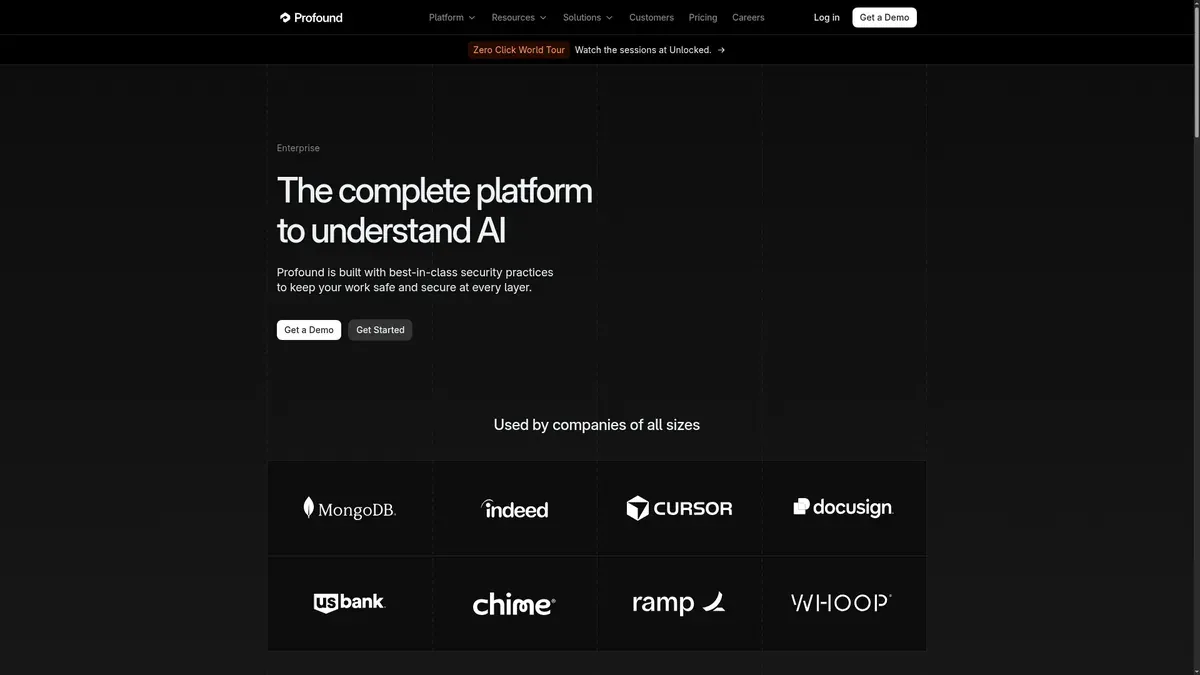
Profound's strongest case is governance. SOC 2 Type II, Enterprise SSO that syncs with your identity provider (Microsoft Entra ID, Okta, and Google Workspace are among those it supports), fine-grained roles, and an activity log that gives admins an audit trail of logins, role changes, API keys, and Agent actions are the sort of things a security review asks for.
The limits are mostly unknowns. The public trial runs 50 prompts daily for seven days, in one language and one region, across ChatGPT, Gemini, and Google AI Overviews, but that describes the trial and not paid limits. The material also does not list supported publishing platforms or say whether a person reviews anything before an Agent publishes. If audit visibility and flexible Agents are your main requirements, Profound suits you, as long as you confirm which data and actions your users would actually get.
DeepSmith's workspaces are isolated per brand with owner and member roles, and the platform is SOC 2, GDPR, and ISO certified. Publishing runs through Content Studio, so a visibility gap and the article that closes it sit in one workflow.
Scrunch vs DeepSmith

Scrunch is the clearest example of a coverage step-up, with the Core and Enterprise numbers above, plus SSO, role-based access, and a dedicated account team. It also goes beyond monitoring with visibility audits, citation discovery and optimization, and what it calls its Agent Experience Platform, which is about how AI agents see and use a site.
That makes Scrunch a good fit for a team that wants broad engine and country coverage with custom capacity, and also has citation and agent-focused work on its plate. The public material does not show an editorial production or publishing workflow, or what its MCP connection exposes, so it is not a substitute for writing and publishing content.
DeepSmith: Monitoring and Production in One Platform
DeepSmith is an AI search analytics and content production platform in one. It tracks how AI engines answer questions about your brand, finds the gaps where you are invisible or losing, and produces the on-brand content to close those gaps from the same data. That is a different category from a monitoring specialist, and it is not a claim that a specialist is worse. If all you need is to observe AI answers, a monitoring-first tool may be all you want.
On the measurement side, AI Visibility reports mention rate, citation rate, and share of voice with trends, a breakdown by platform, a competitor leaderboard, the sources AI cites most, and which of your pages get cited.

The Content Map then lays your pages and your competitors' pages out by topic and funnel stage, shows coverage gaps and untapped topics, and re-checks sitemaps every 24 hours. Opportunity Agents turn that data into content ideas, and each idea carries the data point that justifies it.

Production is the part monitoring-only tools leave out. Content Studio moves ideas from New Ideas to Planned Content to Produced Content. The Writer produces a researched, brand-grounded article with internal and external links, a cover image, and metadata, and Autowrite can do it on a scheduled date without anyone in the app. You can publish to WordPress, Webflow, Strapi, Sanity, or Contentful, or to your own webhooks. The figures above use demo data, so the numbers show the layout and are not a customer result.
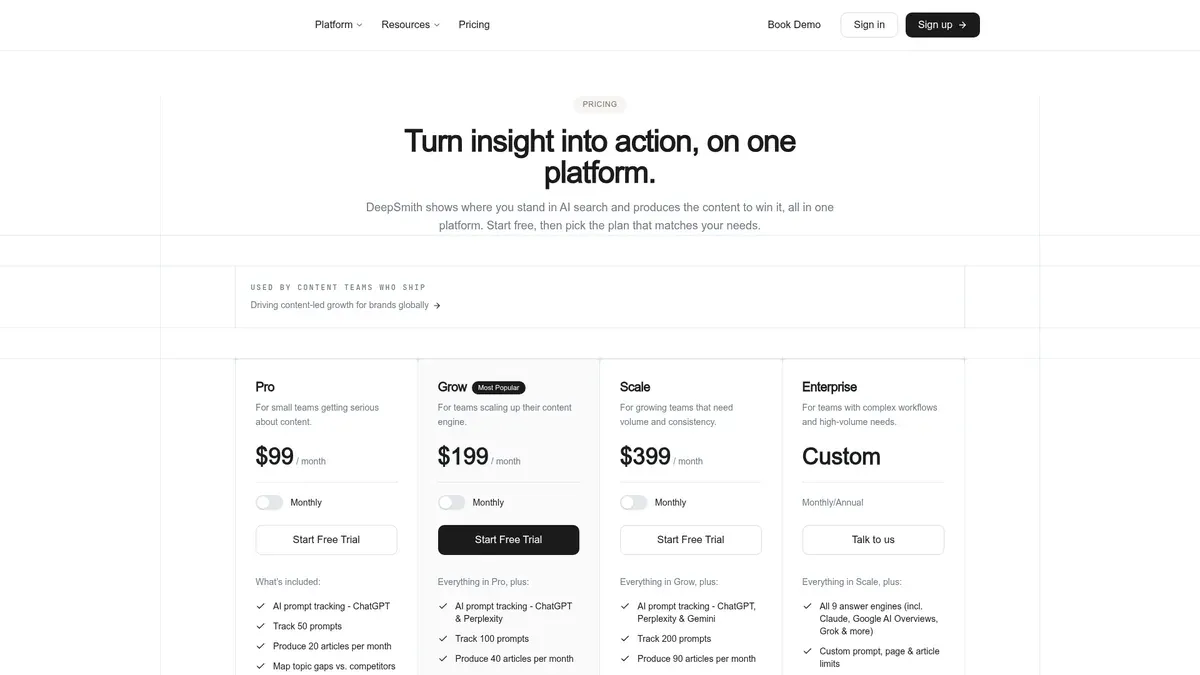
On the plan side, engine coverage grows with each tier: Pro tracks ChatGPT, Grow adds Perplexity, and Scale adds Gemini. Enterprise is custom, with custom limits, multi-region tracking, 1:1 expert onboarding, and a dedicated account manager. The API and MCP server are read-only, and webhooks send signed event notifications with automatic retries, so none of them publish anything, and the public material does not say they are limited to Enterprise. The MCP server guide for content teams explains what connecting an assistant to a workspace looks like.
When Enterprise Monitoring Is Worth It
Seven questions cover most of it:
- Coverage: Which platforms, countries, languages, brands, and buyer prompts do you actually need? Is each tied to a real audience, or would it be an unused "unlimited" feature?
- Sample volume and cadence: How many prompts, how often, and how many repeat runs? Does the vendor explain how it handles model changes and answers that vary?
- Decision stakes: Is monitoring for exploring and watching trends, or for budget and executive decisions? The second needs more disclosure about method and more validation.
- Workflow: Do you need exports, a warehouse, an API, reporting tools, alerts, or automated actions? What can each one do, and what are the request limits?
- Governance: Are SSO, roles, audit logs, data residency, or retention required? Ask to see the exact control and which plan includes it.
- Service: Will you use onboarding, training, prompt research help, a named manager, or priority support? Is it included or only on request?
- Actionability: Is there a process for deciding and making changes once the data is in? Without one, even a great dashboard sits unused.
Enterprise is more likely to be worth the gap when several of these are firm requirements, especially wider coverage together with integrations and formal governance or service. An entry level AI monitoring tool is more likely to be enough when a single small team is working on a narrow set of questions, can act on a dashboard or export, and has no required SSO, audit, or service terms. A middle tier can make sense when you need API access or higher prompt limits but not the governance and service layer.
Nothing here shows that enterprise monitoring raises citations, improves rankings, or pays back by itself, so a return figure has to come from your own numbers. If you are still working out how much capacity you need, the guide on how to estimate prompt and engine needs walks through it, and the best AI visibility tools roundup shows how the wider market compares.
Which Should You Choose
If you are a small team setting a baseline on a manageable set of buyer questions, start with an entry-level plan. The budget-friendly AI visibility trackers for startups are a sensible place to look, and a few weeks of data will show what you need before you pay for more.
If security or procurement requires SSO, audit logs, and documented controls, a governance-focused option such as Profound is worth a close look, along with the best AI visibility tools for enterprise brands list. If your priority is daily checks across several countries with data going into your warehouse or Slack, OtterlyAI is a natural candidate. If you need broad engine and country coverage plus citation and agent-focused work, look at Scrunch.
If you are a marketing lead who wants the visibility data to turn into evidence-backed ideas and published articles, DeepSmith is built for that. Seeing where you are missing in AI answers and producing the content to fix it happens in one place, with a 7-day free trial and no long-term contracts. You can start a free DeepSmith trial and see real data and real drafts before you pay.
Related guides
- Is an AI Citation Tracker Worth Keeping After the Trial? How to Judge the Value: Judge at trial end whether to keep an AI citation tracker by checking data usefulness, actions it triggered, effort to maintain and alternatives, and decide using a simple.
- How to Set an AEO Budget for an Early-Stage Startup: Set an AEO budget for an early-stage startup by splitting spend between tracking, content and technical fixes, deciding what to defer, and tying each line to a milestone.
- Featured Snippets and AI Overviews: How to Analyze Your Performance in Both: Analyze both surfaces in one workflow: list queries where you hold a snippet or overview citation, compare impressions and clicks in Search Console, and note where each wins.
- Buying an AEO Platform: Contract Terms, Onboarding and Multi-Year Commitments: Review the contract terms that matter when buying an AEO platform: renewal and exit clauses, data ownership, onboarding commitments and multi-year pricing, so you can negotiate with a.
- Prompt Volume: Can Anyone Know How Often People Ask AI a Question?: Learn why no one has true prompt volume for AI engines, what estimates exist and how to prioritize without it.