If you are responsible for more than one brand, more than one site, or more than one business unit, you already know the problem this guide solves. One team writes in a voice that sounds nothing like the others. A claim gets repeated on a second site after legal already flagged it on the first. Nobody can say, in under a minute, who owns a given domain or when it was last reviewed. Multi-brand content governance is what fixes this, and it is not the same job as editing one draft or scaling one team's output. It is the set of standards, ownership rules, and audit habits that keep every brand and every site playing by the same core rules while still sounding like themselves. By the end of this guide you will have a working model for multi-site AEO governance you can pilot on a handful of properties before rolling it out across the rest of the portfolio.
Before you build anything, it helps to separate three jobs that get lumped together and shouldn't be. Governance sets the rules, the ownership, and the standards that apply across brands and sites. Quality control checks whether one specific draft is accurate and ready to publish. Production covers calendars, writing tools, and how fast content actually gets made. This guide stays on governance. If you are looking for how to review an individual AI draft, or how to scale your writing output, that is a different guide. This one is about the structure that has to exist before any of that work is trustworthy at scale.
Step 1: Map the portfolio before you write a single rule
What to do: Build a complete inventory of every property that represents your organization publicly: every brand's main site, every regional or language subsite, product sites, documentation sites, campaign microsites, and anything else an AI system or a human reader could land on. For each one, record who owns it, which business unit it belongs to, what domain and subdomain it sits on, what CMS runs it, which markets it serves, what legal or regulatory rules apply, and when it was last reviewed for governance. Do not stop at the corporate blog. AI answers pull from product pages, help centers, comparison pages, and partner content just as often as from a blog post.
How to tell it's done: Pick any domain in the portfolio at random. You should be able to answer, within a couple of minutes, who owns it, which rules apply to it, what system publishes it, and when someone last checked it against your standards. If that takes longer than a couple of minutes, or if nobody can answer at all, the inventory is not finished.
Common mistake: treating the portfolio as a list of URLs. A spreadsheet of domains tells you nothing about who is accountable for each one. Governance breaks down at exactly the property where the owner, the reviewer, or the last check-in date is missing, so capture the people and the process alongside the domain.
Step 2: Separate the rules every brand follows from the rules each brand sets for itself
What to do: Build two layers of standards instead of one long list. The shared layer covers things that should never vary by brand: accessibility requirements, crawlability and indexability, required page metadata, how structured data gets verified against visible content, source and evidence requirements for claims, and how incidents get escalated. The brand layer covers the things that make each brand distinct: approved positioning, tone and voice, preferred terminology, which claims a brand can and cannot make, visual identity, and regional language requirements. Separating the content standards across business units this way is what lets you enforce consistency without forcing every brand into an identical voice.
How to tell it's done: Ask an editor on any brand's team two questions about any page: which rules apply to every site in the company, and which rules apply only to this brand. If they can answer both without guessing, the split is working. If a rule reads like "sound professional" with no further definition, it is not operational yet. Turn it into examples of what passes and what doesn't, plus a named owner who maintains it. This is what multi-brand content governance actually looks like day to day: two clear answers to those questions, not a single style guide everyone is expected to interpret the same way.
Pro tip: do not try to standardize personality. Standardize the system. The enterprise should require accurate claims and consistent technical baselines, but the brand voice itself is allowed, and expected, to sound different from one property to the next.
Step 3: Build one taxonomy that every brand can use the same way
What to do: Define a shared set of fields that every property tags content with: brand, business unit, region, product, buyer stage, topic, content type, page owner, risk tier, review date, and the AI-search prompt group a page is meant to answer. Use controlled values. If one business unit calls a stage "consideration," another calls it "mid-funnel," and a third calls it "evaluation," you cannot compare coverage across the portfolio at all. Allow local extensions for real differences, like a regional regulation or a product line unique to one market, but require every local term to have a definition, an owner, and a link back to the enterprise term it extends.
A tool like DeepSmith's Content Map can support this work by mapping your own pages and your competitors' pages onto one shared topic structure with funnel stages attached, which gives a taxonomy team something concrete to test definitions against. It should not become the enterprise's only taxonomy authority on its own; someone still has to own the definitions and decide what counts as a match.
How to tell it's done: Take a sample of pages from every major brand and have two different teams classify them using your taxonomy. If they land on the same classification most of the time, the definitions are clear enough. If they disagree often, the problem is usually a vague term or overlapping categories, not the people doing the classifying.
Common mistake: building a taxonomy that mirrors your org chart instead of the questions your buyers actually ask. An org-chart taxonomy is useful for internal reporting, but an AEO taxonomy also needs to describe the problem a reader has, the product that solves it, and where they are in deciding to buy.
Step 4: Give each brand a governed context record instead of a shared style guide
What to do: Create one controlled record per brand that holds its positioning, its products, its approved and disallowed terminology, the claims it can make and the evidence behind them, its competitive set, its voice rules, and examples of on-brand and off-brand writing. Treat every claim as data with a status, not as a line in a PDF: approved, conditional on evidence, expired, or prohibited. This is the mechanism that stops one brand's claim from leaking into another brand's content just because a writer worked on both.
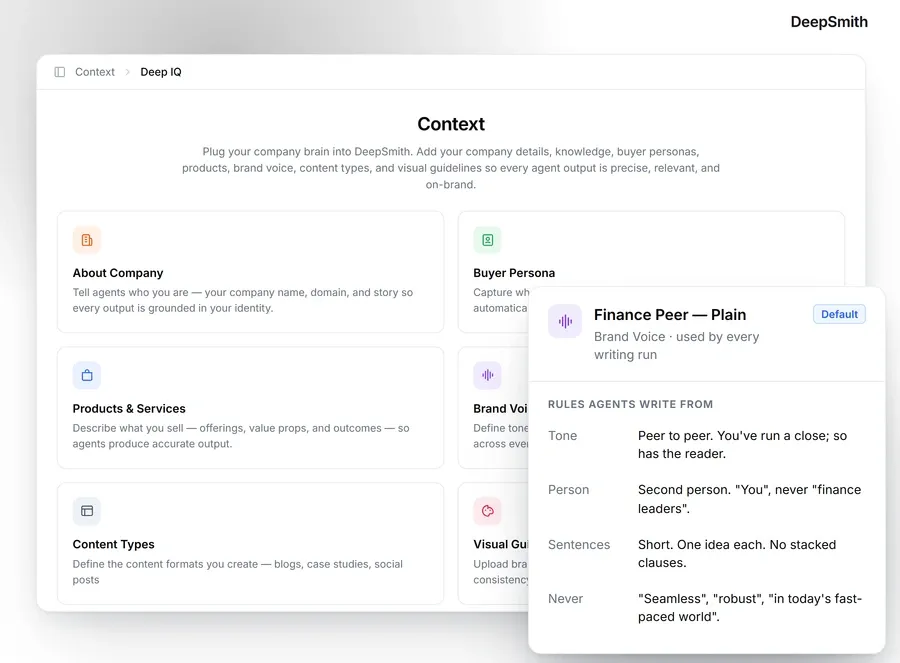
DeepSmith's Deep IQ is built for exactly this kind of stored context: company description, product details, personas, brand voice, and visual guidelines that every draft is grounded in automatically instead of being re-briefed each time. Multi-Workspace keeps that context isolated per brand or client, so one workspace's claims, competitors, and voice never bleed into another's. The image below shows what that stored context looks like in practice.
Neither of these replaces your legal review or your enterprise approval policy. They give each brand a single, versioned place to keep the facts and rules a writer or a reviewer needs, which is the governance principle regardless of which platform holds it.
How to tell it's done: Hand a brand owner a proposed sentence for their brand's content. They should be able to say immediately whether it is factually approved, what evidence backs it, who has to sign off on it, and whether it expires. If a brand's context record only describes tone and adjectives with no product or claims detail, it is incomplete.
Step 5: Assign approval rights by risk, not by seniority
What to do: Build a decision matrix that names roles, not departments: who is responsible for doing the work, who is accountable for the final call, who must be consulted first, and who just needs to be informed. Then sort content into three risk tiers. Routine educational content with no regulated claim and no new product promise is low risk and can move fast under local ownership. Comparisons, pricing pages, and competitive claims are medium risk and need a documented review step. Regulated topics, safety claims, and anything with real legal or reputational exposure are high risk and need explicit accountable sign-off, not a general sense that "someone from legal" will catch it.
How to tell it's done: No approval path in your documentation should contain a phrase like "the right person" or "the business owner" with nothing more specific. Every path should name a role, a backup for that role, and a deadline for the decision.
Common mistake: making the central team accountable for every single publication. That turns governance into a bottleneck and defeats the purpose. Central governance should own the standards and the high-risk decisions. Local owners should be trusted with routine execution inside those boundaries.
Step 6: Set one technical baseline every property has to clear
What to do: Multi-site AEO governance depends less on any AI-specific trick and more on every property clearing the same basic technical floor. Require every site to pass a documented check that crawlers are not blocked, important pages return successfully and are indexable in text form, internal links make key pages findable, structured data matches what is actually on the page, and redirects and canonical tags are intentional rather than accidental. These are the same fundamentals search engines have asked for all along, and they are also what determines whether a page is even eligible to be used as a supporting source in an AI answer.
Do not promise that clearing this baseline guarantees a citation. It does not, and treating it as a guarantee sets the wrong expectation with every brand team that has to do the work. What it does guarantee is that a page is not disqualified by something fixable, like a blocked crawler or missing structured data.
How to tell it's done: Every site has a technical checklist, a named technical owner, a date it was last audited, and a record of any exceptions with a reason attached. A finding is either open, accepted as a known risk, remediated, or verified closed. Nothing sits in an unlabeled state indefinitely.
Step 7: Write down the rules for how AI gets used across every brand
What to do: You cannot govern AI content multiple brands are producing without a written policy that covers approved uses, prohibited uses, who is accountable for a piece after it publishes, what evidence a claim needs before it goes live, and what data can and cannot be entered into an AI tool. Before any business unit uses AI at scale, require them to answer a short set of questions: what need does this content meet, why does it need to exist as its own page, what evidence backs its claims, who owns it after publication, and when will it be reviewed or retired. Search engines already define large volumes of low-value, unoriginal pages as a spam problem regardless of how they were produced, so the policy should focus on purpose and accountability, not simply on whether a human or a model typed the words.
How to tell it's done: Every business unit using AI at scale can point to a written answer for each of those questions for its own workflow, not just a general statement that "we use AI responsibly." That written answer is what lets you govern AI content multiple brands are producing without reviewing every draft by hand.
Pro tip: borrow from established risk-management thinking rather than inventing your own from scratch. Documenting roles, keeping an inventory of the AI tools and use cases in play, and defining risk tolerance up front saves you from discovering gaps only after something goes wrong.
Step 8: Build a portfolio audit that actually gets acted on
What to do: Audit four things on a recurring schedule: whether each property still has a current owner and standards profile, whether pages carry the required governance metadata, whether the technical baseline still holds, and whether your AI-search visibility is moving in the direction you expect. For that last part, track mentions and citations as two separate numbers. A mention is when an AI answer names your brand. A citation is when it links to one of your pages as a source. A brand can be mentioned often and cited rarely, or cited on a page that describes it in a way you would not choose, and combining the two numbers into one hides which problem you actually have.
DeepSmith's AI Visibility tracks a stable set of prompts on a schedule and reports mention rate, citation rate, and share of voice separately, broken down by platform, along with exactly which of your pages are being cited and by which competitors you are losing ground to. That gives an audit something concrete to review instead of a handful of manual searches done once a quarter.
A workable cadence looks like this: continuous or daily monitoring for severe technical failures, a monthly look at prompts and citations, a quarterly review of brand context and high-risk pages, and a full annual review of the whole governance model. Review sooner than that after a rebrand, an acquisition, a CMS migration, or a legal change.
How to tell it's done: Every audit finding has an identifier, a named owner, a severity, a deadline, and evidence that it was actually fixed, not just flagged. An audit report with no owner and no deadline is a document, not governance.
Step 9: Create an exception process before someone needs one
What to do: Write down how a business unit requests an exception to a shared standard: what they're asking for, why, what risk it introduces, what compensating control offsets that risk, who approves it, and when it expires. Do the same for changing a shared standard itself. Record the proposed change, identify which brands and sites it touches, test it on a representative property, get sign-off from the standards owner, publish the new version with examples, and set a migration deadline. Content standards across business units only stay meaningful if exceptions expire instead of quietly becoming a second, unwritten policy that nobody remembers approving.
How to tell it's done: Anyone on a brand team can explain what changed, why, which version currently applies, and by when they need to migrate. If an exception has no review date attached to it, it is not an exception anymore. It is a permanent gap in your standards.
What to do next
Start with one representative group of brands and sites, not the whole portfolio at once. Include a mix of CMSs, markets, and risk levels so your pilot actually stresses the model. Publish the smallest set of mandatory shared standards you can defend, assign ownership and risk tiers, run one audit cycle, and fix what the pilot reveals before you expand. Enterprise content governance AI search programs succeed or fail on this kind of staged rollout far more than on any single tool decision.
If you want a place to hold the pieces of this model, DeepSmith's Deep IQ gives every brand its own governed context, Multi-Workspace keeps that context isolated per brand or client, and AI Visibility gives you the mention, citation, and cited-page data your quarterly audits need. None of that replaces the ownership decisions and the written standards this guide walks through, but it gives you somewhere real to put them once you've made those decisions. You can try it on your own portfolio with a free trial.