If you've ever typed "what is Google BERT" into a search box because someone on your team mentioned it in a meeting, here's the short version. BERT is a language-understanding system Google uses in Search. It helps Google figure out what a sentence actually means, not just which words are in it. And yes, it can affect which pages show up and how they're ranked, because understanding what someone means is part of deciding what's relevant to them. What it isn't is a score on your website that you can raise. There's no BERT dial to turn.
That distinction matters more than it sounds like it should, because a lot of SEO advice over the years has treated BERT like a checklist item. It isn't one. Let's go through what it actually is, how it works, and what it means for the way you write.
What is Google BERT?
BERT stands for Bidirectional Encoder Representations from Transformers. That's a mouthful, so it helps to know where it came from. Google released BERT as an open research approach to natural language processing back in November 2018, written up by two of its research scientists. Natural language processing, or NLP, is just the general term for getting computers to work with human language: understanding questions, sorting text, finding the right answer inside a passage.
Google folded a version of this approach into Search starting in October 2019. That's an important thing to keep straight: the BERT that researchers can download and experiment with isn't the same thing as whatever Google actually runs inside Search today. The public research model tells you about the method. It doesn't tell you the size, training data, or exact setup of the system Google uses in production, and you shouldn't assume it does.
Google's own search ranking systems guide describes BERT as an AI system that helps it understand how combinations of words express different meanings and intent. That's the version worth remembering. It's a system for understanding language, not a new rule for website owners to follow.
It's also not new in the sense of "recently added." Google's ranking systems guide, last updated in December 2025, still lists BERT as one of the systems it uses. This isn't a 2019 update that came and went. It's a part of how Search works now.
The rollout happened in stages, and the numbers from each stage tell you something different, so it helps to keep them separate. At launch in October 2019, Google said the change would help it better understand around one in 10 searches in the United States, in English, specifically ones where the relationship between words mattered. Within weeks, Google reported it was rolling BERT out to more than 70 languages. By October 2020, Google said BERT was being used in almost every query in English, and its February 2022 explanation of its ranking systems described that same broad role continuing. The one-in-10 figure describes the early launch. The almost-every-query figure describes where things stood a year later. They're not two measurements of the same thing, and neither one tells you anything about how much traffic a particular website gained or lost.
How does BERT understand a search?
The core idea is that a word's meaning depends on the words around it. Google uses the example of "bank account" versus "bank of the river." Say the word "bank" by itself and you don't know which one is meant. Add the rest of the sentence and suddenly it's obvious.
Older systems could use the words that came before a word to help interpret it. BERT's real advance was being bidirectional, meaning it can use words from both before and after a given word when it builds up what that word means in context. Google's example is "I accessed the bank account." The word that comes after "bank" (account) is exactly what tells you which "bank" is meant. A system that only looked backward from "bank" would miss that.
This isn't just a theoretical nicety. Small, easy-to-skip words can flip the meaning of a whole search. Google's own documented examples make this concrete:
- A search for "2019 brazil traveler to usa need a visa" is about someone from Brazil traveling to the US. Before BERT, Google's results sometimes focused on US citizens traveling to Brazil instead, because the word "to" and the relationship it sets up weren't being weighted correctly. After BERT, that direction gets read correctly.
- A search for "can you get medicine for someone pharmacy" is asking whether you can pick up a prescription on someone else's behalf. Without picking up on "for someone," earlier results leaned toward general information about filling your own prescription. The phrase "for someone" changes the actual question being asked, and catching that mattered.
These aren't abstract test cases. They're the kind of small-word, plain-language confusion that happens in real searches all the time, and they're why Google built this in the first place.
Two more of Google's examples are worth knowing, because they show the same idea from different angles. A search for "do estheticians stand a lot at work" is asking about the physical demands of a job. Before BERT, Google's systems sometimes matched "stand" with "stand-alone" instead of recognizing the question was about standing on your feet. And a search for "parking on a hill with no curb" depends entirely on the word "no." Earlier systems put too much weight on "curb" and not enough on the fact that there wasn't one, which is the opposite of what the searcher was describing. Drop the word "no" and you get a completely different, and wrong, answer.
None of this means BERT gets everything right. Google's own 2019 announcement included an example where it still got a search wrong: asked what state is south of Nebraska, the system's best guess was a place called "South Nebraska," which isn't an answer to the question at all. Better language understanding narrows the gap between what someone means and what a system reads. It doesn't close it completely, and Google never claimed it would.
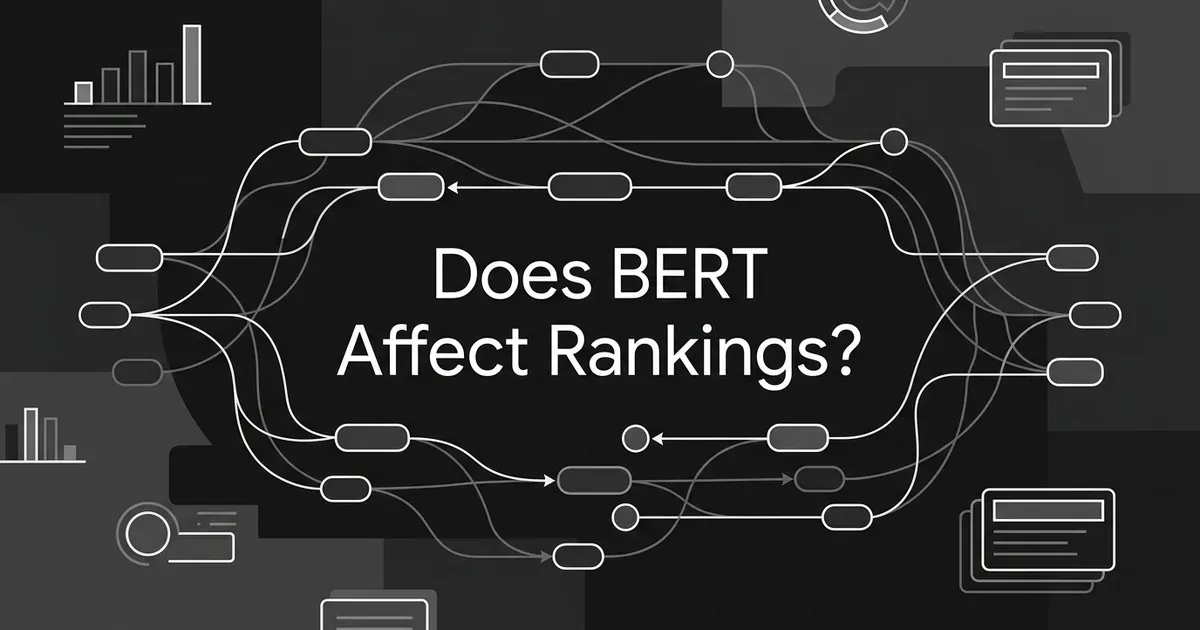
Does BERT affect rankings?
Yes, it does, and it's worth being precise about how. Google has said, in its own public explanations, that BERT contributes to both ranking and retrieval. Retrieval is finding the documents that could be relevant to a search in the first place. Ranking is putting them in order once you've got that set. BERT's language understanding feeds into both, as part of a larger group of systems Google uses together, not as a lone switch that decides everything.
So when you hear someone say "BERT only affects how Google reads the query, not how it ranks pages," that's not quite right. Understanding the query is part of figuring out relevance, and better relevance assessment changes what gets ranked where. Here's a simple way to picture it: imagine two pages, one explaining how to travel from Brazil to the US and the other explaining the reverse route. Both pages use the same countries and the word "visa." Neither page did anything wrong. But a better read of which direction the traveler is going can change which page looks like the better match for a given search, without either site touching its content.
This is exactly why the phrase "BERT ranking factor" causes confusion. It sounds like a property of your page with a number attached, something you could nudge up with the right edits. Google doesn't describe it that way anywhere in its own documentation. There's no published BERT score for a page, no target value, and no formula that converts changes you make into a BERT improvement. BERT is a system that helps Google understand language. It isn't a lever sitting on your site waiting to be pulled.
It's also worth saying plainly: if a page ranks lower after some update somewhere, that alone doesn't tell you BERT is the reason, and it definitely doesn't mean the page did something wrong. A page can simply be a weaker match for what a search actually means. That's a mismatch, not a penalty, and timing by itself can't prove which system caused it.
So when someone asks does BERT affect SEO in the sense of "will it change my traffic," the honest answer is that it can, indirectly, by changing how well a page's language matches what a searcher is actually asking for. That's different from asking whether BERT is a setting you can adjust on your own site, which it isn't.
What does BERT mean for SEO?
The clearest advice on this came directly from Google. Danny Sullivan, who handled public search communications for Google at the time, said there was nothing specific to optimize for with BERT, and nothing anyone needed to rethink about their approach. John Mueller, in guidance reported shortly after, said the changes were about understanding both the questions people ask and the text already on the page, and that the practical response was to write naturally instead of stuffing in keyword variations.
That's really the whole playbook, but it's worth unpacking into things you can actually act on:
Answer the actual question being asked, including who's doing what, for whom, and under what conditions. A page about prescriptions in general isn't the same as a page about picking up someone else's prescription, even if it uses the same words.
Keep the small words that carry the relationship. Direction, exceptions, and negatives like "no" or "not" can completely change what a sentence means. Don't trim them out in the name of cleaner copy if they're carrying real meaning.
Use the terms your reader actually needs, and don't feel like you have to hide technical vocabulary to sound "natural." Natural writing means clear writing, not simplified writing.
Skip the keyword stuffing. Repeating variations of a phrase doesn't make your answer clearer, and it doesn't do anything for how BERT or any other part of Google's systems reads your page.
Make ambiguous sentences more explicit where it genuinely helps a reader. If a sentence could be read two ways, don't assume a system (or a person, for that matter) will pick the right one.
None of this is a BERT-specific checklist. It's the same advice good editors have always given: write clearly, answer the real question, don't pad it out. BERT is the reason that advice holds up technically, not a reason to invent a new set of rules on top of it.
What BERT can't tell you about search performance
There's a real limit to what BERT explains, and it's worth being honest about it. Google hasn't published the exact architecture, size, or training setup of the BERT systems running inside Search today. There's no public weight you can point to and say "this is how much BERT matters in the total ranking calculation." There's no way, using the information Google has made public, to isolate how much of a traffic change on a given page came from BERT specifically versus something else moving at the same time.
If someone offers you a tool that produces a "BERT score" for your page, treat that skeptically. Google hasn't issued a page-level BERT score, so a third-party number using that name is that tool's own interpretation, not a Google metric. The same goes for anyone pitching a "BERT ranking factor" audit or a checklist that promises to raise one: there's no such audit Google publishes a method for, because there's no such factor to measure in the first place. Google Search Console can show you which queries bring people to a page, along with impressions, clicks, and position, and that's genuinely useful for checking whether a page is reaching the searches it's meant to serve. It just isn't a way to measure BERT's effect specifically.
It's also worth separating this from a different, more recent question: whether a page is likely to get cited by AI answer engines like ChatGPT, Perplexity, or Google's AI Overviews. BERT is part of the history of how Google's Search understands language, but it doesn't explain how those separate systems choose what to cite. A page being well matched to a search under BERT's language understanding doesn't guarantee anything about whether it gets quoted in an AI-generated answer. Those are related questions about machines reading language, but they're not the same question, and treating a "BERT-optimized" page as automatically ready for AI citation is a leap the evidence doesn't support.
The honest version of the takeaway is this: review whether a page clearly answers the question it's meant to answer. That's a useful exercise with or without BERT in the picture. Chasing an invented BERT test is not.