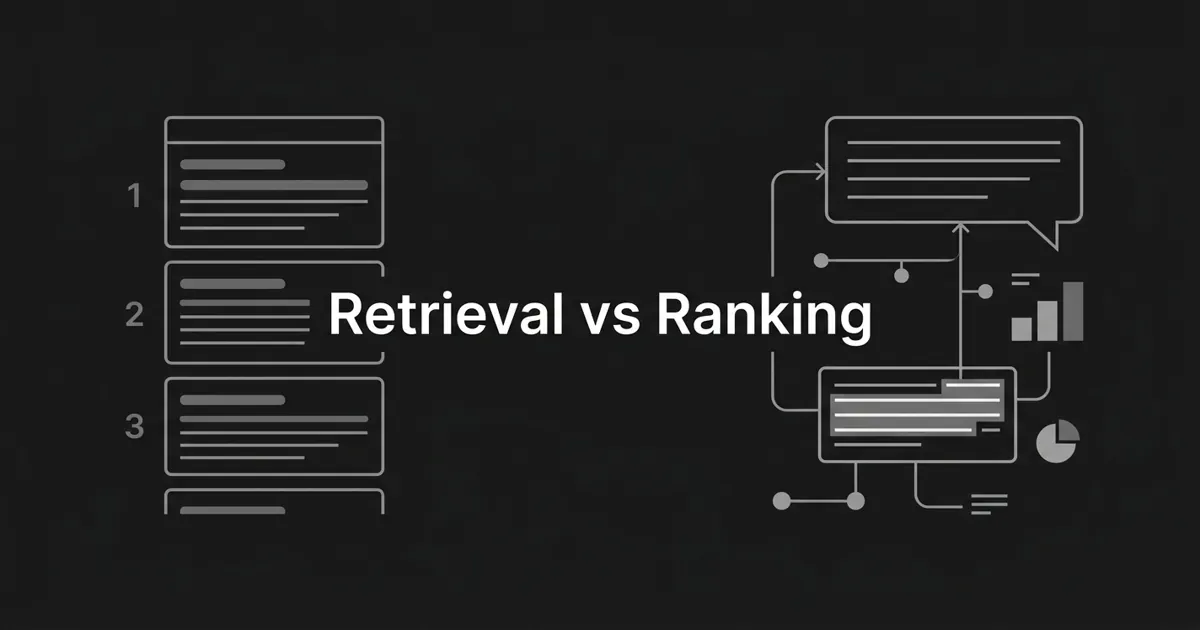
Most content teams inherited a single mental model of winning: reach the top of the results page and the traffic follows. That model still governs classic search, but it does not govern which source an AI engine quotes. The distinction at the center of this shift is retrieval vs ranking, and the two describe different jobs. Ranking orders a set of pages so a human can choose among them. Retrieval assembles the candidate set an answer engine then reads, quotes, and attributes. A page can sit in Google's top three and never be cited, while a page ranked seventh, or ranked nowhere at all, becomes the passage the model lifts into its answer. Understanding retrieval vs ranking is the difference between optimizing for a position and optimizing for inclusion in a generated answer.
This piece compares the two selection models at the mechanics level. It does not attempt the full inventory of what makes a page citable, and it does not break down how each engine differs from the next; those are separate questions. The goal here is narrower and more foundational: to explain why the page that ranks and the page that gets cited are decided by two different systems, and why the AI citation vs SEO ranking gap is now wide enough that teams optimizing for one can miss the other entirely.
Ranking and retrieval do two different jobs
In information retrieval, the two words name adjacent but distinct stages. Retrieval is the process of casting a wide net: selecting, from an index of millions, the subset of documents that are plausibly relevant to a query. It is judged on recall, on whether the right documents made it into the candidate pool at all. Ranking is the process of ordering that pool by relevance or importance so the strongest results appear first. It is judged on precision. A textbook illustration, drawn from vector-database documentation, describes retrieval fetching roughly a thousand documents that match a query, then ranking sorting the top ten by intent.
Classic Google search runs both stages and shows the user the ranked output: ten ordered links. An AI answer engine runs both stages as well, but the ordered list is not the product. After retrieval and ranking, the model performs a third act that has no equivalent on a traditional results page. It selects specific passages from the retrieved set, grounds its generated sentences in them, and attaches those passages as inline citations. The consequence is worth stating plainly. Ranking decides who is shown. Retrieval decides who is available to be quoted. The citation step decides who is actually quoted, and that final decision is made against the retrieved set, not against the ranked list a searcher would see.
The two models side by side
The following comparison isolates where the ranking model and the retrieval and citation model diverge. Reading it top to bottom explains most of why a lower-ranked page can win the citation.
| Criterion | Ranking model (classic Google results) | Retrieval and citation model (AI answers) |
|---|---|---|
| Primary unit of selection | The whole webpage or URL | A passage, a self-contained chunk of text |
| Who selects | A ranking algorithm scoring whole pages | A language model choosing passages to ground its answer |
| Optimization target | Position in the top ten organic results | Inclusion in the retrieved set and extractability of the passage |
| What the user sees | An ordered list of ten links | A generated answer with a handful of inline citations |
| Core signals | Backlinks, on-page relevance, technical health, authority | Semantic fit to the exact prompt, passage extractability, entity clarity, trust, freshness in context |
| What winning means | A numeric position, first, second, third | Being the passage the model chooses to cite |
| Granularity of change | Page-level, edits propagate through re-crawl and re-rank | Passage-level, a single paragraph can win or lose a citation on its own |
| Update cadence | Slow, gated by crawl and re-rank cycles | Fast, the model re-retrieves per query and can re-cite within hours |
| Personalization | Light, mostly location and history | Heavy, full conversation context and rewritten sub-queries |
The row that carries the most weight is the last conceptual one. Domain authority, historically a strong correlate of ranking position, appears to be a far weaker predictor of AI citations. One analysis covered by Digital Applied reported that the correlation between domain authority and AI citation likelihood has fallen from roughly r=0.43 to about r=0.18. Authority still helps, but it no longer dominates the outcome the way it dominates a ranked list. A high-authority page can hold the ranked top ten and still be skipped, because the engine needed a passage it did not lead with.
What is being selected: the whole page against the passage
The clearest structural difference is the unit of selection. A ranking algorithm evaluates and orders whole pages, and a searcher clicks through to read them. An answer engine narrows a much larger field down to a few passages. Reverse-engineering of Google's AI Overviews describes a multi-stage funnel: several hundred candidate documents are retrieved, narrowed by semantic similarity to a smaller pool, filtered by a quality and experience gate, re-ranked on how extractable each passage is, and finally fused into a set of roughly five to fifteen cited sources. ChatGPT Search, which draws on Bing's index behind a fine-tuned model, most often attaches one to three sources per answer. Perplexity typically pulls several pages per query and cites three or four of them.
The visible winners, in other words, are only the last few survivors of a long funnel. A page can clear retrieval and even rank well, then fail at the extraction stage because its key claim is buried beneath an introduction. This is the specific reason why AI cites lower-ranked page content that opens with a clean, self-contained answer over a higher-ranked page that makes the reader work for it. The selection is happening at the paragraph, not the URL.
Who decides: an algorithm against a language model
The second difference is the nature of the selector. Google's ranking is the output of relevance and authority algorithms applied to pages at scale. An AI citation, by contrast, is a generation decision. The model is writing an answer and reaches for passages that let it ground a claim, and the act of citing is a byproduct of composing text, not a ranked position published for comparison. That difference explains why citation behavior feels less stable than ranking. A ranked position is a relatively durable, public, ordinal fact. A citation is a presence-or-absence event on one generated answer, and the same page can be cited on one prompt and absent on a closely related one.
What signals carry weight: links against passages
The ranking model's strongest historical signals are link-driven: domain rating, anchor text, internal links, and brand mentions accumulated over time. The citation model weights a different bundle. It rewards semantic relevance to the specific prompt, passage-level extractability, entity clarity, the trustworthiness of the source in context, and freshness where the query implies it. The shift in the domain-authority correlation noted earlier is the quantified version of this change. The signals that earned a ranking and the signals that earn a citation overlap, but they are not the same set, which is the core of the AI citation vs SEO ranking divergence. This is also where the durable, off-page vote of a backlink and the per-answer selection of a citation part ways, because one compounds over months while the other is recomputed on every query.
Where the win is captured: a position against a citation slot
A SERP position is a public and comparable metric; two pages can be ranked against each other and the ordering is stable enough to report. An AI citation is neither ordinal nor stable in the same way. It is binary per answer, and its distribution across ranked positions is flatter than click behavior. Analysis from Profound found that position one receives around 27.5 percent of human clicks but only about 10 percent of ChatGPT citations, while position ten receives roughly 2.5 percent of clicks and about 4 percent of citations. Practitioners call this citation flattening: once a page is inside the candidate set, an engine distributes citations far more evenly across positions than a human distributes clicks. Being ranked first buys much less citation advantage than it buys click advantage.
Update speed: re-crawl against re-retrieve
The two models also move at different speeds. A new or substantially revised page can take days to weeks to re-rank, because ranking is gated by crawl, index, and re-rank cycles. Retrieval runs per query. The same page can be picked up, re-retrieved, and re-cited within hours if a passage matches a tracked prompt well. For a team publishing answer-first content against known buyer questions, the feedback loop on citation is far shorter than the loop on ranking, which changes how quickly a content investment can show up in AI answers.
Why AI cites a lower-ranked page
The mechanics above combine into four components that together explain why a page ranked seventh can be cited while the page ranked second is not. Each has an established name.
The first is query fan-out. An answer engine rarely retrieves against the literal prompt alone. It rewrites a single question into multiple sub-queries, through decomposition, reasoning, and generated hypothetical documents, then retrieves against all of them. The pages that survive are the ones that match across several phrasings, not only the exact keyword a ranking was earned on. Query fan-out is one reason the overlap with the literal ranked top ten is so low.
The second is reciprocal rank fusion. Results from the fanned-out sub-queries are merged using a fusion method that rewards pages appearing consistently across many variants, regardless of their position on the original query. A page that ranks moderately on the literal term but strongly across the reformulations can outrank, inside the fused set, a page that ranks first on the literal term alone.
The third is passage-level re-ranking. The model evaluates retrieved documents at the passage level, scoring how well a specific chunk answers the sub-query, and applies a confidence threshold before a passage qualifies. A page that ranks well but buries its answer fails this stage; a page that ranks lower but leads with a clean, self-contained claim passes it.
The fourth is the extraction window. When the model scans for an answer unit, it reads the first sentences under a heading. If a section opens with a long anecdote or a generic preamble, the window closes before the answer appears, and the passage is skipped even though the page ranks. The practical lesson is that retrieval and ranking get a page into contention, while extraction decides the citation, and extraction rewards structure over position.
What the data says about the ranking-to-citation gap
The measured overlap between ranking and citation is low, and it points the same direction across studies even where the exact figures differ. An Ahrefs analysis of 15,000 long-tail prompts, published in August 2025, found that only about 12 percent of AI-cited URLs ranked in Google's top ten for the originating prompt, and that roughly 80 percent of AI citations did not rank anywhere in Google for the original query. On the ChatGPT side, AuthorityTech reported that a large majority of ChatGPT's most-cited pages do not rank in Google's top hundred, and that 28.3 percent of them have zero organic Google visibility, pages Google effectively cannot find that ChatGPT cites regardless.
The numbers vary by sample, cut-off, and date, and they should be read as a range rather than a single constant. Different studies use a top-ten cut-off, a top-hundred cut-off, or a different prompt set, and the underlying behavior is shifting month to month. Ranking has not become irrelevant. It still functions as a gate into the retrieved set, and engines whose index tracks a search backend inherit some of its ordering; a Semrush analysis of a large ChatGPT query sample found that most cited pages also ranked well in Bing's results. The defensible reading is that ranking helps a page qualify for retrieval, and structure decides the citation from there.
That same body of work describes what cited pages tend to have in common. In the Semrush sample, a clear majority of cited pages contained structured answer capsules such as definitions, lists, or FAQ blocks; a smaller but substantial share contained original data or proprietary research; and a meaningful fraction placed the key answer within the first third of the page. None of those characteristics is a ranking signal in the classic sense. They are extractability signals, and they line up with the passage-level mechanics rather than with position.
A page that ranked lower and got cited anyway
A published example makes the abstraction concrete. A B2B industrial manufacturer, documented in a case surfaced through reverse-engineering of Google's AI Overview sourcing, moved from zero AI Overview citations to roughly ninety over the measured period, with AI-driven traffic rising sharply. The lever was not a climb up the rankings. The team invested in passage-level extractability, structured schema, named entities, and original data, optimizing for the late stages of the citation funnel, the re-rank on answer units and the fusion into the cited set, rather than for organic position. In funnel terms, they won the stages that decide the citation, not the stage that decides the ranked list.
Consider a smaller, generic version of the same pattern. A competitor's explainer ranks second for "what is content scoring," and a comparable page ranks seventh. The seventh-ranked page can still be the cited source if its definition sits at the top of the page, uses the exact entity phrasing rather than a near-synonym, and contains a short excerpt the model can lift without surrounding context. The higher-ranked page reads well for a human scrolling a results page; the lower-ranked page is built to be quoted. This is the everyday shape of why AI cites lower-ranked page content, and it is a matter of construction, not authority.
Which should you optimize: ranking or retrieval and citation?
The honest answer is both, treated as two stages of one funnel rather than as competing bets. Ranking still gets a page into the candidate set, and answer-engine structure decides whether a passage is cited from there. The right emphasis depends on the situation, and the framing below maps circumstances to actions, not to a single tool.
If a sales team is hearing prospects quote a competitor's name from ChatGPT or Perplexity, the priority is to stop optimizing for the top ten in isolation and start tracking the prompts buyers actually ask, then observe which exact pages the engines cite and produce answer-first content for those prompts. If a site ranks well but organic traffic has declined since AI answers began appearing, the likely cause is that ranked pages are being paraphrased into answers with no click, and the remedy is to audit cited-page characteristics, structured answer blocks, original data, and an answer placed early, then rewrite the pages that fail them. If a team is launching a new category with no citations yet, ranking alone is an unreliable lever, because engines will retrieve through fanned-out sub-queries no one can fully anticipate, so tightly extractable answer units per buyer question matter more than position. If leadership is asking what the AI search strategy is, the useful answer ties the strategy to prompt-level citation coverage across platforms rather than to a rank report.
This is the operational gap DeepSmith is built to close. As one platform for AI search analytics and content production, it tracks how AI engines answer the questions that matter in a category, reporting mention rate, citation rate, and share of voice across the covered engines, and showing which of a site's pages are actually cited and which competitor pages win the prompts. That measurement feeds a production engine that turns a planned question into a publish-ready article, researched, internally linked, and formatted for extraction, rather than a first draft to rescue. The point is not to abandon ranking. It is to stop treating position as a proxy for citation, and to produce for the mechanics that decide citation directly. DeepSmith reports where a brand appears and does not appear in AI answers, and it does not control or guarantee rankings, citations, or traffic; what it changes is how systematically a team can act on the retrieval vs ranking distinction instead of guessing at it.
A team that wants to see its own citation and ranking picture side by side can start on a 7-day free trial with real data and real drafts before paying. The compounding logic is straightforward: ranking builds familiarity, retrieval and citation build inclusion in the answer, and inclusion is now the load-bearing half.