You published something good on a topic you know cold. Then you asked ChatGPT the exact question that page answers, and a competitor got cited instead.
That stings. It is also not a writing problem, so please do not go rewrite that page again.
Answer engines do not pick the best page on a topic. They pick the source that looks most complete on it. One strong page is a coin flip. A site that has covered the whole subject, and linked it together so the coverage is visible, is the safe bet. That is the topical authority AI search quietly runs on.
This guide is how to build topical authority an engine can actually recognize: one topic, one pillar, a set of spokes, links that hold them together, and consistent entity signals underneath. Nine steps, in the order you would really do them.
You are probably closer than you think. Most teams already have half the pages. They just have not connected them.
What topical authority means to an answer engine
Topical authority is a system's perception that your site is the comprehensive expert source on a defined subject area. You earn it by covering that subject in depth and breadth, not by winning one keyword.
It is authority scoped to a topic, which is why it behaves so differently from the domain-level number you might be used to. A site can have high domain authority overall and zero topical authority in a niche it never covered. A small site can own a niche completely.
Here is the shift that matters. Classic Google ranked pages: one query, ten blue links, best single page wins. Answer engines synthesize an answer across many pages at once, so they reach for the source that is most complete on the subject being asked about. The unit of competition moved from the page to the topic.
Five signals compose it:
- Depth: how many angles of the topic you have covered.
- Breadth: how many distinct subtopics sit under the umbrella.
- Internal cohesion: how tightly those pages link to each other with descriptive anchors.
- Entity consistency: whether your brand, products, authors, and core concepts are named identically everywhere.
- External validation: mentions and links from sources the engines already trust on that topic.
Want a number to steer by? Koray Tuğberk GUBUR's topical authority ratio is the cleanest one: the keywords where you rank in the top 10 inside a topic universe, divided by the total keywords in that universe. Rank for 250 of a 5,000-keyword universe and you are at 5%. Higher ratios track with higher visibility on the topic, and with higher citation rates in AI answers.
You do not need a perfect number. You need it moving up on one topic.
Step 1: Pick the one topic you will own
Pick a topic where you already rank for some queries but do not dominate. That is the sweet spot. You have proof of relevance and room to grow.
Then write one sentence: "We will own [topic] for [audience] making [decision]." If it does not fit in one sentence, it is too big.
List the five questions the topic must answer for a buyer. Pull them from sales calls, support tickets, and enablement docs, not from your imagination.
Done when the scope statement fits on one line, the five questions are specific, and you can defend why this topic and not its sibling.
Where people go wrong: picking "marketing" instead of "B2B SaaS pricing page conversion." Too broad and you never finish. Too narrow and there is no cluster to build. And if a giant incumbent owns every page-one result, pick a different hill.
Common mistake: the content buffet. Covering 30 topics shallowly instead of 5 deeply. Engines reward comprehensive coverage of a topic, not thin coverage of many. Pick one, dominate it, then expand.
Step 2: Build your buyer prompt list
Now collect every real question buyers ask about that topic. This is the raw material for everything downstream, so do not rush it.
Mine these, in this order:
- People Also Ask boxes for your seed keywords.
- Reddit, Quora, and niche forums where buyers actually complain.
- Sales call transcripts and customer interview notes.
- Support tickets and enablement docs.
- Autocomplete on Google and YouTube.
Aim for 30 to 80 distinct prompts, grouped by buyer stage: awareness, consideration, decision.
Done when the list covers the full journey with no obvious holes, and every prompt is one a real person would type.
Where people go wrong: writing prompts from the brand's point of view. "What is our product" is not a buyer question. "How do I pick the right one" is.
If assembling that list from scratch sounds like a week you do not have, this is one place tooling genuinely helps. DeepSmith's topic tracking surfaces keyword clusters with volume, difficulty, and how much of each you already cover, so the list starts from real demand instead of a blank doc.
Step 3: Cluster the prompts into a topical map
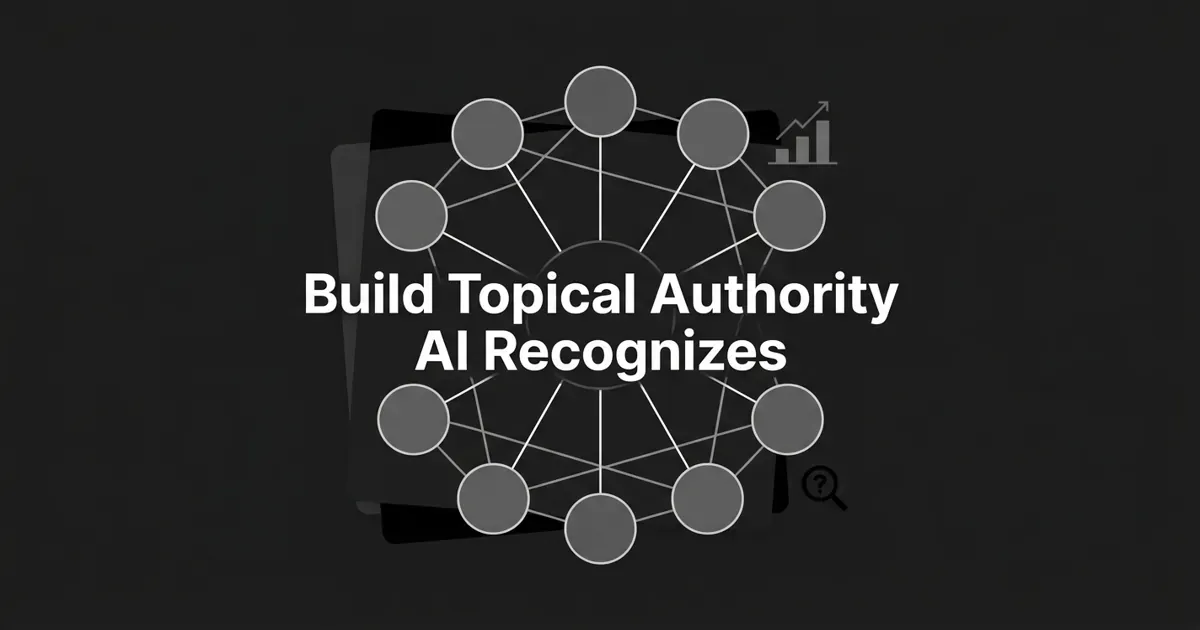
Group prompts that share a subtopic. Each group becomes one spoke. The pillar sits at the center.
Aim for 8 to 12 spokes per pillar as a working default. A small niche site can win with 5 to 7 tightly scoped ones. Genuinely competitive niches push past 20.
Merge any cluster too thin to carry an article. Split any cluster that would produce a 3,000-word grab bag.
Done when every cluster holds at least three prompts, no prompt fits two clusters equally well, and the map reads like a coherent explanation of the subject.
Where people go wrong: skipping the map and writing prompts straight into articles. The clusters go fuzzy, the spokes overlap, and you end up with eight pages competing with each other instead of one topic coverage AEO can read.
Take a breath here. This step is a whiteboard afternoon, not a quarter.
Step 4: Audit what you already have
Before you write anything new, mark each planned spoke with one of three statuses:
- Covered: an existing page substantially answers that cluster's prompts.
- Covered-weak: a page exists but is shallow, stale, or off-angle.
- Missing: nothing exists.
Then sequence the work: Missing first, Covered-weak second (a refresh is faster than net-new), Covered last, where the job is adding internal links and reinforcing entities.
This audit is the honest picture of your topic coverage AEO rewards, and it is usually kinder than you feared.
Done when every cluster has at least one page assigned and every page has one clear next action: write, refresh, or link-boost.
Where people go wrong: marking a spoke "covered" because a page exists on roughly that subject. Open it. If it does not answer the cluster's actual prompts, it is Covered-weak, and calling it done is how clusters stay full of holes.
Step 5: Build the pillar page
The pillar covers the whole topic at survey depth. Not listicle depth. Think 2,500 to 5,000 words that genuinely orient someone.
Build it like this:
- Lead with a one-sentence definition inside the first 100 to 200 words.
- Make your H2s mirror the spoke clusters, so each section has somewhere to link down to.
- Give every H2 a short extractable summary before the deep dive.
- Include a glossary, a comparison table, and a step block where the topic supports them.
- Show a visible "Last updated" date, and set dateModified in schema.
Done when the pillar is useful on its own, every spoke has a contextual link from it, and the pillar itself has at least one inbound link from navigation or the footer.
Where people go wrong: shipping 50 tips and calling it a pillar. A pillar organizes a subject into named subtopics and points to depth. A tip list points nowhere.
Pro tip: own one entity per cluster. Pick the pillar's main noun phrase and repeat it consistently across the cluster's titles, H1s, H2s, URLs, and meta descriptions. Consistency is what lets an engine lock the association.
Step 6: Produce the spokes and link the cluster both ways
One spoke per cluster, 800 to 2,000 words, each answering its primary prompt in the first 100 to 200 words.
Every spoke needs four things:
- H2s and H3s phrased as the questions buyers actually ask.
- At least one extractable element: a definition, list, table, step block, or FAQ.
- A link up to the pillar, with a descriptive anchor, in the introduction.
- Links sideways to one to three related spokes where the topics genuinely overlap.
That last pair is the whole game. Links are what turn a folder of articles into a content cluster authority AI engines can see as one subject. Hub-and-spoke is not decoration. It is the signal.
Direction matters too. Spokes linking up while the pillar never links down is a half-built graph. Go bidirectional.
How many links is enough? A study of 23 million internal links found the correlation with rankings improves up to roughly 45 to 50 inbound internal links per URL, then flattens. So there is a real ceiling, and you are almost certainly under it, not over it.
Done when every spoke links up to the pillar, every spoke has at least one contextual inbound link from a sibling, and each spoke yields a clean 40 to 80 word answer without rewriting.
Where people go wrong: cross-linking every spoke to every other spoke. That is noise, not cohesion. Link where the overlap is real.
This is also the step that eats teams alive. Nine articles plus the linking is a quarter of manual work for most lean teams. DeepSmith's writer turns one planned idea into a finished, on-brand article with internal links, metadata, and a cover image already in place, and Autowrite produces planned pieces on their scheduled dates without anyone in the app. The strategy above is still yours. The production grind does not have to be.
Step 7: Make every page extractable
Getting retrieved and getting cited are two different jobs. Retrieval puts you in the candidate set. Extraction is what gets you quoted.
Perplexity pulls roughly 5 to 10 pages per query and cites 3 to 4 of them. Being in the retrieved set is not the finish line.
Run this checklist on every page in the cluster:
- A direct, factual answer in the first 100 to 200 words.
- At least one H2 phrased as a question.
- At least one bulleted or numbered list.
- A table or definition block where the topic supports it.
- An author byline with credentials.
- Visible datePublished and dateModified.
- Citations to primary sources for factual claims.
Done when you can copy a clean 40 to 80 word answer off the top of any page in the cluster without touching a word.
Where people go wrong: opening with an anecdote that buries the answer past the extractable zone. Your favorite intro may be the reason nobody quotes you.
Step 8: Lock your entity signals across the cluster
This is the layer most teams skip, and it is the one that makes a cluster legible as a single subject instead of a pile of URLs. Entity signals are what give a content cluster authority AI engines can trust, not just parse.
Three rules:
- Name consistency. Use exactly the same brand, product, author, and concept names on every page, and on your About page, LinkedIn, Crunchbase, and Wikidata.
- Definition consistency. Define the core concept the same way on the pillar and every spoke. Define it two ways and the engine cannot lock the association.
- Relationship consistency. Describe how the concepts relate the same way everywhere, and reinforce it in schema.
The schema worth deploying across a cluster: Organization on your homepage and About page with sameAs links to your authoritative profiles, Person on every author bio, Article or BlogPosting on every page with author, publisher, datePublished, and dateModified, FAQPage on Q&A pages, BreadcrumbList site-wide, and DefinedTerm on glossary entries.
Worth calibrating your expectations here. One observational study found pages with schema cited about 2.4 times more often, while a separate tracking study of 1,885 pages adding schema found AI citations barely moved. Schema is table stakes for machine readability, not a growth lever on its own. Do it, then move on.
Wikipedia and Wikidata are the highest-leverage anchors, because Wikipedia is the single most cited domain in AI answers at roughly 16% of AI Overview citations. Claiming a Wikidata item for your brand and authors is a real afternoon well spent.
Done when searching your brand or author name returns one consistent identity, and every page in the cluster uses identical names and definitions.
Where people go wrong: name drift. "Acme," "Acme Inc.," and "ACME Software" across three pages breaks the signal you spent a quarter building. And author bios that say "Admin" are a wasted slot.
Step 9: Measure citations per topic, not rankings
Rank tracking alone will lie to you now. A page can sit at position one and never get cited. Another can sit at position eight and be the source in half the answers on its topic.
Track these per cluster, not site-wide:
- Mention rate: how often you are named in answers to the cluster's prompts.
- Citation rate: how often the cluster's pages are linked as sources, per engine.
- Share of voice: your share of total citations on those prompts, against competitors.
- Prompt coverage: which prompts produce a citation, and which produce nothing.
- Page attribution: which exact URLs are earning it.
Expect the engines to disagree wildly, and do not panic when they do. Across 17.2 million citations, citation rates ran 94% for Perplexity, 88% for Google AI Overviews, 61% for Gemini, 48% for ChatGPT, and 13% for Claude. Claude is stingy by nature. That is the engine, not your content.
Ranking still matters more than the "SEO is dead" crowd suggests. Ahrefs found 64% of AI Overview citations come from pages in the organic top 10, and 94% from the top 20. Across 75,000 brands, organic mention rate and AI Overview mention rate correlate at r = 0.74. The old work still feeds the new result.
This is the measurement layer the whole playbook runs on, and it is the piece you cannot do by hand. DeepSmith tracks mention rate, citation rate, share of voice, and competitor citations across ChatGPT, Perplexity, Gemini, Claude, and Google AI Mode, with page-level attribution, so you can see which cluster is actually earning the answers.
Monthly is the right cadence for the topic dashboard. Weekly only for spokes where freshness genuinely moves, like statistics, pricing, or regulations.
Where people go wrong: treating AI visibility as one global number, reporting on it quarterly, and never mapping a citation back to the cluster that earned it.
What to do next
Do not start all nine steps this week. Start with one.
Pick the topic. Write the one-sentence scope statement. Pull 30 prompts and draw the map on a whiteboard. That is a single afternoon, and it tells you exactly how much of the cluster you already have.
Most teams find they are three or four spokes away from a defensible cluster, not thirty. That is the good news hiding in the audit.
Then build in the order above: pillar, spokes, links both ways, entities, extraction, measurement. Give it 3 to 6 months on a focused niche and you will see the citation rate move on your prompts. Take one topic all the way rather than five halfway.
None of this is exotic. It is the topical authority AI search has rewarded all along, just made visible enough for a machine to follow.
If the strategy is clear and production is your bottleneck, that is exactly the gap DeepSmith was built for. You can start a free trial and see real citation data and real drafts on your own topics before you pay for anything.
One topic. One map. Start there.