A multi-agent AI system turns a marketing team from a group of people each executing one task into a human-led operating model, where specialized AI agents handle bounded pieces of work, an orchestrator coordinates the handoffs between them, and people keep ownership of strategy, judgment, risk, and the final call. That matters because it is not the same thing as fewer people doing the same jobs. It is a different way of dividing the work itself.
You have probably already tried a few AI tools that write a draft, summarize a report, or generate ad variations. Those are useful, but a single chatbot answering one prompt at a time does not reshape an org chart. Multi-agent AI marketing is a coordinated system of specialized agents, each with its own job, tools, and boundaries, working together toward one shared outcome.
This piece explains what a multi-agent AI system actually is, what a marketing stack built from one contains, how work divides across the agents, and how that changes what your team spends its time on. It will not hand you a restructuring plan or a hiring checklist. Those depend on your team's size and risk tolerance, and deserve their own piece. What follows is the map you need before you can draw that plan.
What is a multi-agent AI system?
An AI agent is a system that can use a model, instructions, tools, and sometimes memory to reason toward a goal and take action inside a defined environment. It is more than a text generator because it can choose which tool to use, pull in information it needs, take several steps in sequence, and adjust based on what happens after each step. Anthropic describes the basic building block this way: a language model augmented with capabilities like retrieval, tool use, and memory. OpenAI's own agent documentation breaks it down similarly, into the model, its tools, its knowledge and memory, guardrails on what it can do, and an orchestration layer tying it together.
A multi-agent AI system is a coordinated group of these specialized agents working toward one shared outcome. Each agent has a bounded role, passes information or output to other agents, and works inside an orchestration and governance layer, drawing on shared context and using tools that let it actually act, not just talk.
That rules out a common misunderstanding. Running five separate prompts in five chat windows is not a multi-agent system, even if each prompt does a different job. Nothing coordinates them, hands work between them, or checks the output before it goes anywhere. A real multi-agent marketing stack needs role boundaries and a mechanism that decides how work gets divided, passed along, checked, and finished.
It helps to place multi-agent systems next to what they get confused with. Deterministic automation runs a fixed rule: a form gets submitted, a contact gets added to a list. An LLM workflow runs model calls down a predefined path, like researching a topic, drafting from it, then routing for review. A single agent dynamically chooses its own steps in a loop, the way an agent investigating a competitor decides on its own which sources to check. A multi-agent system goes a step further: several specialized agents dividing, exchanging, checking, and coordinating work toward one outcome, the way a strategy agent, a research agent, and an analytics agent might cooperate on a single campaign.
The orchestrator does more work in this picture than any single specialist. It might be a program, a supervisor agent, or a mix of both. Its job is to interpret the objective, route work to the right specialist, break a big goal into smaller tasks, decide what runs in parallel versus in sequence, hold onto context as work moves between agents, retry or flag anything that fails, and assemble the final result. It is closer to an operations manager than to any one marketer on your team. A human manager usually sets its objectives and watches how it performs.
What does a multi-agent marketing stack contain?
Picture the stack as layers rather than a row of agent icons, because the agents are only one part of it.
At the top is the goal layer, where a person supplies the objective: launch a campaign, grow qualified pipeline, build a content backlog. A vague goal produces vague delegation downstream, so the objective needs to carry the outcome, the audience, any constraints, and what requires approval.
Below that sits the model layer. Different agents can run on different models depending on the task. A high-reasoning model earns its cost on strategy or ambiguous research. A faster, cheaper model is often enough for classification or high-volume transformation. Which model goes where is an architecture decision, not a reason to hand every agent the most expensive option by default.
Next is the knowledge and context layer, giving every agent access to what it needs to act consistently: brand positioning and approved claims, product details, buyer personas, past campaign performance, the content inventory, editorial standards, and legal or privacy rules. This should never be a generic pile of documents. It needs authoritative sources, freshness rules, and a clear line between an approved fact and a draft.
Then comes the tool and integration layer, letting agents act on the systems where marketing work actually happens, from the CMS to analytics and social publishing. Every tool needs defined permissions and a defined failure behavior, and a given agent's tool access should be narrower than what it is technically capable of. A social agent that can draft a post should not automatically be able to publish it without a human signing off.
The specialist agent layer is where the work divides: a strategy agent turning a goal into objectives, a research agent gathering competitor evidence, an audience agent segmenting people by buying stage, a writer agent producing the asset, a distribution agent adapting it per channel, and an evaluator checking factuality before anything ships. These are illustrative roles, not a hiring list. Some might be separate agents, some might live inside one workflow, and some stay human depending on the risk involved.
Over all of that sits orchestration, managing task decomposition, routing, timeouts, permissions, and review gates so the whole thing stays traceable. And finally there is evaluation, the layer that keeps this from turning into an unsupervised content generator: input and output checks, brand and factuality checks, and human approval gates. The World Economic Forum's 2025 governance report puts it plainly: treat agents with the rigor you would use onboarding a new employee, with defined roles, safeguards, and structured oversight.
How do the agents divide marketing work?
A campaign launch shows why several specialized agents can outperform one general-purpose agent trying to do everything. A human leader defines the business goal, audience, offer, and approval threshold. A strategy agent turns that into a campaign brief. A research agent investigates customer needs and competitors. An audience agent translates that into segments and buying-stage context. A content agent produces the assets using approved brand context. An SEO or AEO agent checks discoverability and linking. A distribution agent adapts the approved asset per channel. An evaluator checks factuality and policy fit. A human reviews strategic fit and anything touching a sensitive claim. Approved agents then schedule or publish through permitted systems, and an analytics agent tracks results and feeds them back into planning.

HubSpot describes a similar setup with strategy, social, and prospecting agents working together, a useful illustration though it should be read as one vendor's example, not proof every team needs those exact agents. The architectural point that carries across any version of multi-agent AI marketing is that the agents share one objective and a common pool of context. They are not producing separate outputs in separate windows that someone stitches together by hand afterward.
There is more than one way to arrange this coordination, and the pattern changes what breaks and how. A sequential workflow hands output from one stage to the next, easy to trace but slower when steps could run at once. Parallel specialist workers run independent subtasks simultaneously, fast but needing a strong synthesis step to reconcile anything that conflicts. An orchestrator-workers pattern lets a supervisor dynamically decide what a task requires and delegate accordingly, flexible but harder to predict and budget. A router sends each request straight to the specialist built for it, efficient but vulnerable to a routing mistake. Hierarchical supervision has a higher-level supervisor coordinating groups of related agents, which scales better but adds more places for errors to propagate. And an evaluator-optimizer pattern has one agent produce work and another check it against a rubric, strong for quality control as long as the evaluator does not share the generator's blind spots.
How does the AI agent org chart change human roles?
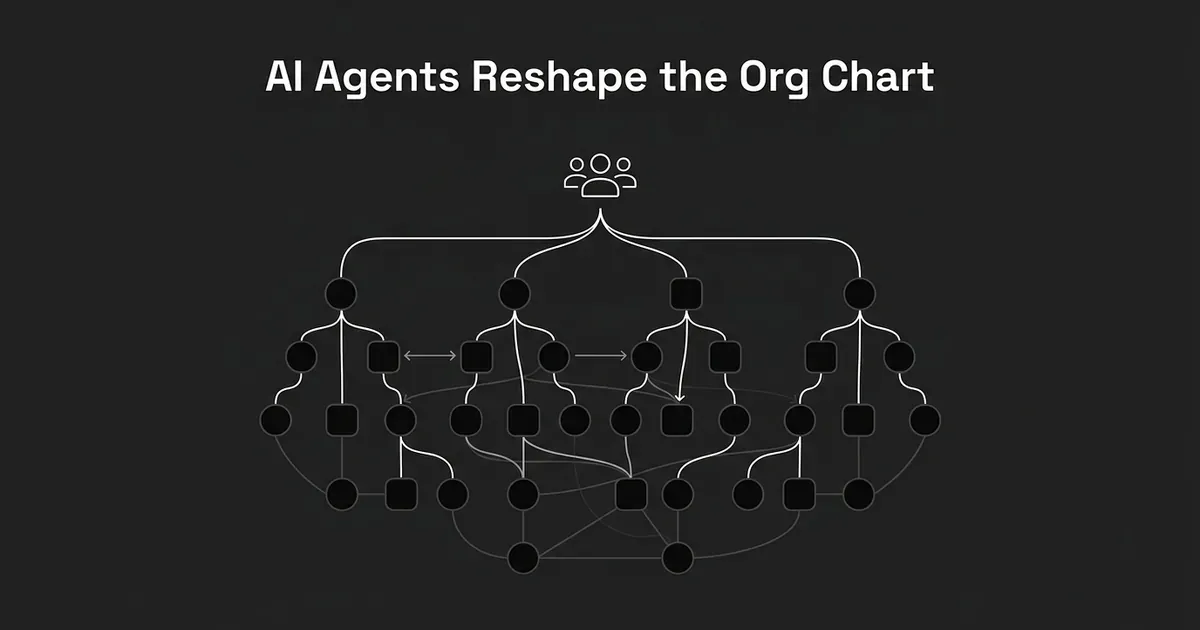
The org chart does not disappear. It gains a second structure layered across content, social, demand generation, and analytics: business goals at the top, human owners holding strategy and accountability, orchestrators coordinating workflows, specialist agents aligned to repeatable work, and human review points at the places that carry real risk. The agents here generally do not have reporting lines in the HR sense. What they have are scopes, permissions, and a named human owner.
For the humans, the shift moves from supervising individual tasks to directing the system as a whole: setting the commercial objective, deciding what level of autonomy is acceptable, allocating budget and risk tolerance, and judging whether the system is producing business value rather than just more output. Microsoft's 2025 Work Trend Index describes this as a progression from assistants, to agents acting as digital colleagues under human direction, to humans setting direction while agents carry out entire workflows. That is a forecast built on survey data, not proof every marketing team has already arrived there.
The change reaches each functional role differently. A content lead spends less time fixing headings and chasing links, and more time setting the editorial thesis and judging which pieces deserve investment. A demand-generation lead spends less time assembling campaign variants and more time on audience strategy and the trade-offs between growth and brand. An analyst spends less time compiling the same recurring report and more time defining what should be measured. A social lead spends less time reformatting one idea for five channels and more time deciding where a person, not an agent, needs to be the one responding. Across every role, the pattern is the same: less time producing each individual unit of work, more time designing and improving the system that produces many of them.
None of this is settled evenly. Well-specified, high-volume tasks such as formatting, summarizing, and recurring reporting are more exposed than ambiguous strategy or anything depending on a relationship or real creative taste. That does not make entry-level marketers unnecessary. It changes what entry-level work looks like, shifting it toward supervising a system's output and handling the exceptions it cannot resolve on its own.
Why is the change about operating model, not just headcount?
The evidence does not support a universal headcount conclusion. McKinsey's November 2025 report on the state of AI found that organizations getting real value from AI were nearly three times as likely as others to have fundamentally redesigned their workflows, with 55% of high performers reporting that redesign against 20% of everyone else. On workforce size, opinions split: 32% of respondents expected a decrease over the coming year, 43% expected no change, and 13% expected an increase. The strongest signal is about redesigning how work happens, not about jobs disappearing. Bolting agents onto existing roles without rethinking the workflow tends to produce less value than designing the goal, the handoffs, and the evaluation criteria from scratch.
What tends to emerge instead is a more pod-based structure: one human owner accountable for a business outcome, an orchestrator underneath them, several specialist agents doing the bounded work, shared data feeding all of it, and a human reviewer for anything touching quality or risk. A content-growth pod might combine a human strategist, a research capability, a production agent, an SEO evaluator, and a distribution agent working as one unit toward a shared number, rather than separate people each owning one step of a linear process. Treat this as an illustration of how responsibilities connect, not a template to copy with a fixed headcount.
That restructuring also creates responsibilities that do not map onto the old functional chart: someone has to own agent and workflow design, the quality of shared data, which permissions each tool integration carries, and monitoring of what happens when something goes wrong. Those responsibilities might land with marketing operations, a central AI platform team, or a dedicated agent owner. No single title has won that role yet, and it is worth treating that as genuinely unsettled.
A few structural things change alongside the chart itself. Coordination stops being handled informally through meetings and becomes something encoded into routing, state, and permissions, so it needs to be treated as real operational infrastructure. Shared context becomes an organizational asset: product facts and brand voice become reusable inputs the whole system draws from, which raises the stakes on keeping that context accurate, since a stale fact can spread across every channel at once. Review moves to sit closer to where the risk actually is, with low-risk formatting checked automatically and a public claim still requiring a person's sign-off. And measurement has to expand beyond activity, since publishing faster means nothing if quality or brand trust quietly declines while volume goes up.
Real caution belongs here too. More agents can mean more coordination overhead, and a system with many moving parts can end up less reliable than a simpler one if the task never benefited from being split apart. Errors can compound: a wrong audience assumption can drive a wrong strategy, which produces the wrong content, and the system can look productive the whole time it is amplifying an early mistake. The same shared knowledge layer that improves consistency can spread a stale claim everywhere if nobody maintains it.
DeepSmith is one example of how shared context can connect visibility work to production work directly: it tracks how AI engines answer questions about a brand, surfaces where the content gaps are, and produces on-brand articles from that same context, so the visibility signal and the content response are not two disconnected systems. That is one architecture choice among several, not the only correct way to build this.
Where does the model break?
A multi-agent system is not automatically better than a simpler alternative. Anthropic's research on its own multi-agent system found that its agents typically used about four times as many tokens as a normal chat exchange, and its multi-agent architecture used roughly fifteen times as many. That is a cost trade-off specific to Anthropic's own measurement, not a universal multiplier, but the point holds: multi-agent architecture earns its cost when a task genuinely benefits from being broken apart, run in parallel, or evaluated more deeply. It does not earn its cost when a single agent already solves the problem reliably and cheaply.
Coordination overhead is the most common failure. Every handoff is a place where context can get lost or a step can fail without anyone noticing right away. Parallel work only pays off when the tasks running at the same time are genuinely independent; if every step depends on a decision made earlier in the chain, running things in parallel just adds a synthesis problem without saving real time. Human review can also become the new bottleneck: if every output still needs a person to check every line, the organization has moved the constraint from production to review rather than removing it.
It is worth being honest about what the evidence does not establish. No universal AI agent org chart has been validated, and no reliable benchmark says how many agents a given team should run. The World Economic Forum found that 82% of executives expect to adopt agents within one to three years, which describes an intention, not a completed deployment. PwC's research found that 66% of organizations already using AI agents reported increased productivity and 57% reported cost savings, but that is self-reported data from adopters, worth reading as a signal rather than a guaranteed outcome. The evidence supports a direction of travel toward hybrid human-agent teams and real workflow redesign. It does not prove one optimal structure, and it does not prove multi-agent systems automatically cut headcount.
The org chart, in the end, becomes less a list of job titles and more a map of who is accountable for what, what each agent is capable of, what infrastructure they share, and where a human has to step in before something goes out the door. The winning design is not the one with the most agents attached to it. It is the one that puts the right combination of people, agents, workflows, and review at each point in the process, with someone accountable for the outcome at every step.