Your leadership team asked about the AI search strategy. You opened ChatGPT, typed your category question, and watched a competitor get named instead of you.
That stings. It's also fixable.
Here's the thing most people miss. The fix isn't a better prompt. It's a system. Agentic content automation is what happens when you stop treating AI as a writing assistant and start treating it as a production line: research, drafting, optimization, publishing, distribution, and measurement, all connected, with you approving the parts that matter.
This guide is the map of that system. You'll learn what an AI agent actually is, what MCP does underneath it, how the nine stages of a content and AEO workflow fit together, and where humans still hold the pen. No code. No build instructions. Just the shape of the thing, so you can lead the conversation instead of nodding along in it.
Take a breath. You're closer to this than you think.
What agentic content automation actually means
An AI agent is a program that can do a task on your behalf. It reasons, plans, remembers, and uses tools to get there.
That's the whole definition. It's less mysterious than it sounds.
The useful distinction sits one level down, and Anthropic draws it cleanly. A workflow is when models and tools run through code paths you defined in advance. An agent is when the model decides its own path and picks its own tools as it goes.
Both count as agentic systems. They just hand out control differently.
Why should you care about a vocabulary question? Because it tells you where your risk lives. A workflow does the same thing every time, so you can test it once and trust it. An agent adapts, which is powerful when the task is open-ended and expensive when it wanders.
Most of a content operation is workflow, not agent. That's good news for your budget.
Five patterns cover almost everything you'd want to build with AI agents for content:
- Prompt chaining. Break a task into fixed steps, each one working on the last one's output. Good for anything predictable.
- Routing. Classify the input first, then send it to the right specialist. Good for separating concerns and controlling cost.
- Parallelization. Run several calls at once and combine the results.
- Orchestrator-workers. One model breaks the job into pieces, hands them to worker models, then puts the answers back together.
- Evaluator-optimizer. One model writes, another grades, and they loop until the work clears the bar.
Then there's the fully autonomous agent, where the model decides how many steps the job needs. Use that only in a trusted environment, with real guardrails and a lot of testing behind it.
Anthropic's own guidance is blunt about the tradeoff: agents cost more and take longer in exchange for better performance on hard tasks. Adding complexity without evidence that it improves the outcome usually isn't the right move.
Read that last line twice if your team is mid-rebuild. The fanciest architecture rarely wins. The one you can test does.
Your action this week: list your content steps on one page. Mark each one W for workflow or A for agent. Most will be W. That list is your build order.
MCP is the wiring, not the brain
The Model Context Protocol is an open protocol that connects AI applications to outside data and tools. People compare it to USB-C, and the analogy holds. One standard plug instead of a custom cable per device.
MCP doesn't make the model smarter. It standardizes how the model reaches your stuff.
That distinction matters when you're evaluating vendors. A tool that says "we support MCP" is telling you about its plumbing, not its intelligence.
The three roles
MCP splits into a host, clients, and servers, and it runs on JSON-RPC as a stateful session.
The host is the container in charge. It creates clients, controls their permissions, enforces security and consent, and decides what context gets shared. Think of it as the manager.
A client holds one connection to one server. Nothing more. That isolation is deliberate, so one server can't peek at another.
A server exposes a focused capability. Your CMS could be a server. Your analytics could be a server. Servers only receive the context they need, and the full conversation stays with the host.
The three primitives (this is the part to remember)
An MCP server can expose three things, and each one is controlled by a different party. This is the single most useful mental model in the whole MCP content workflow conversation.
Resources are data with a unique address. Brand guidelines, product fact sheets, persona docs, prior articles, sitemap exports, Search Console pulls. The application decides which resources are in scope.
Prompts are templated messages and workflows. Repeatable briefs, QA checklists, review passes. The user picks when to run one, which makes them a controlled checklist rather than a surprise.
Tools are functions the model can execute. Search, fetch, extract, internal-link lookup, structure checks, image generation, CMS publish. The model discovers and invokes these on its own.
Resources are application-driven. Prompts are user-controlled. Tools are model-controlled.
Read that three-way split again, because it answers a question you're probably already asking: where does the machine get to act, and where do I stay in charge? The protocol has an opinion. There should always be a human able to deny a tool invocation.

Transports, briefly
MCP works the same on any transport. Two official ones exist: stdio for local development, and Streamable HTTP for production. The semantics don't change between them.
You don't need to hold this detail. You do need to know it exists, so when an engineer says "we'll run it over Streamable HTTP," you can nod for the right reason.
Your action this week: write down every place your brand context currently lives. Docs, spreadsheets, a wiki, someone's head. Those are your future resources, and the list is usually shorter than people fear.
The nine stages of an AI content pipeline, and who runs each
Here's where the abstract gets concrete. A full AI content pipeline has nine stages. Each one has a natural agent pattern, a natural role in an MCP content workflow, and a natural human checkpoint.
1. Research. Routing or orchestrator-workers. Resources supply brand context and prior articles; tools handle search, fetch, and sitemap reads. You approve which sources are eligible to be cited.
2. Brief and planning. Prompt chaining. Prompts carry the brief template; resources carry the persona and product profile. You confirm the funnel stage, the audience, and the claim boundaries.
3. Drafting. Parallelization plus evaluator-optimizer. Resources hold brand voice and the claims to make or avoid; tools run structure checks and internal-link search. You review for claims, voice, and product accuracy.
4. Internal linking. Tool use. A link scanner reads the sitemap and proposes placements. You approve or adjust them.
5. Cover and metadata. Tool use. Visual guidelines live as a resource; image generation is a tool. You approve the cover and the metadata before anything ships.
6. Publishing. Tool use. The CMS integration or a webhook does the push. You approve the final publish action.
7. Distribution. Prompt chaining or routing. Per-channel tone templates as prompts, a post generator as a tool. You approve the copy before it posts.
8. Monitoring. Evaluator-optimizer. Visibility tools capture mentions, citations, and sentiment on a schedule. You decide what counts and how often it runs.
9. Optimization and the loop back. Evaluator-optimizer again. Agents read the tracked data and return the next round of ideas. You approve which ones enter the queue.
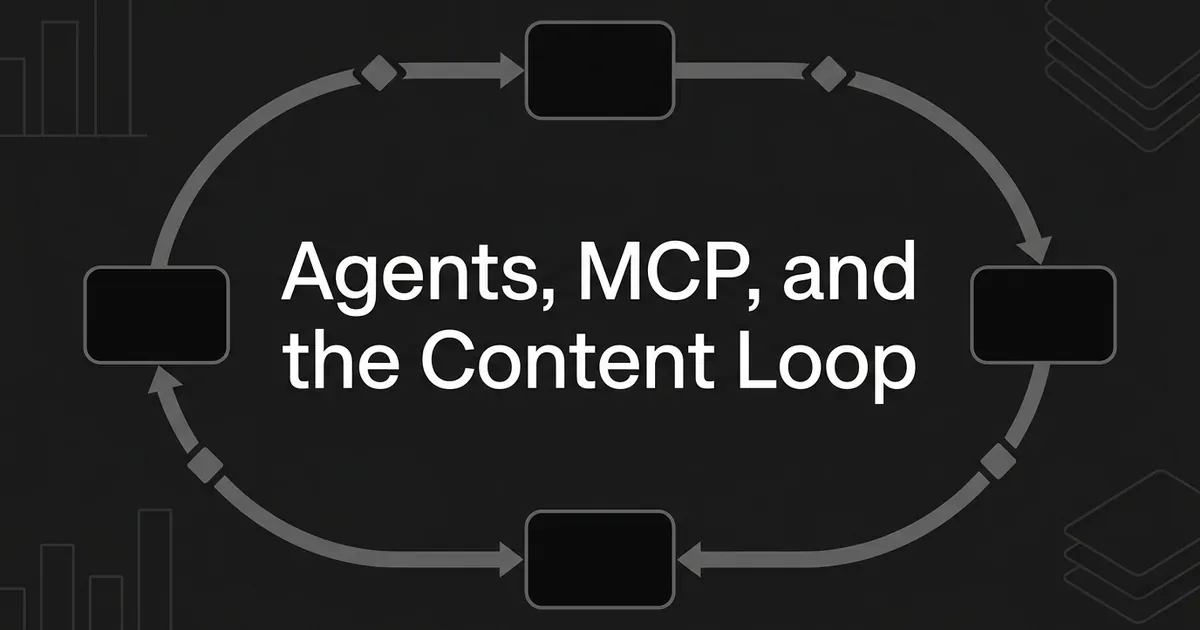
Notice what just happened. Stage nine feeds stage one. This isn't a line, it's a loop, and the loop is the whole point.
A single-tool stack can't close it. Your writing tool doesn't know what got cited. Your tracker doesn't know what you're about to publish. The data sits in two places and nobody joins it up.
That gap is the reason DeepSmith puts AI search analytics and content production on the same platform. The visibility data and the production queue read from the same store, so what an engine cited last month can shape what gets written next month. One system, one loop.
One more thing before you go shopping for tools. The quality of AI agents for content depends less on the model than on the tools you hand them. Anthropic's guidance on this is worth borrowing: build a rough version, evaluate it against real tasks, then repeat that loop until it performs. Consolidate related functions instead of exposing a hundred tiny ones. Return high-signal information, not raw identifiers and opaque error codes. Group related tools under a shared prefix so their boundaries are obvious.
The failure mode is specific. Too many tools, or tools that overlap and blur into each other, distract an agent from the efficient path. Fewer, sharper tools beat a bigger catalog every time.
That's a buying criterion, not just an engineering note. When a vendor demos, ask what the system actually hands the model.
Feeling like nine stages is a lot? It is. You don't build nine. You build one, then the next.
Your action this week: pick the single stage that eats the most of your time. For most content leads it's stage four or stage three. Automate that one and leave the other eight alone.
Where agentic AEO changes the loop
AEO means answer engine optimization: the work of getting cited inside AI-generated answers. Google glosses both AEO and GEO as industry terms for the same goal.
Agentic AEO is what that work looks like when the measurement runs on a schedule instead of in your browser tab on a Friday afternoon.
Start with the honest part. Google's official position is that the best practices for SEO remain relevant for AI features in Search. There are no additional requirements to appear in AI Overviews or AI Mode. No special optimizations. No new machine-readable files or special schema markup.
To be eligible as a supporting link, your page has to be indexed and snippet-eligible in Google Search. That's it. And indexing and serving are never guaranteed.
So if a vendor sells you secret AEO markup, you now know enough to say no.
What changes is the unit of measurement. SEO tracks a keyword's position. AEO tracks whether an engine answered a buyer's question using you.
Two numbers do most of the work here, and they're not the same:
- A mention is when the answer names your brand.
- A citation is when the answer links to one of your pages as a source.
An answer can do one without the other. Track them separately or you'll misread your own progress.
The working pattern looks like this. Pick 10 to 20 prompts your buyers actually type, mixing problem-aware, category, and comparison questions. Run each prompt on each platform twice, a few days apart, because patterns matter and one-off results don't. Capture mention rate, citation rate, sentiment, and the full answer history. Tag which pages earn citations and which prompts drive them.
Then connect Google Search Console, so the AI-side view and the search-side view sit next to each other.
Now the loop can close. Group your site and your competitors' sites under one shared topic taxonomy, tag each topic with a funnel stage, and two gaps fall out. A coverage gap is a topic where you publish but a competitor publishes more. An untapped topic is one where a competitor publishes and you have nothing at all.
Those gaps are your backlog. Each idea should carry the data point that justifies it, so you can defend the queue in a planning meeting instead of guessing at it.
Watch the shape of the reporting too. A per-platform breakdown tells you whether you're strong on one engine and invisible on another. A competitor leaderboard tells you who is taking the answers you want. A list of the sources an engine cites most tells you where the authority in your category currently sits, which is often not where you assumed.
Keep the sitemap side current as well. When your site and your competitors' sites are re-checked daily, new pages fold into the map on their own and your gap analysis stays honest without an import ritual.
DeepSmith tracks ten engines across its tiers, from ChatGPT on the entry plan through Perplexity and Gemini, with all ten on Enterprise. The point isn't the count. It's that the same platform holding those numbers also holds the writing queue they should feed.
Your action this week: write your 10 buyer prompts. Not keywords. Actual questions, in your buyer's words. That list is the foundation of everything above it.
The humans who stay in the loop
Let's kill a fear. Agentic content automation doesn't remove your editors. It moves them.
The agent frameworks are explicit about this, and it's worth borrowing their vocabulary because it's precise.
Guardrails run automatically. They validate an input before work starts, an output before it leaves, or a tool call before it fires. No person is involved. They're cheap and they run every time.
Approvals pause the run so a person decides. In the OpenAI Agents SDK, a tool marked as needing approval doesn't execute. The run stops, returns its pending items, and waits. You approve or reject, and it resumes from the same state instead of starting over.
That second mechanism is the one to understand, because it's the technical shape of "a human said yes." The pause is interruptible across long waits. Your editor can go to lunch.
Where should the approvals sit? Three places earn one every time:
- Claims. Anything asserting a fact, a number, or a product capability.
- Brand voice and editorial judgment. Does this sound like us, and is it the piece we meant to write?
- Publish. The action itself.
That last one deserves its own paragraph. Publishing is the least reversible thing in your workflow. Once a page is live, it becomes part of the corpus AI engines read and cite. Pulling it down later doesn't unring that bell.
The window for cheap intervention is before publication. Spend your review budget there.
There's a security reason for approvals too, and it isn't paranoia. Tool calls are arbitrary code execution. Tool descriptions should be treated as untrusted unless they come from a server you trust. Official guidance recommends keeping tool approvals on, even for reads.
Prompt injection is the specific worry. The defenses are stacking structured outputs, isolation, guardrails, and approvals together. Combined, they reduce the risk a lot. None of them remove it.
Your action this week: name one person as the release owner for AI-produced content. Not a committee. One name, with the authority to say no.
Governance you can actually run
Governance sounds like a word that costs three months and a consultant. It doesn't have to.
NIST published its AI Risk Management Framework on January 26, 2023, and a companion Generative AI Profile on July 26, 2024. Both are voluntary guidance, not law. Don't let anyone tell you otherwise.
What they give you is a structure: govern, map, measure, manage. Underneath that sit trustworthiness properties worth stealing outright, including accountable and transparent, safe and secure, and valid and reliable.
Here's what those turn into on a Tuesday:
Roles. Write down who owns AI content output and who can approve a publish. One page is enough.
Provenance. Track which inputs shaped each draft, and which version of your brand context was live when it was produced. When a claim turns out wrong six months later, this is what lets you find every other page carrying it.
Fact-checking. Build a verification step for any non-trivial claim, leaning on primary sources rather than generated summaries.
Testing. Periodically probe your own system for failure modes. Hallucinated stats, invented product capabilities, the wrong competitor named. Find them on purpose, before a reader does.
Disclosure. Where a reader might reasonably wonder how something was made, say so. Google's own guidance points the same direction.
One more thing on the spam question, because it worries people more than it should. Google doesn't ban AI-generated content. What violates the spam policies is using automation to generate content whose primary purpose is manipulating rankings. Content that shows real expertise, experience, authoritativeness, and trustworthiness gets rewarded, however it was made.
So write for the reader. That's the compliance strategy.
And on the security side, one line to carry with you: MCP cannot enforce security at the protocol level. Consent flows, access controls, and scope minimization are your implementation's job, not the protocol's. Ask any vendor how they handle that, and listen for a specific answer.
Your action this week: open a doc. Write the release owner's name and three claim types that always need a human check. That's a governance policy. You're done.
How to start without rebuilding your stack
You don't need nine agents. You need one loop that closes.
You may not need to build an MCP content workflow at all. If a platform already connects tracking, production, and publishing, you get the same shape without standing up servers. Build the protocol layer when you have a system nobody else connects to, not because the acronym is in the air.
Start with measurement, because measurement is what makes everything after it defensible. Define your prompts, run them on the engines your buyers use, and capture mentions and citations separately. Give it two weeks. Patterns will show up.
Then take the single most-cited gap and write for it, with your brand context stored once instead of re-briefed every time. The draft should arrive with structure, links, metadata, and a cover already in place, not as a rough thing waiting for two hours of your evening.
Then publish, wait, and re-run the same prompts. Did the number move? That question is the whole discipline.
This is the loop DeepSmith runs: track where you show up in AI answers, find the gaps, produce the on-brand content that closes them, then measure again from the same data. The Content Map keeps your site and competitor sites on one shared taxonomy. Opportunity Agents read that data and return ideas with the evidence attached. Autowrite produces on a schedule so the pipeline keeps moving through the weeks you don't have time.
You still approve. That part shouldn't change.
If you want to see the loop with your own data instead of a diagram, start a free DeepSmith trial and give it your first ten prompts. Seven days is enough to see whether the gaps are where you thought they were.
They usually aren't. That's the useful part.