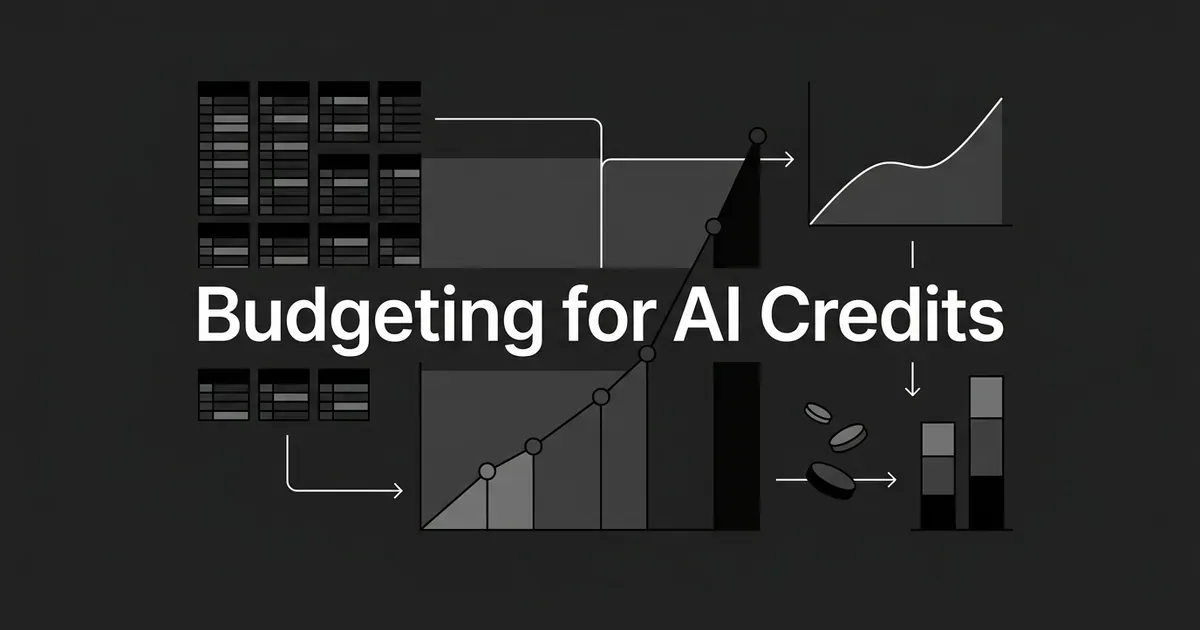
If you want to budget for AI credits without guessing, you need one artifact: a sheet that turns every tool's billing unit into a monthly workload forecast, split into fixed and variable cost, with a reserve for retries and a set of alerts that fire before the invoice does. This piece walks you through the AI cost model marketing teams can actually build and trust, field by field, plus a worked example with real numbers so you can see how the math runs. Building this once and updating it weekly is what turns predictable AI spend into a habit instead of a hope.
The AI credit budget template
Copy this into a spreadsheet. Use one row per tool and workload, not one row per vendor, since a single vendor can run separate rows for text generation, image generation, research, and automation.
- Workstream: the marketing activity that uses AI (blog drafting, content refreshes, image creation, campaign analysis).
- Tool or vendor: the product, API, or internal workflow doing the work.
- Owner: the person accountable for the forecast and the actuals.
- Billing model: subscription, seats, credits, tokens, requests, images, or a mix of these.
- Billing unit: the exact unit that shows up on the invoice or usage report.
- Included allowance: what the plan or free tier already covers.
- Unit price: the price of one billing unit, with currency and billing period.
- Fixed monthly cost: the recurring subscription, seats, or minimum commitment.
- Workload driver: the activity that actually creates usage (articles, briefs, conversations, users).
- Baseline quantity: the expected workload before growth or seasonality.
- Unit consumption: how many billing units one workload unit uses.
- Growth or seasonality factor: the expected change from baseline, as a multiplier.
- Retry and rework factor: extra usage from failed calls, revisions, and reruns, labeled as an assumption.
- Expected billable quantity: baseline quantity times unit consumption times the growth and overhead factors.
- Forecast variable cost: expected billable quantity times unit price.
- Expected total cost: fixed cost plus variable cost plus any known fees.
- Budget guardrail: the alert, threshold, or hard cap tied to this row.
- Actual usage and actual cost: what the vendor invoice or dashboard actually reports.
- Variance and variance explanation: the gap between forecast and actual, and the operational reason for it.
- Next action: the decision the variance triggers, such as adjusting the forecast or changing models.
The next sections walk through filling in each part of this sheet.
List every workflow that touches AI
Start with activities, not products. Write down every task AI touches: drafting, editing, research, internal linking, image generation, social repurposing, campaign analysis, reporting, and any one-off experiments your team has run. Then match each activity to the tool or model doing the work.
This step catches two mistakes that quietly blow up a budget. The first is forgetting small usage streams that add up once a whole team is using them. The second is budgeting for the visible subscription while ignoring the API, credit, image, or overage charges sitting behind it. Give every row an owner and a cost center too, because a shared account with no owner makes it almost impossible to explain a variance later.
Find out how each tool actually bills you
Do not start with a single column called "AI credits." First work out whether the vendor charges by seat, by subscription, by vendor-defined credits, by input and output tokens, by requests, by images or minutes, by background jobs, or by some mix of these.
This distinction matters because tokens and credits behave differently. Tokens are a model-consumption unit, so you can usually calculate a token price straight from your own usage data. Credits are vendor-defined, and one credit can mean one action, part of an action, or a different amount depending on the feature. Microsoft's own AI-credit documentation makes this point directly: credits measure use of AI features, while separate feature limits vary by feature, entry point, and plan. A single example, like one credit per inbox summary, does not generalize to other features or other vendors. HubSpot's pricing page is a useful second example: it lists a rate per 1,000 credits when billed annually, with a different credit cost for a resolved Customer Agent conversation than for a Data Agent run. Treat each of these as a demonstration of the method, not a rule that transfers to your own vendors.
Split fixed, included, variable, and excluded costs
Every row in your sheet should show four separate amounts. Fixed commitment is the subscription, seats, or minimum spend you pay regardless of usage. Included capacity is what the plan bundles in, like a set number of credits, tokens, or seats. Variable usage is anything consumed above or outside that included amount. Excluded or conditional charges cover taxes, storage, retrieval, image or audio processing, and anything else that shows up as a separate line.
Do not treat included capacity as free capacity. It has a real cost built into what you pay for the plan, it can expire, it may not roll over month to month, and it may not even be usable for the workload your team actually needs. This split is the backbone of any AI cost model marketing teams can rely on when finance asks for the number behind the number.
Turn marketing work into a usage forecast
Pick the driver your team can actually forecast, and multiply it out. That might be articles per month times input tokens per article, content refreshes times output tokens per refresh, campaigns times analyses per campaign, or conversations times credits per resolved conversation.
For anything running through an API, pull actual input and output token counts rather than estimating from word count. Providers give you the tools to do this precisely: OpenAI's token-counting documentation supports counting input tokens before you send a request, and Gemini's documentation gives a rough guide of one token to about four characters, useful for a first pass but not a substitute for the provider's own tokenizer once the numbers matter.
Build low, base, and high scenarios
A single point estimate hides more than it reveals when your workload is uncertain, so build three scenarios instead of one. The low case assumes reduced workload or slower adoption. The base case is the plan you have actually approved. The high case assumes more campaigns, more users, longer prompts, or faster adoption than planned.
Keep workload, unit consumption, and price as three separate variables inside these scenarios, because a high case driven by more articles calls for a different response than one driven by a price increase or a switch to a pricier model. The high case is not a forecast you expect to hit. It is a decision boundary, the point at which your team needs to approve more budget, move a workload to batch processing, route simpler tasks to a cheaper model, or pause anything discretionary.
Add a retry and rework buffer
Retries, failed calls, regenerated drafts, editorial revisions, and abandoned experiments are real usage, even though none of them show up as finished work. Where you have no history to draw on, use a clearly labeled planning assumption rather than an industry number pulled from somewhere else.
Once you have a few months of actuals, you can calculate this directly: take total usage, subtract the usage tied to accepted production output, and divide by the accepted production usage. That gives you an observed overhead rate you can apply going forward. Keep failed requests separate from planned revisions in your tracking, since a retry caused by a rate-limit error is an operational problem to fix, while a second draft an editor asked for is expected production work. Blending the two into one number hides the one you actually need to act on.
Set alerts, limits, and approval rules
A spreadsheet does not make a budget predictable on its own. What makes it predictable is a layered set of controls: visibility into usage by vendor, project, model, and owner; alerts at set percentages of the monthly budget; approval steps for new models or bulk jobs; restricted access through project-level permissions; rate limits to stop a runaway automation; and a defined fallback, whether that is a cheaper model, a queued batch job, or a pause.
Predictable AI spend depends on knowing whether an alert is really a limit or just a notification, so check the difference before you rely on either. OpenAI's documentation notes that project spend limits can default to a soft threshold, meaning requests keep going through even after you cross it, alongside a hard-limit mode you can also configure. Google Cloud budgets work the same way: an alerts-only budget will notify you, but it will not stop a service or stop billing on its own unless you build that automation yourself. Anthropic separates spend limits, which cap monthly cost, from rate limits, which cap request and token throughput over time. These solve different problems, so give each one its own line in your control sheet rather than assuming one covers the other.

A worked example with real numbers
Here is how the math runs for one illustrative team. Treat the workload numbers and the overhead assumption as examples of the method, not a benchmark to copy.
Say a team pays a fixed platform subscription of $199 a month. It also runs 300 drafting jobs a month through Claude Sonnet 5, priced at $2 per million input tokens and $10 per million output tokens, using 30,000 input tokens and 6,000 output tokens per job. On top of that, it runs 1,000 routing or classification jobs a month through OpenAI's gpt-5-nano, priced at $0.05 per million input tokens and $0.40 per million output tokens, using 8,000 input tokens and 1,000 output tokens per job.
The drafting workload uses 9 million input tokens, costing $18, and 1.8 million output tokens, costing another $18, for a $36 subtotal. The routing workload uses 8 million input tokens, costing $0.40, and 1 million output tokens, costing $0.40, for an $0.80 subtotal. Add those together and you get $36.80 in base variable usage. Apply a 15 percent retry and rework assumption and that becomes $42.32. Add the $199 fixed subscription and the total base budget comes to $241.32 a month.
Run the same math at 80 percent of expected usage and the total drops to about $232.86. Run it at 130 percent and it rises to about $254.02. Notice that the fixed subscription dominates this particular budget, while the token usage swings with model choice, output length, and retries. A different mix of workloads or models could easily flip that relationship, which is exactly why the sheet tracks fixed and variable cost on separate lines instead of blending them into one number.
If your team already pays for a platform subscription with a defined production allowance, like DeepSmith's plans starting at $99 a month for a set number of articles, tracked prompts, and seats, that subscription belongs in the fixed-cost row of your sheet, with its included capacity recorded separately. Track how much of that allowance you actually use each month, the same way you would track any other included capacity, so you can tell whether the plan still fits the workload.
Adjust the template for your team size
A small team can run this on one shared sheet with one row per workflow and one clear owner. Start with fixed costs, included allowances, and your three highest-volume activities, and review the sheet weekly rather than building a complex allocation system before you need one.
A growing team should add workspaces, projects, cost centers, model names, and individual owners, along with separate API keys or projects for production, experiments, and automation. Add approval rules for bulk jobs and new model choices. Start reviewing cost per accepted output by workstream instead of just total spend.
A large team or agency needs a standard workload taxonomy, project-level cost allocation, defined approval thresholds, restricted permissions, and a real monthly close process. Allocate shared platform costs using an explicit rule, such as active users or published outputs, keep client workspaces isolated where that matters, and keep a running log of every price change and model change you make.
How to know the budget is working
You will know this budget is doing its job when the monthly invoice stops being a surprise. Run a weekly review of month-to-date spend against forecast, the run-rate projection for the rest of the month, usage by tool and owner, and any unusual spikes. At month-end, reconcile the actual invoice against your forecast, update next month's baseline with what you learned, and retire any subscriptions, seats, or keys nobody is using.
The real test is whether you can explain a variance the moment it shows up, not after finance flags it. Once your team is reviewing forecast against actuals every week, predictable AI spend stops being a mission statement and starts working as an operating model you can trust, and this is the AI cost model marketing leaders can defend week over week instead of one built once and forgotten. If you would rather have a platform track this kind of production spend and capacity for you automatically, DeepSmith's plans build the article, prompt, and seat allowances into one subscription, and you can try it with a 7-day free trial.