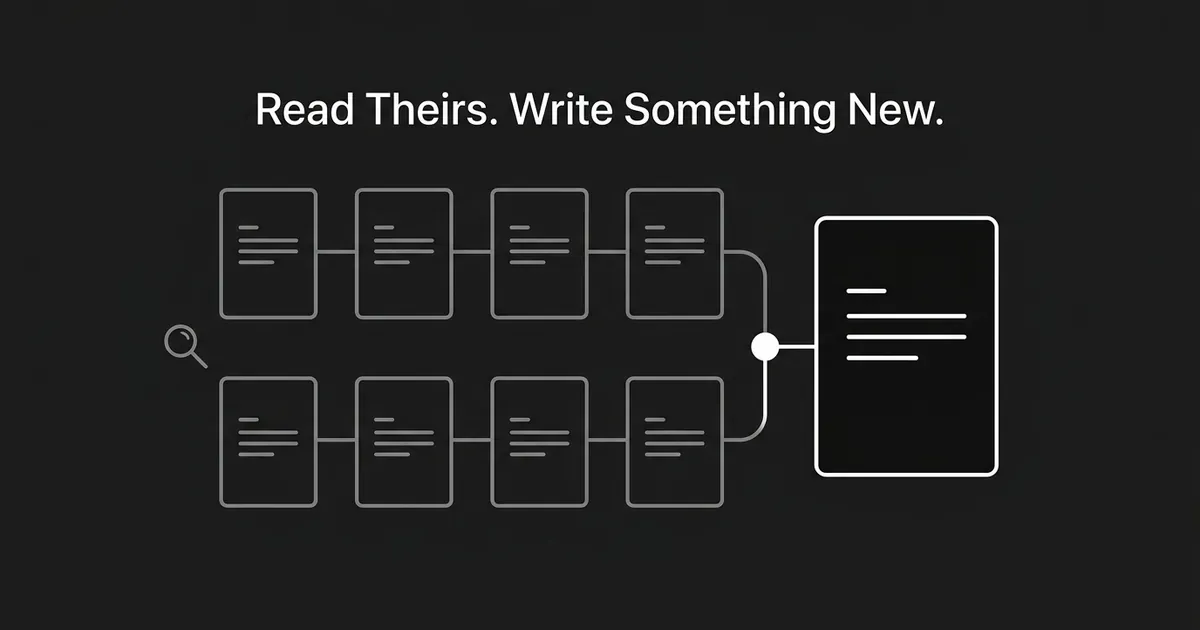
You already have a folder of competitor article links you saved "for later." The problem is not finding competitor content, it is knowing how to find content ideas from competitors without just rewriting what they already said. This guide walks a marketing lead through a repeatable way to do competitor content research: read competitor pages, note what they do and don't do for the reader, and turn that gap into an original, defensible brief. By the end you'll have a working method for content research from competitors that you can run on one page today and repeat every time you need fresh angles.
Step 1: Write down the buyer question before you open a single competitor page
Before you look at anyone else's content, write one sentence naming who the reader is, what task or decision brought them to this topic, and what your team can credibly speak to. Something like: "A marketing lead choosing a content workflow needs to know how to tell whether a new article angle adds something beyond an existing comparison." That sentence becomes the test you hold every competitor page against.
Set boundaries while you're at it. Which buyer stage are you writing for? Which use case? Which product category actually matters here? A page only counts as relevant competitor content if it answers that same buyer question, even if the publisher isn't a direct rival. A well-known industry blog can hand you a useful page to study even though it doesn't sell what you sell, you just can't call it a competitor page when you write it up.
Common mistake: starting from "what is our competitor writing about?" That question gives you a list of subjects, not a reason your audience needs another page on the topic. Start from the reader's task instead.
Done when: you can explain in one sentence why each page you go on to select matters to that same reader task. That sentence is also the question you'll use later to judge what each page leaves unresolved, so it's worth getting specific now rather than fixing it after the fact.
Step 2: Build a short, purposeful reading list
Now go find pages, and open the actual pages, not just the headlines in a search results list. Look for a handful that tackle your buyer question from different angles: a direct competitor's practical guide, another publisher's comparison, a case study if one exists. Three to six pages is usually enough to see real variation without turning this into a research project that eats your week.
For each page, record the title, the publisher, the URL, the format, the date if the page shows one, and a line on why it made your list. Keep this in a working sheet you can come back to, because "I remember roughly what that page said" falls apart by the time you're three pages in. If a page has clearly changed since you first noted it, record the version you actually read.
This is also where DeepSmith's AI Visibility can save you a step. It shows the exact competitor pages that are getting cited in answers to the prompts you track, broken down by platform, and it checks competitor sitemaps daily so a newly published page doesn't sit undiscovered for weeks. That's a way to surface candidates worth opening, not a verdict on whether the page is good or whether it converts. A hand-picked list of pages you already know works just as well if you don't have that view yet.

Pro tip: if a page shows up because it's cited in an AI answer or has a lot of backlinks, treat that as a reason to open it, not a reason to copy it. Popularity is a selection signal, not an editorial verdict.
Done when: every page on your list has a specific, written-down reason it connects to the buyer question from step 1, and the list is short enough that you'll actually read every page on it rather than skimming half of them and guessing at the rest. A shortlist of four pages you read properly beats a spreadsheet of forty titles you never open.
Step 3: Read each page for its promise and its reader
Open each page and actually read it: the headline, the opening paragraphs, the section headings, and the conclusion, then dip into the body wherever you need to check whether it delivers on what it promised. For each page, answer four questions in your notes: who is this written for, what task or decision does it promise to resolve, what point of view or constraint shapes the answer, and what is the reader supposed to do once they finish reading?
Write short observation labels in your own words. Don't paste competitor sentences into a file that might end up feeding a draft later, that's how borrowed phrasing quietly becomes your own article. You should be able to describe each page in one sentence without repeating its title: for this reader, this page answers this question by taking this angle, and points them toward this action.
Common mistake: reading only the headline and headings and assuming that's the article. A headline that sounds novel can turn out to be unsupported once you read the body, and a generic-sounding title can be hiding a genuinely useful worked example. You won't know which one you're looking at until you read past the H2s.
Keep your observations and your assumptions in separate columns, even mentally. "This page has no worked implementation example" is something you can point to on the page. "Its readers probably wanted a video instead" is a guess, and it's fine to write it down, but label it as a guess. Mixing the two is how a research note quietly turns into an unfounded claim by the time it reaches a brief.
Step 4: Map how the page actually delivers its answer
This step is about structure and evidence, not just tone. For each page, note the format (how-to, comparison, checklist, case study), the section sequence, and whether it gives the reader concrete steps, criteria, or a decision framework, or just talks around the topic. Note any examples, screenshots, diagrams, or tables, whether sources are named, whether time-sensitive claims carry a date, and how specific the instructions actually are.
For a how-to page, ask whether a reader could follow it and know when they were done. For a comparison, ask whether the criteria and the evidence behind them are visible or just asserted. For a case study, separate the reported results from anything that reads like marketing copy dressed up as proof. And when a page includes a diagram or chart, ask whether it's actually resolving something the prose couldn't say cleanly, or just decorating the page.
A simple row for your notes looks like this: page, reader and task, angle, format and structure, evidence or demonstration, useful element, unanswered question, possible original contribution. You're not scoring the page, you're building the raw material for step 5.
You don't need every field filled in for every page, and you don't need to treat a competitor's length as a target. If a page runs long because it covers five related decisions in one article, that tells you something about how it's structured, not how long your own piece should be. Note length only when it actually changes whether the reader can finish the job, not as a benchmark to hit.
Common mistake: mistaking polish for completeness. A long, well-designed article with a dozen headings can still leave the reader without a clear next action. Check what someone can actually do after reading it, not how much space the page fills.
Step 5: Find the opening a reader actually needs, not just something the page skipped
Go back to the buyer question you wrote in step 1 and compare it against your notes from steps 3 and 4. Look for an unanswered decision, a skipped implementation step, a trade-off the page never explains, an assumption that doesn't hold for your audience, dated material you can verify and update, or a claim that's stated but never backed up. Then ask the harder question: what does your team actually have access to that would let you answer it better? Direct product expertise, a customer-approved example, a real demonstration, an original analysis?
Before you propose anything new, check whether your own site already has a page answering the same question, so you're not quietly duplicating work you've already done. For each opening you find, try finishing this sentence: "The existing page helps [reader] with [task], but leaves [specific question] unresolved, and we can answer it with [evidence we can actually provide]." If you can't fill in that last part honestly, park the idea. It isn't ready.
Common mistake: treating "they didn't include this heading" as your whole strategy. An added section only earns its place if it solves a real part of the reader's task and you can actually support it. A competitor skipping a topic might mean it wasn't worth including, not that you've found a gap.
This is also the step where you catch a launder before it happens. If a page states a number, a date, or a product claim you're tempted to reuse, verify it against the original source rather than repeating it because a competitor said it first. Competitor content research works from what you can independently stand behind, not from what someone else already published.
Step 6: Turn the observation into your own article concept
Now write a fresh concept in your own words, without looking back at the competitor's outline while you do it. Give it a working title, a specific audience, a central question, an angle, a format that fits, and a plan for the evidence you'll use. A tighter audience or a different decision point is often enough to make a page genuinely distinct, even when the general topic overlaps with what's already out there.
Keep the pattern of a useful format (a how-to's step structure, a comparison's criteria-then-evidence shape) separate from the competitor's particular execution: their examples, their screenshots, their specific wording. You can learn from the pattern. You can't reuse the execution.
This is where DeepSmith's Remix feature fits, if you're using it. You point Remix at a competitor page, or a page that's winning AI citations for a topic you track, and it generates fresh angles that land in your ideas backlog. It's a starting point for ideation, not a verdict on originality: you still need to read the source page yourself and judge whether the angle it generates is genuinely different, relevant to your audience, and something you can actually support with real evidence.
Common mistake: swapping the format or adding your company name to a rival's headline while keeping the same promise, the same section order, and the same unverified claims. That's a repaint, not a new idea.
Here's what that reframe looks like in practice. Say a rival's article is a broad list of criteria for choosing a content platform. A distinct concept, if your team can actually back it, might walk a marketing lead through applying a short evaluation worksheet to their own approval workflow, with real screenshots and honest limitations included. The worksheet, the tested process, and the specific audience decision are the contribution. Rearranging the rival's list into a slightly different order would not be.
Step 7: Write the brief and queue it for a real writer
Turn the winning concept into something a writer could pick up cold. Record the target reader and their task, a one-sentence promise, the original angle, the format you've chosen and why, three to five questions the piece absolutely has to answer, what first-hand evidence you have and who owns getting it, any claims that still need verifying, what the piece must not borrow from the source page, and what the reader should be able to do once they finish it.
If you have more than one idea competing for the same slot, judge them on how relevant they are to your actual audience, how distinct they are from what's already published (yours and theirs), how ready your evidence is, and how useful the finished piece will actually be. A simple high, medium, low call is enough for most teams, you don't need a scoring model for this.
DeepSmith can take a signed-off idea like this and turn it into a full production run: research, drafting in your brand voice, internal and external linking, a cover image, and publish-ready metadata, without you writing the brief into a doc and then re-explaining it to a freelancer. You still make the editorial call on originality and evidence before anything goes out, the platform handles the production work around that decision, not the decision itself.
Common mistake: handing someone a folder of competitor links with no editorial decision attached. That isn't research, it's a bookmark list. Research becomes an idea the moment someone names the audience, the new contribution, and the evidence that backs it.
Once the piece is published, judge it against the reader task it promised to solve and whatever performance measures you normally use, not against whether the competitor page you started from ever earned a citation or a ranking. A page you researched carefully can still underperform, and one you weren't sure about can surprise you. The point of this process is a defensible reason for the page to exist, not a guaranteed result.

What to do next
Pick one competitor page that's relevant to something you're planning to write about anyway. Run it through the seven steps above and write one real brief at the end, not five half-finished ones. That single completed brief will teach you more about how to find content ideas from competitors than reading about the process twice. Once it feels natural on one page, it scales to a stack of them without much more effort per page, and competitor content research stops being a special project and becomes a normal part of how you plan.
If tracking which competitor pages are actually winning AI citations, and turning the strongest ones into ideas, sounds like something you'd rather not do by hand every week, DeepSmith's 7-day free trial gives you real data and real drafts before you pay anything.