You wrote a solid explainer. An AI engine answered the question anyway, and it quoted someone else. That stings, and it is fixable. This guide walks you through how to write definitions for AI search, one sentence at a time, so your page becomes the easiest thing on the internet for an engine to lift and reuse.
Here is the honest frame before we start. Search "write definition AI quotes" and you will find plenty of promises. Most of them skip this part, so let's say it plainly: nobody can promise an engine will quote you word for word. Google says it does not guarantee crawling, indexing, serving, or featured snippet selection. What you can control is whether your sentence is easy to pull out and reuse without breaking. That is the whole job.
The short version
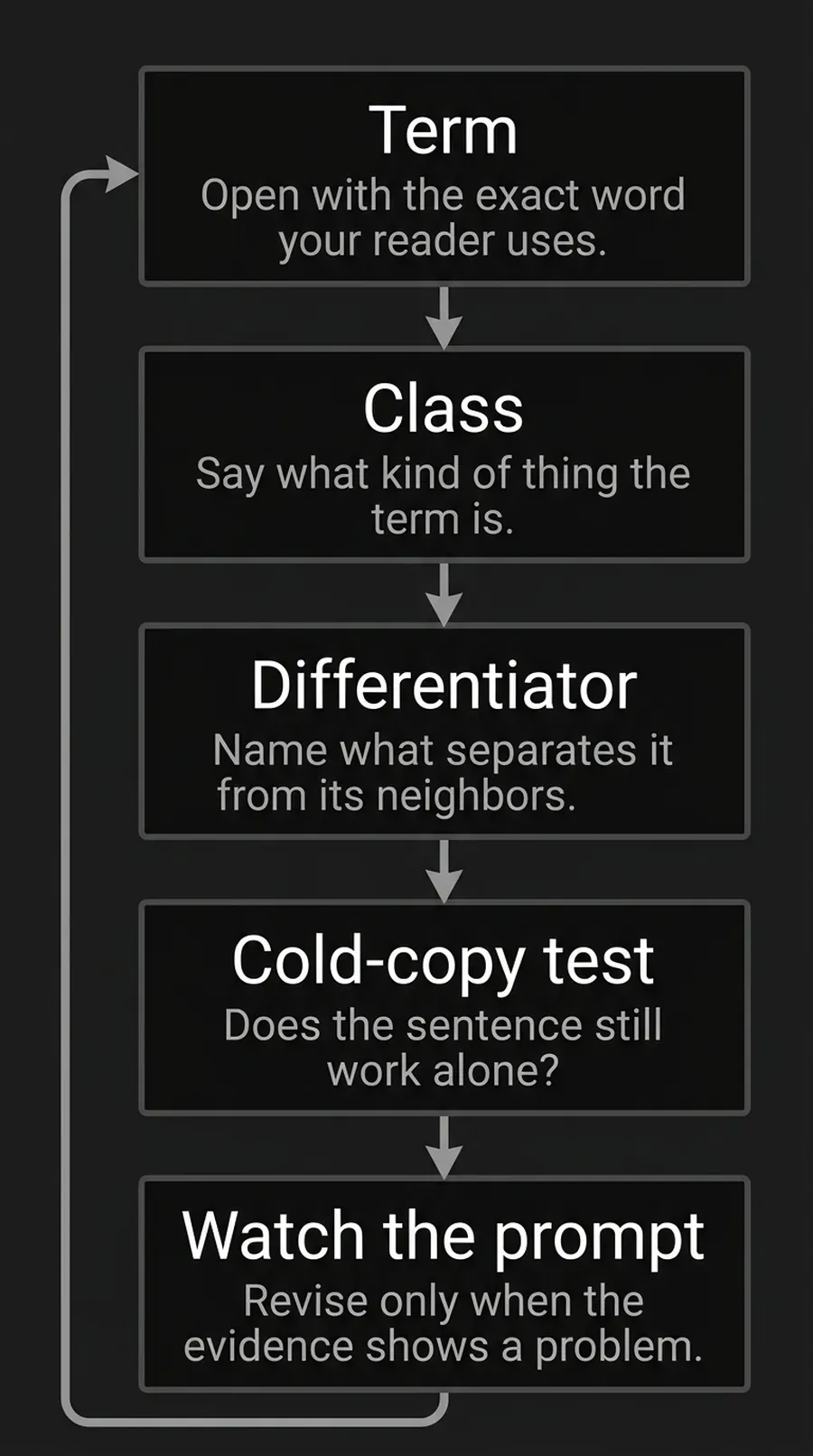
A definition that gets cited by AI does three things in one sentence. It names the term first. It says what kind of thing the term is. It states what makes the term different from its neighbors.
That is the pattern:
[Term] is a [clear category] that [the characteristics that separate it from similar things].
Here it is filled in:
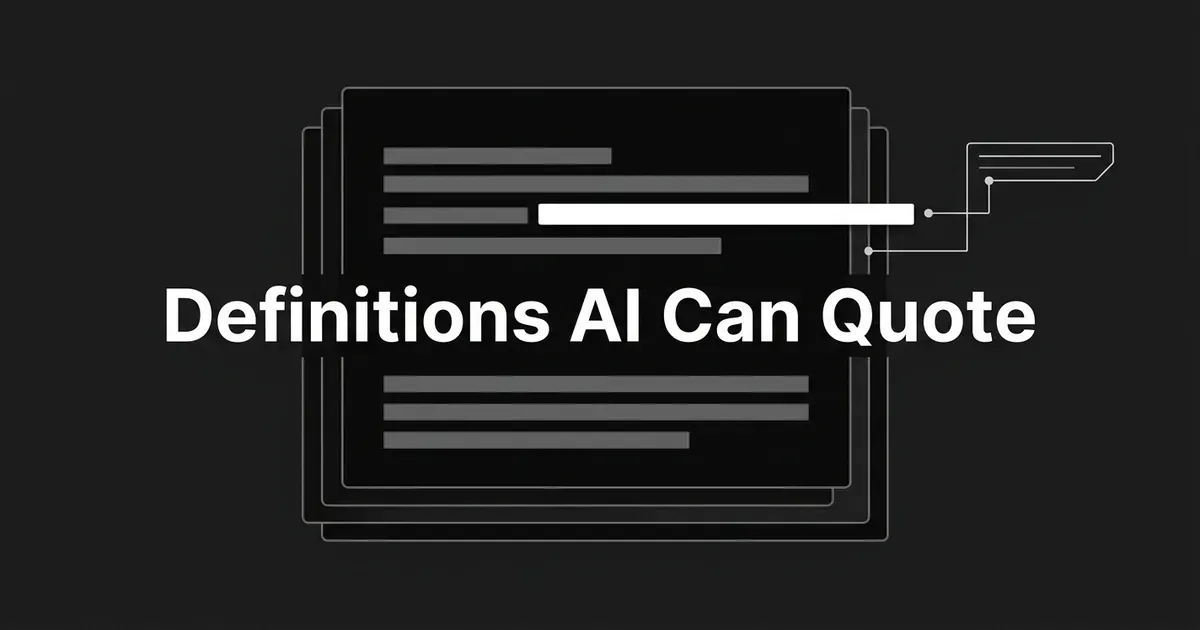
A canonical definition is a short, authoritative explanation of a term that states what category the term belongs to and what makes it distinct.
If you take one thing from this guide, take that shape. It is what canonical definition AEO advice is circling around, minus the jargon. Everything below is how to get a real sentence into it.
Step 1: Pick one term, not one topic
Start by writing the question your passage must answer, in one line, in your reader's words. Something like "What is a definition passage for ChatGPT?" or "What does canonical mean in AEO?"
A term is worth defining when it is unfamiliar to your reader, central to understanding your space, or loaded with different meanings depending on who you ask.
How you know it is done: the question asks for one term's meaning. Not a comparison. Not a history. Not a list of examples. You can point at one noun or phrase and say "that is what this sentence defines."
Where people go wrong: they start with a topic instead of a term. "AI search content" is a subject area you could write about for a year. "Definition passage for ChatGPT" is a target you can answer in twenty words.
If you are not sure which terms to pick, start with the questions your buyers actually ask. Those are the prompts you want to be present in. DeepSmith's AI Visibility module is built for exactly this part: you define the prompts that matter in your space, and it checks them on a schedule so you can see which ones name you and which ones do not. Pick your definition targets from the prompts where you are missing.
Step 2: Put the term first
Start the sentence with the exact term, spelled and capitalized the way your readers write it. No warm-up. No scene-setting. No "in today's landscape."
Weak: "As brands compete for visibility in changing search environments, marketers are paying more attention to this approach."
Strong: "A canonical definition is a short, authoritative explanation of a term..."
Read those two again. The first one could be about anything. The second one identifies itself in four words.
How you know it is done: the first few meaningful words say what is being defined. If you copied that sentence into a blank document, it would still announce its own subject.
Where people go wrong: they bury the term behind context because it feels abrupt to open cold. It does feel abrupt. Do it anyway. Practitioners call this answer-first writing, and it treats your opening sentence as the most liftable unit on the page. That is a working heuristic, not a published ranking factor, and it is still the highest-leverage change most writers can make.
Step 3: Name the class
Now say what kind of thing the term is. A process. A metric. A document. A method. A statement. This is the part most drafts skip, and skipping it is what makes a definition feel slippery.
Weak: "A canonical definition is a canonical explanation..."
Strong: "A canonical definition is a short, authoritative explanation..."
The first version repeats the label. The second one classifies it. See the difference?
Pick the smallest accurate category. The class has to be broad enough to cover every real instance of the term, and narrow enough to be useful. "Thing," "concept," and "content" are almost never the right answer.
One grammar rule that pays for itself: define a noun with a noun, a verb with a verb. And skip "X is when" or "X is where." Those constructions read like a definition but do not classify anything.
How you know it is done: by the middle of the sentence, your reader knows whether the term is a practice, an object, a document, a metric, or an idea.
Step 4: Add the one difference that matters
Next comes the differentiator: the smallest set of characteristics that separates this term from the ones sitting next to it. Function, purpose, scope, or defining behavior usually does the work. Background almost never does.
Weak: "A definition passage is a passage that defines a term."
Strong: "A definition passage is a short section that identifies a term, places it in a broader category, and states the characteristics that distinguish it from related terms."
The first is a circle. It tells your reader nothing they did not already have.
How you know it is done: someone can read your sentence alone and answer "how is this different from the thing beside it?"
Pro tip: if you need three or four subordinate clauses to squeeze in the distinction, you are trying to do two jobs in one sentence. Split them. Keep the first sentence as the clean answer, then use the next sentence for nuance or an example. One clean sentence plus one clarifying sentence beats one exhausting sentence every time.
Step 5: Run the cold-copy test
This is the step that separates a definition that gets cited by AI from one that quietly falls apart in an answer box.
Copy your definition sentence, and only that sentence, into a blank document. Read it. Does it still make sense?
If it does not, the usual culprits are easy to spot:
- Pronouns with no home. "It," "this," "the approach," "the method described here."
- References to text that is no longer there. "As noted above," "in the previous section."
- Jargon your reader would have to go look up.
Weak: "It is a way to make these passages more useful, as discussed above."
Strong: "A citation-ready definition passage is a self-contained explanation written so an answer engine can reuse it without importing missing context."
Repeat the actual term where a pronoun used to sit. Yes, it reads a little more formally. That is the trade, and it is worth it, because an extracted sentence never travels with the paragraph above it.
Plain language helps here twice over. Familiar words, concrete claims, direct grammar. Clarity is for your human reader first, and it happens to make your sentence much easier to match to a question.
Where people go wrong: they write the definition for the article and forget it might travel alone. Write every definition as if it will be read by someone who has never seen your page.
Consistency matters too, especially once more than one person is writing. If your team defines the same term three slightly different ways across five posts, you have three weak candidates instead of one strong one. This is a big part of what Deep IQ does inside DeepSmith: your company positioning, products, personas, brand voice, and content types are stored once as structured context, and every article the platform produces is grounded in it. It keeps your terminology steady across a whole library. It does not make an engine quote you, and no tool can.
Step 6: Give the passage one job
Your definition sentence is the answer. Everything after it in the paragraph exists to support that answer, not to compete with it.
A clean passage looks like this:
Canonical definition: one sentence with the term, the class, and the differentiator. Clarification: one sentence explaining a boundary or a common use. Example: one concrete example, but only if it clears up real confusion.
Keep one passage focused on one question. If you find yourself defining three related terms in one block, split them. Each term deserves its own focused passage.
How long should the passage be? Shorter than you think, and there is no official number. Google says there is no ideal page length and no need to chop your content into tiny pieces for AI. Practitioner guidance floats one to three sentences, or roughly 120 to 180 words for a broader answer block. Treat those as rules of thumb, not requirements. Aim for one sentence as the canonical answer and add detail only when it genuinely helps.
Where people go wrong: the 180-word opening paragraph that gives history, compares four alternatives, and recommends a tool before the actual definition ever shows up. If your reader has to hunt for the meaning, so does everything else.
A note on evidence. A well-known GEO study tested content changes across a synthetic benchmark of 10,000 queries in 25 domains, generating responses with GPT-3.5-turbo and also evaluating on Perplexity. Adding citations, quotations, and statistics produced reported relative improvements of 30 to 40 percent on one visibility metric and 15 to 30 percent on another. Writing that was fluent and easy to understand showed a reported 15 to 30 percent visibility boost. The same study found no significant gain from an authoritative writing style on its own, and little to nothing from keyword stuffing. Those are results from one experimental setup, not universal benchmarks, and they do not mean a citation will make an engine lift your sentence. Use supporting evidence when it actually supports the definition. Never bolt it on for decoration.
Step 7: Test, publish, then watch the prompt
Before the piece goes out, run four quick checks on the sentence:
- Term-first test: does it open with the exact term?
- Class test: does it say what kind of thing the term is?
- Distinction test: does it name what separates the term from its neighbors?
- Cold-copy test: does it survive alone in a blank document?
Then check the boring technical side, because a perfect sentence on a page nothing can reach is still invisible. The page needs to be crawlable and indexed. It needs to be eligible to show a normal search snippet. The definition needs to exist as real text, not baked into an image. Internal links should make the page findable.
Here is the good news on that front: Google says there are no additional AI-specific technical requirements for AI Overviews or AI Mode. No special AI files. No special schema markup. Ordinary, competent SEO fundamentals are the requirement. And Google is equally clear that indexing and serving are never guaranteed.
After publishing, watch the prompt rather than the sentence. Did the target question start naming you? Did it cite your page? Which competitor page is winning it instead? DeepSmith's AI Visibility tracks that loop: per-prompt mention and citation rates, full answer history, which of your pages get cited, and which competitor pages win the prompts you care about. It measures what happened. It does not control what an engine decides.

Then revise only when the evidence points at a real problem: your definition is unclear, your page does not cover the question, something is inaccurate, or the page is hard to find. Do not rewrite a good sentence because one engine gave a different answer on one run. Answers vary by design. Google says AI Overviews and AI Mode may use query fan-out across related subtopics and different models, so the responses and the links move around.
Templates you can steal today
Four shapes cover most of what you will need.
Basic:
[Term] is a [category] that [defining characteristic or function].
Process:
[Term] is a [process or method] that [action] to [purpose], unlike [nearby method] which [distinction].
Use the comparison clause only when the distinction is essential. Otherwise it makes the sentence heavy.
Metric:
[Term] is a [metric] that measures [specific quantity] over [scope or period].
Never invent a scope or a period. If the metric has no established one, leave it out.
Definition plus clarification:
[Term] is a [class] that [distinguishing characteristic]. In practice, it means [plain-language boundary or use].
The first sentence is your candidate answer. The second one is for the humans.
The mistakes that cost you the quote
Almost everyone makes at least two of these. That is normal. Fix them one at a time.
| Mistake | Why it fails | Fix |
|---|---|---|
| Opening with background | The answer arrives too late | Put the term and its meaning first |
| "X is when" or "X is where" | It never names a category | Define a noun with a noun |
| Circular wording | It repeats the term instead of explaining it | Add a real class and a real difference |
| A class that is too broad | The sentence never narrows anything | Choose the smallest accurate category |
| Too many new terms | Your reader has to look up three more things | Use familiar words, or define only what is essential |
| Orphan pronouns | The sentence breaks the moment it is extracted | Repeat the actual term |
| Several questions in one passage | Nothing in the block is a clean answer | Give each definition its own passage |
| The definition buried after context | Nobody can tell which sentence is the answer | Make the first sentence the answer |
| Unsupported authority claims | "Official" and "standard" often overstate the case | Attribute or qualify it |
| Invented precision | A made-up number destroys trust fast | Use sourced facts, or no number at all |
| Treating a heuristic as a rule | No engine promises a word count or a quote | Label practitioner advice as what it is |
| Chasing one model's wording | Engines use different models and outputs vary | Optimize for durable clarity, then monitor |
Extraction, paraphrase, and what you are actually aiming at
One distinction worth holding onto, because it keeps expectations honest.
In question answering, an extractive answer is a span of text taken verbatim from a source passage. An abstractive answer is new wording generated from the source, not quoted from it. When people search for write definition AI quotes, extraction is what they are picturing: their exact sentence, lifted whole.
Both happen. An engine may quote you, paraphrase you, blend you with three other sources, pick a different page entirely, or show no answer feature at all. You cannot pick which. What you can do is make your sentence the cleanest available candidate for extraction, and useful enough that a paraphrase still carries your meaning.
That is what canonical definition AEO really comes down to. Not a trick, and not markup. One sentence that says what a thing is, so clearly that reusing it is the path of least resistance.
What to do next
Pick the one term your buyers ask about most. Just one, this week.
Write its definition using the pattern behind how to write definitions for AI search: term, class, differentiator. Run the four tests. Publish it where the full explanation already lives, near the top of that page. Then watch whether the prompt starts naming you.
That is a small piece of work with a long tail, and you can do it today.
If you want the tracking and the writing to live in the same place, that is what we built DeepSmith for. It shows you where AI answers name you and where they do not, then turns those gaps into publish-ready articles grounded in your own brand context. You can start a free trial and see real prompts and real drafts before you pay. No tool can promise a verbatim lift, ours included. What a tool can do is tell you what is actually happening and help you write the next fifty definitions with the same care as the first.