You checked ChatGPT for one of your buyer questions, and a competitor came back instead of you. Now you need a tool that tells you why, and you are not sure the one you have is the right one.
That is a normal place to be. AI citation tracking is young, tools are changing fast, and the LLMrefs alternatives on the market look almost identical from their homepages. They are not.
Here is the good news. The differences that matter are small in number, and you can check them in an afternoon. Which engines does the plan you can actually afford cover? Can you read the answer behind the number? And once you see a gap, does anything help you close it?
This guide walks you through the eight best LLMrefs alternatives, tools that track how AI engines name and cite your brand. Each one is a genuine fit for someone. Only some of them will be a fit for you, and by the end you will know which.
How I picked these LLMrefs alternatives
Six questions decided which LLMrefs competitors made the shortlist. They are the same six I would ask on a demo call, so borrow them.
- Does it read generated answers and show citations? A tool that only counts brand mentions does not answer the question you have.
- Which engines come with the plan you would buy? Vendors publish a full platform list, then gate engines by tier. Those are two different things.
- Can you inspect the evidence? Look for full answers, the cited URLs, source classification, page-level attribution, prompt history, and competitor movement.
- How deep is the reporting? Mention or visibility rate, citation rate, share of voice, sentiment, position, trends, exports, APIs, dashboards, and multi-workspace controls.
- Can your team act on what it sees? A recommendation is not a production workflow. Briefs, drafts, publishing and distribution are.
- Is the commercial model legible? Prompt quotas, per-engine charges, credits, domains, projects, users, audits, add-ons, annual billing, trial terms. If LLMrefs pricing already felt hard to model, that matters more than the headline number.
One methodology note before the list. AI answers change between runs. A single manual check is a snapshot, not a trend, so any tool worth paying for has to run the same prompts repeatedly on a fixed schedule. Ask each vendor how often it runs a prompt, which engines it queries, whether it stores the full answer and the cited URLs, and how it turns all that into a rate.
Two words also get mixed up constantly, so let's separate them now. A mention is when an answer names your brand. A citation is when an answer links to one of your pages as a source. You can be named without being linked, and linked without being prominent. Share of voice compares you to rivals. Sentiment says whether the answer describes you well.
The 8 best LLMrefs alternatives at a glance
| Tool | Best for | Public pricing | Engine coverage | Main trade-off |
|---|---|---|---|---|
| DeepSmith | Teams that want visibility tied to content production | $99, $199, $399 monthly; $80, $160, $299 billed yearly; Enterprise custom | Ten named engines, tiered from ChatGPT up to all ten | Full ten-engine coverage sits on Enterprise or Custom |
| Profound | Enterprise AEO teams and configurable agent workflows | Starter $99, Growth $399 monthly billed yearly; Enterprise custom | Starter ChatGPT; Growth three engines; Enterprise up to nine | Growth has three engines and no API |
| Peec AI | SEO and GEO teams, especially agencies | Starter $95, Pro $245, Advanced $495 monthly on the current AI-instructions page | Broad model catalog listed; three models shown on the brand tiers | Measures and recommends, does not write or publish |
| OtterlyAI | Solo marketers and small teams on a budget | Lite $29, Standard $189, Premium $489 monthly | Four base engines; AI Mode, Gemini and Claude are add-ons | Extra engines and prompts push the real cost up |
| Ahrefs Brand Radar | Established SEO teams already inside Ahrefs | AI plan from $199 monthly; custom prompts from $50 monthly | AI Overviews, AI Mode, ChatGPT, Perplexity, Gemini, Copilot; Claude on custom prompts | Strongest where real search demand exists; no sentiment in reviewed evidence |
| Scrunch | Data teams that want APIs and full answer payloads | Core $250 monthly; Enterprise custom | Core four LLMs; Enterprise nine | Core caps workspaces, users, competitors and fan-out |
| Semrush AI Visibility Toolkit | Teams already running on Semrush | Public pages show $99 monthly per domain; verify at checkout | ChatGPT, Google AI and AI Mode, Gemini, Perplexity | Per-domain pricing, 25 tracked prompts, no free trial |
| Rankscale | Agencies wanting engine breadth and dashboards | Pro $99, Growth $385, Enterprise $780 monthly | 17+ engines stated overall | Credit model needs careful budgeting |
Prices move. Every figure here comes from each vendor's own public pages as of September 2026, so check the current page before you buy.
1. DeepSmith
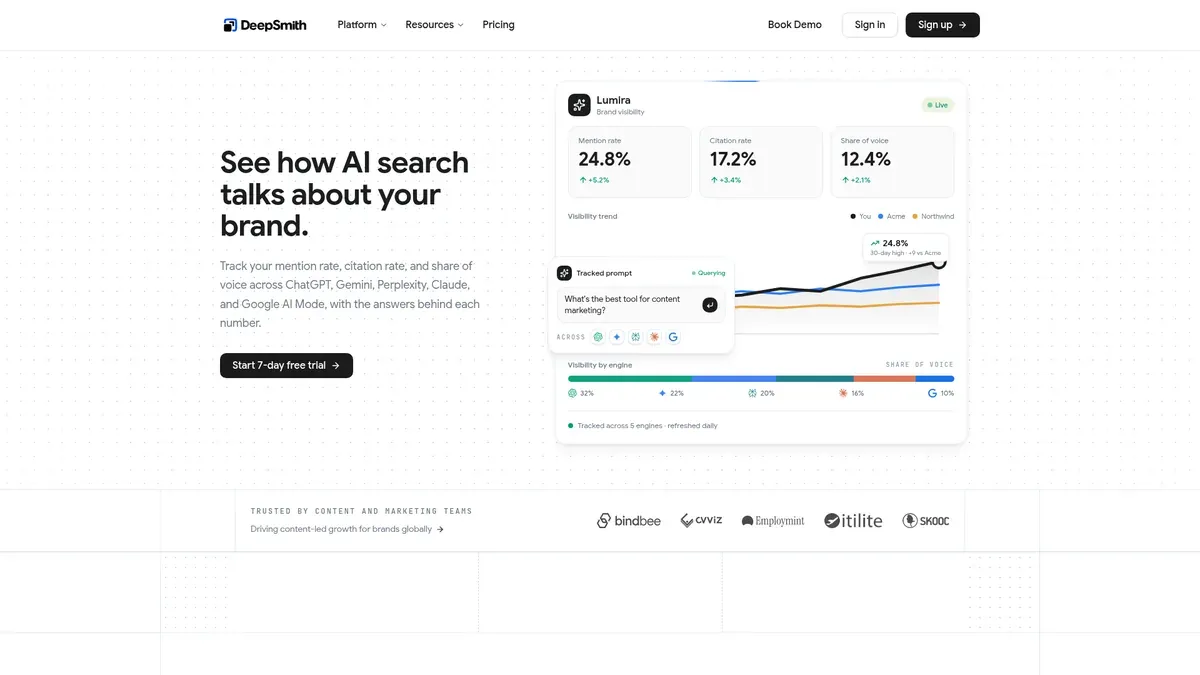
Best for: marketing leads who need measurement and production to live in the same place, instead of a dashboard that hands them a gap and walks away.
DeepSmith is an AI search analytics and content production platform. You see where you show up in AI search, find the gaps, and close them with on-brand content, all in one place. It is a production engine, not a writing assistant, so what comes out is a finished article rather than a first draft you have to rescue.
Start with the measurement side. You define the buyer questions worth tracking, and AI Visibility runs them on a schedule. The Overview reports mention rate, citation rate, share of voice, trends, a per-platform breakdown, a competitor leaderboard, and the sources AI cites most. Prompts holds per-prompt mention and citation rates plus the full answer history, so you can read what the engine actually said. Pages shows which of your pages get cited, each one's share of your total citations, and the prompts driving them. Competitor citations name the rival winning a prompt, the exact page doing it, and the platform it happened on.

Now the part most trackers stop short of. Opportunity Agents read that same data and hand back content ideas with the evidence attached: get cited for a tracked prompt, turn mentions into citations, take a competitor's citations, fix how AI describes you, win prompts nobody owns yet. Content Map crawls your site and your competitors' sites into one shared taxonomy of topics and funnel stages, then flags coverage gaps and untapped topics. Content Studio takes it from there through New Ideas, Planned Content, the Writer, and Produced Content, with Autowrite generating a scheduled article without anyone opening the app. Publishing goes straight to WordPress, Webflow, Strapi, Sanity, Contentful, or your own webhooks. Deep IQ stores your company, products, personas, brand voice, visual guidelines and content types, so every draft is grounded in your real context instead of a fresh briefing.

Key features: mention rate, citation rate, share of voice, sentiment and visibility trend across ten engines; full answer history per prompt; page-level citation attribution; competitor citation tracking; Content Map coverage gaps; Opportunity Agents with evidence attached to every idea; Autowrite; CMS publishing; Apps Library for LinkedIn, X, newsletter and more.
Pricing: Pro is $99 a month, Grow is $199, Scale is $399. Billed yearly those drop to $80, $160 and $299. Pro gives you 20 articles and 50 tracked prompts a month, Grow gives you 40 and 100, Scale gives you 90 and 200. Enterprise is custom and adds 1:1 onboarding and a dedicated account manager. The 7-day free trial gives you real data and real drafts before you pay, with no long-term contracts and no cancellation fees.
One honest limitation: the full ten-engine set is Enterprise or Custom, not an entry-plan promise. Pro covers ChatGPT, Grow adds Perplexity, Scale adds Gemini. If you need Claude or Google AI Mode on day one, that is a real constraint worth naming. For most teams starting out, ChatGPT through Gemini is where the buyer questions are being asked anyway, and staging coverage keeps the tiers honest instead of implying every plan includes everything.
Why it sits at number one here: plenty of tools measure mentions and citations. What earns the top spot is the loop. Evidence finds the gap, agents explain what to do about it, stored context grounds the response, the Writer produces the article, Autowrite schedules it, connectors publish it, and Apps Library turns it into distribution. If your real bottleneck is briefing, SEO cleanup, internal linking and publishing rather than a shortage of dashboards, that loop is the difference.
2. Profound
Best for: large brands and dedicated AEO teams that want deep answer-engine intelligence, attribution, and workflows they can configure.
Profound covers Perplexity, ChatGPT, Claude, Gemini, Grok, Microsoft Copilot, DeepSeek and Google AI Overviews across the platform, gated by plan. Starter tracks ChatGPT, Growth tracks ChatGPT, Perplexity and Google AI Overviews, and Enterprise supports up to nine answer engines. Agent Analytics tracks AI-sourced traffic and attribution across unlimited domains, with named integrations including Akamai, AWS, Cloudflare, Fastly, Google Analytics, Google Cloud Platform, Netlify, Vercel and WordPress.
The Agents product is the interesting piece. Agent Builder uses drag-and-drop workflows that can chain web scraping, LLM prompts, Answer Engine Insights lookups and API calls, covering research, competitive tracking, content generation and publishing, with approval steps before anything goes live.
Pricing: Starter is $99 a month billed yearly with 50 prompts, one seat and no exports or API. Growth is $399 billed yearly with 100 prompts, three engines, three seats and CSV and JSON exports. Enterprise is custom and adds API, SSO, multiple companies and a dedicated specialist.
One honest limitation: Growth stops at three answer engines and has no API, and Enterprise pricing and quotas are custom, so you cannot compare the real enterprise cost from the public table. Profound is the better call when enterprise analytics and configurable agents justify that buying process.
3. Peec AI

Best for: analytics-led SEO and GEO teams, and agencies running several clients at once.
Peec measures Visibility, Position, Sentiment and Share of Voice, and it is careful about a distinction most tools blur: sources are all the URLs an engine accessed, citations are the URLs referenced in the visible answer. Its source layer classifies each one as Editorial, Corporate, UGC, Reference or Own Website, and Gap Analysis surfaces the sources where competitors are cited and you are not. Competitor suggestions appear once a rival shows up alongside you twice, and you can add your own with aliases or regex rules. Prompt management supports tags, Active, Suggested and Inactive states, and a beta Prompt Volume score. Exports run through CSV, Looker Studio, the Peec API and its MCP server.
Pricing: the current AI-instructions page shows Starter at $95 a month with 50 prompts and one project, Pro at $245 with 150 prompts and two projects, and Advanced at $495 with 350 prompts and five projects. Enterprise is custom. Annual billing saves about 15%.
One honest limitation: the product page lists a broad model catalog while the pricing table shows three included models on the brand tiers, so confirm your plan's coverage rather than assuming the full list. Peec also notes that AI models only read HTML and cannot load JavaScript-dependent content, and it was pursuing SOC 2 rather than holding it in the reviewed material. It analyses and recommends, but it does not write or publish the article for you.
4. OtterlyAI

Best for: solo marketers, freelancers and small teams who want a real entry price and no enterprise contract.
Otterly bundles AI Prompt Research, AI Search Analytics and AI Search Optimization. You get brand reports, a Brand Visibility Index, Domain Ranking, Link Citations Analysis, GEO audits, recommendations, detailed exports, and multi-country support across more than 50 countries. Lite includes 1,000 GEO URL audits a month and three recommendations a week. Standard raises audits to 5,000 and adds a Looker Studio connector, 2,000 API requests, 2,000 MCP requests and 200,000 Agent Analytics events. Premium goes to 10,000 audits, 5,000 API and MCP requests, and a million Agent Analytics events.
Pricing: Lite is $29 a month, Standard is $189, Premium is $489, with annual equivalents of $25, $160 and $422. Lite includes 15 search prompts, Standard 100, Premium 400. Enterprise is custom, starting from $1,000 a month. A free trial is offered.
One honest limitation: base plans cover four engines, which are ChatGPT, Google AI Overviews, Perplexity and Microsoft Copilot. Google AI Mode, Gemini and Claude are paid add-ons priced separately by tier, and extra prompt capacity costs more again, so the sticker price and the real price can drift apart. Independent comparison also found less depth on share of voice and sentiment than some rivals. Lead with what Otterly does well: transparent monitoring and audits at a price a solo marketer can actually sign off.
5. Ahrefs Brand Radar

Best for: established brands and SEO teams already living inside the Ahrefs ecosystem.
Brand Radar measures AI visibility across more than 464 million search-backed prompts and stores the responses, which is a different bet from live custom tracking. The prompts are mapped to real search demand rather than made up. Core platforms are AI Overviews, AI Mode, ChatGPT, Perplexity, Gemini and Copilot, with Claude available on custom prompts. Metrics include mentions, citations, estimated impressions weighted by the search volume behind a prompt, search demand, topics and AI Share of Voice. Fanout queries show the related searches an AI system generates while working through a prompt, and Brand Radar also connects AI visibility to web, YouTube, TikTok and Reddit signals, plus which pages AI crawlers are reading.
Pricing: the Brand Radar page shows an AI plan starting at $199 a month, with custom prompts from $50 a month. Reviewed evidence indicates a default allowance of 2,500 custom-prompt checks a month, consumed by combinations of prompt, model and location, with a sample showing five prompts on one platform using 150 checks a month and overage at $0.020 per check. Confirm the current structure before you commit, because the commercial presentation has moved.
One honest limitation: the pre-collected index makes broad analysis fast, but it fits best where your brand or topic already has meaningful search demand. Custom prompt tracking is a separate usage-priced layer, and the reviewed comparison evidence says Brand Radar does not report brand sentiment and folds prompt tracking into reports rather than offering a dedicated prompt-tracking workflow.
6. Scrunch
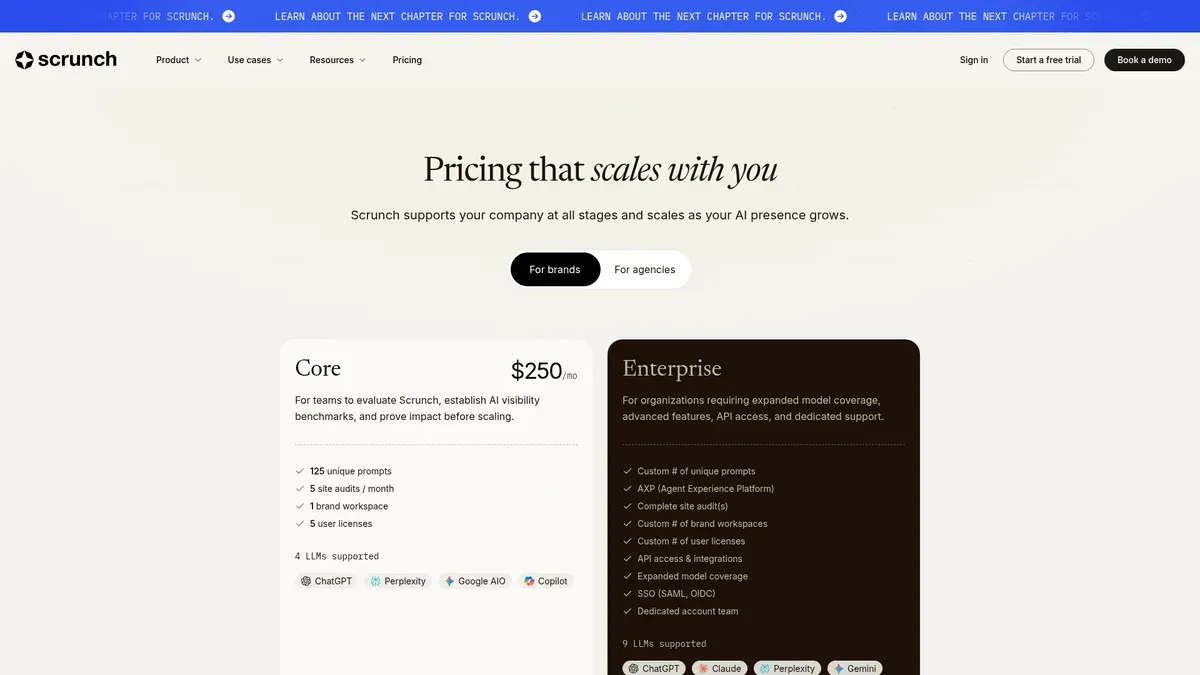
Best for: data teams that want APIs, full answer payloads, and AI customer-experience signals feeding another reporting environment.
Scrunch monitors prompt results, surfaces authoritative citations and tracks brand performance over time. Core and Enterprise both include Citations and Sources, Funnel Stages, Prompt Management and a Reporting Dashboard, and Core adds AI Agent or Bot Traffic, Sentiment Analysis, and Insights and Recommendations. The plan table also covers AI Search Trends, countries, personas, languages and competitors.
The APIs are the standout. The Query API gives aggregated access to core visibility metrics for BI tools, reporting pipelines and scheduled exports. The Responses API retrieves the full AI answer, citations, sentiment, competitors and metadata for each prompt execution. If your team wants answer-level evidence in its own warehouse, that is a genuinely strong position.
Pricing: Core is $250 a month with 125 unique prompts, five site audits a month, one brand workspace, five user licences, one country, three personas, two languages, five competitors, three AI Search Trends topics and four LLMs. Enterprise is custom and covers nine LLMs with query fan-out. A 7-day free trial is shown.
One honest limitation: Core is materially narrower than Enterprise on almost every axis, including one workspace, five users, five competitors, limited fan-out and four engines. The reviewed evidence also does not show a native end-to-end production workflow, so measurement still has to hand off somewhere.
7. Semrush AI Visibility Toolkit

Best for: teams whose reporting already runs through Semrush and who want AI visibility inside the same suite.
The toolkit covers Visibility Overview, Competitor Research, Prompt Research, Brand Performance, Prompt Tracking and an AI Search Site Audit. The AI Visibility Score compares your brand mentions in AI answers against the median for top industry competitors. Brand Performance reports share of voice, sentiment and the narratives driving your reputation. Competitor Research finds the prompts and topics where rivals are cited and you are not, and Prompt Research adds topic-level volume, difficulty and intent. Named platforms across the reviewed pages include ChatGPT, Google AI and AI Mode, Gemini and Perplexity. Update cadence varies: most reports refresh daily, Brand Performance weekly, and Site Audit on demand. Prompt Tracking covers more than 220 countries and territories.
Pricing: the reviewed help page states $99 a month with no free trial, and the pricing page separately presents Base at $99 per domain billed annually alongside a different starting-price view. Those presentations are not fully reconciled, so treat $99 as the reference point and verify your exact domain and subscription setup at checkout. The package includes one domain for Brand Performance, 25 tracked prompts, 300 daily AI Analysis queries, 1,000 daily Prompt Research queries, AI Search Checks for up to 100 pages, and 10 CSV exports a day. Extra Brand Performance domains are $99 each per month, and 50 more tracked prompts are $60 a month.
One honest limitation: per-domain pricing, a 25-prompt tracking allowance, an extra charge for more prompts and no free trial make it awkward as a standalone citation tracker. The value is the ecosystem, so it pays off when you already want the rest of Semrush.
8. Rankscale
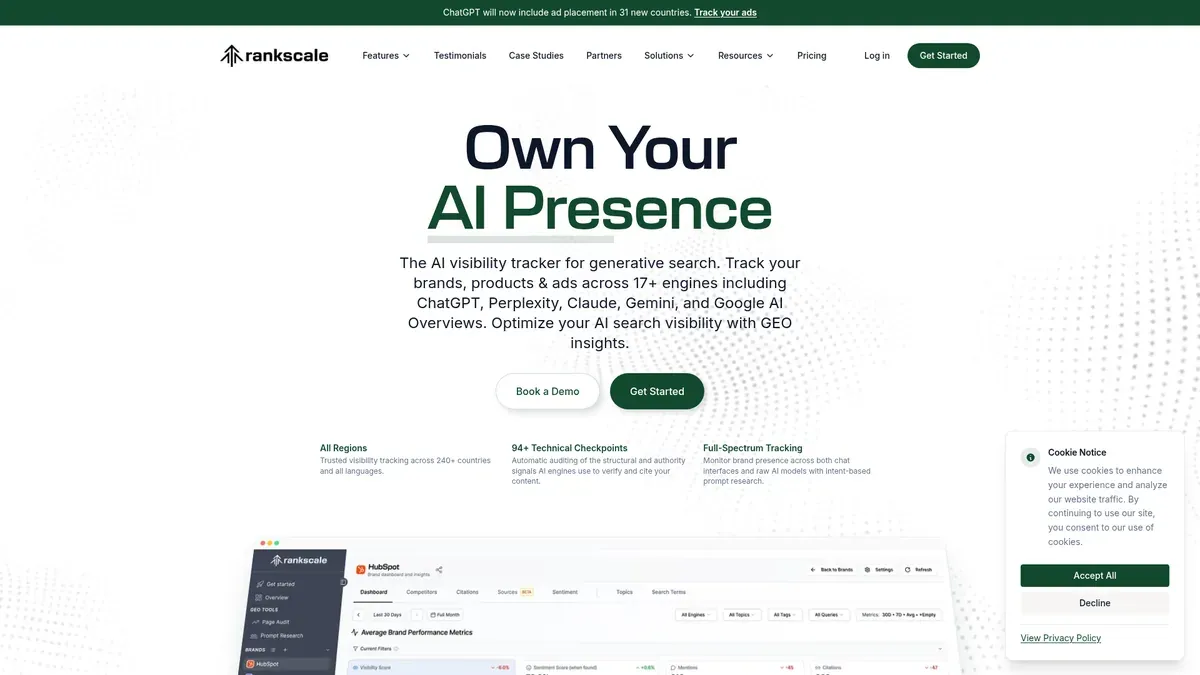
Best for: agencies and teams that want broad engine coverage, page audits and client-facing dashboards.
Rankscale states 17+ engines on its product page, including ChatGPT, Perplexity, Claude, Gemini and Google AI Overviews, with DeepSeek, Mistral, Grok and Copilot named elsewhere. Treat 17+ as overall platform coverage and check your plan before you promise a client anything specific. The platform covers visibility tracking, competitor benchmarking, citations analysis, trend insights, sentiment, custom dashboards, and page audits that assess how a single URL performs for AI search. Prompt research explores prompts and intents by segment, region and language, search-term creation is unlimited on the reviewed plans, and scheduling runs from hourly to monthly. White-label reporting, public dashboard sharing, multi-client use and a REST API are all supported.
Pricing: Pro is $99 a month with 1,200 credits, up to 4,800 answers, 50 page audits and up to 10 brand dashboards. Growth is $385 with 5,500 credits, up to 22,000 answers, 200 audits and 50 dashboards. Enterprise is $780 with 12,000 credits, up to 48,000 answers, 200 audits and 100 dashboards. Yearly billing saves 15%, and a 7-day Pro trial is available.
One honest limitation: credits are harder to reason about than prompt quotas. A query typically costs 0.25 credits per engine per prompt, so a prompt run across six engines burns six times what a single-engine check does. Model your engines, frequency and regions before you pick a tier, because the headline search-term number will not tell you what you need.
How to choose the right LLMrefs alternative
You do not need to compare all eight alternatives to LLMrefs. Find your situation below and you have your shortlist.
Choose DeepSmith if the visibility report has to become a content backlog and then a publishing schedule. This is the fit when your bottleneck is briefing, internal linking, brand voice, publishing and distribution rather than a shortage of data.
Choose Profound if you have a dedicated enterprise AEO function, want Agent Analytics or custom answer-engine workflows, and are comfortable with a custom procurement cycle.
Choose Peec AI if you are analytics-led, want source classification and gap analysis, or run an agency that needs Looker Studio, API and MCP outputs across projects.
Choose OtterlyAI if budget and a transparent self-serve entry matter most and four base engines cover your audience. Budget for the add-ons if Google AI Mode, Gemini or Claude are essential.
Choose Ahrefs Brand Radar if you already value Ahrefs' search-demand data and want fast, broad visibility analysis. Check the custom-prompt allowance first if you plan heavy prompt monitoring.
Choose Scrunch if APIs, full answer payloads, AI-agent traffic and funnel-stage reporting matter more than an integrated production pipeline.
Choose Semrush if Semrush is already your reporting hub. Confirm whether your quote is the per-domain package, a starting-price configuration, or a broader Semrush One subscription.
Choose Rankscale if engine breadth, page audits, credit scale and white-label dashboards are the priority. Model the credit burn before you sign.
One last thing worth saying plainly. A citation is not automatically a click, a lead, or revenue. These tools show you visibility and evidence, and the reviewed material does not establish a straight line from citation to pipeline. Treat citations as a leading signal, not a revenue number.
Your next step
If you are early in this and just want to see where you stand, start small. Write down the ten questions your buyers actually ask an AI engine. Run them. Note who gets named and who gets linked. That alone will tell you more than another week of reading comparison pages.
When you want that check to run on a schedule, and you want each gap it finds to turn into a finished article instead of a note in a doc, start a 7-day DeepSmith trial. Real data and real drafts, before you pay anything.